Key takeaways
- ByDefault is a solid, developer-leaning GEO tool at $99-$599/mo, but it caps you at 4 tracked models per plan and its content output is limited to a handful of articles per month.
- Promptwatch covers every major model from day one at a similar price point and adds crawler-log analysis, content gap detection, and automated CMS publishing that ByDefault doesn't match.
- Profound and Scrunch AI offer strong enterprise feature sets but both pulled back their self-serve pricing in 2026, pushing smaller teams toward custom quotes.
- Otterly.AI and Peec AI are the budget-friendly picks if you just need prompt tracking across a handful of engines without the content layer.
- Roughly 40-60% of cited domains in AI answers change month to month, so whichever tool you pick, treat any single snapshot as a starting point, not a verdict.
Why people go looking for a ByDefault alternative
ByDefault (bydefault.so) built its reputation on something genuinely useful: showing you not just whether a model mentioned your brand, but the exact web-search queries it ran to get there. That's a real content-gap signal, and its AI crawler log analysis (claimed at over 1 million requests a day for customers like Upstash and Context7) is a legitimate differentiator against pure prompt trackers.
The friction shows up once you've used it for a month or two. Every plan, Starter through Scale, locks you to 4 models out of the ChatGPT/Claude/Gemini/AI Overviews/coding-agent set. If you need Perplexity and Copilot and Grok tracked at once, you're out of luck. The content side is thin too: Growth gives you 5 articles a month, Scale gives you 10, and that's the ceiling even at $599/mo. For teams that want monitoring and execution to live in the same workflow, that's a bottleneck.

This guide walks through 9 platforms that compete with ByDefault on citation tracking, and in most cases, go further on model breadth, crawler diagnostics, or content production.
What actually matters when comparing these tools
Before the list, a few things worth knowing about how AI citations behave, because they change what you should prioritize in a tool.
ChatGPT cites around five sources per web-search answer on average, while Google AI Overviews cites roughly double that, and Perplexity sits close to ten with very little day-to-day variance, according to Promptwatch's data on average sources per response. Microsoft Copilot, meanwhile, has swung from under two sources to nearly seventeen within a matter of weeks in the same dataset. A tool that only samples one or two models is going to miss that kind of volatility entirely.
Citation content types matter too. Product pages are the single most-cited format in ChatGPT answers at 22.4% of all classified citations, followed by landing pages at 16.8%, according to Promptwatch's ChatGPT citation share by content type data. If your content strategy leans on blog posts and PDFs, you're optimizing for a format that gets cited less than a third as often as a well-built product page.
And the AI crawler landscape itself is moving. OpenAI's share of verified AI crawler requests dropped from 94.8% in early June 2026 to 79.8% by early September, per Promptwatch's AI crawler traffic data. That's Meta, Anthropic, and others eating into what used to be an OpenAI-dominated crawl. A tool that only logs ChatGPTBot is going to leave you blind to where the rest of that traffic is going.
The 9 best ByDefault alternatives in 2026
1. Promptwatch: the most complete stack, not just a tracker
Promptwatch is the one I'd point most teams to first, and not because it's the flashiest name on this list. It's because it closes the exact gap ByDefault leaves open: ByDefault tells you where you're invisible, Promptwatch's agents help you actually fix it.

At the Essential tier ($95/mo), you already get every major model, ChatGPT, Claude, Gemini, Perplexity, Copilot, Grok, rather than picking 4. Professional ($245/mo) adds crawler log analysis across 25 million log entries, automated content generation with CMS publishing to Webflow, Framer, or WordPress, and ChatGPT Shopping tracking. Business ($579/mo) scales that to 100 million log entries and city/state-level targeting. There's also a free Explore plan with 10 ChatGPT-only prompts if you want to kick the tires first.
What separates it from monitoring-only competitors is the action layer: content gap analysis that compares your pages against what AI is actually citing, Unified Actions that turn visibility data into a prioritized to-do list, and Agent Chat for asking plain-English questions about your citation data. It's used by 1,840+ brands including Duolingo, Yelp, and Shutterstock, and is rated 4.7/5 on G2. Crisp, one of its customers, scaled to 5-10 published articles a day using the platform and saw 2x higher conversion rates from AI traffic than from traditional channels.
If you want the longer comparison, Promptwatch's own 2026 roundup of 21 GEO platforms lays out where it sits against Profound, Scrunch, and the rest in detail.
2. Profound: strong enterprise feature set, but self-serve pricing just disappeared
Profound built a good reputation for Agent Analytics, which connects to Cloudflare, Vercel, AWS, and Google Analytics to show AI bot traffic hitting your site. The catch as of September 2026: its published Starter ($99) and Growth ($399) tiers vanished from the pricing page. What's left is a one-time free 10-prompt ChatGPT trial and custom Enterprise pricing, with the agency tier still self-serve at $399/mo per client workspace covering ChatGPT, Perplexity, and AI Overviews.

If you're a smaller team that liked Profound's old pricing, that door has mostly closed. Enterprise buyers get daily tracking across up to 9 engines and SOC 2 compliance, so it's still viable, just not for a quick self-serve signup anymore.
3. Scrunch AI: built for teams that want AI to see a different version of their site
Scrunch's real differentiator is its Agent Experience Platform, which serves AI-optimized page versions at the edge to crawlers while regular visitors see the normal site. That's a genuinely different approach from everyone else on this list, who mostly optimize the one page everyone sees.
Core starts at $250/mo for 125 prompts and 4 engines; the AXP feature is Enterprise-only. Scrunch serves 500+ brands including Lenovo and SKIMS and was acquired by Sitecore in 2026, which is a reasonable signal of staying power. Known limitations from user reviews: prompt credits burn faster than expected, and data refreshes every few days rather than in real time.
4. AthenaHQ: YC-backed, broad model coverage from the first tier
AthenaHQ covers 8+ engines starting at its entry tier, which is unusual, most competitors gate Claude and Gemini behind higher plans. Self-Serve/Starter runs $295/mo (first month discounted to $95) for 3,600 credits, where one credit equals one AI response.

The catch is credit math. Tracking 50 queries a day across 5 engines burns 250 credits daily, so that 3,600 monthly allocation lasts about two weeks before you're buying add-on credits at $100 per 1,250. Worth modeling your actual query volume before committing.
5. Otterly.AI: the cheapest real entry point, if you're willing to pay for add-ons
Otterly's Lite plan at $29/mo is the lowest self-serve price in this category, covering 15 prompts across ChatGPT, AI Overviews, Perplexity, and Copilot. The trade-off: Gemini, Claude, and Google AI Mode are all paid add-ons on every tier, ranging from $9 to $439/mo depending on which model and which plan tier you're on.

It claims 40,000+ marketing professionals as users and supports 65+ countries, which makes it a reasonable pick for teams that mostly care about volume and don't need deep crawler diagnostics.
6. Peec AI: unlimited seats and an MCP server for the technically inclined
Peec repriced in August 2026 to euro-denominated plans: Starter at EUR70/mo, Pro at EUR180/mo, Advanced at EUR360/mo. Every tier lets you pick 3 of 6 core engines (ChatGPT, AI Overviews, AI Mode, Copilot, Perplexity, Gemini), with extra engines available as paid add-ons.

What stands out is the MCP Server, which connects to Claude Desktop, Claude Code, Cursor, and Windsurf, and can pull scraped markdown of any cited source URL for analysis inside those tools. If your team already lives in an AI coding assistant, that's a genuinely convenient workflow. Unlimited team seats on every plan is also a nice touch most competitors don't match.
7. Semrush AI Visibility Toolkit: the pick if you already live in Semrush
At $99/mo standalone, or $199/mo bundled into Semrush One, this is squarely aimed at SEO teams who don't want a separate tool. It covers ChatGPT, Perplexity, Gemini, SearchGPT, and AI Overviews, with custom prompt tracking up to 200 depending on tier, plus sentiment analysis that breaks out brand strengths and weaknesses.
The honest take: it's a bolt-on to an existing SEO suite rather than an AI-first platform, so the AI-specific data tends to be shallower than purpose-built tools. Fine if convenience matters more than depth.
8. Ahrefs Brand Radar: good for a fast lookup, limited for ongoing tracking
Ahrefs built an index of 470M+ monthly prompts across 7 AI surfaces, which makes its instant brand-visibility lookup genuinely fast for a one-off check. Custom prompt tracking is an add-on starting at $50/mo, with the full index starting at $199/mo per platform or $699/mo for everything plus 2,500 custom-prompt checks.
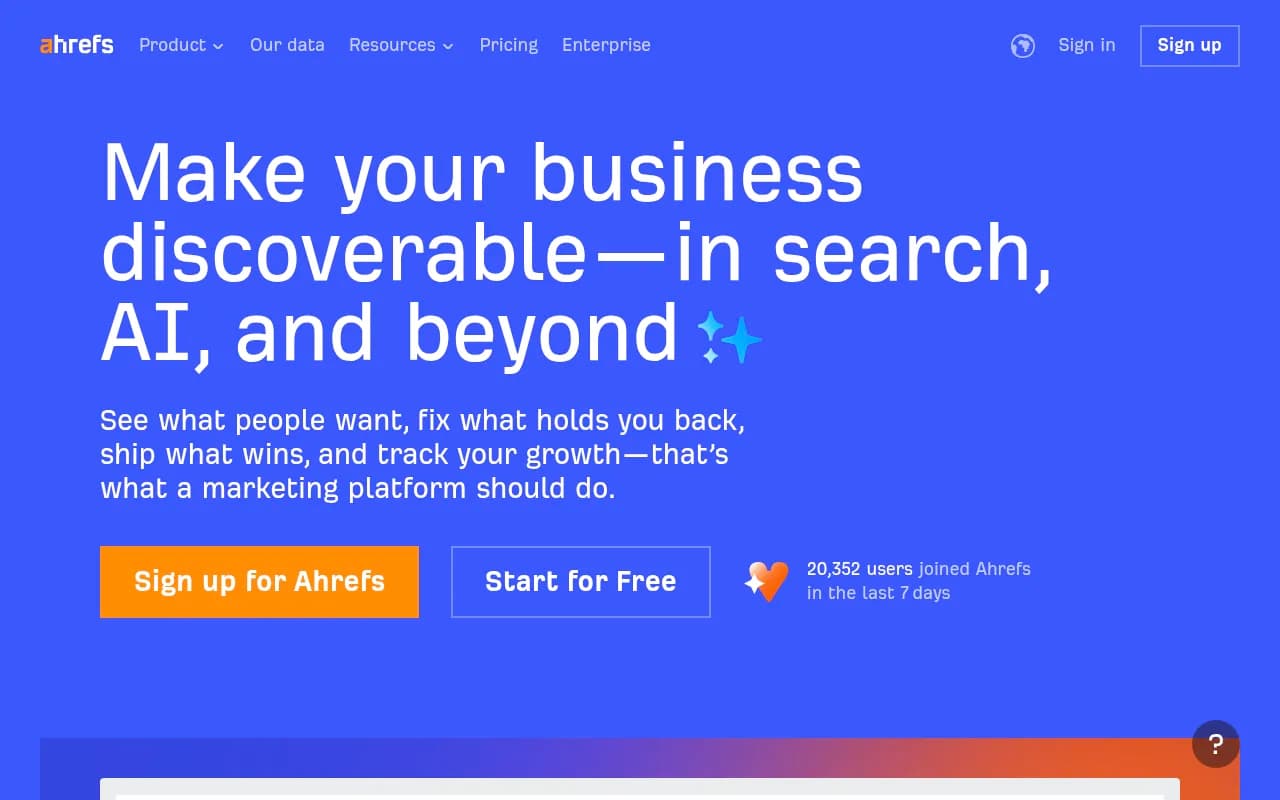
No sentiment analysis here, which is a gap versus Semrush's offering. Best treated as a research tool for scoping out opportunity rather than a daily-driver visibility dashboard.
9. ZipTie: a focused, solo-friendly diagnostic
For teams that want a lighter-weight, less expensive way to check AI visibility without committing to a full platform, ZipTie offers deep analysis for AI search visibility aimed at smaller operations.
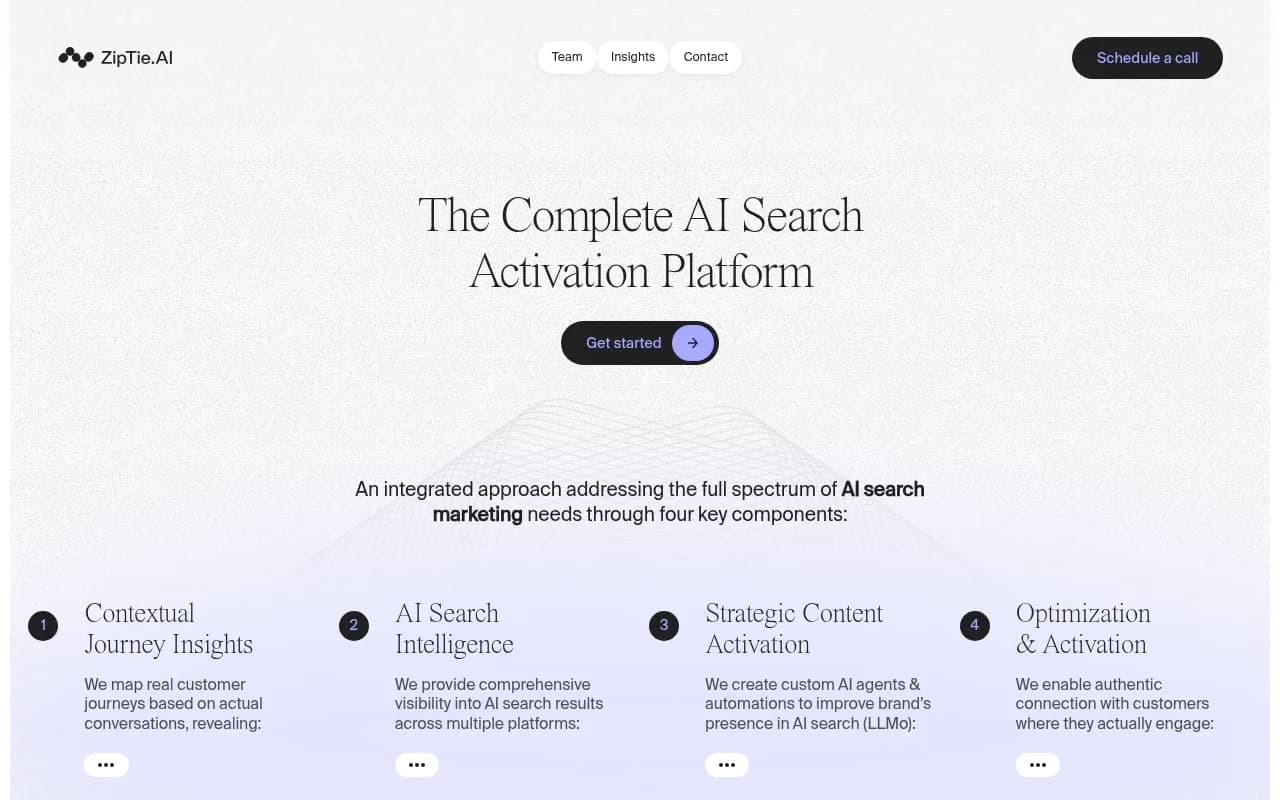
It won't match the model breadth or content execution of Promptwatch or AthenaHQ, but as a diagnostic layer before you commit budget to a bigger platform, it's a sensible first step.
Side-by-side comparison
| Tool | Entry price | Models at entry tier | Content generation | Crawler log analysis |
|---|---|---|---|---|
| ByDefault | $99/mo | 4 (pick from 8) | 5 articles/mo (Growth) | Yes |
| Promptwatch | $95/mo | All major models | 5 AEO articles/mo, auto-publish | Yes, 25M+ logs on Pro |
| Profound | Custom (self-serve gone) | Up to 9 (Enterprise) | No | Yes |
| Scrunch AI | $250/mo | 4 | No | Partial (AXP, Enterprise) |
| AthenaHQ | $295/mo | 8+ | No | No |
| Otterly.AI | $29/mo | 4 (others paid add-on) | No | No |
| Peec AI | EUR70/mo | 3 of 6 (pick) | No | No |
| Semrush AI Toolkit | $99/mo | 5 | Yes (separate module) | No |
| Ahrefs Brand Radar | $199/mo | 7 | No | No |
How to actually choose
If your team's main pain point is that you track citations but have nothing systematic to do about them, that's the strongest case for Promptwatch. The content gap analysis plus automated CMS publishing closes the loop that most of this category leaves open: you find the gap, then you still have to brief a writer, publish, and hope it gets picked up. Promptwatch's Content Agents do the writing and publishing part, with a review inbox if you want a human check before it goes live.
If you're an enterprise buyer with a dedicated technical team and budget for custom pricing, Profound or Scrunch's Enterprise tiers are worth a conversation, particularly if Scrunch's edge-served AI page versions genuinely matter for your stack.
If you just need a cheap, reliable prompt tracker and don't care about content execution or crawler logs, Otterly.AI at $29/mo or Peec AI's Starter tier are the most sensible starting points. Just budget for the model add-ons if you need Gemini or Claude from day one.
Whichever you pick, remember that AI citations shift fast, somewhere between 40% and 60% of cited domains change month to month across this category. Treat any tool's first report as a baseline, not a finished answer, and plan to re-check in 30 days. For a broader look at the category beyond these nine, the GEO software directory at bestgeosoftware.com is a reasonable next stop.
A quick note on content strategy once you're tracking citations
Whatever tool you land on, the data above on content types is worth internalizing before you start producing anything. Product and landing pages together make up about 39% of ChatGPT's citations, while reviews get roughly 3x more weight specifically on branded prompts, according to the same Promptwatch content-type breakdown cited earlier. If your roadmap is full of generic blog posts, you're writing for a format that's statistically less likely to get picked up than a well-structured product page or a direct comparison piece.
That's also exactly the kind of gap a content-gap report is built to surface, rather than something you can eyeball from a spreadsheet of mentions. It's one more reason the monitoring-plus-execution tools on this list tend to outperform pure trackers over a full quarter, not just in the first week of setup.