Key takeaways
- Most AI search visibility tools are monitoring dashboards -- they show you where you're invisible but don't help you fix it. The four tools in this guide all claim to go further by generating or publishing content.
- Relixir, Whitebox, SnowSEO, and Atomic AGI each take a different approach: autonomous agent publishing, narrative fix automation, auto-generated SEO pages, and integrated Google + LLM tracking respectively.
- The critical question isn't "does this tool publish content?" -- it's "does the content it publishes actually get cited by AI models?" Those are very different things.
- Content that gets cited by ChatGPT, Claude, and Perplexity needs to be structured around real prompt data, not generic SEO filler. Tools that don't ground their content generation in citation data tend to produce content that ranks in Google but gets ignored by LLMs.
- Promptwatch is the only platform in the broader GEO market rated as a "Leader" across all categories in a 2026 comparison of 12 platforms -- and its content generation is grounded in 880M+ real citations analyzed.
The promise sounds great: connect your domain, let the AI figure out where you're invisible, and watch it publish content that gets you cited in ChatGPT responses. A few tools are now making exactly that claim. But there's a wide gap between "publishes content" and "publishes content that AI models actually cite."
This guide looks at four tools that have positioned themselves in the "action" tier of GEO: Relixir, Whitebox, SnowSEO, and Atomic AGI. I'll break down what each one actually does, where they fall short, and how to think about which (if any) fits your situation.
What "getting cited" actually requires
Before comparing tools, it's worth being clear about what we're optimizing for. When ChatGPT, Perplexity, or Claude answer a question, they pull from a mix of training data and real-time web sources. Getting cited means your content needs to:
- Be discoverable by AI crawlers (technical accessibility)
- Match the specific prompts users are asking (topical relevance)
- Be structured in a way LLMs can extract and quote (format and clarity)
- Come from a domain that AI models already trust (authority signals)
Most content generation tools nail point 3 at best. The harder problems -- knowing which prompts to target, understanding what's missing from your site versus competitors, and building domain authority in AI indexes -- require real citation data, not just SEO heuristics.
That context matters a lot when evaluating the four tools below.
Relixir

Relixir describes itself as an "AI-native CMS" with autonomous content publishing. The pitch is that it monitors your AI search gaps, generates content to fill them, and publishes that content without requiring manual approval at every step.
The autonomous publishing angle is genuinely interesting. Most GEO tools hand you a content brief and expect your team to do the writing. Relixir tries to close that loop by acting as an agent that moves from gap identification to published page.
Where it gets complicated: autonomous publishing is only valuable if the content being published is good enough to get cited. Relixir's content generation draws on competitive gap analysis, which is the right instinct -- you want to know what prompts your competitors are visible for that you're not. But the depth of that analysis matters. Are the gaps identified based on actual LLM response data, or are they inferred from keyword patterns? That distinction drives the quality of what gets published.
For teams that are resource-constrained and need to move fast, Relixir's agentic approach removes friction. For teams that care deeply about content quality and citation accuracy, the autonomous nature of it might feel like a loss of control.
Best for: Growth-stage companies that need to produce a lot of GEO content quickly and are comfortable with an AI-first publishing workflow.
Whitebox
Whitebox takes a slightly different angle. Rather than generating long-form articles, it focuses on what it calls "AI narrative fixes" -- identifying the specific ways AI models describe your brand incorrectly or incompletely, then generating targeted content to correct those narratives.
This is a more surgical approach than Relixir's volume-first strategy. If ChatGPT consistently describes your product as a "basic analytics tool" when you're actually an enterprise platform, Whitebox tries to surface that misrepresentation and generate content that shifts the narrative.
The agentic framing here is that Whitebox "ships" these fixes automatically -- it's not just flagging problems for your team to address. That's a meaningful distinction from pure monitoring tools.
The limitation is scope. Narrative correction is valuable, but it's a subset of the full GEO problem. If you're not being mentioned at all for a category of prompts, fixing how you're described doesn't help. Whitebox is strong at the "sentiment and accuracy" layer of AI visibility, weaker at the "share of voice" layer.
Best for: Established brands with existing AI visibility who want to improve how they're described rather than whether they're mentioned.
SnowSEO

SnowSEO sits closer to the programmatic content generation end of the spectrum. It auto-generates pages optimized for AI visibility -- think topical hubs, FAQ pages, and comparison content -- at scale.
The value proposition is volume and speed. SnowSEO can produce a large number of pages targeting different prompt variations, which in theory increases the surface area for AI citations. This approach borrows from programmatic SEO playbooks and applies them to the GEO context.
The honest concern with this approach: LLMs are increasingly good at identifying thin or templated content. Google's AI Overviews, in particular, have shown a preference for content with genuine depth and specificity. Publishing 200 auto-generated pages that all look structurally similar is a reasonable bet for traditional SEO, but it's a shakier bet for AI citation.
SnowSEO works best when the generated content is genuinely differentiated -- when it's answering specific questions with real data, not just filling in templates with keyword variations.
Best for: Teams running high-volume content strategies who want to extend their programmatic SEO approach into GEO.
Atomic AGI
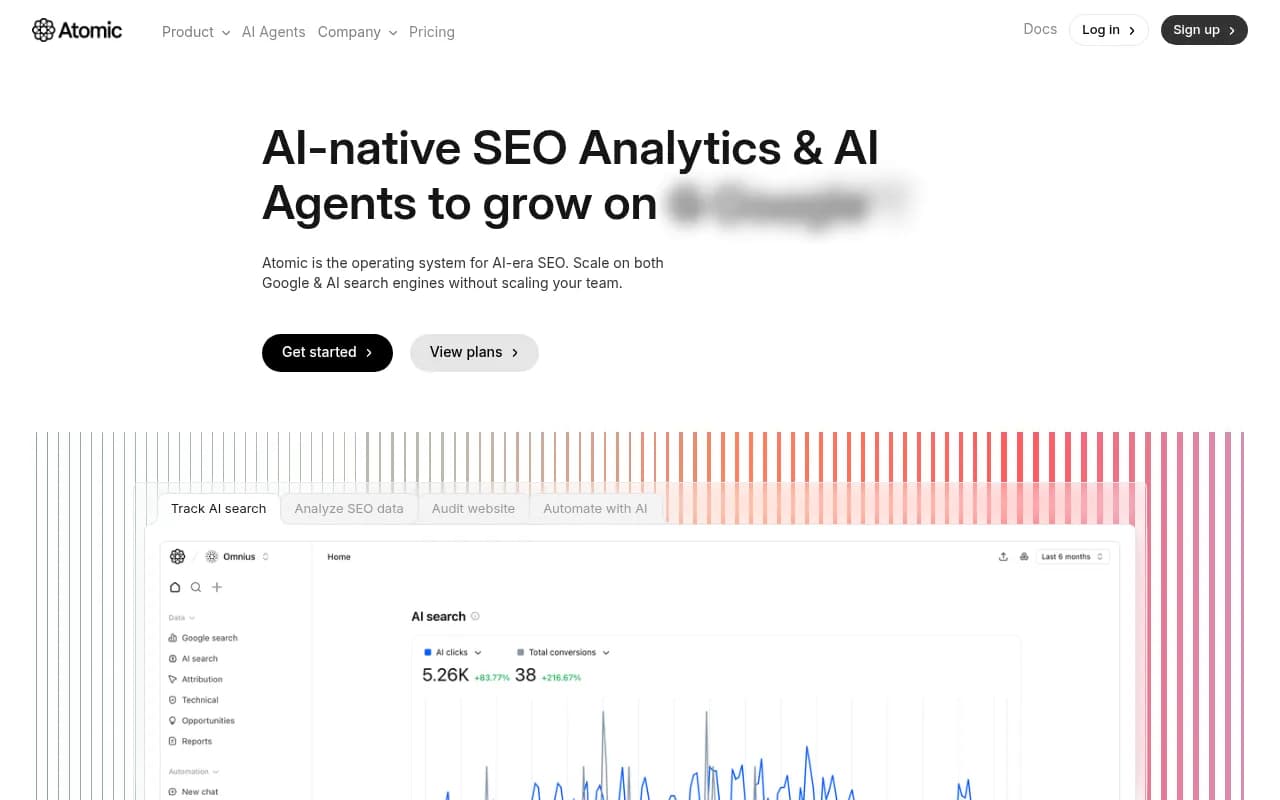
Atomic AGI is the most integrated of the four in terms of combining traditional search and AI search tracking. It monitors both Google rankings and LLM visibility in a single platform, then uses that combined data to inform its content automation.
The Google + LLM integration is genuinely useful because the two aren't entirely separate. Pages that rank well in Google are often more likely to be cited by AI models that pull from web sources in real time. Understanding the relationship between your traditional search performance and your AI visibility gives you a more complete picture.
Atomic AGI's content automation leans on this dual-signal approach -- it identifies gaps in both channels and generates content designed to perform in both. That's a more sophisticated framing than tools that treat GEO as entirely separate from SEO.
The downside is complexity. More signals mean more data to interpret, and the platform can feel dense if you're primarily focused on AI visibility rather than managing a full SEO program.
Best for: SEO teams that want to manage traditional and AI search visibility in one place without switching between tools.
How they compare
| Feature | Relixir | Whitebox | SnowSEO | Atomic AGI |
|---|---|---|---|---|
| Content generation | Yes (autonomous) | Yes (narrative fixes) | Yes (programmatic) | Yes (SEO + GEO) |
| Auto-publishing | Yes | Yes | Yes | Partial |
| Gap analysis | Yes | Partial | Partial | Yes |
| Citation data grounding | Moderate | Moderate | Low | Moderate |
| Google + LLM tracking | LLM-focused | LLM-focused | LLM-focused | Both |
| Narrative/sentiment fixes | Partial | Strong | Weak | Partial |
| Best use case | Fast GEO publishing | Brand narrative correction | Volume content | Full SEO + GEO teams |
| Pricing transparency | Moderate | Limited | Moderate | Moderate |
The problem none of them fully solve
Here's the honest assessment: all four tools generate content. None of them have fully cracked the hardest part of GEO, which is grounding content generation in real, current citation data at scale.
To understand what content actually gets cited by AI models, you need to know:
- Which specific prompts are driving AI responses in your category
- Which sources AI models are currently pulling from for those prompts
- What's missing from your site versus those cited sources
- How often AI crawlers are visiting your pages and what they're reading
That's a data problem before it's a content problem. Tools that skip straight to content generation without deeply solving the data layer tend to produce content that feels right but doesn't move the needle on AI citations.
Where Promptwatch fits in
Promptwatch takes a different approach to this problem. Rather than jumping straight to content generation, it starts with the data layer: 880M+ citations analyzed, real-time AI crawler logs, prompt volume and difficulty scoring, and query fan-outs that show how a single prompt branches into sub-queries.

The content generation in Promptwatch is built on top of that citation data. When it identifies a gap -- a prompt your competitors are visible for that you're not -- it generates content grounded in what AI models are actually citing, not just what ranks in Google. That's a meaningful difference from tools that use keyword data as a proxy for prompt data.
It also closes the loop in a way the four tools above don't fully do: you can track which specific pages are being cited, by which AI models, how often, and connect that back to actual traffic and revenue through GSC integration, a code snippet, or server log analysis.
For teams that want to understand the full picture before publishing, and then track whether what they publish actually works, that end-to-end approach is harder to replicate with the tools in this comparison.
How to choose
The right tool depends on where your biggest bottleneck is:
- If you're not producing enough GEO content and need to move fast, Relixir's autonomous publishing removes friction.
- If you have existing AI visibility but the way AI describes you is inaccurate or unflattering, Whitebox's narrative fix approach is worth exploring.
- If you're running a high-volume programmatic content strategy and want to extend it to GEO, SnowSEO fits that workflow.
- If you're an SEO team managing both Google and AI search and want a unified view, Atomic AGI's dual-signal approach makes sense.
- If you want to start with real citation data, understand exactly what's missing, generate content engineered to get cited, and track the results end-to-end, Promptwatch is the more complete platform.
The honest reality in 2026 is that most teams will need to iterate. Publish content, track whether it gets cited, adjust. The tools that support that iteration loop -- rather than just generating content and hoping for the best -- are the ones worth building a GEO workflow around.
Other tools worth knowing about
A few other platforms are doing interesting work in the "action" tier of GEO:
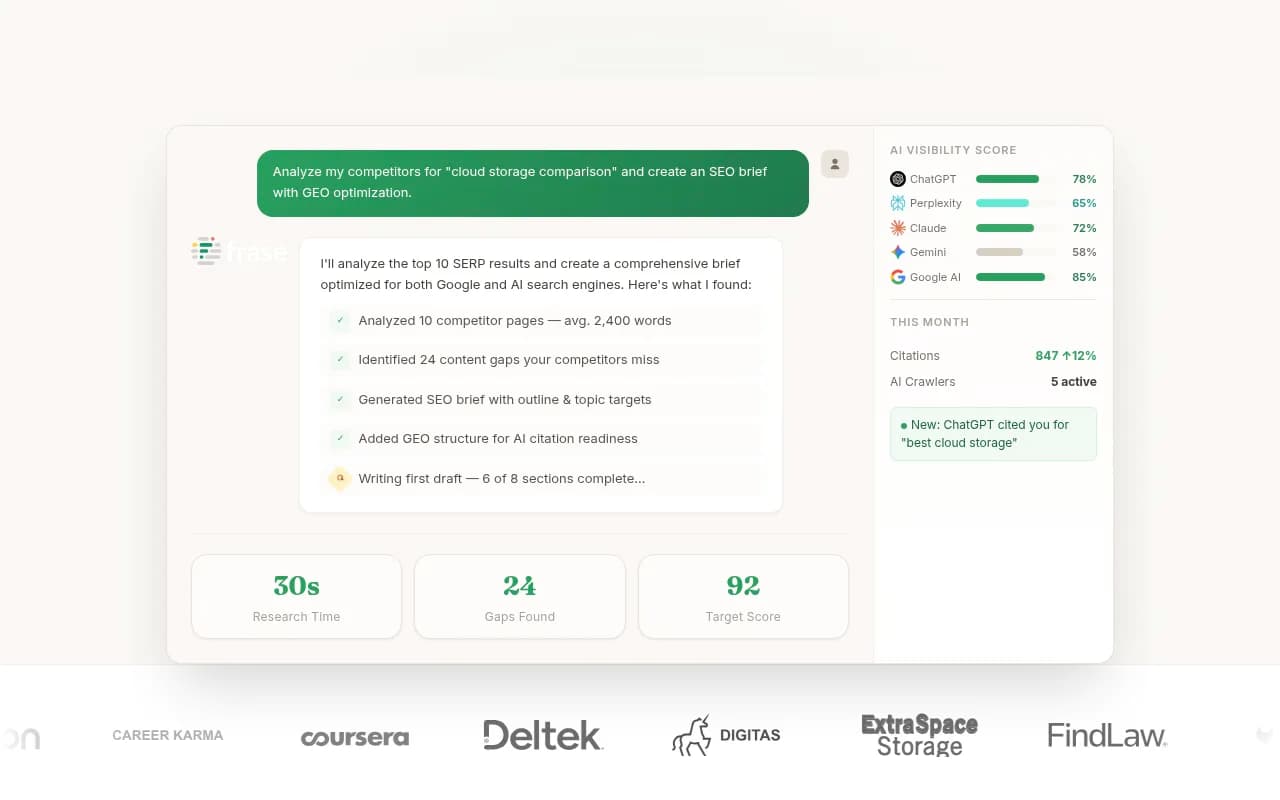
Frase has long been strong on content briefs and now integrates GEO-specific optimization into its workflow.

SearchAtlas combines LLM visibility tracking with an AI-powered SEO automation agent that can handle a significant chunk of the content pipeline.

Qwairy focuses on GEO strategy and optimization with a structured approach to prompt targeting.

AthenaHQ tracks visibility across 8+ AI search engines and is building out its optimization capabilities.
The market is moving fast. Six months ago, most of these tools were monitoring-only. The shift toward action -- generating and publishing content, not just reporting on gaps -- is the defining trend of 2026 in GEO. The question is which tools are doing it with enough data rigor to actually move the needle on citations, not just page count.