Key takeaways
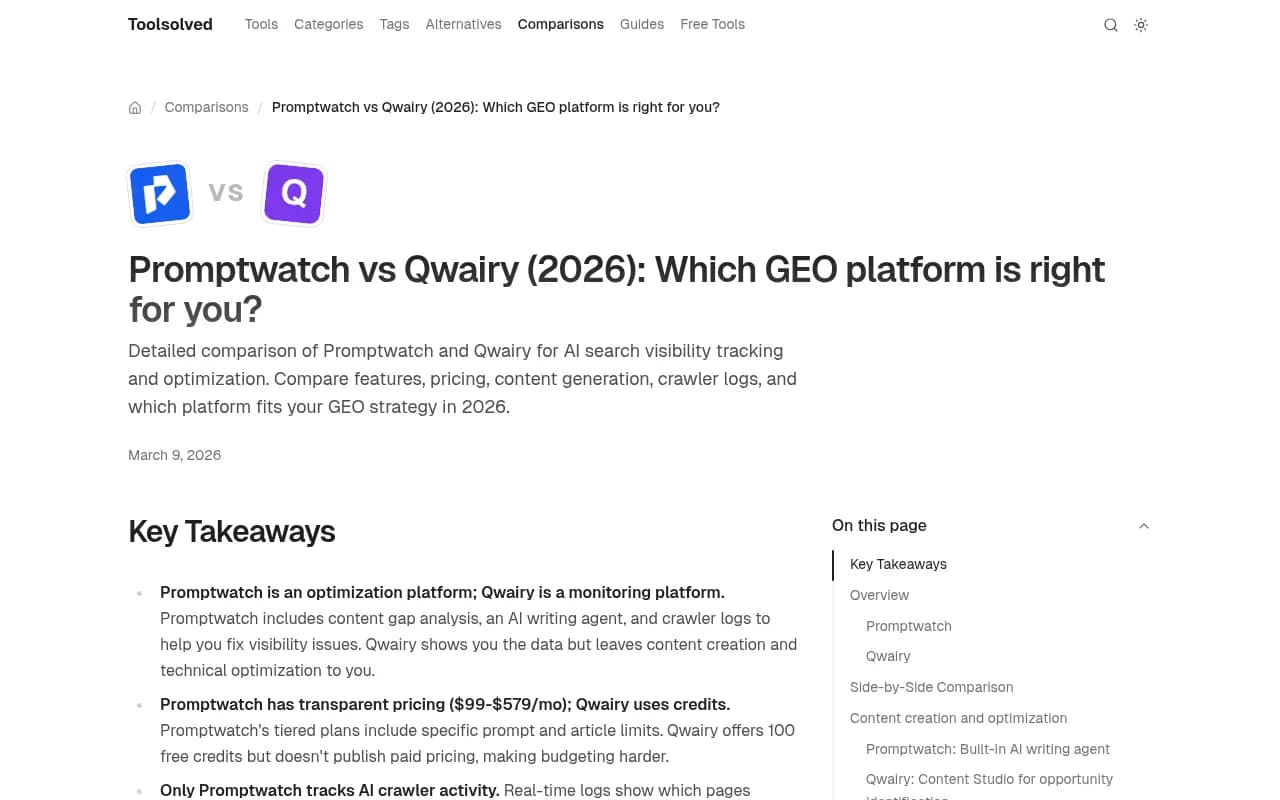
- Promptwatch is an optimization platform with content generation, crawler logs, and traffic attribution built in. Qwairy is a monitoring platform that surfaces data but leaves execution to you.
- Promptwatch has transparent tiered pricing ($99–$579/mo). Qwairy starts at €59/mo but doesn't publish full paid pricing, which makes budgeting harder for teams.
- Only Promptwatch tracks AI crawler activity in real time, showing which pages ChatGPT, Claude, and Perplexity are reading and where they hit errors.
- Both cover the same core AI models (ChatGPT, Claude, Gemini, Perplexity, Copilot, Grok, Mistral, DeepSeek). Promptwatch adds Google AI Overviews and Google AI Mode.
- Qwairy has a broader model count (38+ individual models) and includes an MCP Server and backlink marketplace that Promptwatch doesn't offer.
- The right choice depends on what your team actually needs: if you want to monitor and have your own content workflow, Qwairy works. If you want to find gaps and fix them inside one platform, Promptwatch is the stronger fit.
GEO platforms have multiplied fast. Two years ago there were maybe a dozen serious options. Now there are over 200 tools claiming some version of "AI visibility." Most of them are dashboards that show you a number and leave you wondering what to do next.
Promptwatch and Qwairy are both credible options in this space, and they're often compared directly. But they're solving slightly different problems. This guide breaks down exactly where they differ, where they overlap, and which one makes more sense depending on how your team actually works.
What each platform is actually trying to do
Before comparing features, it helps to understand the design philosophy behind each tool.
Promptwatch is built around a loop: find the gaps in your AI visibility, generate content to fill them, then track whether that content gets cited. The whole platform is oriented toward action. You don't just see that a competitor is being cited more than you -- you get told what content you're missing and can generate it directly inside the tool.

Qwairy takes a different approach. It's built around breadth of monitoring and strategic intelligence. The platform covers more individual AI models than almost any competitor (38+ models across 10+ providers), includes a Content Studio for identifying opportunities, and has unique features like an MCP Server and a backlink marketplace. But the actual content creation and technical fixes happen outside the platform.

Neither approach is wrong. They're just suited to different team setups.
AI model coverage
This is one area where Qwairy has a genuine edge. It tracks 38+ individual models across 10+ AI providers, which is the broadest coverage in the market right now. Promptwatch covers 10 AI models: ChatGPT, Claude, Perplexity, Gemini, Copilot, Grok, Mistral, DeepSeek, Meta AI, Google AI Overviews, and Google AI Mode.
For most teams, 10 models is more than enough. The vast majority of AI search traffic comes from ChatGPT, Perplexity, and Google AI Overviews. But if you're in a market where regional or specialized models matter -- or if you want visibility into model-specific behavior across different versions of GPT-4o vs GPT-4 Turbo, for example -- Qwairy's depth is hard to match.
| Feature | Promptwatch | Qwairy |
|---|---|---|
| AI models tracked | 10 (incl. Google AI Mode) | 38+ models across 10+ providers |
| Google AI Overviews | Yes | Yes |
| Google AI Mode | Yes | Yes |
| ChatGPT Shopping tracking | Yes | Not specified |
| Multi-language/region | Yes | Yes |
| Custom personas | Yes | Yes |
Monitoring and tracking capabilities
Both platforms cover the core monitoring use cases: brand mention tracking, sentiment analysis, competitor comparisons, share of voice, and citation tracking. The differences show up in the details.
Promptwatch includes page-level tracking, which shows exactly which pages on your site are being cited, how often, and by which AI model. This is more granular than brand-level visibility scores and makes it much easier to understand what's working.
Qwairy's monitoring is strong at the strategic level. It shows you visibility trends, competitor heatmaps, and how your brand is perceived across different AI models. The platform also surfaces which sources AI models cite in their responses, which is useful for understanding where to publish.
One feature Promptwatch has that Qwairy doesn't: AI crawler logs. These are real-time logs of AI crawlers (ChatGPT, Claude, Perplexity, etc.) hitting your website -- which pages they read, how often they return, and any errors they encounter. If an AI model can't access your content because of a crawl error, you'll see it here. Qwairy doesn't offer anything equivalent.
| Feature | Promptwatch | Qwairy |
|---|---|---|
| Brand mention tracking | Yes | Yes |
| Competitor heatmaps | Yes | Yes |
| Page-level citation tracking | Yes | Limited |
| AI crawler logs | Yes | No |
| Reddit & YouTube tracking | Yes | No |
| Citation source analysis | Yes | Yes |
| Prompt volume & difficulty scores | Yes | Yes |
| Query fan-outs | Yes | Not specified |
Content gap analysis and content creation
This is the biggest practical difference between the two platforms.
Promptwatch's Answer Gap Analysis shows you exactly which prompts competitors are visible for that you're not. You see the specific topics and questions AI models want answers to but can't find on your site. Then -- and this is the part most competitors skip -- you can generate that content directly inside Promptwatch using its built-in AI writing agent.
The writing agent produces articles, listicles, and comparisons grounded in citation data from 880M+ analyzed citations. It's not generic SEO content. It's built to get cited by specific AI models based on what those models have historically cited.
Qwairy has a Content Studio that identifies content gaps and surfaces opportunities. It's a solid research tool. But it doesn't auto-generate content. Your team still has to write it, brief it out, or use a separate tool. That's fine if you have writers or a content agency. It's a meaningful gap if you're a lean team trying to move fast.
| Feature | Promptwatch | Qwairy |
|---|---|---|
| Answer gap analysis | Yes | Yes (Content Studio) |
| AI content generation | Yes (built-in writing agent) | No |
| Citation-grounded content | Yes (880M+ citations) | No |
| Content brief export | Yes | Yes |
| Backlink marketplace | No | Yes |
| MCP Server | No | Yes |
Traffic attribution and ROI measurement
Knowing you're being cited is useful. Knowing that those citations are driving actual traffic and revenue is what makes GEO a defensible investment.
Promptwatch connects AI visibility to real traffic through three methods: a code snippet, Google Search Console integration, or server log analysis. You can see which AI-driven visits are landing on which pages and trace that back to specific prompts and citations. This closes the loop between visibility scores and business outcomes.
Qwairy's attribution capabilities aren't as clearly documented. The platform focuses more on visibility intelligence than downstream revenue measurement.
For teams that need to report on GEO ROI to leadership, this matters. "Our AI visibility score went up 12 points" is a harder sell than "AI search drove 3,400 sessions last month, up from 1,100."
Unique features worth noting
A few things each platform does that the other doesn't:
Promptwatch only:
- AI crawler logs (real-time visibility into how AI bots interact with your site)
- ChatGPT Shopping tracking (monitor when your brand appears in product recommendations)
- Traffic attribution with GSC integration and server log analysis
- Reddit and YouTube tracking (surfaces discussions that influence AI recommendations)
Qwairy only:
- MCP Server (connects AI agents directly to your visibility data)
- Backlink marketplace (find and acquire links that improve AI citation rates)
- 38+ individual model tracking (granular model-version coverage)
The MCP Server is genuinely interesting. It lets AI agents query your GEO data directly, which opens up workflow automation possibilities that most platforms haven't thought about yet. If your team is building AI-assisted workflows, that's worth paying attention to.
Pricing comparison
Promptwatch publishes its pricing clearly:
| Plan | Price | Sites | Prompts | Articles |
|---|---|---|---|---|
| Essential | $99/mo | 1 | 50 | 5 |
| Professional | $249/mo | 2 | 150 | 15 |
| Business | $579/mo | 5 | 350 | 30 |
| Agency/Enterprise | Custom | Custom | Custom | Custom |
A 7-day free trial is available. Annual billing reduces the cost.
Qwairy starts at €59/month and offers 100 free credits to get started. But full paid pricing isn't published on their site, which makes it harder to budget or compare directly. For agencies managing multiple clients, that opacity can be frustrating.
Who should use which platform
Use Promptwatch if:
- You want one platform that covers monitoring, gap analysis, content creation, and traffic attribution
- You're a lean team that can't afford to have separate tools for each part of the GEO workflow
- You need to prove ROI on GEO to stakeholders
- Technical SEO matters to your team (crawler logs, indexing issues)
- You're tracking Reddit and YouTube as part of your content strategy
Use Qwairy if:
- You have an existing content team and just need the intelligence layer
- You want the broadest possible AI model coverage, including granular model versions
- You're building AI agent workflows and the MCP Server is useful to you
- You're interested in the backlink marketplace as a citation-building channel
- You're comfortable with less pricing transparency in exchange for potentially lower entry cost
How they compare against the broader market
It's worth noting that both Promptwatch and Qwairy are meaningfully ahead of simpler monitoring tools. Platforms like Otterly.AI and Peec AI are essentially dashboards -- they show you visibility data but offer no content creation, no crawler logs, and no traffic attribution.


Profound and Scrunch are strong enterprise options with deep analytics, but they come in at higher price points and don't include content generation either.

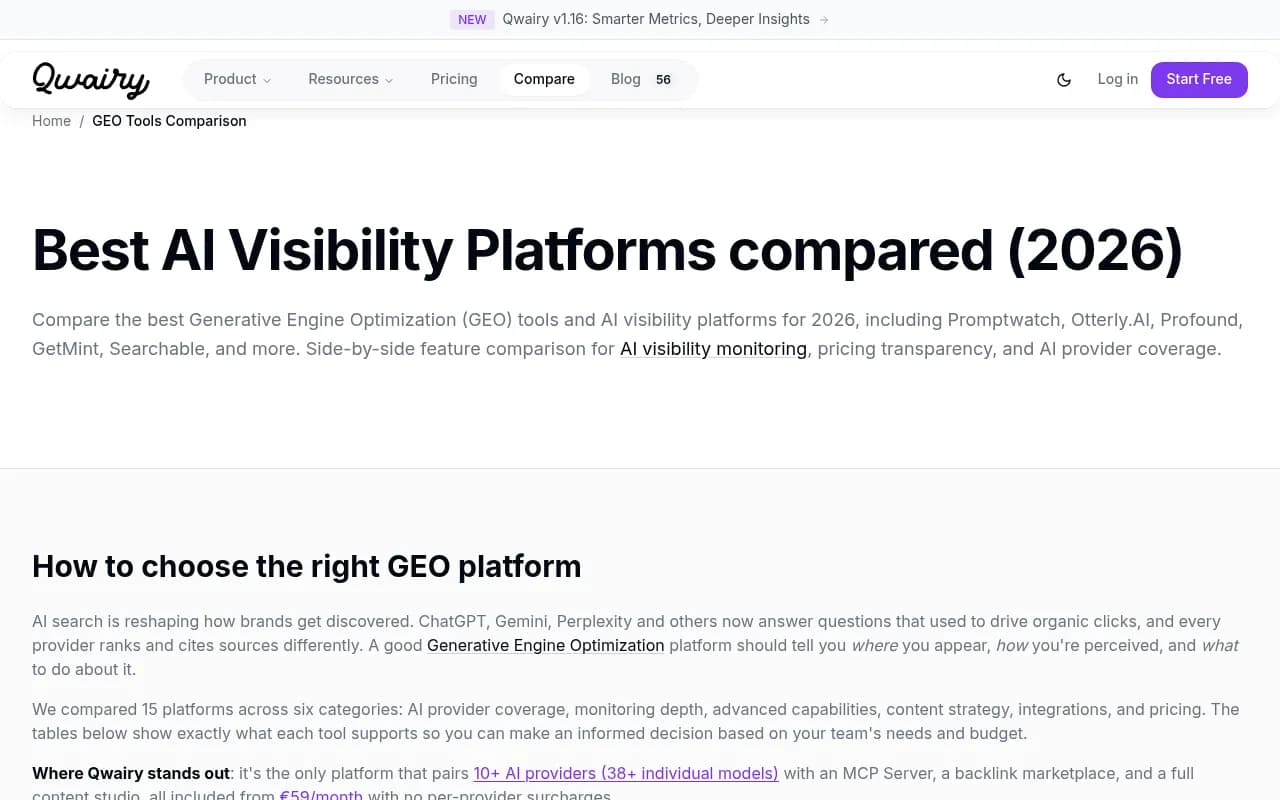
The honest summary: Promptwatch and Qwairy are both in the top tier of GEO platforms right now. The choice between them is less about which is "better" and more about whether your team needs an end-to-end optimization workflow or a best-in-class monitoring and intelligence layer.
Final take
If you're a GEO team that wants to move fast -- find gaps, generate content, track results, show ROI -- Promptwatch is the more complete solution. The built-in writing agent alone saves a significant amount of time, and the crawler logs give you a technical layer that most competitors don't offer at all.
If you're a team with strong content resources and you want the deepest possible monitoring coverage across AI models, Qwairy's breadth is impressive. The MCP Server and backlink marketplace are also genuinely differentiated features that could matter depending on how your workflow is set up.
Both offer free trials or free credits. The fastest way to decide is to run the same set of prompts through both platforms and see which one gives you clearer direction on what to do next.