Key takeaways
- Promptwatch is the only platform of the three that closes the full loop: find gaps, generate content, track results. The other two are primarily monitoring tools.
- Profound costs significantly more than competitors and lacks built-in content creation — you get data, then you're on your own.
- Qwairy has the broadest AI model coverage (38+ models) and the lowest published starting price (€59/mo), but doesn't generate content or log AI crawler activity.
- If your team already has writers and just needs visibility data, Qwairy or Profound can work. If you want one platform to handle monitoring and optimization, Promptwatch is the stronger fit.
- All three cover the core AI models: ChatGPT, Claude, Gemini, Perplexity, Copilot, Grok, Mistral, and DeepSeek.
The GEO platform market has gotten crowded fast. Twelve months ago most marketing teams had never heard of "AI visibility tracking." Now there are 15+ tools competing for the same budget line, and the differences between them aren't always obvious from a features page.
This guide focuses on three platforms that come up most often in buying conversations: Qwairy, Promptwatch, and Profound. They're not the cheapest options, and they're not the most expensive. They sit in the middle of the market where serious marketing teams actually shop. Here's what separates them.
What these platforms actually do
Before comparing features, it's worth being clear about what GEO platforms are supposed to accomplish. The core job is simple: tell you whether AI search engines (ChatGPT, Perplexity, Claude, Gemini, etc.) are recommending your brand when someone asks a relevant question.
But "telling you" is where the platforms diverge. Some show you a dashboard and stop there. Others go further and help you understand why you're invisible and what to do about it. That distinction matters more than almost any individual feature.
Promptwatch: the optimization platform
Promptwatch is the platform most focused on actually fixing your AI visibility, not just measuring it. The core workflow is a loop: identify which prompts competitors rank for that you don't, generate content designed to get cited, then track whether that content moves the needle.

The content gap analysis is genuinely useful. You put in a set of prompts relevant to your industry, and Promptwatch shows you which ones your competitors appear in but you don't. That's not a novel idea, but the execution matters: Promptwatch ties those gaps directly to its AI writing agent, which generates articles and listicles grounded in 880M+ citations analyzed from real AI responses. The output isn't generic SEO filler — it's structured to match the format and sourcing patterns that AI models actually cite.
A few things Promptwatch does that the other two don't:
- AI crawler logs: Real-time logs showing which pages ChatGPT, Claude, and Perplexity are crawling, how often, and what errors they're hitting. This is genuinely rare in the market. If an AI model keeps hitting a 404 on a page you want cited, you'll see it.
- Reddit and YouTube tracking: Surfaces discussions and videos that AI models use as sources. Most platforms ignore these channels entirely.
- ChatGPT Shopping monitoring: Tracks when your products appear in ChatGPT's shopping carousels — relevant for e-commerce brands.
- Query fan-outs: Shows how a single prompt branches into sub-queries, so you can prioritize content that covers a topic cluster rather than a single keyword.
Pricing is transparent: $99/mo (Essential), $249/mo (Professional), $579/mo (Business). A 7-day free trial is available. The platform is used by 6,700+ brands including Booking.com and Center Parcs.
The one honest limitation: Promptwatch's full UI is available across all plans, but API access is an add-on rather than included by default. For teams that want to pipe data into custom dashboards, that's worth checking before you commit.
Qwairy: the broadest model coverage
Qwairy takes a different approach. It's built around breadth: 10+ AI providers with 38+ individual models tracked, which is more than any other platform in this comparison. If you care about visibility across niche or emerging AI models — not just the big five — Qwairy has an edge.

The platform also includes a Content Studio, a backlink marketplace, and an MCP Server, which is an unusual combination. Starting at €59/month, it's the most affordable of the three at entry level.
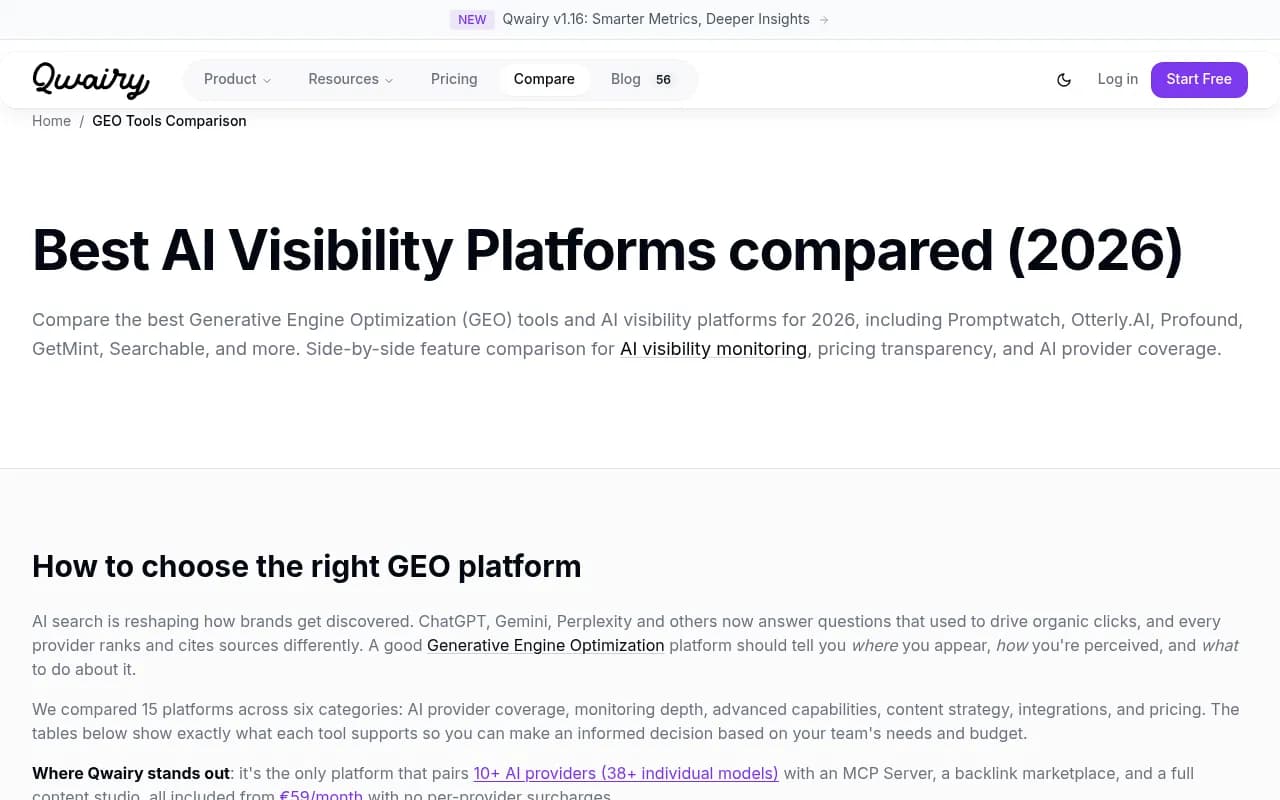
Where Qwairy falls short is on the action side. The Content Studio surfaces content gaps and opportunities, but it doesn't auto-generate articles the way Promptwatch does. You get the intelligence, then your content team does the work. For teams with strong writers, that's fine. For teams that want one tool to handle both, it's a gap.
Qwairy also doesn't offer AI crawler logs. You can see where you appear (or don't) in AI responses, but you can't see whether AI crawlers are actually reading your pages or running into technical issues. That's a meaningful blind spot for technical SEO teams.
Pricing transparency is another issue. Qwairy offers 100 free credits to start, but paid plan pricing isn't published on the site. That makes it harder to budget without a sales conversation — which is a friction point for smaller teams.
Profound: the premium monitoring tool
Profound is the most established name in this comparison and, depending on the plan, the most expensive. It covers the major AI models, has solid monitoring depth, and is used by enterprise teams that need reliable data at scale.

The criticism that comes up most in community discussions is fair: Profound costs significantly more than comparable tools and doesn't help you create content to fix the gaps it identifies. One analysis from Contentmonk put the premium at 48% above competitors for equivalent monitoring features. You get a clear picture of where you're invisible — then you're on your own to fix it.
That's not necessarily a dealbreaker. If you have a content team, a content agency, or an SEO team that just needs reliable visibility data to prioritize their work, Profound delivers that. The dashboards are clean, the data is trustworthy, and the enterprise integrations are solid.
But for teams that want a platform to do more than report problems, Profound's monitoring-only approach starts to feel like paying for a diagnostic tool that doesn't come with any treatment.
Head-to-head feature comparison
| Feature | Promptwatch | Qwairy | Profound |
|---|---|---|---|
| AI models tracked | 10 (incl. Google AI Mode) | 10+ providers, 38+ models | 8+ |
| Content gap analysis | Yes | Yes (Content Studio) | Yes |
| AI content generation | Yes (built-in writing agent) | No (manual) | No |
| AI crawler logs | Yes | No | No |
| Reddit/YouTube tracking | Yes | No | No |
| ChatGPT Shopping tracking | Yes | No | No |
| Query fan-outs | Yes | No | No |
| Prompt volume/difficulty | Yes | No | No |
| Backlink marketplace | No | Yes | No |
| MCP Server | No | Yes | No |
| API access | Add-on | Yes (full) | Add-on |
| Starting price | $99/mo | €59/mo | Higher (not published) |
| Free trial | 7 days | 100 free credits | Available |
| Pricing transparency | Full | Partial | Limited |
Which platform fits which team
The right answer depends almost entirely on what you want the platform to do for you.
If you want one tool that monitors and optimizes
Promptwatch is the clearest choice. The content gap analysis, AI writing agent, and crawler logs work together in a way the other two don't match. You can run the full cycle — find gaps, generate content, track results — without switching tools. For marketing teams that don't have a dedicated content agency or technical SEO team, that matters.
If you need the widest AI model coverage and have your own content team
Qwairy's 38+ model tracking is genuinely impressive, and the €59/mo entry point is the lowest of the three. If your team has writers who can act on the gap data, and you want to track visibility across a broader set of AI providers, Qwairy is worth a serious look.
If you're an enterprise team that needs reliable monitoring data and has existing content workflows
Profound works well here. The data quality is solid, the enterprise integrations are mature, and if you're feeding visibility data into a larger content operation, the monitoring-only approach isn't a limitation — it's just a different division of labor. The price premium is harder to justify for smaller teams, but enterprise buyers often have less price sensitivity than workflow sensitivity.
What the community says
The GEO practitioner community has been pretty direct about these tools. A thread in r/GEO_optimization from early 2026 described Profound as throwing "vanity metrics and unnecessary features" at users while being more expensive than alternatives. The sentiment isn't universal, but it reflects a real frustration: paying more for a tool that shows you problems without helping you solve them.
Qwairy gets credit for breadth and value. The model coverage is genuinely differentiated, and the pricing is competitive. The gap is on the action side.
Promptwatch consistently comes up as the platform that "goes further" — the crawler logs and content generation are features that practitioners notice because they're solving problems the monitoring-only tools don't touch.
A note on the broader market
These three aren't the only options. If budget is tight, tools like Peec AI and Otterly.AI offer basic monitoring at lower price points.


If you're an agency managing multiple clients, Search Party and AthenaHQ are worth evaluating.

And if you're already deep in the Semrush ecosystem, their AI Visibility Toolkit is an obvious starting point even if it doesn't go as deep as dedicated GEO platforms.
The market is moving fast. Features that were differentiators six months ago are becoming table stakes. The platforms that will matter in 12 months are the ones building around the full optimization loop, not just the monitoring layer.
Bottom line
Qwairy, Promptwatch, and Profound are all legitimate tools. None of them are bad choices. But they're solving different versions of the same problem.
Profound tells you where you stand. Qwairy tells you where you stand across more models. Promptwatch tells you where you stand and then helps you do something about it.
For most marketing teams in 2026, "doing something about it" is the part that's actually hard. That's where the real value is.
If you're evaluating these platforms, start with the free trials. The Promptwatch 7-day trial and Qwairy's 100 free credits both give you enough data to see whether the platform fits your workflow before you commit to a monthly plan.