Key takeaways
- Qwairy is a capable monitoring tool, but it doesn't help you act on what it finds -- most teams hit this wall once AI search becomes a serious channel.
- The GEO platform market in 2026 is split between monitoring dashboards and full optimization platforms. The difference matters a lot.
- Promptwatch is the strongest all-around alternative, combining gap analysis, AI content generation, crawler logs, and traffic attribution in one workflow.
- If budget is tight, tools like Otterly.AI and Peec AI cover the basics at lower price points.
- For enterprise teams, Profound and Scrunch offer deeper analytics, though neither closes the loop on content creation.
- The best choice depends on whether you need to track visibility, improve it, or both.
Why teams look for Qwairy alternatives
Qwairy is a reasonable starting point. It covers AI provider monitoring, has a clean interface, and recently added features like an MCP server and backlink marketplace. For teams just dipping their toes into GEO, it works.
But there's a pattern that keeps coming up: teams get the data, see they're invisible for certain prompts, and then... get stuck. The dashboard shows the problem. It doesn't help solve it.
That's the core limitation of monitoring-only tools. You can see that a competitor is getting cited by ChatGPT for "best project management software for remote teams" and you're not. What you can't do is figure out why, what content you're missing, or generate something that might actually fix it.
Other friction points teams report:
- Shallow competitor analysis -- you see who's winning, not what's driving their citations
- No content generation or optimization features built in
- Limited visibility into how AI crawlers interact with your site
- No traffic attribution to connect AI visibility to actual revenue
If any of that sounds familiar, here are eight alternatives worth considering.
The GEO platform landscape in 2026
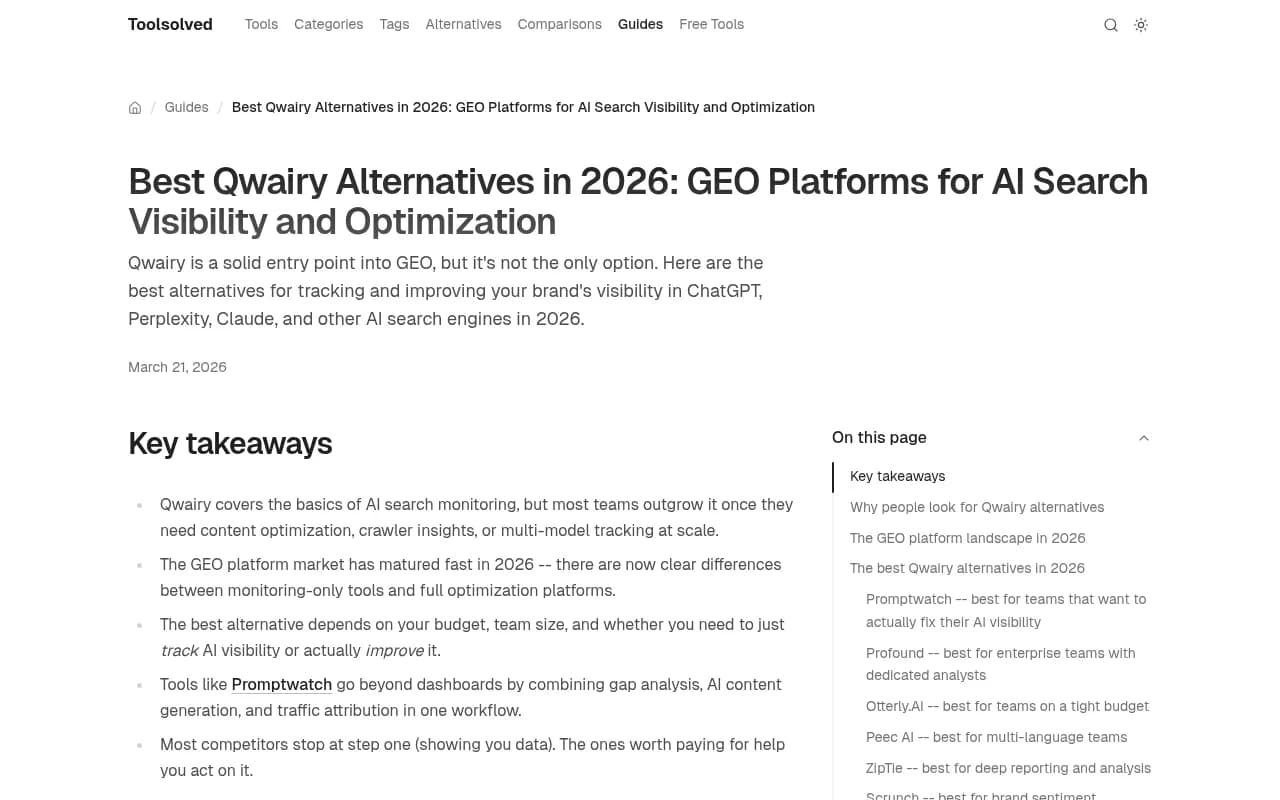
The market has split pretty clearly into two camps. Monitoring dashboards show you citation data, share-of-answer metrics, and competitor comparisons. Optimization platforms do all that and then help you act on it -- content gap analysis, AI-assisted writing, crawler diagnostics, and attribution.
Most tools launched in 2024-2025 are firmly in the first camp. That's fine if you're just starting out. But if AI search is becoming a real acquisition channel for your business, "just tracking" starts to feel like watching a race from the sidelines.
The 8 best Qwairy alternatives in 2026
1. Promptwatch -- best for teams that want to actually fix their AI visibility
Promptwatch is the most complete GEO platform available right now. The core difference from Qwairy (and most competitors) is that it doesn't stop at showing you data. It's built around a loop: find the gaps, create content to fill them, track the results.
The Answer Gap Analysis is genuinely useful -- it shows you the specific prompts your competitors are visible for that you're not, and what content your site is missing to compete. From there, the built-in AI writing agent generates articles, listicles, and comparisons grounded in real citation data (880M+ citations analyzed). This isn't generic content; it's engineered around what AI models actually cite.
On the tracking side, Promptwatch monitors 10+ AI models including ChatGPT, Claude, Perplexity, Gemini, Grok, DeepSeek, and Google AI Mode. The AI Crawler Logs feature is something most competitors don't have at all -- you can see exactly which pages ChatGPT or Perplexity's crawlers are reading, how often they return, and whether they're hitting errors. That's the kind of diagnostic data that actually tells you why you're not getting cited.
Traffic attribution rounds it out: connect a code snippet, GSC integration, or server logs to see which AI citations are driving real visits and revenue.
Pricing starts at $99/month for the Essential plan (1 site, 50 prompts, 5 articles), with Professional at $249/month and Business at $579/month. Free trial available.

2. Profound -- best for enterprise teams with deep analytics needs
Profound is one of the more established players in this space and has a strong feature set for larger teams. It covers the major AI models, offers solid competitor benchmarking, and has decent prompt intelligence. The interface is polished and the data is reliable.
Where it falls short relative to Promptwatch: no content generation, no Reddit/YouTube tracking, and no ChatGPT Shopping monitoring. It's also priced at the higher end of the market, which makes it harder to justify if you're not getting optimization features alongside the analytics.
That said, if your primary need is deep monitoring and reporting for a large brand -- and you have a separate content team to act on the data -- Profound is a solid choice.

3. Otterly.AI -- best for small teams on a tight budget
Otterly.AI is one of the more affordable options in the GEO space and covers the core monitoring use case reasonably well. You get ChatGPT, Perplexity, and Claude tracking, share-of-voice metrics, and basic competitor comparison.
The limitations are real though. No crawler logs, no content generation, no visitor analytics, and limited model coverage (Gemini and Google AI Mode are add-ons). It's a monitoring-only tool, which means you'll hit the same "now what?" wall as with Qwairy.
But if you're a small team that just needs to keep an eye on AI visibility without a big budget, Otterly.AI gets the job done.

4. Scrunch AI -- best for brands that need enterprise-grade monitoring
Scrunch has built a solid reputation for enterprise AI visibility monitoring. It covers most major AI models, has good brand sentiment tracking, and integrates with existing marketing tech stacks reasonably well.
The gap: Google AI Mode is enterprise-only, and like most tools in this category, there's no content creation or optimization workflow. You're getting a very good dashboard, not an optimization platform. For Fortune 500 brands with dedicated content teams, that might be fine. For everyone else, it's a lot of money for data you still have to act on manually.
5. AthenaHQ -- best for teams focused on brand perception across AI engines
AthenaHQ tracks your brand visibility across 8+ AI search engines and puts a lot of emphasis on how AI models describe and position your brand, not just whether you appear. That's a useful angle -- knowing that Perplexity describes you as "expensive" when you're not is actionable in a different way than citation counts.
It's monitoring-focused, though. No content generation, no crawler logs, no traffic attribution. The API is available but there's no full UI access. If brand perception and sentiment are your primary concern, AthenaHQ is worth a look. If you need to improve your visibility, not just measure it, you'll need to pair it with something else.

6. Peec AI -- best for multi-language and multi-region tracking
Peec AI has carved out a niche in multi-language AI visibility monitoring, which is genuinely underserved in this market. If you're a brand operating across multiple countries and need to track how you appear in AI search results in French, German, Spanish, or other languages, Peec AI is one of the few tools that handles this well.
The trade-off: it's primarily a monitoring tool. Claude and some other models are add-ons rather than included by default. No content generation, no crawler insights. But for international teams where language coverage is the priority, it's a strong option.

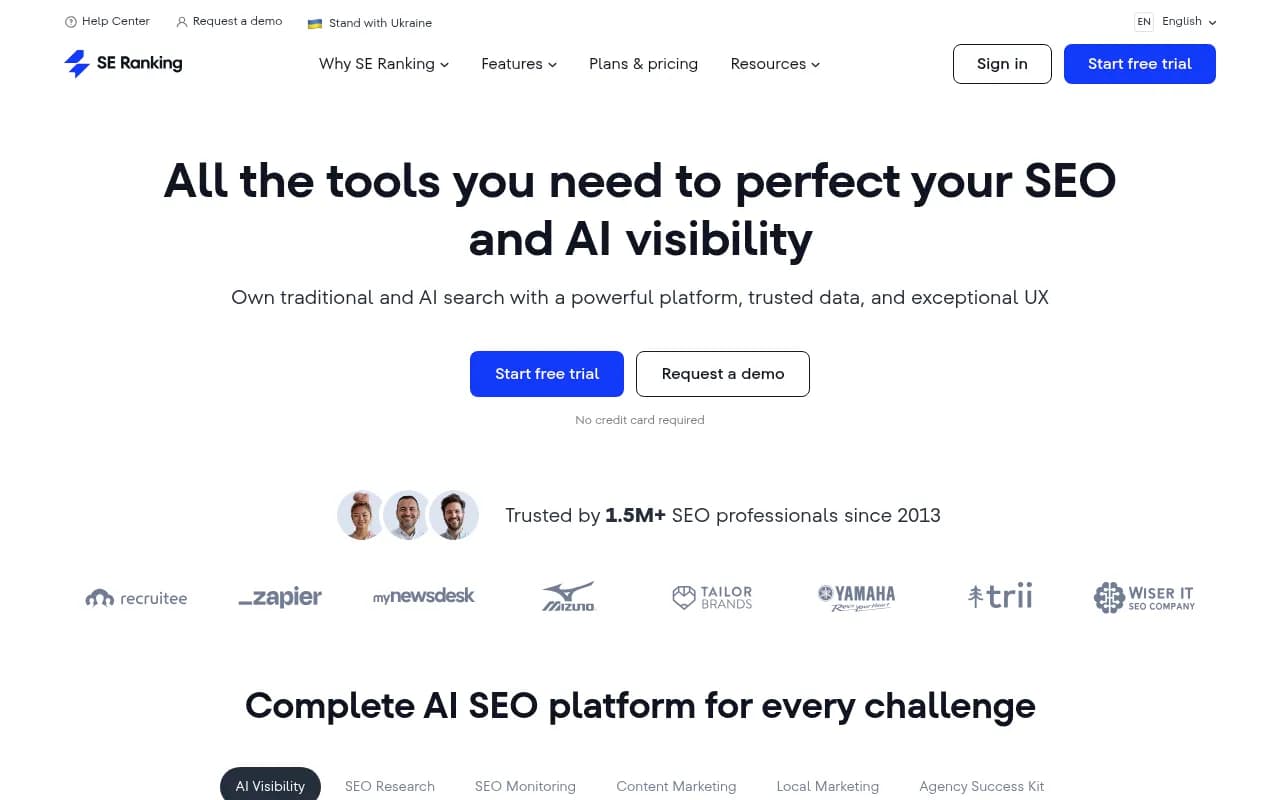
7. SE Ranking -- best for teams that want AI visibility alongside traditional SEO
SE Ranking is primarily an SEO platform that has added AI visibility tracking as part of its broader toolkit. If your team is already using SE Ranking for keyword tracking, site audits, and backlink monitoring, the AI visibility features are a natural extension rather than a separate tool to manage.
The AI visibility features aren't as deep as dedicated GEO platforms -- you won't get crawler logs, content gap analysis, or ChatGPT Shopping tracking. But if consolidation is the goal and you want to reduce the number of tools in your stack, SE Ranking is a reasonable way to cover both traditional SEO and basic AI visibility in one place.
8. Rankscale -- best for teams that want API-first flexibility
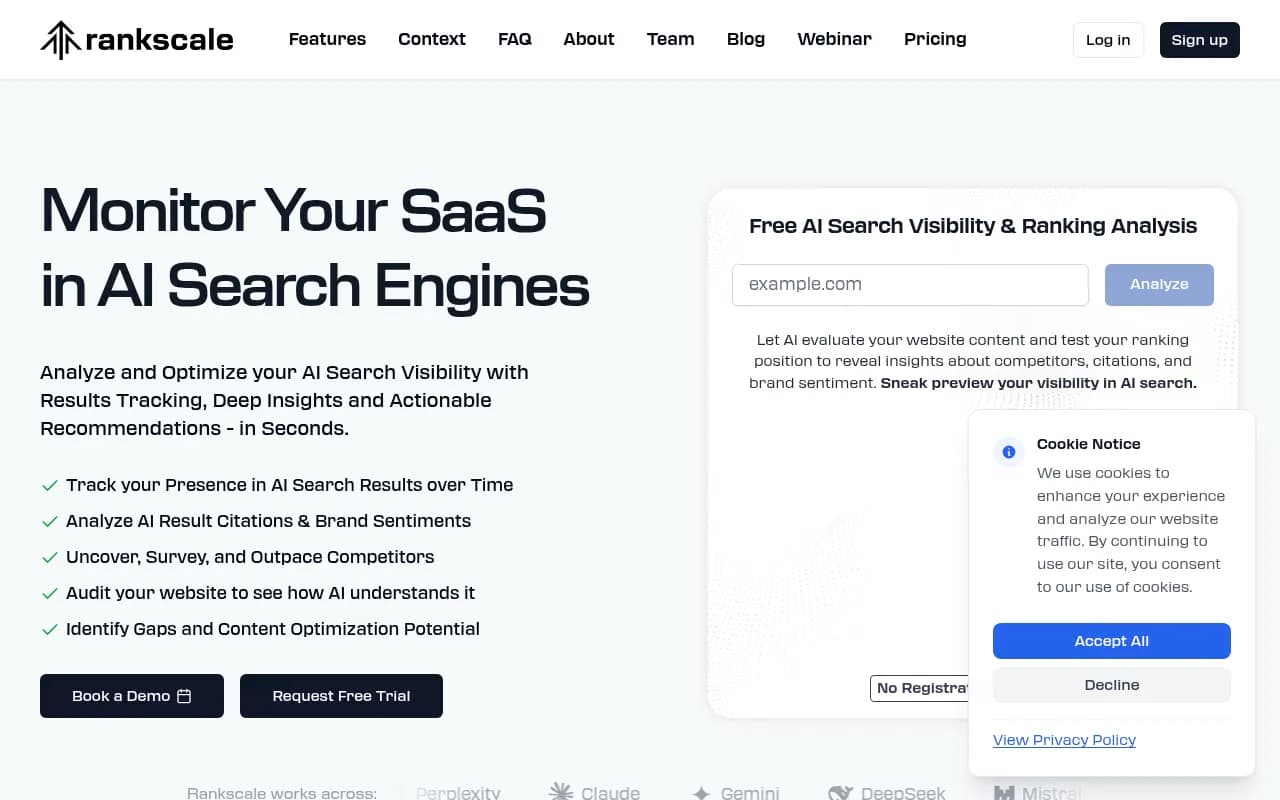
Rankscale takes a more technical approach to AI visibility tracking, with strong API access that makes it easier to build custom workflows and integrate data into existing reporting setups. If your team has engineering resources and wants to pull AI visibility data into a custom dashboard or BI tool, Rankscale is worth evaluating.
The UI is more limited than some competitors, and like most tools here, it's primarily a tracking platform rather than an optimization one. But for data-forward teams that want flexibility over a polished dashboard, it's a solid option.
Side-by-side comparison
| Tool | AI models covered | Content generation | Crawler logs | Traffic attribution | Reddit/YouTube tracking | Best for |
|---|---|---|---|---|---|---|
| Promptwatch | 10+ (ChatGPT, Claude, Perplexity, Gemini, Grok, DeepSeek, Copilot, Mistral, Meta AI, Google AI) | Yes | Yes | Yes | Yes | Teams that want to track AND fix AI visibility |
| Profound | Most major models | No | No | Limited | No | Enterprise monitoring and analytics |
| Otterly.AI | ChatGPT, Perplexity, Claude (Gemini add-on) | No | No | No | No | Small teams, tight budgets |
| Scrunch AI | Most major models (AI Mode enterprise-only) | No | No | No | No | Enterprise brand monitoring |
| AthenaHQ | 8+ models | No | No | No | No | Brand perception and sentiment tracking |
| Peec AI | Most models (Claude add-on) | No | No | No | No | Multi-language and multi-region teams |
| SE Ranking | Limited AI coverage | No | No | No | No | Teams consolidating SEO + AI visibility |
| Rankscale | Most major models | No | No | No | No | API-first, technical teams |
How to choose the right alternative
The decision mostly comes down to one question: do you need to track your AI visibility, or do you need to improve it?
If tracking is enough -- you're early in your GEO journey, you just need to know where you stand, and you have a content team that can act on the data independently -- then Otterly.AI, Peec AI, or even Qwairy itself might be sufficient. They're cheaper and simpler.
If you need to improve your AI visibility, not just measure it, the calculus changes. You need something that can tell you specifically what content you're missing, help you create it, and then confirm that it's working. That's a much shorter list of tools, and Promptwatch is the most complete option in that category right now.
A few other factors worth weighing:
- Team size and budget: Essential plans start at $99/month for Promptwatch vs. lower entry points for Otterly.AI. If you're a solo marketer, the cheaper option might make sense to start.
- International needs: Peec AI is the standout for multi-language tracking. Promptwatch also supports multi-language and multi-region monitoring, but Peec AI has made it a core focus.
- Technical resources: If your team has engineers who want API access and custom integrations, Rankscale gives you more flexibility. Promptwatch also has an API and Looker Studio integration.
- Existing tool stack: If you're already in SE Ranking for SEO, adding their AI visibility features might be the path of least resistance even if it's not the deepest option.
The bottom line
Qwairy isn't a bad tool. But the teams that outgrow it tend to do so for the same reason: they can see the problem but can't fix it from within the platform. That gap between "here's your data" and "here's what to do about it" is where most monitoring-only tools fall short.
The GEO platforms that are actually worth paying for in 2026 are the ones that close that loop. Promptwatch does it most completely -- gap analysis, content generation, crawler diagnostics, and attribution all in one place. The others on this list are worth considering depending on your specific constraints, but if the goal is to actually improve your AI search visibility rather than just watch it, that's where to start.