Goodie AI Review 2026
Monitors product visibility across ChatGPT Shopping, Amazon Rufus, Google AI Mode and Perplexity Shopping with optimization tooling.
Key takeaways
- Goodie AI bundles visibility monitoring, prompt research, a content writer, crawler analytics, and an agentic commerce tracker into one dashboard, aiming for a closed loop of research, monitor, action, and measure.
- Third-party audits have flagged real inconsistencies between Goodie's marketing cards and its own pricing tables (model counts that don't match, "daily" data collection claims that don't square with the response quotas sold), so read the pricing page carefully before buying.
- It lacks the depth of AI crawler log data, Reddit and YouTube citation tracking, and the agentic content-publishing pipeline that Promptwatch offers, and its prompt-volume and difficulty scoring is thinner than what dedicated GEO platforms provide.
- Entry pricing starts at $399/month for the Core tier, which is expensive relative to simpler trackers, though Goodie's pitch is that the bundle (measurement plus optimization plus attribution) justifies the premium.
- Review coverage is still thin. G2 shows a strong 4.9/5 but from only 8 reviews, and OMR lists zero reviews, so there isn't much independent signal yet.
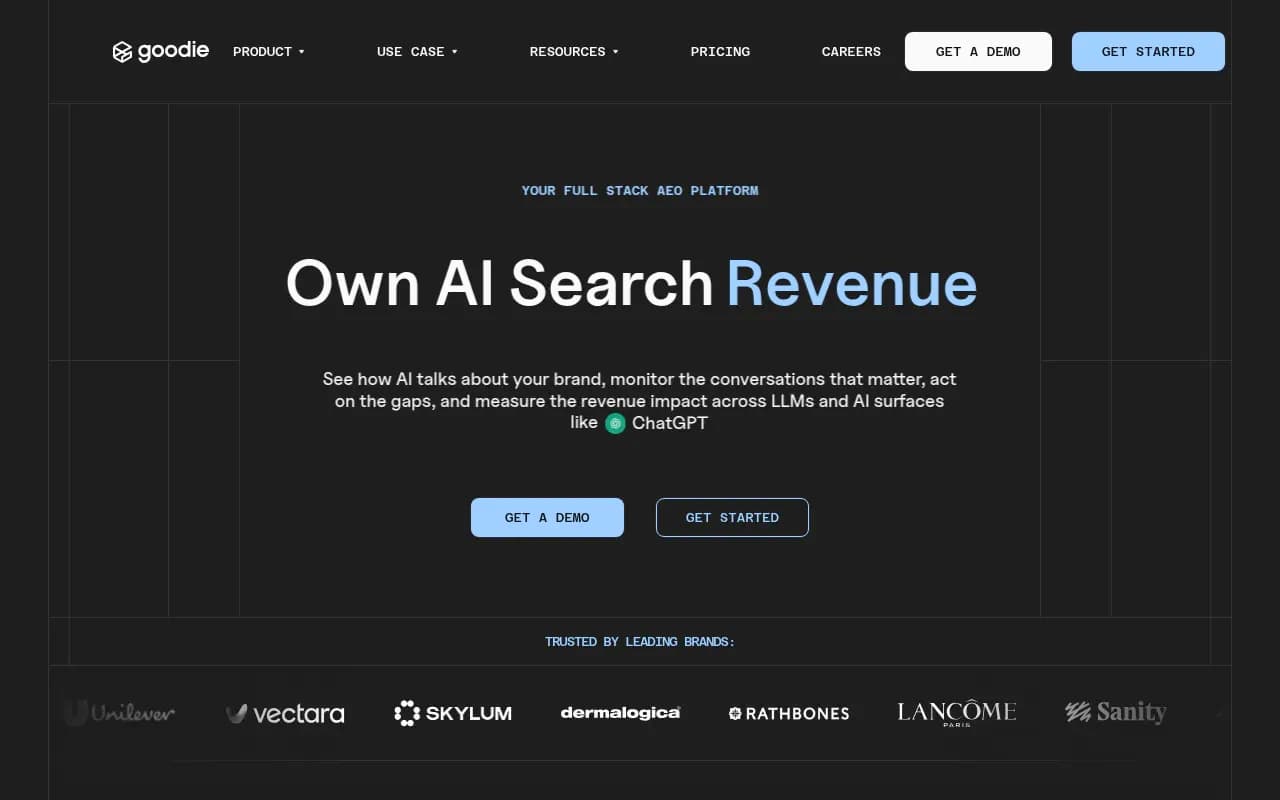
Goodie AI, built by a New York team that launched the platform in 2024 and has been rapidly adding features through 2026, sits in the answer engine optimization category: software that tracks how brands show up inside ChatGPT, Gemini, Perplexity, Claude, Copilot, Grok, and Google's AI Overviews and AI Mode, then tries to help marketers do something about it. The pitch on the homepage is a "closed loop" of research, monitor, action, and measure, which is a fair summary of what the product actually does across its six feature areas: Prompt Research, Visibility Monitoring, Optimization Actions, Content Studio, Agentic Commerce Suite, AI Agent Analytics, and Analytics & Attribution.
Who's it for? The homepage lists finance, retail, SaaS, travel, and fintech as target verticals, and the case studies back that up: Dermalogica (an 85% increase in AI search visibility), Rathbones (a UK wealth manager, 106% increase in AI citations), and SteelSeries (a 3.2x increase in AI search conversions over six months, reportedly the most-retrieved gaming brand across three LLMs). That's a credible enterprise and mid-market client list, and it tells you Goodie is positioned above the scrappy, single-founder prompt trackers that have flooded this category over the past two years.
Key features
- Prompt Research maps the actual questions customers type into AI tools, then ranks them by volume and intent so teams know which prompts to chase first. It's a reasonable starting point for any AEO program, though a rival comparison piece (covering Profound) claims Goodie doesn't have real conversation-volume data behind this the way some competitors do, so treat the "high-volume" labeling as directional rather than exact.
- Visibility Monitoring tracks brand mentions, sentiment, and competitive share across ChatGPT, Gemini, Perplexity, Claude, and the rest of the tracked models, depending on your tier. Core gets 5 models, Pro gets 8, Enterprise up to 13 (including an oddly unexplained surface called "Sparky" that shows up on the pricing table without any definition elsewhere on the site).
- Optimization Actions generates a prioritized to-do list of what to fix, similar in spirit to Promptwatch's Unified Actions, though Goodie's version is scoped to content and technical gaps rather than a full agentic workflow that writes and publishes for you.
- Content Studio writes AI-optimized content meant to carry the authority markers LLMs look for (author credentials, structured answers, citations). It's a genuine differentiator versus pure trackers like Otterly.AI or Peec.ai, which stop at monitoring and leave content production to someone else.
- Agentic Commerce Suite is Goodie's most distinctive feature: SKU-level tracking of how products show up inside ChatGPT Shopping, Amazon Rufus, Perplexity Shopping, and AI Mode Shopping. This is a narrower niche than general AEO, and it's the feature that shows up in Goodie's own product description most prominently, so if you're an e-commerce brand worried about AI shopping agents recommending competitors instead of you, this is the reason to look at Goodie specifically.
- AI Agent Analytics monitors which AI crawlers (GPTBot, ClaudeBot, PerplexityBot, and others) are hitting your site, and flags technical issues before they cost you citations. This is a feature most prompt-tracking tools skip entirely, and it's good that Goodie has it, though the depth (how many crawlers, how granular the logs, whether there's a crawl-to-citation path shown) isn't fully documented on the public site.
- Analytics & Attribution tries to connect AI visibility back to revenue, which is the hardest and most valuable thing any GEO platform can do. Goodie advertises "direct revenue attribution" starting at the Core tier and "complete revenue attribution" at Enterprise, but the public materials don't explain the attribution methodology in much detail.
- Goodie MCP is an MCP server integration included from the Core tier up, letting teams pull AEO data into other tools and workflows rather than being locked inside Goodie's own dashboard.
- Brand Command, a newer addition launched around August 2026, lets brands define canonical facts (naming, pricing, positioning) and checks every AI mention against those facts, flagging inaccuracies and showing which competitors get recommended instead of you. This is closer to brand reputation management than classic AEO, and it's a smart extension of the core monitoring product.
Who is it for
Goodie is built for mid-market and enterprise brands with a marketing or SEO team that can act on the recommendations, not for solo operators who just want a cheap dashboard to check once a week. The case studies (Dermalogica, Rathbones, SteelSeries, plus logos from Vectara, Skylum, Lancôme, and Sanity) point to retail, beauty, finance, and SaaS companies with real content and PR operations behind them. The dedicated Agentic Commerce Suite also makes it a reasonable fit for e-commerce and consumer product brands worried specifically about AI shopping surfaces, a niche Promptwatch also covers through its ChatGPT Shopping and Ads Radar feature but which few other GEO tools touch at all.
Agencies get their own pricing track starting at $275/month for a Growth plan, with multi-domain dashboards and white-label reporting, so Goodie is also pitching itself at agencies managing AEO programs for multiple clients rather than a single brand.
Who shouldn't use it: solo founders or small teams on a tight budget, since $399/month for the Core tier is a steep entry point compared to trackers like Rank Prompt ($39/mo) or Gumshoe ($99/mo) that cover similar engine counts at a fraction of the price. Teams that need hard data on prompt search volumes and conversation-level evidence, rather than directional estimates, may also want to look elsewhere, since independent reviewers have questioned how real Goodie's prompt-volume numbers actually are.
Integrations and ecosystem
Goodie ships an MCP server starting at the Core tier, which is a meaningful nod to how teams increasingly want AEO data inside Claude, Cursor, or other MCP-compatible tools rather than siloed in a web dashboard. Beyond that, the publicly documented integration footprint is thin. G2's own data shows only one sourced integration (Claude) backed by real user reviews, and there's no public GitHub repository, suggesting Goodie isn't positioning itself as a developer-first, API-heavy platform the way some competitors do.
Social presence is modest: the official X account (@Goodie_AI) posts multiple times a week on AEO trends but has a small follower count, and the company maintains LinkedIn and Instagram pages. There's no indication of a dedicated browser extension or mobile app.
Pricing and value
Goodie's published pricing (as of the live pricing page) runs three tiers for brands, plus a separate agency track:
- Core: $399/month. 5 models tracked (ChatGPT, AI Overview, Perplexity, AI Mode, Copilot), 120 prompts, 50 optimizations/month, direct revenue attribution, 5 seats plus AEO strategist support, 7-day free trial.
- Pro: $999/month, labeled "Most Popular." 8 models (adds Gemini, Amazon Alexa, and the unexplained "Sparky"), 250 prompts, 100 optimizations/month, SKU-level agentic commerce visibility, unlimited seats plus AEO strategist support.
- Enterprise: custom pricing. Up to 13 models, tailored prompt volume, complete revenue attribution, white-glove implementation, multi-brand dashboard, unlimited seats and a dedicated strategist, MCP and API access.
- Agencies: a separate Growth plan starts at $275/month with unlimited seats and AEO strategist support bundled in.
Annual billing saves roughly 20%. Worth flagging: an independent audit from EchoWi found a real discrepancy between Goodie's advertised "daily" data collection and the actual prompt/response quotas sold, which, by their math, implies real sampling closer to once every three days on the entry tier rather than daily. The same review and a separate comparison piece covering Profound also noted inconsistent model-count claims between marketing cards and the fine-print comparison tables. None of this means the product doesn't work, but it does mean buyers should ask Goodie's sales team to confirm exact response volumes and model counts in writing before signing, rather than taking the marketing page at face value.
Compared to Promptwatch, whose Essential tier starts at $95/month with 50 prompts and 6,000 responses across all tracked models, Goodie's Core tier at $399/month for 120 prompts and a narrower 5-model set is noticeably more expensive per unit of coverage.
Strengths and limitations
Goodie does several things well. The Agentic Commerce Suite is a genuine point of differentiation for brands worried about AI shopping agents, and the AI Agent Analytics (crawler monitoring) feature is rare among competitors at this price point. Brand Command, the newer canonical-facts-checking layer, is a smart answer to a real problem: AI models often get brand facts wrong, and most trackers don't tell you that's happening. The case studies with named enterprise brands (Dermalogica, Rathbones, SteelSeries) also lend real credibility that smaller competitors can't match yet.
But measured against Promptwatch, the gaps are specific and worth naming. Goodie's public materials don't show anything resembling Promptwatch's AI crawler logs at the request level (which crawler, which page, what error), its Reddit and YouTube citation tracking, or its ChatGPT Shopping and Ads Radar competitive intelligence on who's bidding on your prompts. Goodie's prompt research also appears to lack the query fan-out mapping and difficulty scoring that Promptwatch provides, and there's no public evidence of an automated content agent that plans, writes, and publishes directly to a CMS on a schedule, which is core to Promptwatch's Agentic AI Search Optimization offering. Goodie's content studio generates copy, but publishing and scheduling into Webflow, Framer, or WordPress doesn't appear to be part of the package.

Other limitations: review volume is thin (8 reviews on G2, zero on OMR), pricing has visibly shifted tier names and limits at least once in 2026 according to archived comparisons, and the "daily data collection" claim doesn't fully match the response quotas sold on paper. None of these are fatal, but they're the kind of thing a prospective buyer should push on during a sales call.
Bottom line
Goodie AI is a credible, enterprise-leaning AEO platform with a genuinely useful niche in agentic commerce tracking and crawler analytics, and it's already landed recognizable brand logos as proof. But the pricing is steep for what you get per model tracked, independent audits have found real inconsistencies between its marketing claims and its fine print, and it falls short of Promptwatch's depth on crawler logs, Reddit and YouTube citation data, query fan-outs, and automated content publishing. Teams that specifically need AI shopping visibility tracking might justify the premium; teams that want a full research-to-publish GEO workflow with more transparent data and a lower cost per response should put Promptwatch on the shortlist first.
Tags:
Frequently asked questions
What is Goodie AI?
Who is Goodie AI for?
What platforms does Goodie AI monitor?
How much does Goodie AI cost?
Is Goodie AI free to use?
What problem does Goodie AI solve?
What is agentic commerce optimization?
How is Goodie AI different from traditional SEO tools?
Does Goodie AI work with Amazon Rufus?
Can Goodie AI help improve product visibility in ChatGPT Shopping?
Similar and alternative tools to Goodie AI