Awario Review 2026
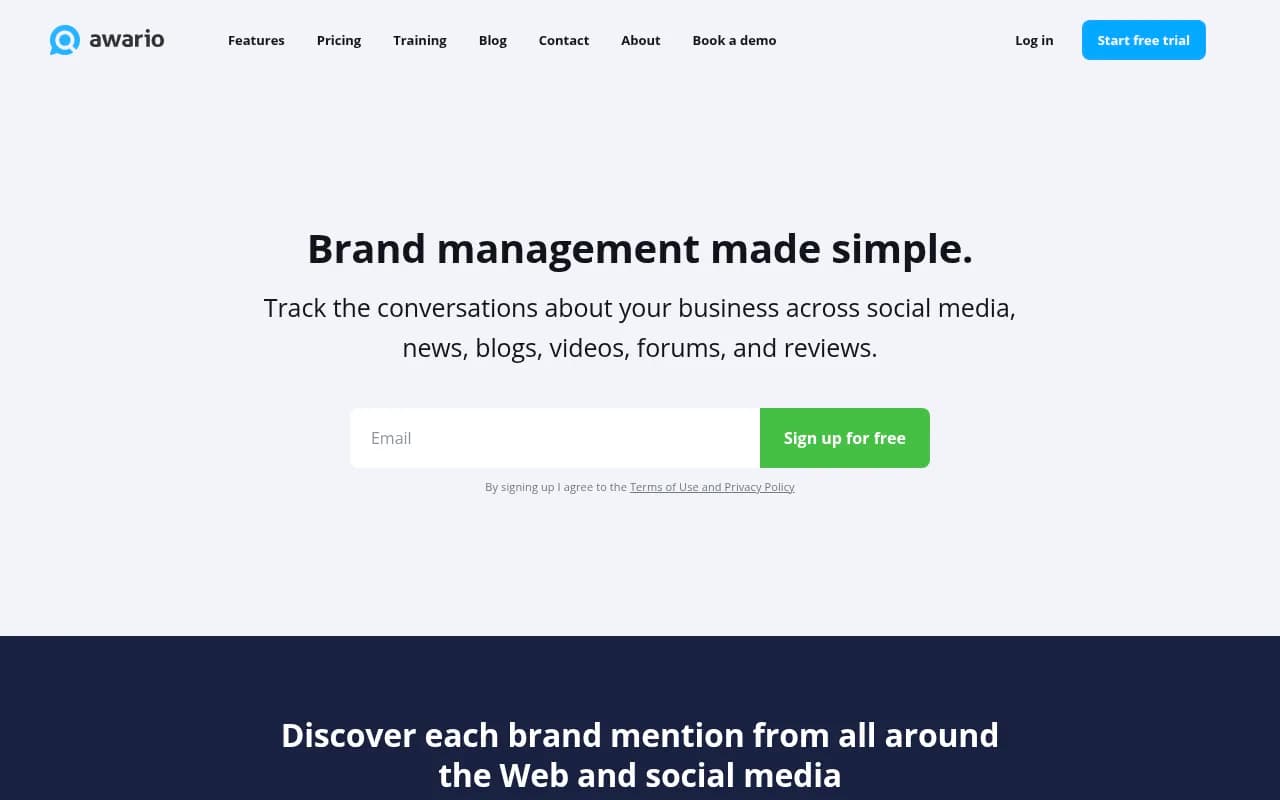
Awario is a comprehensive brand monitoring tool that tracks mentions across social media, news sites, blogs, forums, and the web. It crawls over 13 billion pages daily to help businesses monitor brand reputation, find sales leads, engage customers, identify influencers, and analyze competitors. Used
Summary: What you need to know about Awario
- Real-time monitoring across 10+ sources including X, Reddit, YouTube, Facebook, Instagram, blogs, forums, and news sites -- with 13 billion pages crawled daily
- Strong for lead generation and social selling -- finds people actively looking for solutions you offer
- Lacks content generation, AI crawler logs, and traffic attribution that Promptwatch offers for AI search visibility
- Pricing starts at $49/mo (Starter) with limited alerts -- Pro at $149/mo is the sweet spot for most teams
- Best for: Social media managers, PR teams, and agencies focused on traditional brand monitoring and customer engagement

Awario is a brand monitoring platform built around one core promise: be the first to know when someone mentions your brand, competitors, or industry keywords anywhere online. Founded as a social listening tool, it's evolved into a multi-source monitoring system that tracks conversations across social media, news, blogs, forums, and the broader web. The company positions itself as more comprehensive than tools relying solely on API access -- they crawl 13 billion web pages daily on top of social platform APIs.
The target audience is broad but centers on three groups: marketing teams tracking brand reputation and sentiment, sales teams hunting for leads in social conversations, and PR/agency professionals managing multiple clients. It's particularly popular with small-to-midsize businesses and agencies that need affordable monitoring without enterprise complexity. Companies using Awario range from solo consultants to teams of 50+.
Awario launched in the mid-2010s as part of the social listening wave. It's remained independent (no major acquisitions or funding announcements) and competes in a crowded space against tools like Mention, Brand24, and Brandwatch. The pitch: better coverage through proprietary crawling, faster alerts, and a simpler interface than enterprise platforms.
Core monitoring capabilities
Awario's foundation is keyword-based alert creation. You define search terms (brand names, product names, competitor names, industry keywords) and the platform monitors 10+ sources: X (Twitter), Facebook, Instagram, Reddit, YouTube, Vimeo, blogs, forums, news sites, and general web pages. Each alert can use Boolean operators for precision -- "brand name" AND "customer service" NOT "job opening" -- to filter noise.
The crawling claim is the differentiator. Most monitoring tools rely entirely on social APIs (which have rate limits and delays). Awario supplements API data with its own web crawler that indexes 13 billion pages daily. This means it catches mentions on niche forums, small blogs, and regional news sites that competitors miss. In practice, this works well for obscure brand mentions but less so for high-volume keywords where API coverage is already strong.
Real-time alerts arrive via email, Slack, or in-app notifications. You can set alert frequency (instant, hourly, daily) and filter by source, language, location, and sentiment. The speed is genuinely fast -- mentions often appear within minutes of posting, especially on X and Reddit where Awario seems to prioritize.
Historical data is limited by plan. Starter stores 30,000 mentions per alert, Pro stores 300,000, Enterprise stores 1 million. Once you hit the cap, old mentions drop off. This is fine for ongoing monitoring but frustrating if you want to analyze long-term trends or go back months later.
Sentiment analysis and reach metrics
Awario auto-tags mentions as positive, negative, or neutral using natural language processing. The accuracy is decent but not perfect -- sarcasm and context-dependent language trip it up. You can manually override sentiment tags, which is necessary for client reporting where precision matters.
Reach estimates show how many people potentially saw each mention based on follower counts (social) or site traffic estimates (web). These numbers are directional, not exact. A mention from an account with 50K followers gets tagged with 50K reach, even if the tweet only got 200 impressions. Still useful for prioritizing which mentions to engage with.
Influencer scoring ranks authors by reach, posting frequency, and engagement. This helps identify power users in your niche -- journalists, bloggers, Reddit moderators, YouTube creators. You can filter mentions by influencer score to focus on high-impact conversations. The scoring is basic compared to dedicated influencer tools (no audience demographic breakdowns or engagement rate calculations), but it's enough to spot the big fish.
Lead generation and social selling
This is where Awario shines for sales teams. Set up alerts for buying-intent keywords -- "looking for [product type]", "recommend a [service]", "best [tool] for [use case]" -- and Awario surfaces people actively shopping. You can reply directly through the platform (for X and Reddit) or click through to engage natively.
The lead generation workflow: create a Boolean alert with purchase-intent phrases, filter by location/language if relevant, sort by recency, and respond fast. Users report this working particularly well on Reddit and X where people openly ask for recommendations. One testimonial mentioned making back the subscription cost in minutes by closing a deal from a Reddit lead.
Awario doesn't score or qualify leads beyond basic reach metrics. There's no CRM integration to push leads into your sales pipeline automatically. You're manually triaging and following up, which works for small teams but doesn't scale well.
Competitor analysis
Create alerts for competitor brand names and compare mention volume, sentiment, and reach against your own brand. The comparison view shows side-by-side charts: who's getting more mentions, who has better sentiment, where each brand is being discussed.
You can also monitor competitor keywords to see what topics they're associated with. If a competitor gets mentioned alongside "poor customer service" frequently, that's an opening. If they're dominating discussions around a feature you also offer, you know where to focus your messaging.
The competitor analysis is solid for directional insights but lacks depth. You can't drill into specific campaigns, track competitor content performance, or analyze their influencer partnerships. It's monitoring, not intelligence. For deeper competitive research, you'd layer in tools like Semrush or SimilarWeb.
Reporting and analytics
The analytics dashboard shows mention volume over time, sentiment breakdown, top sources, geographic distribution, and language split. You can filter by date range and export data as CSV or PDF reports. The PDF reports are white-label friendly (remove Awario branding) for agencies presenting to clients.
Custom reports let you combine multiple alerts into one view -- useful for tracking an entire campaign or multiple brands under one client. The interface is clean but not particularly flexible. You can't build custom charts or dashboards beyond the preset views.
One gap: no integration with Google Analytics or attribution tracking. Awario shows you mentions and engagement, but it can't connect that to website traffic or conversions. You're left inferring impact rather than measuring it directly. This is a major limitation compared to platforms like Promptwatch that offer traffic attribution and visitor analytics to close the loop between visibility and revenue.
Integrations and workflow
Awario integrates with Slack (mention alerts in channels), Zapier (trigger workflows from new mentions), and has a basic API for custom integrations. You can reply to X and Reddit mentions directly in-app, which saves time. For other sources, you click through to the original post.
No native CRM, project management, or marketing automation integrations. If you want mentions flowing into HubSpot, Salesforce, or Asana, you're building that through Zapier. The API documentation is sparse -- it exists but isn't well-supported for developers.
The mobile app (iOS and Android) lets you monitor mentions and reply on the go. It's functional but bare-bones -- you're not doing deep analysis on mobile, just triaging urgent mentions.
Coverage and data quality
Awario monitors X, Facebook, Instagram, Reddit, YouTube, Vimeo, blogs, forums, news sites, and general web pages. Notably missing: TikTok, LinkedIn (limited), Telegram, Discord, and most non-English forums. If your audience lives on TikTok or Discord, Awario won't help.
The 13 billion pages claim is impressive but hard to verify. In practice, Awario does catch mentions on obscure sites that other tools miss -- small regional blogs, niche forums, local news sites. For high-traffic sources like X and Reddit, the coverage is on par with competitors.
Data freshness is strong. Mentions appear within minutes on X and Reddit, within hours on blogs and news. The lag is longer for web crawling (can take a day or two for a new blog post to surface), but that's expected.
False positives are an issue with broad keywords. If you monitor a common word or phrase, expect noise. The Boolean search helps, but you'll still spend time filtering irrelevant mentions. Negative keywords are essential.
Who should use Awario
Awario fits three main personas:
Social media managers and brand marketers tracking reputation, sentiment, and engagement across platforms. If you're managing 2-5 brands and need real-time alerts when someone mentions you, Awario delivers. It's particularly good for crisis monitoring -- catching negative mentions early before they spiral.
Sales teams doing social selling, especially in B2B SaaS or services. If your buyers ask questions on Reddit, X, or niche forums before purchasing, Awario helps you find and engage those conversations. The lead generation use case is strong if you're willing to manually follow up.
PR professionals and agencies managing multiple clients. The white-label reporting, multi-alert dashboards, and influencer identification make it agency-friendly. It's more affordable than enterprise tools like Brandwatch or Meltwater, though less powerful.
Awario is less suited for:
Enterprise teams needing advanced analytics, custom dashboards, or deep integrations. The platform is too basic for large-scale operations.
Content marketers focused on SEO and organic search. Awario monitors social and web mentions but doesn't track search rankings, backlinks, or content performance. For that, you'd use Ahrefs or Semrush.
Teams focused on AI search visibility. Awario doesn't monitor how your brand appears in ChatGPT, Perplexity, Claude, or Google AI Overviews. It has no AI crawler logs, no citation tracking, and no content optimization for AI search. If you care about being visible in AI-generated answers, Promptwatch is the platform built for that -- with Answer Gap Analysis to find content gaps, AI content generation to fill them, and traffic attribution to measure results.
Pricing breakdown
Awario offers three plans:
Starter: $49/mo (billed monthly) or $39/mo (annual). Limits: 3 alerts, 30,000 mentions stored per alert, 1 user. Good for solopreneurs or single-brand monitoring. The 3-alert cap is tight -- you'll hit it fast if you're tracking your brand, competitors, and industry keywords.
Pro: $149/mo (monthly) or $119/mo (annual). Limits: 15 alerts, 300,000 mentions per alert, 3 users. This is the sweet spot for small teams and agencies. Enough alerts to cover multiple brands and campaigns, enough storage for historical analysis.
Enterprise: $399/mo (monthly) or $299/mo (annual). Limits: 100 alerts, 1 million mentions per alert, unlimited users. For agencies managing many clients or large brands with high mention volumes.
All plans include the same features (sentiment analysis, influencer scoring, Boolean search, white-label reports). The differences are purely quota-based. No free plan, but there's a 7-day free trial (no credit card required).
Compared to competitors: Brand24 starts at $99/mo, Mention starts at $49/mo (similar to Awario Starter), Brandwatch is enterprise-only (thousands per month). Awario is competitively priced in the mid-market.
Strengths
Comprehensive source coverage: Monitoring 10+ platforms plus proprietary web crawling means fewer missed mentions than API-only tools.
Fast alerts: Real-time notifications on X and Reddit help you engage conversations while they're active, not hours later.
Lead generation: The buying-intent keyword monitoring is genuinely useful for sales teams. Multiple users report ROI from social selling.
Affordable for agencies: White-label reports, multi-alert dashboards, and reasonable pricing make it accessible for small agencies.
Boolean search: Advanced filtering with Boolean operators reduces noise and improves relevance.
Limitations
No AI search monitoring: Awario doesn't track your brand's visibility in ChatGPT, Perplexity, Claude, Gemini, or Google AI Overviews. It has no AI crawler logs to see which pages AI models are reading, no citation tracking, and no content optimization tools. If AI search visibility matters to your brand, Promptwatch is the platform built for that -- with Answer Gap Analysis to identify content gaps, AI content generation to fill them, prompt volume and difficulty scoring, and traffic attribution to measure impact.
No traffic attribution: Awario shows mentions and engagement but can't connect that to website traffic or conversions. You're guessing at ROI.
Limited integrations: No native CRM, marketing automation, or project management integrations. You're building workflows through Zapier or manually.
Storage caps: Once you hit your mention limit, old data disappears. This is frustrating for long-term trend analysis.
Basic analytics: The dashboards are functional but not flexible. No custom charts, no advanced filtering, no predictive insights.
Missing platforms: No TikTok, limited LinkedIn, no Discord or Telegram. If your audience is there, Awario won't find them.
Bottom line
Awario is a solid, affordable brand monitoring tool for teams focused on traditional social listening and reputation management. It excels at real-time alerts, lead generation from social conversations, and multi-source coverage. The proprietary web crawling does catch mentions competitors miss, and the pricing is reasonable for small teams and agencies.
But it's a monitoring-only platform. It shows you what people are saying but doesn't help you optimize your content, track AI search visibility, or measure traffic impact. If your goal is to monitor social mentions and engage customers, Awario works. If you want to improve how your brand appears in AI search engines like ChatGPT and Perplexity, track AI crawler behavior, generate optimized content, and measure actual traffic from AI visibility, Promptwatch is the platform built for that.
Best use case in one sentence: Small marketing teams and agencies that need affordable, real-time monitoring of brand mentions across social media and the web for reputation management and social selling.
Tags:
Frequently asked questions
What is Awario and what does it do?
How much does Awario cost?
Is Awario free to use?
Who should use Awario?
What sources does Awario monitor?
How does Awario compare to competitors like Mention and Brand24?
Can Awario help with lead generation?
Does Awario offer real-time monitoring?
Similar and alternative tools to Awario