MentionBird Review 2026
Reveals the sources AI assistants cite in your category and explains why competitors get recommended instead of you.
Key takeaways
- MentionBird's core differentiator is real: instead of just charting your AI mentions, it shows the sources behind each answer and generates a per-prompt action plan with effort and impact ratings. Most trackers stop at the chart.
- Entry pricing is awkward. Starter at $79/month only covers ChatGPT and Gemini, and there's no free trial or free plan at all, just a $19 first month with code TRY19.
- It's a very new product with zero third-party reviews, no documented integrations, English-only support, and daily (not real-time) data refresh.
- Compared to Promptwatch, it lacks AI crawler logs, visitor analytics that tie AI mentions to actual traffic and conversions, content generation with CMS publishing, Reddit citation tracking, ChatGPT Shopping and Ads Radar, query fan-outs, and multi-language/multi-region monitoring. It's advice without execution or measurement of business impact.
What MentionBird does
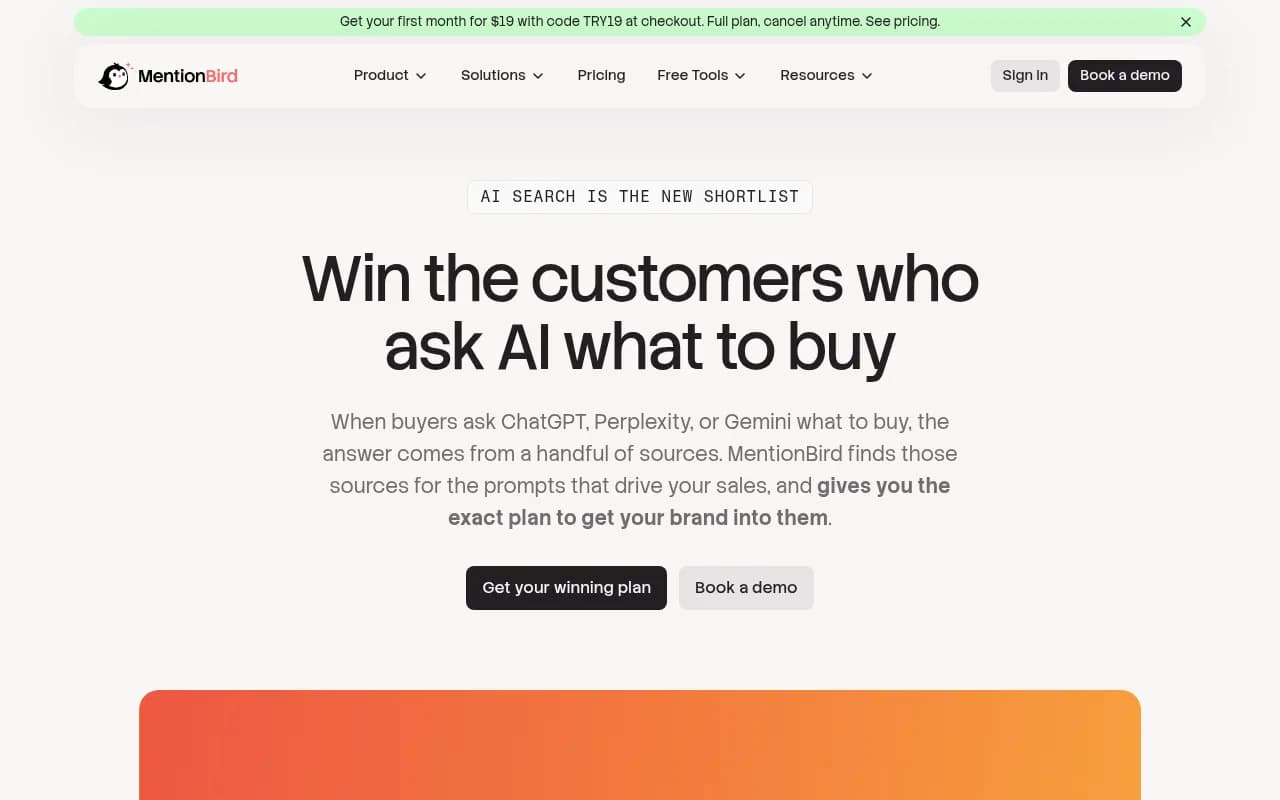
The pitch is simple and I think mostly correct: when buyers ask ChatGPT or Perplexity what to buy, the answer draws on a small set of trusted sources, and if you're not in those sources, you're not on the shortlist. Promptwatch's data on average sources per response backs this up, AI answers cite a handful of sources, not pages of them.
MentionBird works in three steps. You pick the prompts buyers actually use (the tool suggests new ones, with a 1-10 difficulty score and a 1-10 search volume score per prompt). It then checks which sources each AI platform cites for those prompts, showing whether you're cited, whether competitors are, and page-level detail for every cited URL. Finally, its Ranking Advice agent produces a prioritized plan: get featured in trusted roundups, publish a guide, add fit and durability details to product pages, each tagged with effort and expected impact.
That last part is the product's identity. The homepage puts it bluntly: "Other tools tell you what happened. MentionBird tells you what to do." Having tested a lot of AI visibility tools, I'll say this framing is fair. Plenty of dashboards will tell you your share of voice dropped four points. Very few will tell you which cited domain to go after and roughly how much work it'll take.
Features that work well
The source analysis is the strongest part. You get a breakdown of cited domains by type (news, forums, review sites, docs), by content format (listicle, comparison, how-to, review), plus domain authority for each cited site. The distinction between your own pages, competitor pages, and earned coverage is genuinely useful for figuring out whether your problem is content or distribution.
The metrics layer is solid for a young product: visibility score, prominence score, average position in the answer, brand rank among named brands, share of voice versus competitors week over week, and history going back up to 365 days. You can read the actual AI answers verbatim rather than just scores, and every score change traces back to the prompt, model, or citation that caused it. That last detail matters more than it sounds. A visibility drop without an explanation is just bad news; a visibility drop traced to one prompt on one model is a to-do item.
There's also a YouTube video summarization agent that checks whether existing pages cover a topic before recommending new content, which is a nice touch of restraint in a category full of tools that just tell you to publish more.
Where it falls short
The pricing structure is the biggest problem. Starter at $79/month gets you 100 prompt runs per day, but only on ChatGPT and Gemini. Perplexity and Claude, two of the four platforms in the product's own marketing examples, require the $299/month Growth plan. Grok, Google AI Overviews, Copilot, and DeepSeek are Custom-plan only, which means talking to sales. For a tool aimed at startups and small teams (GetApp lists the typical customer at 2-10 employees), gating four of eight platforms behind enterprise pricing is a hard sell when competitors like Otterly.ai start at $29/month with six engines.
A prompt run means one prompt on one platform, once per day, with no rollover. If you track 50 prompts across two platforms on Starter, you're at capacity. Extra runs cost $49/month for 50, stackable.
There's no free trial and no free plan. The company is upfront about why (every crawl costs money, paid access prevents abuse), and the $19 first month softens it, but you're still buying sight unseen. The product also has zero third-party reviews so far, the X account has a couple of followers and no posts, and no integrations are documented anywhere I could find, no Slack, no Zapier, no API, nothing beyond connecting Claude or ChatGPT to your data. Data refreshes once every 24 hours. It's English-only.
How it compares to Promptwatch
MentionBird's advice-only model has a ceiling. It tells you what to do, but you still have to do it, and you still can't see whether AI-driven mentions actually turn into traffic or revenue.
Promptwatch covers the full loop. Its AI crawler logs (Agent Analytics) show when ChatGPTBot, ClaudeBot, PerplexityBot and 400+ other crawlers hit your site, what they read, and what errors they hit, which explains why you're invisible, not just that you are. Visitor analytics attribute actual traffic and conversions from AI platforms, so you can measure business impact instead of mention counts. Then Content Agents plan, write, and publish GEO-optimized content directly to Webflow, Framer, or WordPress, closing the gap between advice and execution.

Things MentionBird simply doesn't have: crawler logs, AI traffic attribution, content generation or CMS publishing, dedicated Reddit citation tracking, ChatGPT Shopping and Ads Radar, query fan-outs, sentiment analysis, multi-language monitoring from any country, scheduled PDF and white-label reports, and an API or MCP server. Promptwatch also monitors all major models on every paid plan rather than splitting them across tiers, and has a free tier plus a 7-day trial on Essential ($95/month) versus MentionBird's pay-first model. Promptwatch's dataset of 4.5 billion analyzed citations and 1,840+ customers also gives it a research backbone MentionBird can't match yet.
To be fair, MentionBird's per-prompt ranking advice with effort/impact ratings is a genuinely good interface for prioritization, and Promptwatch's equivalent (Unified Actions and content gap analysis) is more powerful but less focused on the "which source do I win next" question. If you want a simple prioritized to-do list per prompt, MentionBird's take on it is clean.
Who it's for
The sweet spot is a founder or small marketing team at a B2B SaaS or e-commerce brand that has just realized AI assistants never mention them, wants a concrete prioritized plan, and doesn't need enterprise features. The testimonials (Risely, Facets, Recooty, Omnify, Helixo, Superfans) are all startups, and the founder, Salil Panikkaveettil, is a second-time founder whose previous company, AdNabu, served Shopify merchants, so the SMB DNA is real.
It's a poor fit for agencies managing many clients (the workspace model exists but there's no white-labeling or client portal), enterprises needing SSO and integrations, anyone tracking non-English markets, and anyone who wants to know what AI traffic is actually worth.
Bottom line
MentionBird is one of the more honest entries in the AI visibility space. It doesn't pretend a dashboard solves your problem, and its source-level analysis plus per-prompt ranking advice is a genuinely useful framing for teams that need direction, not just data. The TRY19 first month at $19 is a low-risk way to test that thesis.
But it's early, thin on integrations, expensive for full platform coverage, and it stops at advice. If you want to understand why AI systems skip your site, measure the traffic and conversions those mentions drive, and have agents actually produce and publish the content that fixes the gap, Promptwatch is the stronger choice. If your budget is tight and you just want a prioritized punch list for your top 30 buying prompts, MentionBird earns a look.
Frequently asked questions
What is MentionBird?
Who is MentionBird for?
How does MentionBird work?
How much does MentionBird cost?
Is MentionBird free to use?
What problem does MentionBird solve?
How is MentionBird different from traditional SEO tools?
Can MentionBird help improve my brand's visibility in AI search results?
What AI assistants does MentionBird track?
Does MentionBird show competitor analysis?
Similar and alternative tools to MentionBird