Key Takeaways
- Scrunch costs $250/mo minimum vs Omnia's custom pricing (typically lower entry point) -- Omnia is more accessible for smaller teams testing AI visibility
- Scrunch includes an Agent Experience Platform (AXP) that creates AI-optimized versions of your site -- Omnia lacks this capability entirely
- Omnia provides a step-by-step AI visibility roadmap with actionable insights -- Scrunch focuses more on monitoring and diagnostics
- Both track citations and competitor positioning, but Scrunch offers real-time AI bot crawl logs while Omnia emphasizes prompt discovery
- Scrunch monitors 6+ AI engines; Omnia covers ChatGPT, Perplexity, Gemini, and Copilot -- similar coverage with slight differences
- For brands wanting to actively optimize content for AI: Omnia's roadmap approach wins. For brands needing technical AI crawl diagnostics: Scrunch's bot logs are unique.
Overview
Scrunch
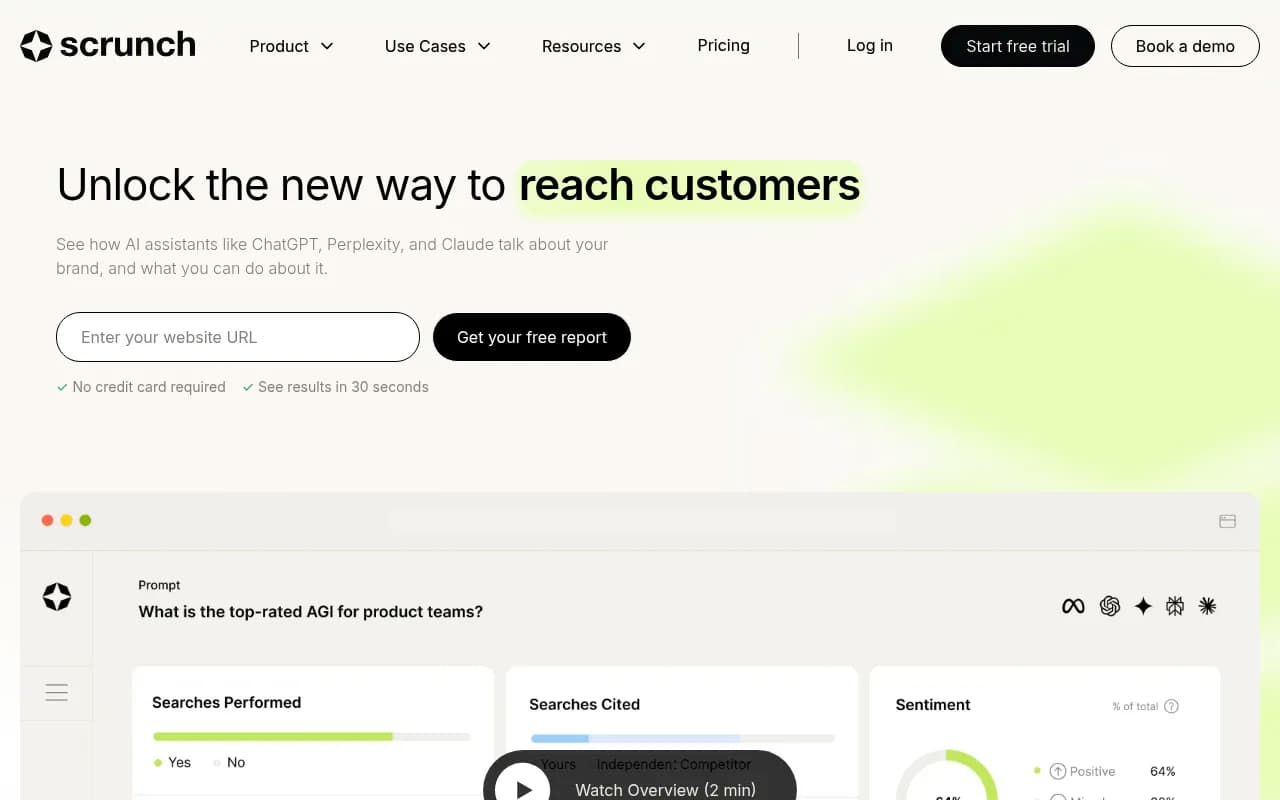
Scrunch positions itself as "The AI Customer Experience Platform" -- a monitoring and optimization tool that tracks how brands appear across AI search engines like ChatGPT, Perplexity, and Claude. The platform's standout feature is its Agent Experience Platform (AXP), which creates parallel, AI-optimized versions of your website specifically designed for AI bot traffic. Scrunch targets mid-market and enterprise brands with a starting price of $250/mo, and claims over 500 companies including Lenovo, Skims, and Penn State University.
The platform splits into three core modules: Monitoring (performance tracking, prompt analytics, AI traffic), Insights (optimization tips, citation analysis, error detection), and the AXP (AI-specific site versions). Scrunch's pitch is that your most important visitor isn't human anymore -- it's the AI bots crawling your site.
Omnia
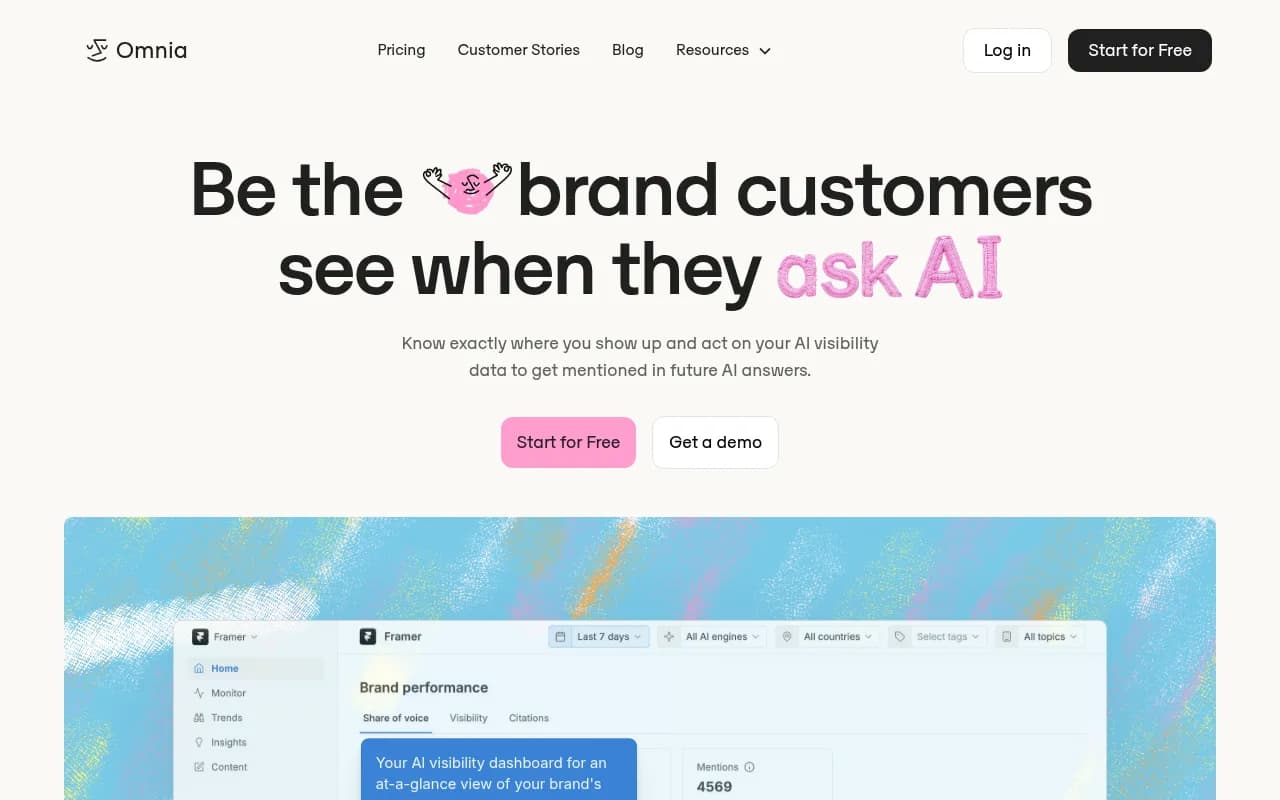
Omnia describes itself as "AI Visibility Software for Marketing Teams" built specifically for SEO and marketing experts. The platform monitors citations and mentions across ChatGPT, Perplexity, Gemini, and Microsoft Copilot. Omnia's core value proposition is translating tracking data into a step-by-step AI visibility roadmap -- not just showing you the problem, but telling you exactly what to fix.
Omnia breaks down into three main capabilities: prompt discovery (finding real questions people ask AI about your industry), brand monitoring (tracking where you show up vs competitors), and actionable insights (content creation, technical SEO, and placement recommendations). The platform targets SEO teams and marketers who want a clear action plan, not just dashboards. Pricing is custom but generally positioned as more accessible than Scrunch's fixed tiers.
Side-by-Side Comparison
| Feature | Scrunch | Omnia |
|---|---|---|
| Starting price | $250/mo (Starter, annual) | Custom pricing (typically lower) |
| Free trial | 7 days | Yes (duration not specified) |
| AI engines monitored | ChatGPT, Perplexity, Claude, Gemini, Copilot, AI Overviews (6+) | ChatGPT, Perplexity, Gemini, Copilot (4) |
| Citation tracking | ✓ | ✓ |
| Competitor analysis | ✓ Share of voice by competitor | ✓ Benchmarking vs competitors |
| AI bot crawl logs | ✓ Real-time feed | ✗ |
| Prompt discovery | ✓ Prompt analytics | ✓ Real question discovery |
| Optimization recommendations | ✓ Tips to expand visibility | ✓ Step-by-step roadmap |
| Agent Experience Platform | ✓ AI-optimized site versions | ✗ |
| Error detection | ✓ Crawl error spotting | Not mentioned |
| Geo/persona segmentation | ✓ By competitor, persona, topic, geo | Not specified |
| Target audience | Mid-market to enterprise | SEO teams, marketing experts |
Monitoring capabilities
Scrunch's monitoring dashboard tracks performance across 6+ AI engines with breakdowns by competitor, persona, topic, and geography. The real differentiator is the real-time AI bot crawl feed -- you see exactly when ChatGPT, Perplexity, or Claude bots hit your site, which pages they access, and any errors they encounter. This is technical visibility most competitors don't offer.
The prompt analytics module shows trends, citations, competitors, and rankings for any prompt you're tracking. Scrunch also measures AI traffic -- how many AI bots are crawling your site and how that volume trends over time. This matters because more crawls generally correlate with better visibility.
Omnia's monitoring focuses on share of voice and citation tracking. You see where your brand appears in AI responses, how often you're cited vs competitors, and which sources AI engines pull from. The interface emphasizes benchmarking -- "you rank #3 for this prompt, competitor A is #1" -- which makes competitive gaps obvious.
Omnia doesn't provide real-time bot logs or crawl error detection. The monitoring is response-focused (what AI says) rather than technical (how AI accesses your site). For most marketing teams, that's fine. For technical SEO teams diagnosing indexing issues, Scrunch's crawl logs are a clear advantage.
Verdict: Scrunch wins on technical depth with bot logs and error detection. Omnia wins on clarity and competitive context for non-technical users.
Insights and optimization
Scrunch's Insights module surfaces three things: optimization tips (actionable suggestions to move up in rankings), citation analysis (which sites AI loves to cite), and error detection (when AI bots can't crawl your site). The tips are specific to your brand's gaps -- "add more case studies to rank for X prompt" or "improve page load speed for AI bots."
The citation analysis is useful for understanding what types of content AI engines trust. If AI consistently cites Reddit threads or YouTube videos for your category, that tells you where to publish or what formats to create.
Omnia's Insights translate into a "step-by-step AI visibility roadmap." This is more prescriptive than Scrunch's tips. Omnia maps out content creation priorities, technical SEO fixes, and content placement strategies -- each tied to filling specific gaps in your AI visibility. The platform essentially builds you a project plan.
Omnia's prompt discovery tool is also stronger. It surfaces real questions customers are asking AI about your industry or product, which helps you understand what content to create. Scrunch has prompt analytics but leans more toward tracking prompts you already know about.
Verdict: Omnia wins for teams that want a clear action plan. Scrunch wins for teams that want diagnostic data and prefer to build their own strategy.
Agent Experience Platform (AXP)
This is Scrunch's unique feature. The AXP creates a parallel version of your website optimized specifically for AI bot traffic. Think of it as a translation layer -- your human-facing site stays the same, but AI bots get a streamlined, structured version that's easier for them to parse.
The pitch: AI bots struggle with JavaScript-heavy sites, complex navigation, and marketing fluff. The AXP strips that away and serves AI bots clean, semantic content. Scrunch claims this improves citation rates because AI engines can actually understand what your site offers.
Omnia has no equivalent feature. It monitors and recommends, but doesn't actively serve different content to AI bots.
Verdict: If you believe AI-specific site optimization is the future, Scrunch's AXP is a major differentiator. If you think that's overkill or prefer to optimize your main site for both humans and AI, it's less relevant.
Prompt discovery and tracking
Omnia emphasizes prompt discovery upfront. The platform helps you find real questions people are asking AI about your industry, product category, or competitors. This is valuable for content planning -- you're not guessing what prompts matter, you're seeing actual user behavior.
Once you've identified prompts, Omnia tracks your visibility for each one and benchmarks you against competitors. The workflow is: discover prompts → track visibility → get recommendations → improve.
Scrunch's prompt analytics assume you already know which prompts to track. You add prompts to your dashboard, then Scrunch shows trends, citations, and rankings over time. It's more of a tracking tool than a discovery tool.
Scrunch does break down performance by persona and topic, which helps you understand which audience segments see your brand in AI responses. That's useful for segmentation but doesn't replace upfront prompt discovery.
Verdict: Omnia wins for teams starting from scratch who need help identifying which prompts to care about. Scrunch wins for teams with established prompt lists who want deep tracking.
Pricing
| Plan | Scrunch | Omnia |
|---|---|---|
| Entry tier | $250/mo (Starter, billed annually) | Custom pricing (typically lower) |
| Mid tier | $417/mo (Growth, billed annually) | Pro Plan (pricing on request) |
| Enterprise | Custom pricing | Custom pricing |
| Free trial | 7 days | Yes |
| Annual discount | Included in listed pricing | Not specified |
Scrunch's pricing is transparent but steep. $250/mo is a significant commitment for smaller teams, especially if you're just testing AI visibility. The Growth plan at $417/mo adds more features but pushes the cost higher.
Omnia's custom pricing is less transparent but anecdotally more flexible. The platform positions itself as accessible to SEO teams and marketers, which suggests lower entry points than Scrunch's fixed $250/mo floor. The lack of public pricing is annoying -- you have to request a quote.
Both offer free trials, which is essential for a category this new. You need to see the data before committing.
Verdict: Omnia likely wins on affordability for smaller teams. Scrunch's transparent pricing is better for budgeting but higher overall.
Pros and cons
Scrunch pros:
- Real-time AI bot crawl logs (unique capability)
- Agent Experience Platform creates AI-optimized site versions
- Error detection for crawl issues
- Geo and persona segmentation
- Transparent pricing
- Monitors 6+ AI engines including Claude
Scrunch cons:
- $250/mo minimum is expensive for small teams
- Prompt discovery is weaker than Omnia's
- Insights are less prescriptive (tips vs roadmaps)
- AXP may be overkill for brands with simple sites
Omnia pros:
- Step-by-step AI visibility roadmap (clear action plan)
- Strong prompt discovery for content planning
- More accessible pricing for smaller teams
- Built for SEO/marketing teams (less technical)
- Competitive benchmarking is clear and actionable
Omnia cons:
- No AI bot crawl logs or error detection
- No Agent Experience Platform equivalent
- Monitors fewer AI engines (4 vs 6+)
- Custom pricing lacks transparency
- Less technical depth overall
Who should pick which tool
Pick Scrunch if:
- You have budget ($250+/mo) and want technical depth
- AI bot crawl diagnostics matter to your SEO strategy
- You want to serve AI-optimized versions of your site (AXP)
- You need geo/persona segmentation for AI visibility
- Your team is comfortable building strategy from diagnostic data
- You're tracking Claude in addition to the big four AI engines
Pick Omnia if:
- You're a smaller team testing AI visibility for the first time
- You want a clear action plan, not just dashboards
- Prompt discovery is critical (you don't know what to track yet)
- You prefer prescriptive recommendations over raw data
- Budget is tight and you need flexible pricing
- Your team is marketing-focused rather than technical SEO
Consider both if:
- You're an agency managing multiple clients with different needs
- You want to compare approaches before committing to one platform
Worth noting: if you're also looking to track AI visibility alongside content optimization and gap analysis, Promptwatch covers that angle with built-in content generation and 880M+ citations analyzed. It's a different approach -- optimization-first rather than monitoring-first -- but complements either Scrunch or Omnia well.

Final verdict
Scrunch and Omnia solve the same core problem (AI visibility tracking) with different philosophies. Scrunch is technical, diagnostic, and feature-rich. Omnia is prescriptive, accessible, and action-oriented.
For most marketing teams just getting started with AI visibility, Omnia's roadmap approach and prompt discovery make it easier to act on the data. For technical SEO teams or larger brands that need crawl diagnostics and AI-specific site optimization, Scrunch's depth justifies the higher price.
Neither platform is a clear winner across the board. Your choice depends on whether you value technical control (Scrunch) or guided optimization (Omnia). Both are solid tools in a category that's still figuring itself out.