Key Takeaways
- Pricing difference is massive: Scrunch starts at $250/mo with a 7-day trial. Profound has no public pricing but estimates suggest $1,000-$3,000+/mo with no trial -- a 4-10x cost gap.
- Scrunch is more accessible for small teams: Lower entry price, self-serve signup, and a free trial make it easier to test. Profound is enterprise-only with custom contracts.
- Profound has stronger AI visibility data: Ranks #1 in AI search with 47.1% visibility vs Scrunch's #23 at 4.7% -- a 10x difference in their own category.
- Scrunch includes an Agent Experience Platform (AXP): Lets you create AI-optimized versions of your site pages. Profound focuses on monitoring and autonomous content agents instead.
- Both track the same LLMs: ChatGPT, Perplexity, Claude, Gemini, Grok, Copilot, Meta AI, DeepSeek, Google AI Overviews.
- Profound has better prompt volume data: Real search demand estimates vs Scrunch's more basic prompt analytics.
Overview
Scrunch
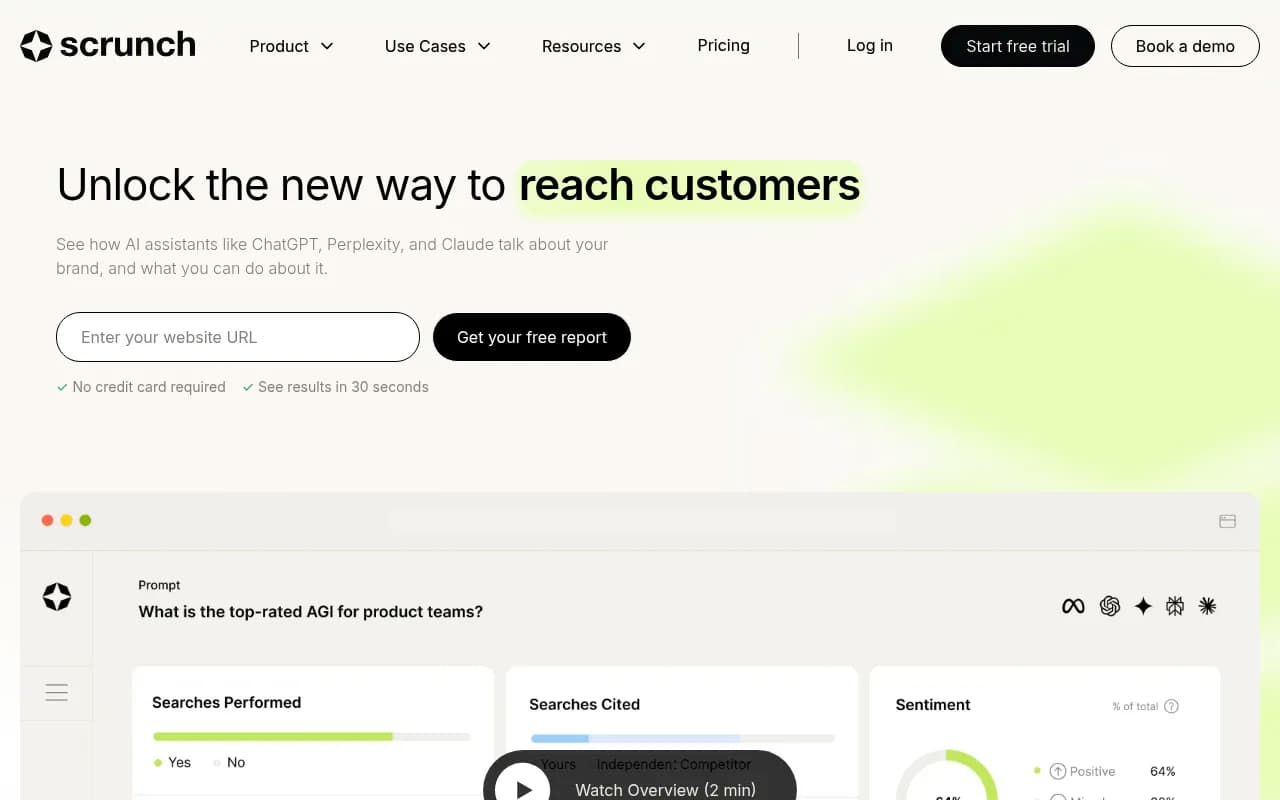
Scrunch positions itself as "the AI Customer Experience Platform" -- a monitoring tool with an added twist. You track how AI engines talk about your brand across ChatGPT, Perplexity, Claude, and others, then use their Agent Experience Platform (AXP) to serve AI-optimized content directly to AI crawlers. The pitch: create a parallel version of your site that's translated for AI traffic.
They've got over 500 companies using it (Lenovo, Skims, Penn State, Crunchbase) and a clear focus on making AI visibility accessible to mid-market teams. Pricing starts at $250/mo for the Starter plan (billed annually), with a Growth plan at $417/mo and Enterprise custom pricing. You get a 7-day free trial to test it out.
The platform covers performance tracking, prompt analytics, AI traffic monitoring, citation analysis, error detection, and optimization tips. The AXP piece is unique -- most competitors don't offer a way to serve different content to AI bots vs human visitors.
Profound

Profound calls itself an "Answer Engine Optimization (AEO) platform" and targets enterprise marketing teams. Used by MongoDB, Ramp, and Zapier, it's built around monitoring AI-generated answers, analyzing prompt volumes, tracking AI crawler behavior, and deploying autonomous marketing agents to create content.
No public pricing. No free trial. You book a demo, talk to sales, and get a custom quote -- estimates put it at $1,000-$3,000+/mo. The platform is more data-heavy than Scrunch: real-time prompt volume estimates, detailed agent analytics, shopping recommendations tracking (ChatGPT product carousels), and a full suite of autonomous content agents.
Profound also publishes research (Profound Index, AEO Report) and runs a partner program for agencies. They monitor the same set of LLMs as Scrunch but emphasize their data accuracy and depth. According to their own visibility tracking, Profound ranks #1 in AI search with 47.1% visibility -- Scrunch ranks #23 at 4.7%.
Side-by-Side Comparison
| Feature | Scrunch | Profound |
|---|---|---|
| Starting price | $250/mo (annual billing) | $1,000-$3,000+/mo (estimated) |
| Free trial | 7 days | None |
| Self-serve signup | Yes | No (demo required) |
| LLMs monitored | ChatGPT, Perplexity, Claude, Gemini, Grok, Copilot, Meta AI, DeepSeek, AI Overviews | ChatGPT, Perplexity, Claude, Gemini, Grok, Copilot, Meta AI, DeepSeek, AI Overviews |
| Prompt volume data | Basic analytics | Real-time demand estimates |
| AI crawler logs | Yes (real-time feed) | Yes (Agent Analytics) |
| Citation tracking | Yes | Yes |
| Competitor analysis | Yes | Yes |
| Content creation | No built-in agent | Autonomous marketing agents |
| Agent Experience Platform | Yes (serve AI-optimized pages) | No |
| Shopping tracking | No | Yes (ChatGPT product carousels) |
| Target audience | Mid-market teams, SMBs | Enterprise marketing teams |
| Setup complexity | Low (self-serve) | High (sales process, custom onboarding) |
| Data sharing | Limited (user feedback) | Better export/integration options |
Pricing
This is where the two platforms diverge sharply.
| Plan | Scrunch | Profound |
|---|---|---|
| Entry tier | $250/mo (Starter, annual billing) | No public pricing |
| Mid tier | $417/mo (Growth, annual billing) | Estimated $1,000-$3,000+/mo |
| Enterprise | Custom pricing | Custom pricing |
| Free trial | 7 days | None |
| Cost per LLM | ~$62.50/engine (Growth tier, 4 engines) | ~$133/engine (estimated, 9 engines) |
Scrunch is transparent: you see the price, you sign up, you start tracking. Profound hides pricing behind a sales process. If you're a small team or testing AI visibility for the first time, Scrunch's $250/mo entry point and free trial make it the obvious choice. If you're an enterprise team with budget and you need the deepest data, Profound's higher price might be justified -- but you're paying 4-10x more.
One Reddit user calculated cost efficiency: Scrunch's Growth plan works out to $62.50 per engine vs Profound's estimated $133 per engine. That's 2x better cost efficiency for Scrunch at the mid-tier level.
User interface
Scrunch has a cleaner, more modern UI. The homepage shows performance dashboards, prompt analytics, and AI traffic trends in a visual layout that's easy to scan. The AXP feature is front and center -- you can see how your site looks to AI bots vs humans.
Profound's interface is more data-dense. You get detailed prompt volume charts, agent analytics, and citation breakdowns. It feels like a BI tool for AI search -- lots of tables, filters, and drill-downs. If you're a data analyst or growth lead who lives in dashboards, you'll appreciate the depth. If you're a marketer who wants quick insights, Scrunch's simpler layout is easier to navigate.
User feedback suggests Scrunch's data "isn't easy to share with stakeholders or act on" -- a complaint about export options and actionability. Profound has better integrations and export capabilities, which matters for enterprise teams that need to pull data into Looker, Tableau, or internal reporting systems.
Verdict: Scrunch wins on visual clarity and ease of use. Profound wins on data depth and export flexibility.
Monitoring and tracking
Both platforms monitor the same set of LLMs: ChatGPT, Perplexity, Claude, Gemini, Grok, Copilot, Meta AI, DeepSeek, and Google AI Overviews. You track brand mentions, citations, competitor rankings, and performance trends across all engines.
Scrunch gives you:
- Performance tracking by competitor, persona, topic, and geo
- Prompt analytics (what people are asking)
- AI traffic monitoring (real-time feed of AI bot crawls)
- Citation analysis (which sites AI loves to cite)
- Error detection (when AI bots can't crawl your site)
Profound gives you:
- Answer Engine Insights (how AI represents your brand)
- Agent Analytics (detailed crawler behavior)
- Prompt Volumes (real-time search demand estimates)
- Shopping tracking (ChatGPT product recommendations)
- Citation analysis
The big difference: Profound's prompt volume data is more robust. They show actual search demand estimates -- how many people are asking each prompt, difficulty scores, and trend data. Scrunch's prompt analytics are more basic: you see what's being asked, but not how often or how competitive it is.
Profound also tracks ChatGPT Shopping recommendations (product carousels), which Scrunch doesn't cover. If you're an e-commerce brand, that's a meaningful gap.
Verdict: Profound has deeper data, especially for prompt volumes and shopping. Scrunch covers the basics well but lacks the granular demand insights.
Content creation and optimization
Scrunch's unique feature is the Agent Experience Platform (AXP). You create AI-optimized versions of your site pages and serve them to AI crawlers while showing the normal version to human visitors. It's like cloaking, but for AI -- you're translating your content into a format that LLMs can parse more easily.
The upside: you can fix indexing issues, highlight key facts, and structure content for AI without changing your human-facing site. The downside: it's manual work. You have to build and maintain these parallel pages yourself.
Profound takes a different approach: autonomous marketing agents. These are AI workers that generate content for you -- FAQs, blog posts, comparison pages, listicles -- based on prompt volume data and citation analysis. You set the parameters, the agent writes, and you review/publish.
Profound's agents are more automated. Scrunch's AXP gives you more control but requires more effort.
If you're looking for a platform that helps you create content that ranks in AI search (not just monitor it), tools like Promptwatch take this a step further -- they combine Answer Gap Analysis (showing exactly which prompts competitors rank for but you don't) with an AI writing agent that generates articles grounded in real citation data. That's the full loop: find gaps, create content, track results.

Verdict: Profound's autonomous agents are better for teams that need to scale content production. Scrunch's AXP is better for teams that want manual control over how AI sees their site.
AI crawler analytics
Both platforms track AI crawler behavior -- which pages bots are reading, how often they return, and what errors they encounter.
Scrunch shows a real-time feed of AI bot activity. You see each crawl as it happens, which pages were accessed, and any errors. It's useful for debugging indexing issues or understanding which content AI engines prioritize.
Profound's Agent Analytics go deeper. You get trend data, crawl frequency over time, and more detailed error reporting. The interface is more analytical -- charts and tables vs a live feed.
For most teams, Scrunch's real-time feed is enough. If you're an enterprise with complex site architecture and you need to diagnose crawl issues at scale, Profound's analytics are more thorough.
Verdict: Tie. Scrunch's real-time feed is easier to use. Profound's analytics are more detailed.
Competitor analysis
Both platforms let you track competitors and see how you stack up.
Scrunch shows competitor rankings by prompt, topic, and geo. You can see who's getting cited more often and where you're losing ground.
Profound includes competitor heatmaps and side-by-side visibility comparisons. The data is more granular -- you can drill down into specific prompts and see exactly why a competitor is ranking higher (which pages they're getting cited from, what content they have that you don't).
Profound's competitor analysis is stronger, but Scrunch covers the basics well enough for most teams.
Verdict: Profound wins on depth. Scrunch is good enough for mid-market teams.
Data accuracy and reliability
This is where Profound has a clear edge. According to their own visibility tracking, Profound ranks #1 in AI search with 47.1% visibility. Scrunch ranks #23 at 4.7%. That's a 10x difference.
Now, this is self-reported data from Profound's platform, so take it with a grain of salt. But multiple sources (Reddit, G2 reviews, comparison articles) confirm that Profound's data is more accurate and up-to-date. They emphasize "real-time data" vs competitors that rely on cached or sampled results.
Scrunch's data is solid but not as deep. User reviews mention that it's "not easy to share with stakeholders or act on" -- suggesting the data is there but the presentation and export options are lacking.
Verdict: Profound has better data accuracy and depth. Scrunch is reliable but less granular.
Integrations and API
Profound has a Developer Docs section and mentions integrations in their nav. They're built for enterprise teams that need to pull data into other systems (Looker, Tableau, internal dashboards).
Scrunch doesn't highlight integrations on their homepage. User feedback suggests export and sharing options are limited.
If you need to integrate AI visibility data into your existing reporting stack, Profound is the better choice.
Verdict: Profound wins on integrations and API access.
Support and onboarding
Scrunch is self-serve. You sign up, start a 7-day trial, and figure it out. There's no mention of dedicated support or onboarding on their site.
Profound is enterprise-only. You book a demo, go through a sales process, and get custom onboarding. They mention "Profound University" (education resources) and a partner program, which suggests more hands-on support.
If you want to test quickly without talking to sales, Scrunch is easier. If you need white-glove onboarding and dedicated support, Profound delivers that (at a much higher price).
Verdict: Scrunch wins on ease of getting started. Profound wins on enterprise support.
Pros and cons
Scrunch pros
- Much lower entry price ($250/mo vs $1,000-$3,000+/mo)
- 7-day free trial (Profound has none)
- Self-serve signup (no sales calls required)
- Unique Agent Experience Platform (AXP) for serving AI-optimized content
- Real-time AI crawler feed is easy to understand
- Modern, visual UI that's easier to navigate
- Better cost efficiency per LLM monitored
Scrunch cons
- Less accurate data (ranks #23 in AI visibility vs Profound's #1)
- Weaker prompt volume insights (no real demand estimates)
- Limited export and sharing options (user feedback)
- No ChatGPT Shopping tracking
- No autonomous content agents
- AXP requires manual work to build parallel pages
Profound pros
- Best-in-class data accuracy (ranks #1 in AI visibility at 47.1%)
- Real-time prompt volume estimates with difficulty scores
- ChatGPT Shopping tracking (product carousel recommendations)
- Autonomous marketing agents for content creation
- Better integrations and API access
- Stronger competitor analysis and citation breakdowns
- Enterprise-grade support and onboarding
- Published research (Profound Index, AEO Report) shows thought leadership
Profound cons
- 4-10x more expensive than Scrunch
- No public pricing (requires sales call)
- No free trial
- Sales process adds friction (not self-serve)
- Data-dense UI is harder to navigate for non-analysts
- Overkill for small teams or companies testing AI visibility for the first time
Who should pick which tool
Pick Scrunch if:
- You're a small to mid-market team with a limited budget
- You want to test AI visibility tracking before committing to a high-cost platform
- You need a self-serve tool that you can start using today
- You want the Agent Experience Platform (AXP) to serve AI-optimized content
- You're okay with less granular data in exchange for lower cost
- You don't need ChatGPT Shopping tracking or autonomous content agents
Pick Profound if:
- You're an enterprise marketing team with budget for a premium tool
- You need the most accurate, real-time data available
- Prompt volume estimates and difficulty scores are critical for your strategy
- You want autonomous marketing agents to scale content production
- You need to track ChatGPT Shopping recommendations (e-commerce brands)
- You require deep integrations with your existing reporting stack
- You're willing to go through a sales process and pay 4-10x more for better data
Consider Promptwatch if:
- You want the full loop: find content gaps, generate AI-optimized content, and track results
- You need Answer Gap Analysis to see exactly which prompts competitors rank for but you don't
- You want an AI writing agent that creates content grounded in real citation data (880M+ citations analyzed)
- You're looking for a platform that combines monitoring, optimization, and content creation in one place
- You want a middle ground between Scrunch's accessibility and Profound's data depth
Final verdict
Profound is the better platform if you have the budget and need the deepest data. It ranks #1 in its own category for a reason -- the data is more accurate, the prompt volume insights are more actionable, and the autonomous agents help you scale content production. But you're paying 4-10x more than Scrunch, and there's no trial to test it first.
Scrunch is the better choice for small to mid-market teams. The $250/mo entry price and 7-day trial make it easy to test. The Agent Experience Platform (AXP) is a unique feature that Profound doesn't offer. The data is solid, even if it's not as deep as Profound's. For most teams, Scrunch delivers enough value at a much lower cost.
If you're deciding between these two, ask yourself: do I need the absolute best data, or do I need a tool I can afford and start using today? That's the real trade-off here.