Key Takeaways
- Scrunch starts at $250/mo and targets enterprise teams with its Agent Experience Platform (AXP) -- a parallel site optimized for AI crawlers. Gauge starts at $99/mo with a freemium tier and focuses on competitive gap analysis and content generation.
- Gauge includes AI content generation in all paid plans (3-18 articles/mo depending on tier). Scrunch positions itself as monitoring-first with optimization tips but no built-in content writer.
- Scrunch's standout feature is the AXP -- you create a version of your site specifically for AI bots to crawl. Gauge's standout is competitive roadmaps that show exactly where competitors are visible and you're not.
- Pricing gap is significant: Gauge's Starter plan ($99/mo, ChatGPT only) is less than half the cost of Scrunch's entry tier ($250/mo). Gauge Growth ($599/mo) covers all models and includes 18 articles; Scrunch Growth ($417/mo) has no content generation.
- Both platforms track the same core AI models (ChatGPT, Claude, Gemini, Perplexity, Copilot, AI Overviews). Scrunch emphasizes real-time bot crawl logs; Gauge emphasizes citation analysis and content gap detection.
- If you need a parallel AI-optimized site and have enterprise budget, Scrunch makes sense. If you want competitive intelligence, content creation, and lower entry cost, Gauge is the better fit.
Overview
Scrunch: Enterprise monitoring with Agent Experience Platform
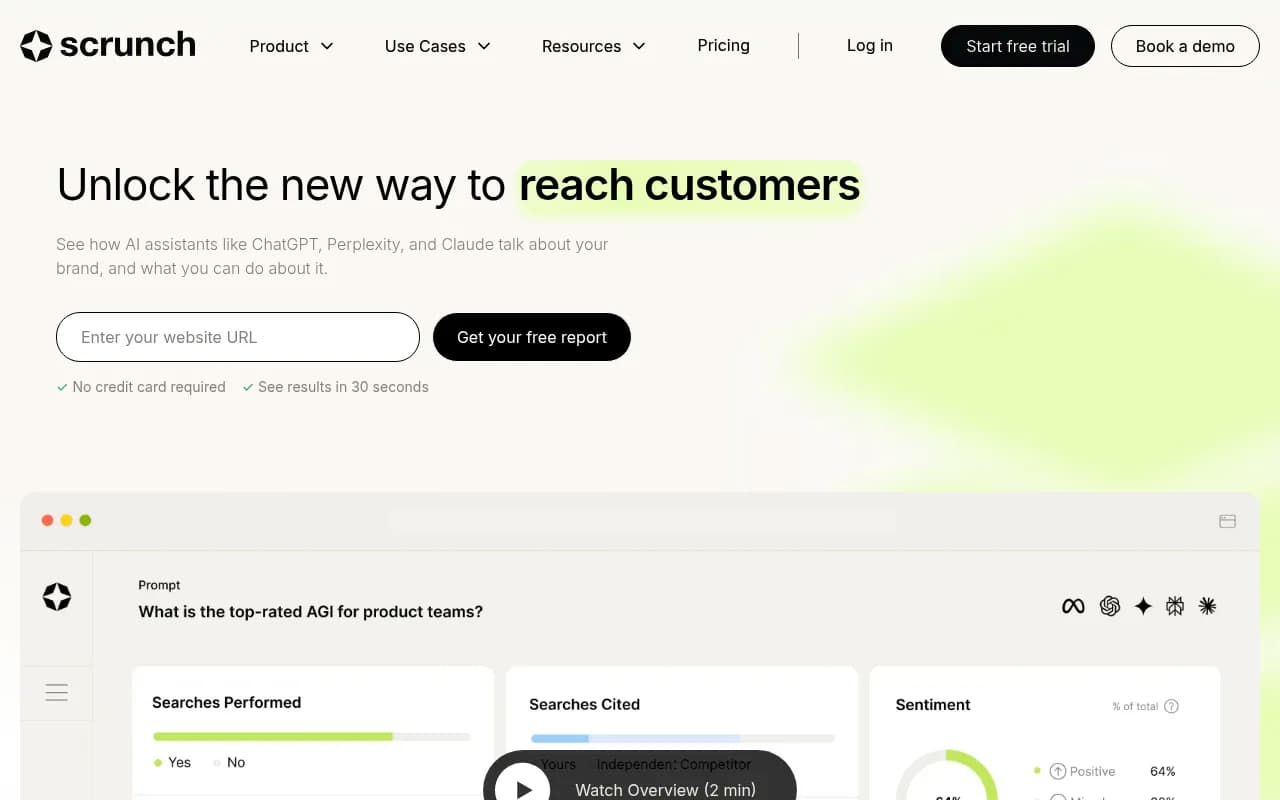
Scrunch positions itself as "The AI Customer Experience Platform" and splits its offering into three pillars: Monitoring (track brand presence across LLMs), Insights (understand how AI interprets your site), and Agent Experience Platform (AXP). The AXP is Scrunch's differentiator -- it lets you create a parallel version of your website specifically for AI bots, translated and optimized for machine consumption. Scrunch targets enterprise teams and agencies with pricing starting at $250/mo. The platform monitors ChatGPT, Perplexity, Claude, Gemini, Copilot, and AI Overviews. Real-time bot crawl feeds show when AI agents hit your site and what errors they encounter. Scrunch emphasizes brand positioning and performance tracking across personas, topics, and geographies.
Gauge: Competitive intelligence and content optimization
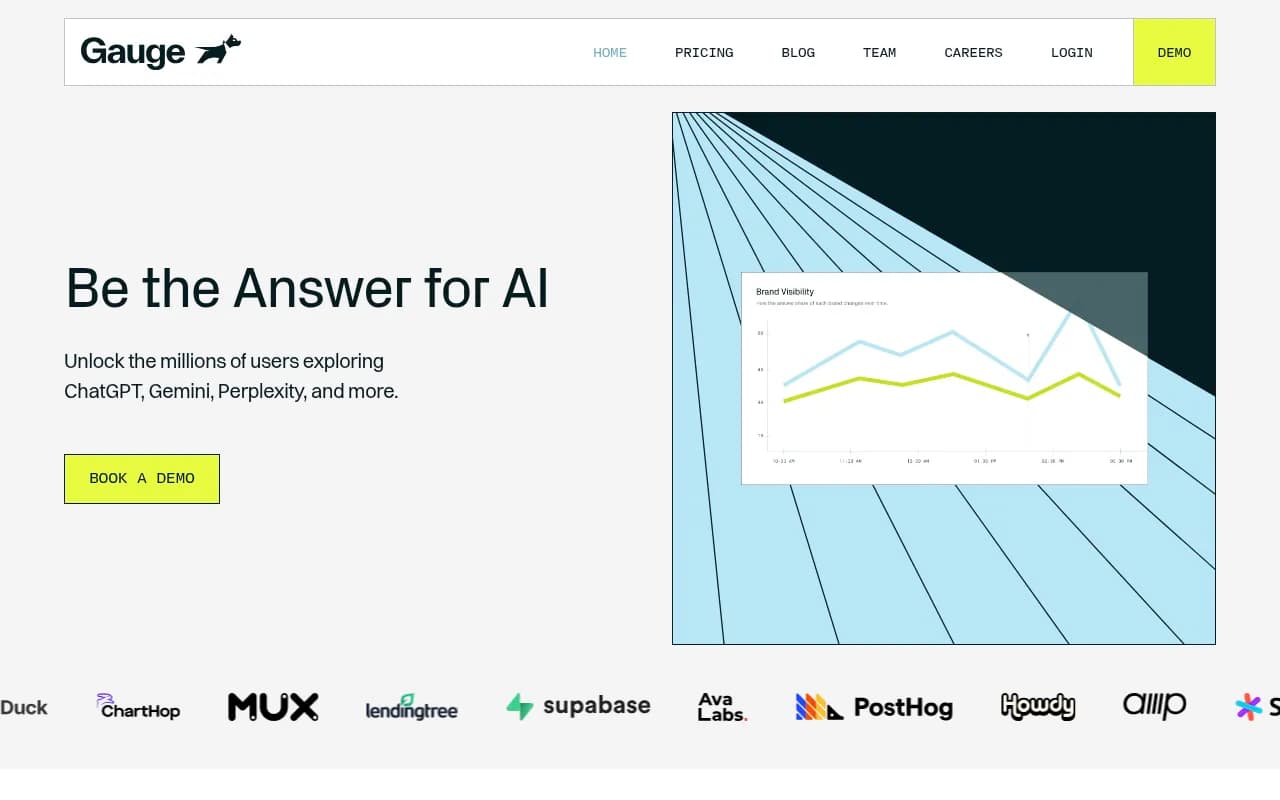
Gauge calls itself a "Complete Toolkit for AI Search" and structures its platform around three actions: Track (monitor AI-generated answers), Understand (analyze citations and competitor gaps), and Act (get clear recommendations and generate content). Gauge's core strength is competitive analysis -- it shows you exactly which prompts competitors rank for that you don't, then helps you create content to fill those gaps. The platform includes AI content generation in all paid plans (3 articles on Starter, 18 on Growth). Pricing starts at $99/mo for a ChatGPT-only tier, with Growth at $599/mo covering all models. Gauge monitors the same set of AI engines as Scrunch and adds features like affiliate targeting and Reddit engagement analysis.
Side-by-Side Comparison
| Feature | Scrunch | Gauge |
|---|---|---|
| Starting price | $250/mo (Starter, annual billing) | $99/mo (Starter, ChatGPT only) |
| Free tier | 7-day trial | Freemium available |
| AI models tracked | ChatGPT, Claude, Gemini, Perplexity, Copilot, AI Overviews | ChatGPT, Claude, Gemini, Perplexity, Copilot, AI Overviews, AI Mode |
| Content generation | ✗ No | ✓ 3-18 articles/mo depending on plan |
| Agent Experience Platform | ✓ Yes (parallel AI-optimized site) | ✗ No |
| Competitive gap analysis | Basic competitor tracking | ✓ Detailed roadmaps showing where competitors win |
| Bot crawl logs | ✓ Real-time feed | Not mentioned |
| Citation analysis | ✓ Yes | ✓ Yes |
| Reddit/social tracking | Not mentioned | ✓ Yes |
| Affiliate targeting | Not mentioned | ✓ Yes |
| Error detection | ✓ Yes | ✓ Yes |
| Target audience | Enterprise teams, agencies | SMBs to mid-market, agencies |
Pricing
The pricing gap between these platforms is one of the biggest decision factors.
| Plan | Scrunch | Gauge |
|---|---|---|
| Free tier | 7-day trial | Freemium (limited features) |
| Starter | $250/mo (annual billing) | $99/mo (100 prompts, ChatGPT only, 3 articles) |
| Growth/Mid-tier | $417/mo | $599/mo (600 prompts, all models, 18 articles) |
| Enterprise | Custom pricing | Custom pricing |
Scrunch's entry point is 2.5x higher than Gauge's Starter plan. Gauge's Growth plan costs more than Scrunch Growth but includes content generation (18 articles/mo) and covers all AI models. Scrunch Growth gives you more monitoring breadth but no content creation tools.
If budget is tight or you're testing AI visibility for the first time, Gauge's $99 entry tier is easier to justify. If you're an enterprise team with budget and you want the AXP feature, Scrunch's pricing makes sense.
Agent Experience Platform vs Content Generation
This is where the two platforms diverge most sharply.
Scrunch's AXP: A parallel site for AI bots
Scrunch's Agent Experience Platform lets you create a version of your site that's specifically designed for AI crawlers. Think of it as a machine-readable layer on top of your existing site. When an AI bot hits your domain, it gets served this optimized version -- cleaner structure, more explicit context, better formatting for LLM consumption. The idea: your human-facing site might be cluttered with navigation, CTAs, and design elements that confuse AI. The AXP strips that away.
This is a genuinely novel approach. Most platforms (including Gauge) focus on optimizing your existing pages. Scrunch says: build a second version just for bots. The trade-off is complexity -- you're maintaining two versions of your content. But for enterprises with resources, it could be a competitive edge.
Gauge's content generation: Fill the gaps
Gauge takes a different angle. Instead of re-architecting your site for bots, it helps you create new content that AI models want to cite. The platform analyzes competitor visibility, identifies prompts where you're missing, and generates articles to fill those gaps. You get 3 articles/mo on Starter, 18 on Growth.
The content generator is grounded in citation data and competitor analysis, not generic SEO filler. Gauge shows you what topics competitors rank for, then writes content targeting those same prompts. This is closer to traditional content marketing but optimized for AI search instead of Google.
Verdict: If you have engineering resources and want to experiment with a parallel AI-optimized site, Scrunch's AXP is worth exploring. If you need to ship content fast and don't want to manage two versions of your site, Gauge's content generator is more practical.
Competitive intelligence
Both platforms track competitors, but Gauge makes it the centerpiece.
Gauge: Roadmaps showing where you're losing
Gauge's competitive analysis shows you exactly which prompts competitors are visible for that you're not. It's not just "Competitor X appears in 45% of answers" -- it's "Here are the 23 specific prompts where Competitor X ranks and you don't, and here's what content you need to create to catch up." The platform builds roadmaps based on this gap analysis. You see the specific angles, topics, and questions AI models want answers to but can't find on your site.
This is actionable. You're not staring at a dashboard wondering what to do next. Gauge tells you: write about X, Y, and Z, and here's why.
Scrunch: Positioning and performance tracking
Scrunch tracks competitors across personas, topics, and geographies. You can see how you stack up by category and monitor trends over time. The platform shows citation sources and rankings for any prompt. But it's more observational -- you see where competitors are winning, but Scrunch doesn't build a step-by-step roadmap to close the gap.
Scrunch's strength is breadth: you can slice competitor data by persona, region, and topic. Gauge's strength is depth: it tells you exactly what to do about the gaps.
Verdict: Gauge wins on actionable competitive intelligence. Scrunch gives you the data; Gauge gives you the plan.
Bot crawl logs and error detection
Both platforms help you understand how AI bots interact with your site, but Scrunch goes deeper here.
Scrunch: Real-time crawl feed
Scrunch provides a real-time feed of AI bot activity on your site. You see when ChatGPT, Claude, Perplexity, etc. hit your pages, what they accessed, and what errors they encountered. This is useful for debugging -- if an AI model can't crawl a key page, you'll know immediately. Scrunch also tracks crawl frequency and patterns over time.
This level of granularity is rare. Most platforms (including Gauge) focus on the output (what AI says about you) rather than the input (how AI accesses your site).
Gauge: Error detection without real-time logs
Gauge mentions error detection as a feature but doesn't emphasize real-time bot logs the way Scrunch does. You'll get alerts when AI bots can't access your content, but the focus is more on fixing the content itself than monitoring bot behavior.
Verdict: If you want deep visibility into bot crawl patterns and real-time debugging, Scrunch is the better choice. If you just need to know when something's broken, Gauge covers the basics.
Citation analysis
Both platforms analyze what sources AI models cite, but they present the data differently.
Scrunch shows you which sites AI loves to cite and how your brand compares. You can see citation trends over time and identify patterns in what gets referenced. The platform emphasizes brand positioning -- are you cited alongside the right competitors? Are you showing up in the right contexts?
Gauge also tracks citations but ties them directly to content gaps. It's not just "AI cites these sources" -- it's "AI cites these sources for prompts X, Y, Z, and here's what you need to publish to get cited too." The citation data feeds into the competitive roadmap.
Both approaches are useful. Scrunch is better for high-level brand positioning analysis. Gauge is better for turning citation data into a content plan.
Reddit, YouTube, and social sources
Gauge explicitly mentions Reddit engagement analysis and social source tracking. Scrunch doesn't highlight this in its feature set. AI models increasingly pull from Reddit threads, YouTube videos, and other social platforms when generating answers. If you want to understand and influence those sources, Gauge gives you more visibility.
This matters for certain industries. If your category has active Reddit communities or YouTube review channels, tracking those sources is critical. Gauge helps you identify which threads and videos AI models cite, so you can engage there or create your own.
Verdict: Gauge has the edge on social source tracking.
Affiliate and partner targeting
Gauge includes affiliate targeting as a feature -- you can identify high-value affiliates and partners that AI models cite, then build relationships or create content for those channels. Scrunch doesn't emphasize this.
For e-commerce brands, SaaS companies with partner ecosystems, or anyone relying on third-party reviews, this is valuable. AI models often cite review sites, comparison pages, and affiliate content. Knowing which affiliates to target can shortcut your way into AI answers.
User interface and ease of use
Both platforms have clean, modern interfaces. Scrunch's dashboard is organized around the three pillars (Monitoring, Insights, AXP) with tabs for performance tracking, prompt analytics, and AI traffic. The real-time bot feed is visually distinct and easy to scan.
Gauge's interface is structured around Track, Understand, Act. The competitive roadmap view is the standout -- it's a clear, prioritized list of what to do next. The content generation tool is integrated directly into the workflow, so you can go from gap analysis to article creation without switching tools.
Neither platform has a steep learning curve. Scrunch feels more enterprise-oriented with deeper settings and configuration options. Gauge feels more streamlined and action-oriented.
Integration and API
Neither platform's website provides detailed information about integrations or API access. Both likely offer API access at enterprise tiers, but you'll need to contact sales for specifics. This is standard for platforms in this category -- most integrations and API features are custom-built for enterprise clients.
Who should pick Scrunch
- Enterprise teams with budget and engineering resources who want to experiment with a parallel AI-optimized site (AXP)
- Brands that need deep bot crawl visibility and real-time debugging of AI access issues
- Teams focused on brand positioning and performance tracking across multiple personas and geographies
- Companies that already have strong content operations and don't need a built-in content generator
- Organizations willing to pay a premium for a monitoring-first platform with enterprise-grade features
Who should pick Gauge
- Teams that want competitive intelligence and a clear roadmap showing where to improve
- Companies that need AI content generation built into the platform (3-18 articles/mo)
- Smaller teams or agencies with tighter budgets -- Gauge's $99 entry tier is more accessible
- Brands that want to track Reddit, YouTube, and social sources that influence AI answers
- Teams looking for an action-oriented platform that tells you what to do, not just what's happening
- Anyone who wants to test AI visibility tracking without committing to a $250/mo minimum
Pros and cons
Scrunch pros
- Agent Experience Platform is a genuinely novel approach to AI optimization
- Real-time bot crawl logs provide deep visibility into AI access patterns
- Strong brand positioning and performance tracking across multiple dimensions
- Enterprise-grade monitoring with detailed error detection
- 7-day trial lets you test before committing
Scrunch cons
- Higher entry price ($250/mo) puts it out of reach for smaller teams
- No built-in content generation -- you get insights but have to create content elsewhere
- AXP requires maintaining two versions of your site, which adds complexity
- Less emphasis on competitive gap analysis and actionable roadmaps
- Social source tracking (Reddit, YouTube) not highlighted as a feature
Gauge pros
- Lower entry price ($99/mo Starter, freemium tier available)
- Built-in AI content generation (3-18 articles/mo depending on plan)
- Competitive roadmaps show exactly where you're losing and what to do about it
- Reddit, YouTube, and social source tracking included
- Affiliate targeting helps you identify high-value third-party channels
- Action-oriented interface that prioritizes next steps
Gauge cons
- Starter plan only covers ChatGPT -- you need Growth ($599/mo) for all models
- No Agent Experience Platform or parallel site optimization
- Less emphasis on real-time bot crawl logs and debugging
- Content generation quality depends on how well the AI writer understands your niche
- Freemium tier likely has significant limitations (details not public)
Final verdict
Scrunch and Gauge solve different problems. Scrunch is a monitoring-first platform for enterprise teams that want deep visibility into how AI bots interact with their site. The Agent Experience Platform is a bold bet on creating a parallel site optimized for machines. If you have the budget and resources to maintain that, it could be a competitive advantage.
Gauge is an optimization-first platform for teams that want to close the gap with competitors. It shows you where you're losing, generates content to fill those gaps, and tracks the results. The lower entry price and built-in content generator make it more accessible for smaller teams and agencies.
If you're an enterprise with $250+/mo budget and you want to experiment with a parallel AI-optimized site, Scrunch is worth exploring. If you're a smaller team or you want a platform that tells you exactly what to do next (and helps you do it), Gauge is the better fit.
For most teams, Gauge's combination of competitive intelligence, content generation, and lower entry cost makes it the more practical choice. Scrunch's AXP is innovative, but it's a heavier lift and a bigger investment.
If you're also looking to track how your brand shows up in AI search results with even deeper citation analysis and content gap detection, Promptwatch is worth checking out -- it covers similar ground with a focus on turning visibility data into actionable content strategies.
