Key Takeaways
- Promptmonitor is significantly cheaper ($29-$129/mo vs $250-$417/mo) and offers a freemium tier, making it accessible for smaller teams testing AI visibility tracking
- Scrunch positions itself as an "AI Customer Experience Platform" with an Agent Experience Platform (AXP) feature that creates AI-optimized versions of your site -- Promptmonitor focuses purely on monitoring and analytics
- Both track the same core LLMs (ChatGPT, Perplexity, Claude, Gemini) but Scrunch adds more advanced features like error detection and real-time bot crawl feeds
- Promptmonitor's interface appears more straightforward for basic tracking needs, while Scrunch bundles monitoring with optimization recommendations and site delivery features
- If you just want to see where you're mentioned in AI responses, Promptmonitor gets you there faster and cheaper. If you need actionable optimization guidance and want to serve custom content to AI crawlers, Scrunch justifies the higher price
- Neither platform offers content generation capabilities -- if you want to close the loop from tracking to actually creating content that ranks in AI search, Promptwatch combines monitoring with AI-powered content creation and gap analysis
Overview
Scrunch
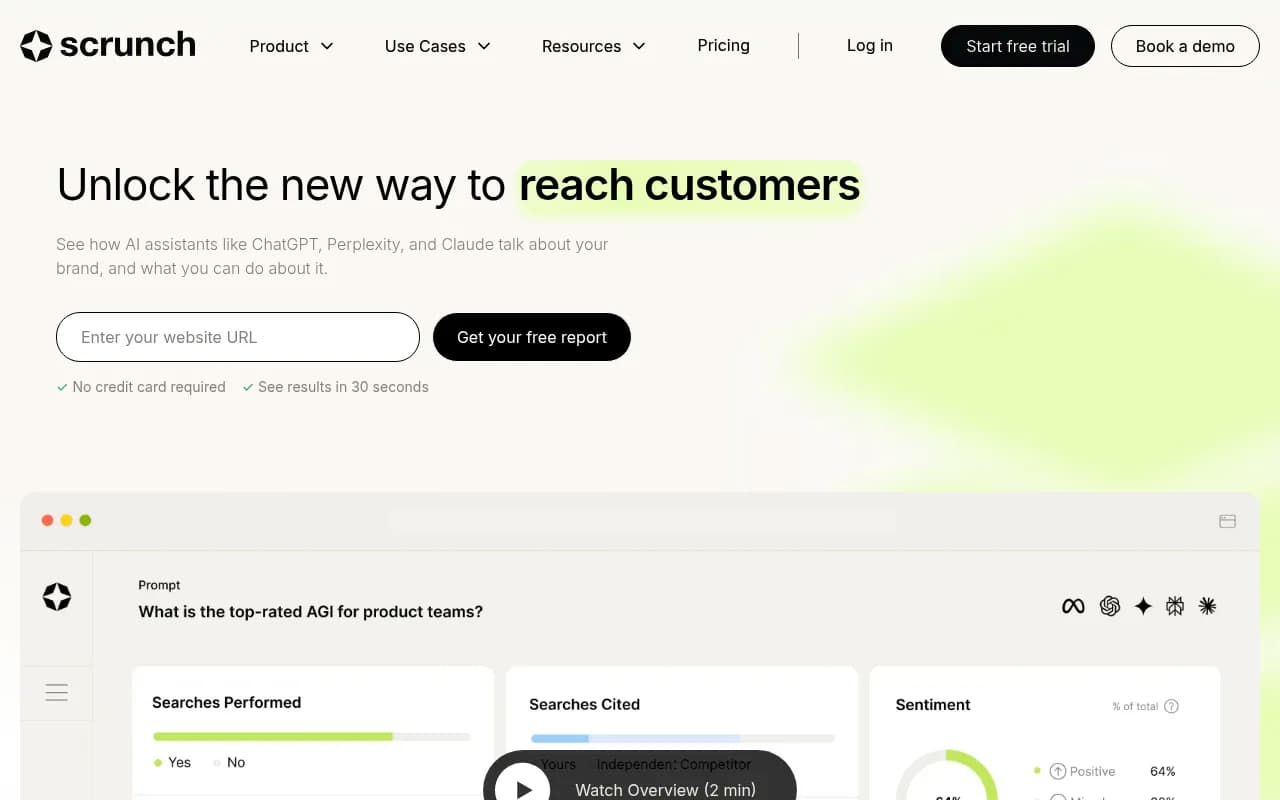
Scrunch markets itself as an "AI Customer Experience Platform" rather than just a monitoring tool. The platform covers three main areas: monitoring brand presence across LLMs, insights and optimization recommendations, and what they call the Agent Experience Platform (AXP) -- a system that creates a parallel, AI-optimized version of your website specifically for AI bot traffic. They're targeting companies that want to treat AI assistants as a distinct customer segment with its own experience layer.
Pricing starts at $250/mo for the Starter plan (billed annually), with a Growth plan at $417/mo and custom Enterprise pricing. They offer a 7-day free trial. The company claims over 500 customers including brands like Lenovo, Skims, and Penn State University.
Promptmonitor
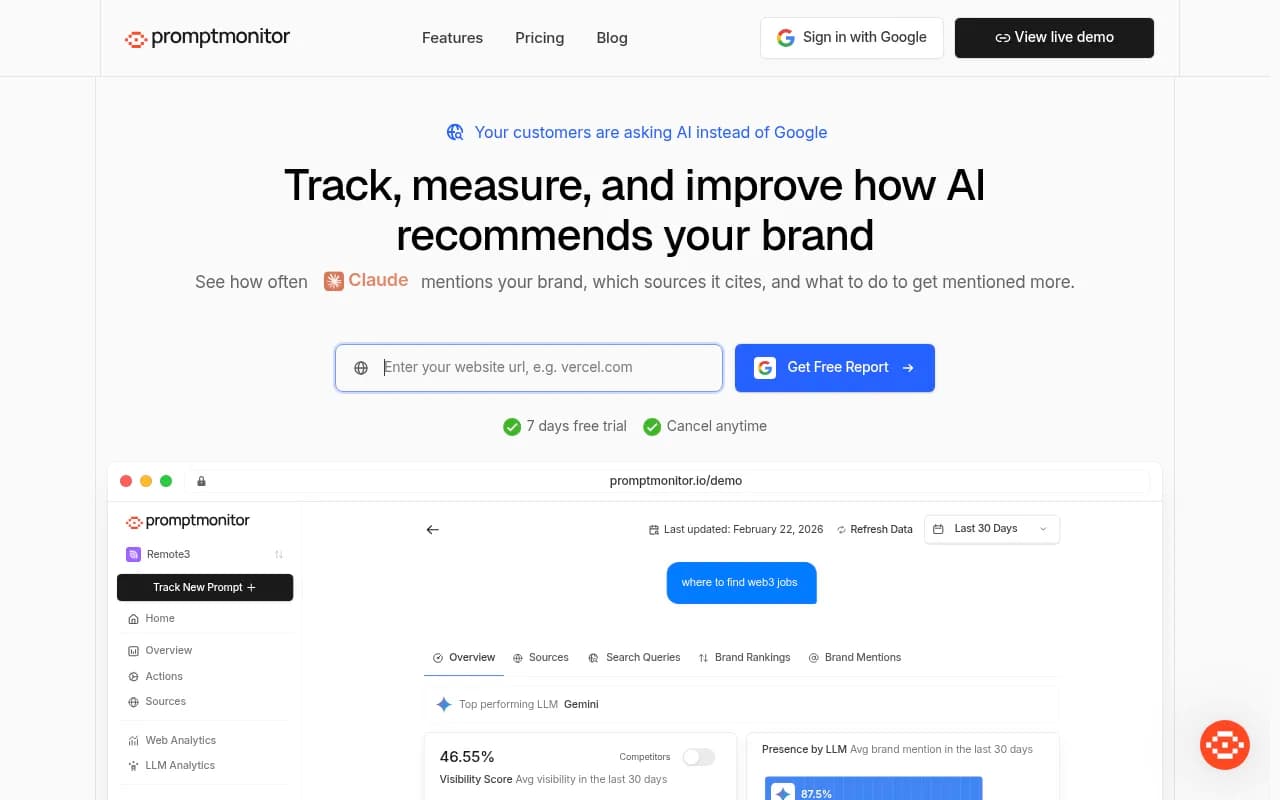
Promptmonitor takes a more focused approach: track and measure how AI recommends your brand, see which sources get cited, and understand what to do about it. The platform monitors ChatGPT, Perplexity, Claude, and Gemini, tracking brand mentions, visibility scores, and source citations. They offer a public demo project so you can see the interface before signing up.
Pricing is more accessible: $29/mo Starter, $39/mo Growth, $129/mo Pro, with custom Agency pricing. They also offer a 7-day free trial with no credit card required. The interface emphasizes visibility scores, presence by LLM, and competitor tracking.
Side-by-Side Comparison
| Feature | Scrunch | Promptmonitor |
|---|---|---|
| Starting price | $250/mo (annual) | $29/mo |
| Free tier | No (7-day trial) | No (7-day trial) |
| LLMs monitored | ChatGPT, Perplexity, Claude, Gemini, others | ChatGPT, Perplexity, Claude, Gemini |
| Brand mention tracking | ✓ | ✓ |
| Competitor analysis | ✓ | ✓ |
| Citation/source tracking | ✓ | ✓ |
| Visibility scoring | ✓ | ✓ |
| AI bot crawl monitoring | ✓ Real-time feed | ✗ |
| Error detection | ✓ | ✗ |
| Optimization recommendations | ✓ | Limited |
| Agent Experience Platform | ✓ (custom AI site) | ✗ |
| Web analytics integration | ✓ | ✓ |
| Public demo available | ✗ | ✓ |
| Agency/multi-client support | ✓ (Enterprise) | ✓ (Agency plan) |
Monitoring capabilities
Both platforms cover the essential LLMs -- ChatGPT, Perplexity, Claude, and Gemini. Scrunch claims to monitor "every LLM" but doesn't specify the full list on their homepage. Promptmonitor is transparent about tracking those four main models.
Scrunch's monitoring dashboard shows performance tracking across competitors, personas, topics, and geographies. They provide prompt analytics that track trends, citations, competitors, and rankings for specific prompts. The standout feature here is the real-time AI traffic feed -- you can see exactly when AI bots crawl your site, what they're accessing, and spot traffic trends over time.
Promptmonitor's monitoring focuses on visibility scores and presence percentages. Their demo project shows a clean interface with visibility trends over time, presence by LLM (with percentages like "86.96% on Gemini, 57.14% on Perplexity"), and a calendar view showing which LLMs mentioned your brand on specific dates. The visibility score combines presence with cross-model consistency -- not just whether you're mentioned, but how consistently across different AI platforms.
Verdict: Scrunch has more depth with the real-time crawl feed and error detection. Promptmonitor's interface is cleaner and easier to parse at a glance, but Scrunch gives you more diagnostic data.
Insights and optimization
This is where the platforms diverge significantly.
Scrunch's Insights module promises "actionable tips to move up the ranks," citation analysis to "uncover the sites that AI loves to cite," and error detection to "spot when AI bots can't crawl your site and fix it." They position this as understanding "the why behind the AI" -- not just tracking mentions but diagnosing what's working or broken. One testimonial claims they went "from invisible to cited right alongside the biggest players in the space" within weeks.
Promptmonitor shows visibility scores and source tracking but doesn't emphasize optimization recommendations as heavily. Their interface includes an "Actions" tab and "Sources" tab in the demo, suggesting they do provide some guidance, but it's not the headline feature.
Neither platform offers built-in content generation. If you identify gaps in your AI visibility, you're on your own to create the content that fills them. This is where a platform like Promptwatch differentiates itself -- it shows you the gaps and then helps you generate the content to close them.

Verdict: Scrunch puts more emphasis on actionable optimization and error diagnosis. Promptmonitor gives you the data but less hand-holding on what to do with it.
Agent Experience Platform (Scrunch only)
Scrunch's most distinctive feature is the Agent Experience Platform (AXP). The idea: create a parallel version of your site that's "translated for AI traffic." Their homepage shows a code snippet of a standard HTML page (263,220 bytes) with the implication that this gets transformed into something AI bots can parse more effectively.
This is a bet that AI crawlers need or benefit from a different content structure than human visitors. Whether that's true in 2026 is debatable -- most LLMs can parse standard HTML just fine. But if you believe AI bots deserve their own optimized experience (similar to how mobile users got responsive design), this feature is unique to Scrunch.
Promptmonitor doesn't offer anything comparable. You monitor your existing site as-is.
Verdict: If you want to experiment with serving custom content to AI crawlers, Scrunch is your only option here. Whether you need this feature depends on how much you believe AI bots struggle with your current site structure.
Pricing comparison
| Plan | Scrunch | Promptmonitor |
|---|---|---|
| Free tier | None | None |
| Trial | 7 days | 7 days (no credit card) |
| Starter | $250/mo (annual) | $29/mo |
| Growth | $417/mo | $39/mo |
| Pro | N/A | $129/mo |
| Enterprise/Agency | Custom | Custom (Agency plan) |
The price gap is massive. Scrunch's entry point is $250/mo billed annually ($3,000/year). Promptmonitor starts at $29/mo ($348/year). Even Promptmonitor's Pro plan at $129/mo is roughly half of Scrunch's Starter.
Scrunch is clearly targeting mid-market and enterprise companies with budget for a comprehensive AI visibility platform. Promptmonitor is accessible to startups, small marketing teams, and agencies managing multiple clients on tighter budgets.
Verdict: Promptmonitor wins on affordability. Scrunch needs to justify 8-10x the cost with significantly more value.
User interface and ease of use
Promptmonitor's public demo project gives you a real look at the interface before signing up. It's clean, with a sidebar navigation (Overview, Sources, Search Queries, Brand Rankings, Brand Mentions, Web Analytics, LLM Analytics) and straightforward charts showing visibility trends and presence percentages. The calendar heatmap showing which LLMs mentioned you on which days is particularly useful for spotting patterns.
Scrunch's homepage shows dashboard screenshots but no live demo. The screenshots look polished and data-rich, with multiple tabs and filters. The real-time AI traffic feed is a unique visual -- seeing bot requests scroll by in real time is compelling if you're into that level of detail.
Both platforms appear to have modern, professional interfaces. Promptmonitor's transparency with the public demo is a plus for evaluation.
Verdict: Promptmonitor edges ahead for letting you try before you buy (even if it's just a demo project). Scrunch's interface looks powerful but you need to sign up for the trial to see it.
Analytics and reporting
Both platforms offer web analytics integration to connect AI visibility to actual traffic. Scrunch emphasizes their AI traffic tracking -- knowing how bots are crawling your site, which pages they hit, and when they return. This is more granular than most competitors offer.
Promptmonitor's demo shows LLM Analytics and Web Analytics tabs, suggesting they track both AI-side metrics (mentions, visibility) and website-side metrics (traffic, conversions). The visibility score methodology -- combining presence with cross-model consistency -- is a thoughtful metric that goes beyond simple mention counts.
Scrunch's prompt analytics track "trends, citations, competitors, and rankings for any prompt," which implies per-prompt drill-downs. Promptmonitor's demo shows a "Search Queries" tab, likely serving a similar purpose.
Verdict: Roughly even. Both provide the core analytics you need. Scrunch's real-time crawl feed is a differentiator if you want that level of operational visibility.
Target audience
Scrunch is built for companies that:
- Have budget ($3,000-$5,000+/year)
- Want to treat AI as a distinct customer segment with its own experience layer
- Need advanced diagnostics like error detection and crawl monitoring
- Are willing to invest in optimization recommendations and potentially restructure content for AI
Promptmonitor fits:
- Startups and small teams testing AI visibility tracking for the first time
- Agencies managing multiple clients who need affordable per-project monitoring
- Companies that want straightforward tracking without the bells and whistles
- Teams that prefer to handle optimization in-house once they see the data
Verdict: Different audiences. Scrunch is enterprise-focused, Promptmonitor is accessible to smaller players.
Pros and cons
Scrunch pros
- Real-time AI bot crawl monitoring with traffic feed
- Error detection to catch when bots can't access your site
- Agent Experience Platform for serving custom content to AI crawlers
- Actionable optimization recommendations built into the platform
- Established customer base with recognizable brands
Scrunch cons
- Expensive -- $250/mo minimum, $3,000/year commitment
- No public demo or transparent feature list
- AXP feature may be overkill if your site is already well-structured
- Unclear exactly which LLMs beyond the big four are monitored
Promptmonitor pros
- Affordable pricing starting at $29/mo
- Public demo project lets you see the interface before committing
- Clean, easy-to-understand visibility scoring
- Transparent about which LLMs are tracked
- No credit card required for trial
Promptmonitor cons
- Limited optimization guidance compared to Scrunch
- No real-time crawl monitoring or error detection
- Fewer advanced features overall
- Less established brand presence (fewer public testimonials/case studies)
Who should pick which tool
Pick Scrunch if:
- You have $3,000+ annual budget for AI visibility tracking
- You want real-time diagnostics on how AI bots interact with your site
- Error detection and crawl monitoring are important to your workflow
- You're interested in experimenting with the Agent Experience Platform concept
- You need a platform that bundles monitoring with optimization recommendations
Pick Promptmonitor if:
- You're testing AI visibility tracking for the first time and want to start cheap
- You're an agency managing multiple clients and need affordable per-project monitoring
- You prefer a straightforward monitoring tool without extra layers
- You want to see a demo before committing to a trial
- You're comfortable handling optimization and content creation separately
Consider Promptwatch if:
- You want to close the loop from tracking to content creation -- not just see where you're invisible but actually generate the content to fix it
- You need answer gap analysis to identify exactly which prompts competitors rank for but you don't
- You want crawler logs, Reddit/YouTube tracking, and prompt intelligence (volume estimates, difficulty scores) in addition to basic monitoring
- You're looking for a platform that combines monitoring, optimization, and content generation in one workflow
Final verdict
This comes down to budget and how hands-on you want the platform to be.
Promptmonitor is the better starting point for most teams. At $29-$129/mo, it's affordable enough to justify as an experiment. The interface is clean, the visibility scoring is thoughtful, and the public demo removes friction from evaluation. You get the core monitoring features you need without paying for extras you might not use.
Scrunch justifies its higher price if you need the advanced diagnostics -- real-time crawl feeds, error detection, and the Agent Experience Platform. The optimization recommendations are more prominent, and the platform feels built for companies that want to treat AI visibility as a strategic initiative rather than a side project. But at $250/mo minimum, you need to be confident you'll use those features.
Neither platform solves the "now what?" problem once you identify gaps in your AI visibility. You still need to create content, optimize pages, and iterate. If you want a platform that helps with that next step, look at tools that combine monitoring with content generation and gap analysis -- that's where the real optimization happens.