Key Takeaways
- Hall AI covers 8 AI platforms vs Scrunch's 7, including DeepSeek which Scrunch lacks
- Hall AI offers a completely free tier with shareable reports; Scrunch starts at $250/mo with a 7-day trial
- Scrunch includes an Agent Experience Platform (AXP) that lets you create AI-optimized parallel versions of your site -- Hall AI doesn't have this
- Hall AI positions itself as a straightforward monitoring tool; Scrunch markets a broader "AI Customer Experience Platform" with optimization features
- Both are monitoring-focused platforms without built-in content generation or gap analysis (tools like Promptwatch fill that optimization gap)
- Scrunch targets enterprise and agency customers with higher pricing; Hall AI aims at individual marketers and smaller teams
Overview
Hall AI
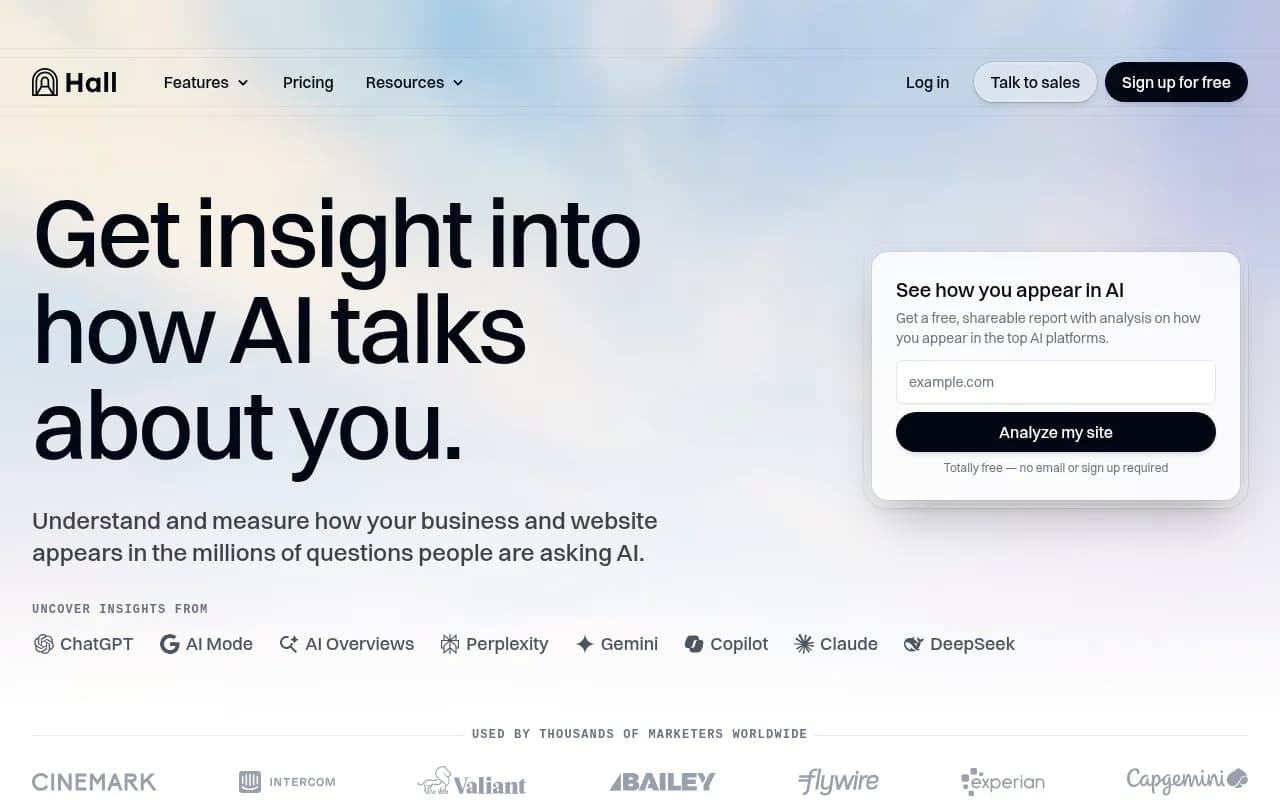
Hall AI is a GEO/AEO monitoring platform that tracks how your brand appears across major AI engines. The pitch is simple: see how ChatGPT, Perplexity, Claude, and others talk about your business. You get citation tracking (which pages AI references), brand sentiment analysis, share of voice metrics, and real-time agent crawler logs. The standout feature is the free tier -- you can generate a shareable report without even signing up, which makes it easy to test before committing.
Hall monitors 8 platforms: ChatGPT, Perplexity, Claude, Gemini, Copilot, Google AI Mode, Google AI Overviews, and DeepSeek. The interface emphasizes simplicity. You're not drowning in data -- you're getting the core metrics you need to understand your AI visibility.
Scrunch
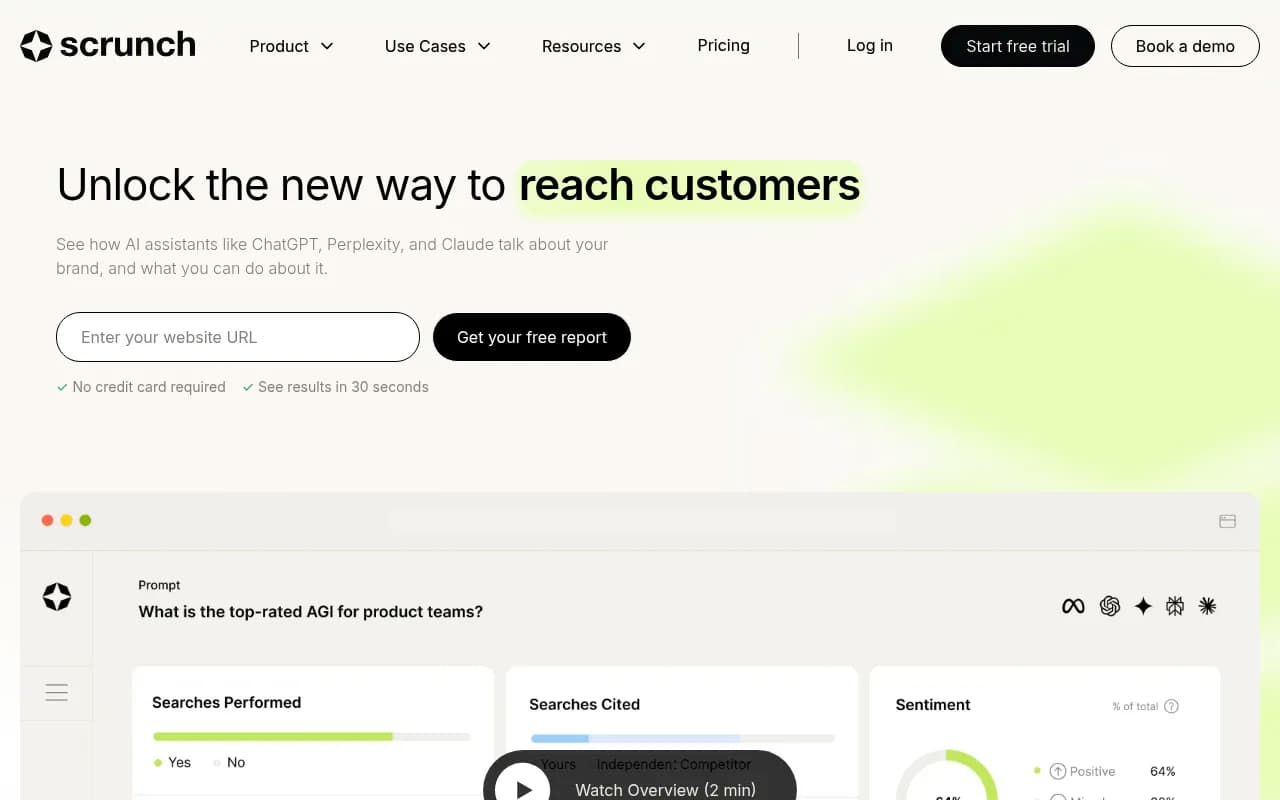
Scrunch positions itself as an "AI Customer Experience Platform" rather than just a monitoring tool. It tracks brand presence across 7 AI platforms (ChatGPT, Perplexity, Claude, Gemini, Copilot, Google AI Overviews, Google AI Mode -- notably missing DeepSeek). The core offering is similar to Hall AI: performance tracking, prompt analytics, citation analysis, competitor benchmarking, and agent crawler monitoring.
Where Scrunch differentiates is the Agent Experience Platform (AXP). This feature lets you create a parallel, AI-optimized version of your site specifically for AI traffic. Think of it as a separate layer that translates your content for machine readers. Scrunch also emphasizes error detection -- spotting when AI bots can't crawl your site and giving you tips to fix it.
Scrunch's pricing starts at $250/mo (Starter plan, billed annually), with a Growth plan at $417/mo and custom Enterprise pricing. You get a 7-day free trial. The target customer is clearly enterprise brands and agencies -- the testimonials feature companies like Lenovo, Skims, and Penn State.
Side-by-Side Comparison
| Feature | Hall AI | Scrunch |
|---|---|---|
| Pricing | Free tier available, paid plans start low (likely $50-150/mo) | $250/mo Starter (annual), $417/mo Growth, Enterprise custom |
| Free trial | Yes (free tier, no signup required) | 7-day trial |
| AI platforms monitored | 8 (ChatGPT, Perplexity, Claude, Gemini, Copilot, AI Mode, AI Overviews, DeepSeek) | 7 (ChatGPT, Perplexity, Claude, Gemini, Copilot, AI Overviews, AI Mode) |
| Citation tracking | ✓ | ✓ |
| Brand sentiment analysis | ✓ | ✓ |
| Share of voice metrics | ✓ | ✓ |
| Agent crawler logs | ✓ | ✓ (with real-time feed) |
| Competitor benchmarking | ✓ | ✓ (by persona, topic, geo) |
| Error detection | Not emphasized | ✓ (spots crawl issues) |
| Agent Experience Platform | ✗ | ✓ (create AI-optimized parallel site) |
| Shareable reports | ✓ (free, no signup) | Not mentioned |
| Target audience | Individual marketers, small teams | Enterprise, agencies |
| Content optimization | Monitoring only | Monitoring + tips, no generation |
Platform coverage
Hall AI monitors 8 AI engines. Scrunch monitors 7. The difference is DeepSeek -- Hall includes it, Scrunch doesn't. Both cover the major players: ChatGPT, Perplexity, Claude, Gemini, Copilot, and Google's AI features (AI Overviews and AI Mode).
DeepSeek matters if you're targeting Chinese markets or want comprehensive coverage of emerging models. For most US/EU brands, the overlap is what counts, and both tools cover the engines that drive the majority of AI search traffic.
Neither tool monitors Meta AI, Grok, or Mistral -- platforms that some competitors like Promptwatch include in their coverage.
Verdict: Hall AI wins on breadth by one platform. The gap isn't huge, but if you want DeepSeek coverage, Hall is your only option here.
Citation and answer insights
Both tools show you which pages AI engines cite when answering questions about your industry. This is the core value proposition: you can see exactly which URLs get referenced, how often, and in what context.
Hall AI presents this as "Website citation insights" -- a straightforward view of which pages appear in AI conversations. You see the page, the question it was cited for, and the AI platform that referenced it.
Scrunch calls this "Citations" and bundles it with "Generative answer insights." The interface shows not just which pages get cited, but also how your brand is positioned in AI responses -- sentiment, share of voice, and competitive context. Scrunch emphasizes the "why" behind the data with optimization tips.
Both tools let you track trends over time. Neither gives you prompt volume estimates or difficulty scores (features you'd find in optimization-focused platforms).
Verdict: Scrunch edges ahead with richer context around citations -- sentiment, positioning, and actionable tips. Hall AI gives you the raw data but less interpretation.
Agent crawler analytics
This is where both tools shine. AI engines don't just generate answers from cached knowledge -- they actively crawl websites in real-time to pull fresh information. Understanding how these bots interact with your site is critical.
Hall AI's "Agent analytics" shows you how AI crawlers are browsing your website. You see which pages they hit, how often, and can connect agent activity with citation data. The interface is clean and focused on the essentials.
Scrunch's "AI traffic" feature goes deeper. You get a real-time feed of bot activity, traffic trends over time, and error detection. Scrunch explicitly calls out when AI bots can't crawl your site -- maybe a page is blocked, maybe it's timing out, maybe the content structure is confusing. You get alerts and tips to fix these issues.
This diagnostic layer is valuable. If ChatGPT can't read your pricing page because of a robots.txt misconfiguration, you want to know immediately.
Verdict: Scrunch wins with error detection and real-time diagnostics. Hall AI gives you the logs, but Scrunch tells you what's broken and how to fix it.
Agent Experience Platform (Scrunch only)
This is Scrunch's differentiator. The Agent Experience Platform (AXP) lets you create a parallel version of your site optimized specifically for AI traffic. Think of it as a separate layer that AI bots see when they crawl your domain.
The idea: your human-facing website might have design elements, navigation, and content structure that confuses AI parsers. AXP lets you serve a cleaner, more structured version to bots without changing your public site.
This is a bold feature. It's also unproven at scale. The risk is that you're essentially cloaking content for bots, which could trigger penalties if search engines or AI platforms decide it violates their guidelines. Scrunch doesn't address this concern in their marketing.
Hall AI doesn't have an equivalent feature. You optimize your actual site or you don't.
Verdict: Scrunch's AXP is innovative but carries risk. If you're comfortable with the cloaking implications, it's a powerful tool. If you prefer a conservative approach, Hall AI's lack of this feature might actually be a plus.
Pricing comparison
| Plan | Hall AI | Scrunch |
|---|---|---|
| Free tier | ✓ (shareable reports, no signup) | ✗ |
| Trial | Free tier serves as trial | 7-day free trial |
| Starter | Likely $50-150/mo (not publicly listed) | $250/mo (annual billing) |
| Growth | Unknown | $417/mo (annual billing) |
| Enterprise | Unknown | Custom pricing |
Hall AI's pricing isn't publicly listed beyond "free tier available" and "paid plans start low." Based on positioning and competitor analysis, expect $50-150/mo for paid plans. The free tier is genuinely free -- no credit card, no signup, just generate a report.
Scrunch is transparent: $250/mo for Starter (annual billing), $417/mo for Growth, and custom Enterprise pricing. That's 2-5x more expensive than Hall AI's likely range.
The price gap reflects target customers. Hall AI is built for individual marketers and small teams who want visibility without enterprise budgets. Scrunch targets agencies and brands with serious AI search budgets.
Verdict: Hall AI wins on affordability and accessibility. Scrunch's pricing is justified if you need the AXP and enterprise features, but it's a steep entry point.
User interface and ease of use
Hall AI emphasizes simplicity. The homepage promises "no email or sign up required" for the free report. The interface is clean, focused on core metrics, and doesn't overwhelm you with options. You're getting visibility data, not a Swiss Army knife of features.
Scrunch's interface is more complex because it does more. You have monitoring dashboards, insights panels, the AXP configuration, error detection alerts, and optimization tips. The learning curve is steeper, but you get more control.
Both tools are web-based SaaS platforms. Neither requires technical setup beyond adding a tracking snippet if you want agent analytics.
Verdict: Hall AI is easier to get started with. Scrunch requires more time to learn but offers more depth once you do.
Content optimization and gap analysis
Neither Hall AI nor Scrunch includes content generation or gap analysis features. Both are monitoring-first platforms. They show you where you stand, but they don't help you create content to improve your position.
This is the core limitation of monitoring-only tools. You see that competitors are getting cited for prompts you're invisible on, but you're left to figure out what content to create on your own.
If you want the full optimization loop -- find gaps, generate content, track results -- you need a platform like Promptwatch that combines monitoring with AI content generation and answer gap analysis.

Verdict: Tie. Both tools stop at monitoring. For optimization, you need to layer in additional tools or manual work.
Competitor benchmarking
Both platforms let you compare your AI visibility against competitors. You can see share of voice, citation frequency, and positioning across different prompts and topics.
Hall AI presents this as straightforward competitive analysis -- who's getting cited more, for which questions, and on which platforms.
Scrunch adds segmentation by persona, topic, and geography. You can slice competitor data by region (US vs EU) or by customer persona (enterprise buyer vs individual user). This granularity is useful if you're running targeted campaigns.
Neither tool offers the depth of competitor heatmaps or prompt-level competitive analysis you'd find in more advanced platforms.
Verdict: Scrunch wins with persona and geo segmentation. Hall AI covers the basics but lacks advanced filtering.
Integration and API access
Neither Hall AI nor Scrunch prominently advertises API access or third-party integrations. Both are standalone platforms designed to be used within their own interfaces.
Scrunch mentions "agent analytics" that connect crawler activity with conversation data, suggesting some internal integration between modules. But there's no mention of exporting data to Looker Studio, connecting to Google Search Console, or building custom workflows via API.
If you need to pipe AI visibility data into your existing analytics stack, you'll likely be limited to manual exports or screen scraping.
Verdict: Tie. Neither tool prioritizes integrations. Both are walled gardens.
Support and documentation
Scrunch's website includes customer testimonials from enterprise clients and mentions a "Book a demo" option, suggesting a sales-assisted onboarding process. The Growth and Enterprise plans likely include dedicated support.
Hall AI's free tier and lower pricing suggest a self-service model. There's no mention of dedicated support or onboarding calls. You're expected to figure it out yourself, which is fine given the simplicity of the interface.
Neither platform has extensive public documentation or knowledge bases visible from their websites.
Verdict: Scrunch likely offers better support for paying customers. Hall AI is self-service.
Pros and cons
Hall AI pros
- Free tier with no signup required -- lowest barrier to entry
- Covers 8 AI platforms including DeepSeek
- Simple, focused interface that doesn't overwhelm
- Affordable pricing for small teams and individual marketers
- Shareable reports make it easy to show stakeholders
Hall AI cons
- No Agent Experience Platform or advanced optimization features
- Less diagnostic depth than Scrunch (no error detection emphasis)
- Self-service only -- no dedicated support
- Pricing not publicly listed beyond free tier
- Monitoring-only tool with no content generation
Scrunch pros
- Agent Experience Platform lets you create AI-optimized parallel sites
- Error detection and real-time diagnostics for crawler issues
- Richer citation context with sentiment and positioning analysis
- Persona and geo segmentation for competitor benchmarking
- Enterprise-grade features and support
Scrunch cons
- Expensive: $250/mo minimum, 2-5x more than Hall AI
- Only covers 7 AI platforms (missing DeepSeek)
- Steeper learning curve due to feature complexity
- AXP cloaking approach carries potential risk
- Still monitoring-focused with no built-in content generation
Who should choose Hall AI
Pick Hall AI if you're an individual marketer, consultant, or small team that wants to understand AI visibility without a big budget. The free tier is perfect for testing the waters -- you can generate a report, share it with your team, and decide if AI search matters for your business before spending a dollar.
Hall AI makes sense if you value simplicity and want the core metrics without complexity. You're not running a massive enterprise SEO operation. You just want to know: does ChatGPT mention my brand? Which pages get cited? How do I compare to competitors?
The DeepSeek coverage is a bonus if you're targeting Chinese markets or want comprehensive platform coverage.
Hall AI is also the right choice if you're philosophically opposed to cloaking content for AI bots. You want to optimize your actual site, not create a parallel version.
Who should choose Scrunch
Pick Scrunch if you're an enterprise brand or agency with a serious AI search budget and you want the most comprehensive diagnostic and optimization features available in a monitoring tool.
Scrunch makes sense if you're willing to pay for error detection, real-time diagnostics, and the Agent Experience Platform. The AXP is a gamble, but if it works, it could give you an edge in AI visibility without restructuring your entire website.
The persona and geo segmentation is valuable if you're running targeted campaigns across different markets or customer segments. You need to know how your brand appears to enterprise buyers in the US vs individual users in the EU.
Scrunch is also the right choice if you want a sales-assisted onboarding process and dedicated support. The higher price point buys you hand-holding.
Final verdict
Hall AI and Scrunch are both solid monitoring tools with different target customers. Hall AI wins on accessibility, affordability, and platform coverage. Scrunch wins on diagnostic depth, optimization features, and enterprise support.
The decision comes down to budget and complexity tolerance. If you're just getting started with AI visibility tracking, Hall AI's free tier is unbeatable. If you're an enterprise brand with budget to spend and you want every diagnostic bell and whistle, Scrunch justifies the premium.
Neither tool solves the core optimization problem: both show you where you're invisible, but neither helps you create the content to fix it. For that, you need a platform that combines monitoring with content generation and gap analysis.
One-liner summary: Hall AI is the accessible entry point for AI visibility monitoring; Scrunch is the enterprise-grade diagnostic platform with a controversial optimization feature and a price tag to match.