Key Takeaways
- Scrunch costs $250/mo minimum vs Peec AI's €89/mo starter plan -- Peec is 64% cheaper for small teams
- Peec AI supports multi-language tracking out of the box; Scrunch focuses primarily on English-language markets
- Scrunch includes an Agent Experience Platform (AXP) that creates AI-optimized versions of your site -- Peec doesn't offer this
- Both platforms track similar AI models (ChatGPT, Perplexity, Claude, Gemini) with comparable monitoring dashboards
- Scrunch provides real-time AI bot crawl logs and error detection; Peec's crawler visibility is more limited
- Peec AI offers a free trial with immediate access; Scrunch requires booking a demo for most features
Overview
Scrunch
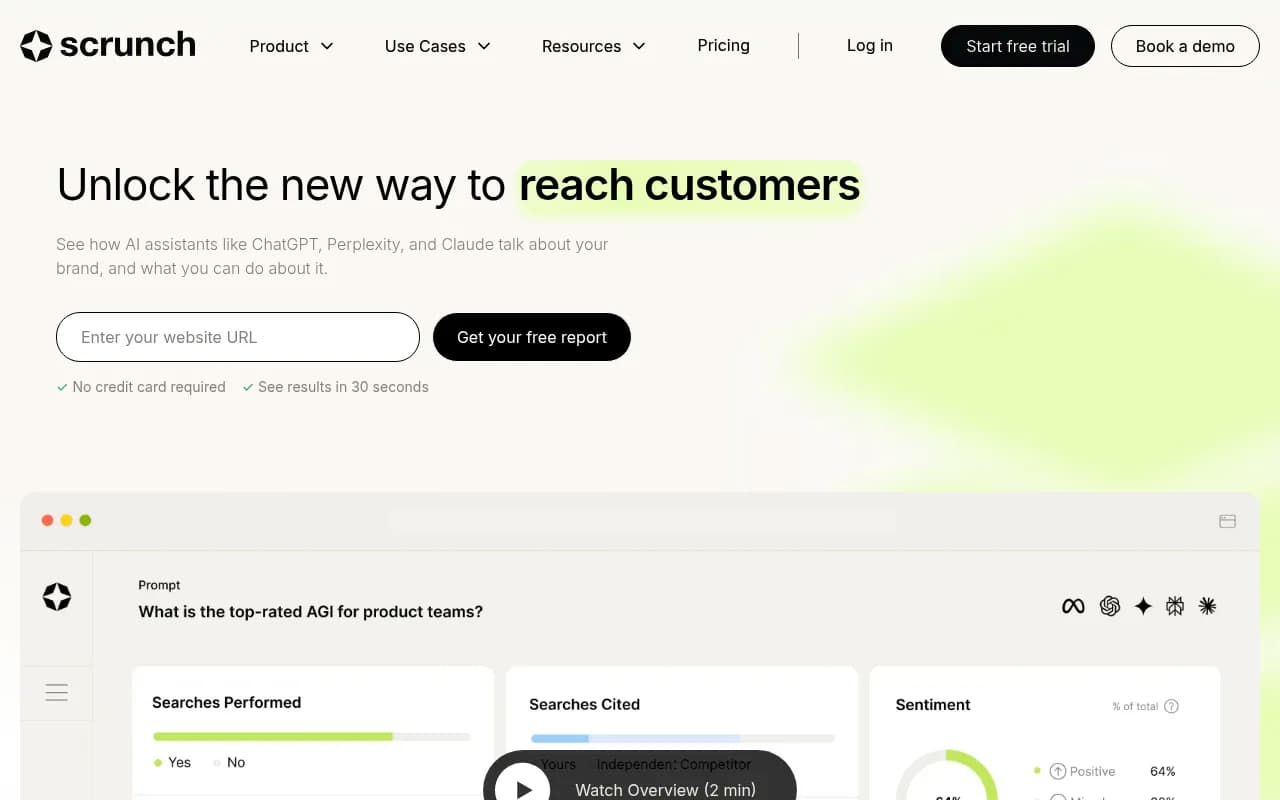
Scrunch positions itself as an "AI Customer Experience Platform" that goes beyond monitoring. The platform tracks how AI assistants like ChatGPT, Perplexity, and Claude mention your brand, then helps you do something about it. Their standout feature is the Agent Experience Platform (AXP) -- essentially a parallel version of your website optimized specifically for AI bot traffic. Scrunch also provides real-time feeds of AI crawler activity, showing exactly when bots hit your site and what errors they encounter.
Pricing starts at $250/mo for the Starter plan (billed annually), with Growth at $417/mo and custom Enterprise pricing. They offer a 7-day free trial, though most features require booking a demo first.
Peec AI

Peec AI takes a more straightforward approach: track brand performance across AI search platforms through three core metrics -- Visibility, Position, and Sentiment. The platform is built for marketing teams who want clean dashboards and competitor benchmarking without the complexity. Peec's strength is multi-language support and the ability to track prompts across different countries, which matters if you operate in non-English markets.
Pricing is more accessible: Starter at €89/mo, Professional at €199/mo, and custom Enterprise plans. They offer a free trial with immediate access -- no demo required.
Side-by-Side Comparison
| Feature | Scrunch | Peec AI |
|---|---|---|
| Starting price | $250/mo (annual) | €89/mo (~$95/mo) |
| Free trial | 7 days (demo required) | Yes (immediate access) |
| AI models tracked | ChatGPT, Perplexity, Claude, Gemini, others | ChatGPT, Perplexity, Gemini, Claude |
| Multi-language support | Limited | Strong (multiple languages + countries) |
| Crawler logs | Yes (real-time feed) | Limited visibility |
| Agent Experience Platform | Yes (AI-optimized site version) | No |
| Custom prompts | Yes | Yes (with tagging) |
| Competitor benchmarking | Yes | Yes |
| Citation analysis | Yes | Yes |
| Error detection | Yes (bot crawl errors) | Basic |
| Sentiment tracking | Yes | Yes (scored 0-100) |
| Position tracking | Yes | Yes (average position) |
Monitoring and analytics
Both platforms cover the basics: track when your brand appears in AI responses, see how often you're cited, compare against competitors. The dashboards look similar -- charts showing visibility trends over time, breakdowns by AI model, prompt-level analytics.
Scrunch's monitoring includes a real-time feed of AI bot activity on your site. You see when ChatGPT's crawler hits your pricing page, when Perplexity scans your blog, when Claude encounters a 404. This is useful for diagnosing indexing issues -- if AI models can't read your content, they won't cite it.
Peec AI focuses on the three-metric framework: Visibility (share of chats mentioning you), Position (average ranking in responses), and Sentiment (how positively you're portrayed). The interface is cleaner and less technical. You can organize prompts with tags, track across different countries, and export data for reporting. But you don't get the granular crawler-level detail that Scrunch provides.
Verdict: Scrunch wins for technical depth and crawler diagnostics. Peec wins for simplicity and international tracking.
Insights and optimization
This is where the platforms diverge.
Scrunch's Insights module analyzes why AI models cite (or don't cite) your brand. You get actionable tips for moving up in rankings, see which external sites AI loves to reference, and spot when bots can't access your content. The optimization suggestions are specific -- "Add structured data to your product pages" or "Fix this broken link that Perplexity keeps hitting."
The Agent Experience Platform takes this further. Instead of just monitoring your existing site, Scrunch lets you create a parallel version optimized for AI consumption. Think of it as a robots.txt file on steroids -- you control what AI models see, how your content is structured for them, and what information they prioritize. This matters because AI bots don't browse websites the way humans do.
Peec AI's insights are more surface-level. You see citation sources, understand which competitors rank higher, and get a sentiment score. The platform tells you what's happening but doesn't dig as deep into the why or how to fix it. There's no equivalent to Scrunch's AXP -- you're monitoring your site as it exists, not creating an AI-optimized version.
Verdict: Scrunch is an optimization platform. Peec is a monitoring platform. If you want to actively improve your AI visibility, Scrunch has more tools. If you just want to track performance, Peec is sufficient.
Multi-language and international support
Peec AI was built with international markets in mind. You can track prompts in multiple languages, monitor how your brand appears in different countries, and see regional variations in AI responses. This is critical if you operate in Europe, Asia, or Latin America -- AI models give different answers depending on language and location.
Scrunch's multi-language support is less developed. The platform works primarily for English-language tracking, with limited visibility into how your brand performs in other markets. If you're a US or UK company focused on English-speaking customers, this isn't a problem. If you need to track German, French, Spanish, or Japanese AI search results, Peec is the better choice.
Verdict: Peec AI wins decisively for non-English markets.
Pricing Comparison
| Plan | Scrunch | Peec AI |
|---|---|---|
| Starter/Entry | $250/mo (annual billing) | €89/mo (~$95/mo) |
| Mid-tier | $417/mo (Growth plan) | €199/mo (~$213/mo) |
| Enterprise | Custom pricing | Custom pricing |
| Free trial | 7 days | Yes (immediate) |
| Annual discount | Required for base pricing | Available |
Scrunch is 2.6x more expensive at the entry level. That $250/mo minimum puts it out of reach for small teams or agencies testing AI visibility tracking for the first time. Peec's €89/mo starter plan is accessible enough to experiment with.
Both platforms offer custom Enterprise pricing for larger organizations. Neither publishes detailed feature breakdowns by tier, so you'll need to contact sales to understand what you're actually getting.
Crawler visibility and technical features
Scrunch provides a real-time feed of AI bot traffic. You see every request from ChatGPT, Perplexity, Claude, and other AI crawlers -- which pages they accessed, response codes, timestamps. This is valuable for technical SEO teams who need to diagnose why AI models aren't indexing certain content.
The error detection feature flags when bots encounter problems: 404s, slow load times, blocked resources, malformed structured data. You can fix these issues before they hurt your AI visibility.
Peec AI doesn't offer this level of crawler visibility. You can see citation sources and understand which pages AI models reference, but you don't get the raw bot traffic logs or error diagnostics.
Verdict: Scrunch is better for technical teams who want to optimize at the infrastructure level.
Ease of use and onboarding
Peec AI has the simpler onboarding. Sign up, add your brand and competitors, define some prompts, and you're tracking within minutes. The interface is clean -- three main metrics (Visibility, Position, Sentiment), straightforward charts, and a prompt library to get started. Marketing teams without technical backgrounds can use it immediately.
Scrunch requires more setup. The platform is more complex, with multiple modules (Monitoring, Insights, AXP) and deeper configuration options. You'll likely need to book a demo to understand what you're looking at. The learning curve is steeper, but you get more control once you're up to speed.
Verdict: Peec AI is easier to start with. Scrunch rewards the investment if you have time to learn it.
Competitor analysis
Both platforms let you benchmark against competitors. You define a set of competitor brands, track the same prompts, and see who ranks higher in AI responses.
Scrunch shows competitor performance across multiple dimensions: visibility by AI model, citation frequency, position in responses, and trending changes over time. The competitor heatmaps are useful for spotting where rivals are winning.
Peec AI presents competitor data in a similar format but with less granularity. You see overall visibility percentages and can compare sentiment scores, but the breakdowns aren't as detailed.
Verdict: Roughly tied. Both platforms cover the basics; neither is dramatically better at competitor tracking.
Pros and cons
Scrunch pros:
- Agent Experience Platform creates AI-optimized versions of your site
- Real-time AI crawler logs and error detection
- Deeper optimization insights and actionable recommendations
- More comprehensive citation analysis
- Better for technical teams who want control
Scrunch cons:
- $250/mo minimum is expensive for small teams
- Steeper learning curve and more complex interface
- Limited multi-language and international support
- Requires demo for full access to features
Peec AI pros:
- €89/mo entry price is 64% cheaper than Scrunch
- Strong multi-language and international tracking
- Clean, simple interface that marketing teams can use immediately
- Free trial with instant access (no demo required)
- Good for teams who just want monitoring without complexity
Peec AI cons:
- No Agent Experience Platform or AI-optimized site creation
- Limited crawler visibility and error diagnostics
- Shallower optimization insights compared to Scrunch
- Fewer technical features for advanced users
Who should pick which tool
Choose Scrunch if:
- You have budget ($250+/mo) and want the most comprehensive platform
- You need the Agent Experience Platform to create AI-optimized content delivery
- Your team includes technical SEO people who will use crawler logs and error detection
- You operate primarily in English-language markets (US, UK, Australia)
- You want to actively optimize your AI visibility, not just monitor it
- You're willing to invest time learning a more complex platform
Choose Peec AI if:
- You're working with a smaller budget and need to start at €89/mo
- You operate in multiple countries or non-English markets
- You want simple monitoring dashboards that marketing teams can use without training
- You need immediate access via free trial without booking demos
- You're testing AI visibility tracking for the first time and want something straightforward
- You don't need deep technical diagnostics or crawler-level data
If you're also tracking how your brand appears across AI search more broadly -- beyond just monitoring -- tools like Promptwatch can complement either platform by adding content gap analysis and AI-optimized content generation to the mix.

Final verdict
Scrunch is the more powerful platform, but Peec AI is the more accessible one. Scrunch's Agent Experience Platform and crawler diagnostics give you tools to actively improve your AI visibility, not just watch it. But that power comes at 2.6x the price and a steeper learning curve.
Peec AI is the smarter choice for most teams starting with AI visibility tracking. The €89/mo entry point is low enough to experiment, the interface is simple enough to use immediately, and the multi-language support matters if you operate internationally. You lose the advanced optimization features, but you get 80% of the value at 40% of the cost.
If you're a larger company with technical resources and budget, Scrunch's additional capabilities justify the premium. For everyone else, Peec AI delivers what you actually need without the complexity you don't.