Key Takeaways
- LLMrefs is significantly cheaper ($79/mo vs $250/mo starting price) and better for small teams or agencies managing multiple clients with tight budgets
- Scrunch includes an Agent Experience Platform (AXP) that lets you create AI-optimized versions of your site -- LLMrefs is monitoring-only
- LLMrefs automatically generates prompt variations from real conversations, while Scrunch requires manual prompt setup
- Both track 8+ AI models, but Scrunch emphasizes real-time bot crawling logs while LLMrefs focuses on keyword ranking trends
- Scrunch targets enterprise brands with deeper pockets; LLMrefs is built for SEO teams and agencies who need fast setup and lower cost
- Neither platform includes built-in content generation -- if you want to close the loop from gap analysis to content creation, tools like Promptwatch add that layer
Overview
Scrunch
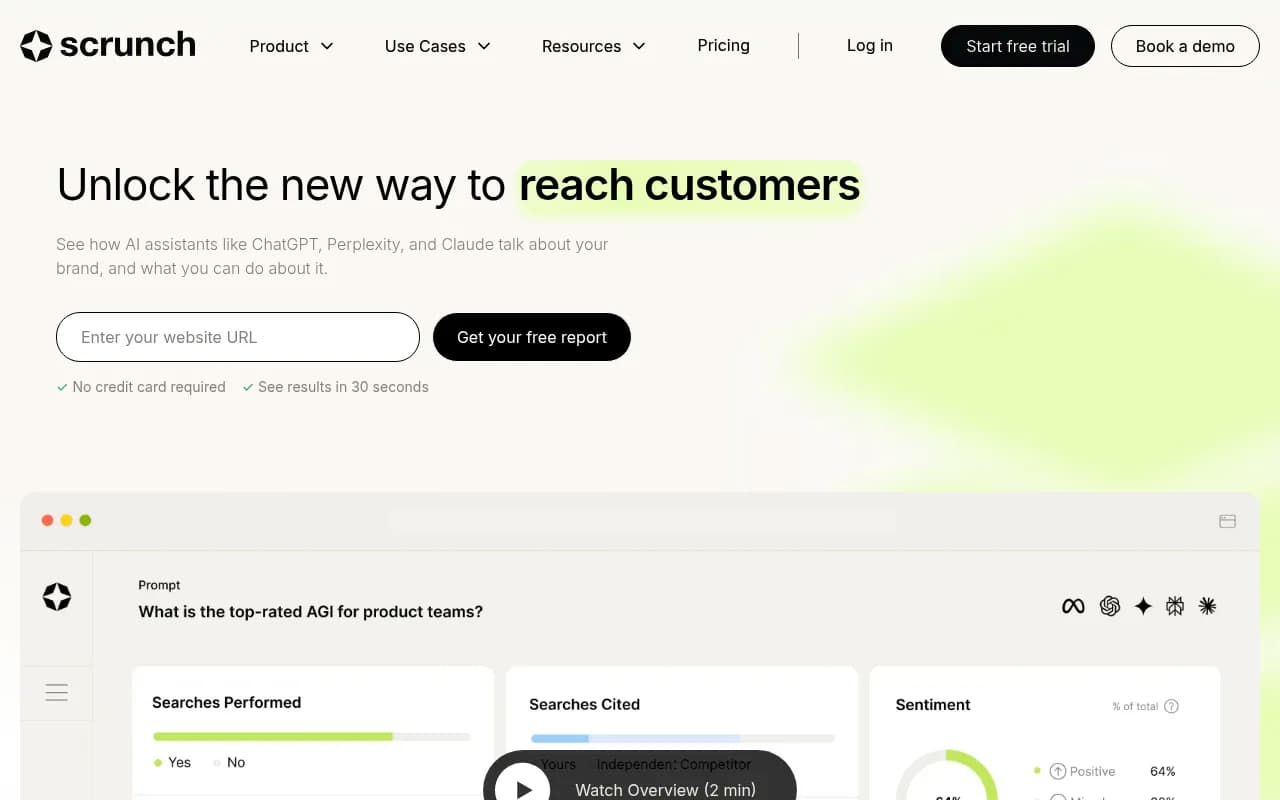
Scrunch positions itself as an "AI Customer Experience Platform" that monitors brand presence across ChatGPT, Perplexity, Claude, and other LLMs. It's used by over 500 companies including Lenovo, Penn State, and Skims. The platform has three main pillars: monitoring (track performance and rankings), insights (understand citations and optimization opportunities), and an Agent Experience Platform that translates your site for AI traffic. Scrunch emphasizes real-time AI bot crawling feeds and error detection. Pricing starts at $250/mo for the Starter plan (billed annually), with Growth at $417/mo and custom Enterprise pricing.
LLMrefs
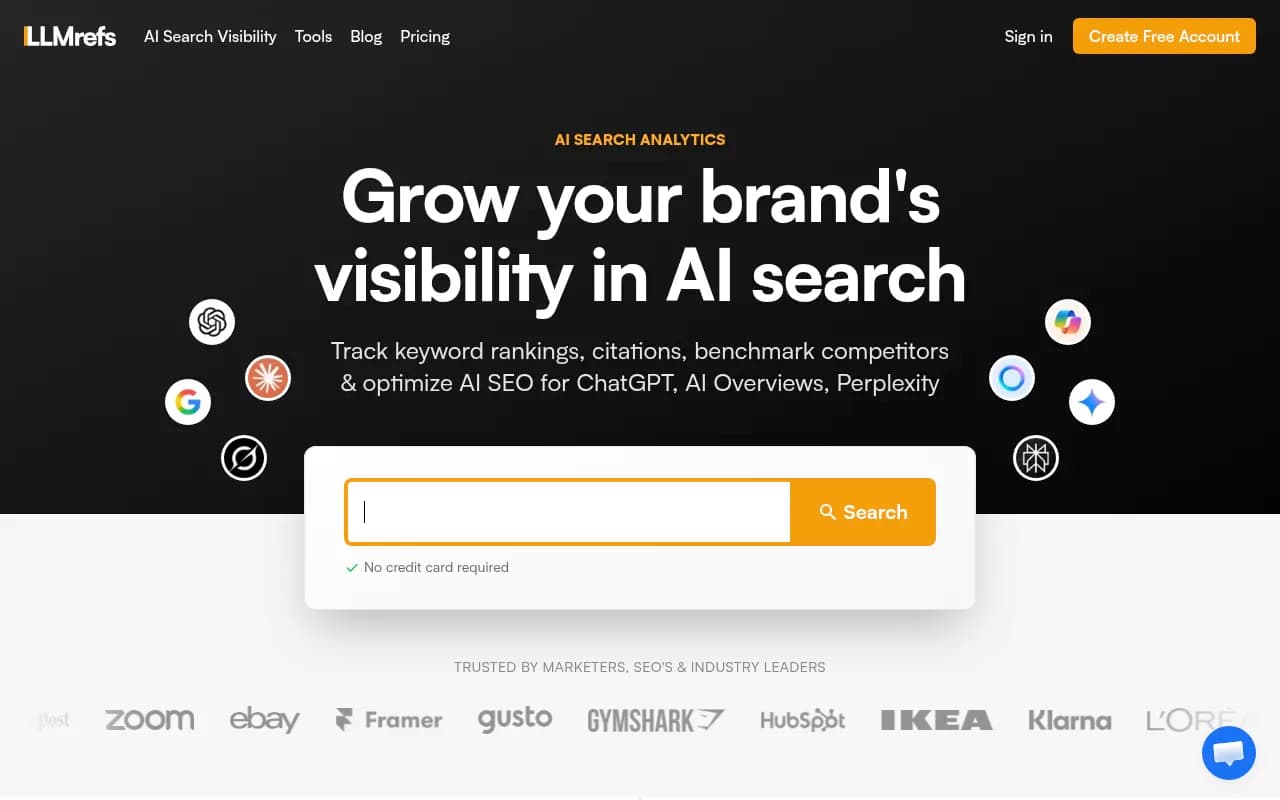
LLMrefs is an AI search analytics platform built for SEO teams and agencies. It tracks keyword rankings, citations, and brand visibility across ChatGPT, Google AI Overviews, Perplexity, Claude, Gemini, and more. The platform automatically generates prompt variations from real conversations, which saves setup time. LLMrefs is used by brands like eBay, Shopify, HubSpot, and The Washington Post. It focuses on ranking trends, competitor benchmarking, and citation analysis. Pricing starts at $79/mo, making it one of the more affordable options in the space.
Side-by-Side Comparison
| Feature | Scrunch | LLMrefs |
|---|---|---|
| Starting price | $250/mo (annual billing) | $79/mo |
| Free trial | 7 days | Yes (no credit card) |
| AI models tracked | 8+ (ChatGPT, Perplexity, Claude, Gemini, Copilot, Meta AI, Grok, AI Overviews) | 8+ (ChatGPT, Perplexity, Claude, Gemini, Copilot, Meta AI, Grok, AI Overviews) |
| Prompt setup | Manual | Auto-generated from real conversations |
| Real-time bot logs | ✓ Yes | ✗ No |
| Citation tracking | ✓ Yes | ✓ Yes |
| Competitor benchmarking | ✓ Yes | ✓ Yes |
| Agent Experience Platform | ✓ Yes (create AI-optimized site versions) | ✗ No |
| Content optimization tips | ✓ Yes | ✓ Yes |
| Error detection | ✓ Yes (bot crawl errors) | Limited |
| Keyword ranking trends | ✓ Yes | ✓ Yes |
| Target audience | Enterprise brands, agencies | SEO teams, agencies, mid-market |
| Setup complexity | Moderate | Low (auto-prompts) |
Pricing comparison
Both platforms use tiered subscription models, but LLMrefs is substantially cheaper at entry level.
| Plan | Scrunch | LLMrefs |
|---|---|---|
| Starter/Basic | $250/mo (annual) | $79/mo |
| Growth/Pro | $417/mo (annual) | Not publicly listed |
| Enterprise | Custom pricing | Custom pricing |
| Free trial | 7 days | Yes (no credit card) |
Scrunch's pricing is roughly 3x higher at the entry point. If you're a small team or agency with budget constraints, LLMrefs is the obvious pick. Scrunch justifies the premium with its Agent Experience Platform and real-time bot monitoring, but you need to actually use those features to get value.
LLM coverage and tracking depth
Both platforms monitor the same core set of AI models: ChatGPT, Perplexity, Claude, Gemini, Google AI Overviews, Copilot, Meta AI, and Grok. This is table stakes in 2026 -- any serious AI visibility tool covers these engines.
The difference is in how they track. Scrunch emphasizes real-time bot crawling logs. You get a live feed showing when ChatGPT, Claude, or Perplexity bots hit your site, which pages they read, and any errors they encounter. This is useful for diagnosing indexing problems -- if AI models can't crawl your site properly, they won't cite you.
LLMrefs focuses more on keyword ranking trends over time. You track how your brand moves up or down for specific prompts, see which competitors are winning, and identify citation patterns. The auto-generated prompt variations are a time-saver here -- LLMrefs pulls real conversation patterns and creates prompt sets automatically, while Scrunch requires you to manually define your tracking prompts.
Verdict: Scrunch wins if you need deep technical visibility into bot behavior. LLMrefs wins if you want fast setup and keyword-focused tracking without manual prompt work.
Prompt and keyword management
This is where the platforms diverge sharply.
Scrunch uses a manual prompt setup model. You define the prompts you want to track, set personas and geographies, and Scrunch monitors how AI models respond. This gives you control but requires upfront work. If you're tracking 50+ prompts across multiple personas, setup takes time.
LLMrefs automatically generates prompt variations from real conversations. The platform analyzes how people actually talk to AI models and creates prompt sets based on those patterns. This is faster and often catches variations you wouldn't think to track manually. The downside: less control over exactly which prompts get monitored.
Both platforms let you track competitors and see which prompts they rank for. Both show citation sources and let you drill into why a competitor is winning.
Verdict: LLMrefs is faster to set up and better for teams that want to move quickly. Scrunch is better if you need precise control over prompt wording and persona targeting.
Agent Experience Platform (Scrunch's differentiator)
This is Scrunch's headline feature and the main reason for its higher price. The Agent Experience Platform (AXP) lets you create a parallel version of your site that's optimized for AI traffic. Think of it as a translation layer -- your human-facing site stays the same, but AI bots get a version that's easier for them to parse and cite.
The AXP addresses a real problem: websites are built for human readers, not AI models. Dense navigation, JavaScript-heavy pages, and scattered information make it hard for AI to extract clean answers. Scrunch's AXP lets you restructure content specifically for AI without touching your main site.
LLMrefs doesn't have anything like this. It's a monitoring and analytics tool, not an optimization platform. You see where you're falling short, but you're on your own to fix it.
Verdict: If you want to actively optimize how AI models see your site, Scrunch's AXP is a unique capability. If you just need visibility and analytics, you're paying for a feature you won't use.
Citation and source analysis
Both platforms show which sources AI models cite when they mention (or don't mention) your brand. This is critical for understanding why competitors rank higher.
Scrunch's citation analysis ties into its insights module. You see which domains AI models trust, which pages get cited most often, and where your content is missing. The platform flags optimization opportunities -- e.g. "Add a comparison table to this page" or "Expand your FAQ section."
LLMrefs also tracks citations and shows competitor source patterns. The interface is more keyword-centric -- you look at a specific prompt, see who ranks, and drill into their citation sources. It's less prescriptive than Scrunch (fewer "do this" recommendations) but gives you the raw data to make your own decisions.
Verdict: Scrunch is more hand-holdy with actionable tips. LLMrefs gives you the data and trusts you to figure out next steps. Both approaches work depending on your team's expertise.
Real-time bot monitoring and error detection
Scrunch includes a real-time feed of AI bot activity on your site. You see when ChatGPT, Claude, or Perplexity crawlers visit, which pages they access, and any errors they hit (404s, timeouts, blocked resources). This is useful for technical SEO teams who want to ensure AI models can index their content properly.
LLMrefs doesn't offer real-time bot logs. It focuses on the output side (what AI models say about you) rather than the input side (how they crawl your site). If a bot can't access your site, you'll eventually see it in your rankings, but you won't get immediate alerts.
Verdict: Scrunch wins for technical teams who need bot-level visibility. LLMrefs is fine if you trust your site is crawlable and just want to track results.
Competitor benchmarking
Both platforms let you track competitors and see how you stack up. You can compare visibility scores, see which prompts competitors rank for, and identify gaps in your coverage.
Scrunch's competitor heatmaps show performance by LLM, persona, and topic. You get a visual breakdown of where you're winning and losing. The interface is polished and enterprise-friendly.
LLMrefs takes a more keyword-focused approach. You track specific prompts, see who ranks in the top 3 or top 5, and analyze their citation patterns. It's less visual but more granular.
Verdict: Scrunch has better visuals for executive reporting. LLMrefs is better for hands-on SEO teams who want to dig into specific keyword battles.
Integration and reporting
Scrunch doesn't publicly list integrations, but the platform is built for enterprise use cases. Expect API access and custom reporting at higher tiers.
LLMrefs also doesn't detail integrations on its public site. Both platforms likely offer API access and export capabilities, but you'll need to ask during a demo.
Neither platform integrates directly with content creation tools. If you want to close the loop from gap analysis to content generation, you'll need a separate tool. Promptwatch fills that gap with built-in AI writing agents that create content grounded in citation data and prompt volumes.

Verdict: Both platforms are analytics-first. Integration ecosystems are unclear without a sales conversation.
Ease of use and setup
LLMrefs wins on setup speed. The auto-generated prompts mean you can start tracking in minutes. The interface is straightforward and keyword-focused, which feels familiar to anyone who's used traditional SEO tools.
Scrunch requires more upfront configuration. You need to define prompts, set personas, and configure tracking parameters. The payoff is more control, but it's a steeper learning curve. The interface is more complex because it's doing more (monitoring, insights, AXP).
Verdict: LLMrefs is faster to get value from. Scrunch is more powerful but demands more setup time.
Pros and cons
Scrunch pros
- Agent Experience Platform lets you optimize site structure for AI without touching your main site
- Real-time bot crawling logs help diagnose indexing issues
- Actionable optimization tips in the insights module
- Enterprise-grade interface and reporting
- Error detection catches bot crawl problems early
Scrunch cons
- 3x more expensive than LLMrefs at entry level ($250/mo vs $79/mo)
- Manual prompt setup takes more time
- Overkill if you just need basic visibility tracking
- Steeper learning curve
LLMrefs pros
- Significantly cheaper starting price ($79/mo)
- Auto-generated prompts save setup time
- Keyword-focused interface feels familiar to SEO teams
- Fast time-to-value
- Used by major brands (eBay, Shopify, HubSpot)
LLMrefs cons
- No Agent Experience Platform or site optimization layer
- No real-time bot crawling logs
- Less prescriptive -- you get data but fewer "do this" recommendations
- Limited public info on integrations and advanced features
Who should pick which tool
Pick Scrunch if:
- You're an enterprise brand with budget for a premium tool ($250+/mo is fine)
- You want to actively optimize how AI models see your site, not just monitor
- Real-time bot monitoring and error detection matter to your technical SEO workflow
- You need polished reporting for executives and stakeholders
- You're willing to invest setup time for more control over prompt tracking
Pick LLMrefs if:
- You're a small to mid-size team or agency with budget constraints
- You want fast setup and auto-generated prompts
- Your focus is keyword ranking trends and competitor benchmarking, not technical bot monitoring
- You're comfortable with a data-first tool that doesn't hold your hand
- You need to track multiple clients or projects without breaking the bank
Consider Promptwatch if:
- You want to go beyond monitoring and actually create content that ranks in AI search
- You need gap analysis that shows exactly which prompts competitors rank for but you don't
- You want an AI writing agent that generates articles grounded in real citation data
- You need crawler logs, prompt volumes, Reddit/YouTube tracking, and ChatGPT Shopping visibility in one platform
- You want to close the loop from visibility tracking to content optimization to traffic attribution
Final verdict
LLMrefs is the better choice for most teams. It's cheaper, faster to set up, and covers the core use case (tracking brand visibility across AI models) without unnecessary complexity. The auto-generated prompts are a real time-saver, and the keyword-focused interface feels natural for SEO teams.
Scrunch makes sense if you have enterprise budget and want the Agent Experience Platform. The ability to create AI-optimized site versions is genuinely unique, and the real-time bot logs are valuable for technical teams. But you're paying 3x more for features that many teams won't fully utilize.
Both platforms are monitoring-first tools. They show you where you're invisible in AI search but don't help you create the content to fix it. If you want an end-to-end solution that goes from gap analysis to content generation to tracking results, look at platforms like Promptwatch that close the action loop.
Bottom line: LLMrefs for budget-conscious teams who need fast visibility tracking. Scrunch for enterprises who want advanced optimization capabilities and don't mind the premium price.