Key Takeaways
- GetMint costs 2x more but includes AI content generation -- Starter at €99/mo vs Hall AI's free tier and likely $50-150/mo paid plans. GetMint writes articles for you; Hall AI doesn't.
- Hall AI offers a free shareable report with no signup -- the easiest way to see how AI talks about your brand right now. GetMint requires paid access from day one.
- GetMint monitors fewer AI engines but goes deeper on optimization -- focuses on ChatGPT, Gemini, Perplexity with content gap analysis and prompt intelligence. Hall AI tracks 8 engines including Claude, Copilot, DeepSeek.
- Both track AI crawler activity, but GetMint shows more granular logs -- Hall AI calls it "agent analytics"; GetMint provides detailed crawler request logs with error tracking.
- GetMint is built for taking action; Hall AI is built for understanding -- GetMint's workflow is find gaps → generate content → track results. Hall AI excels at showing you the current state (citations, sentiment, share of voice) but leaves content creation to you.
- Hall AI has better share-of-voice and sentiment tracking -- explicitly shows how your brand compares to competitors in AI responses and tracks sentiment trends. GetMint has competitor heatmaps but less emphasis on sentiment.
Overview
GetMint
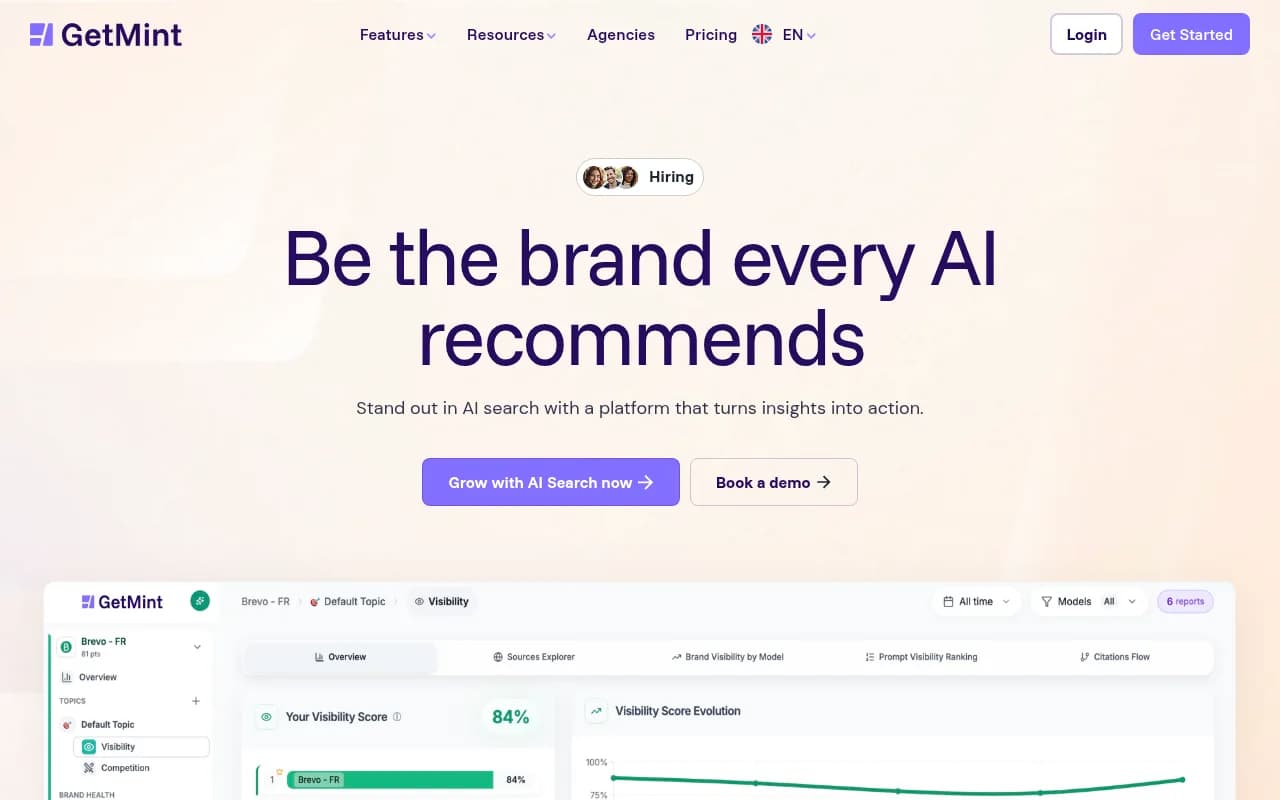
GetMint positions itself as "the first platform for Generative Engine Optimization (GEO)" -- a bold claim in a crowded 2026 market. The pitch: monitor your brand across ChatGPT, Gemini, and other LLMs, then use built-in tools to improve your visibility. The platform covers three core areas: tracking where you appear in AI responses, analyzing content gaps against competitors, and generating optimized content to fill those gaps. Pricing starts at €99/mo for the Starter plan, €229/mo for Growth, and €499/mo for Pro. Free trial available but no permanent free tier.
GetMint's defining feature is the content generation loop. It doesn't just show you where you're invisible -- it helps you write articles, listicles, and comparisons designed to get cited by AI models. The AI writing agent pulls from citation data and competitor analysis to produce content that's supposed to rank in AI search results. Whether that content is actually good enough to publish is another question, but the workflow is there.
Hall AI
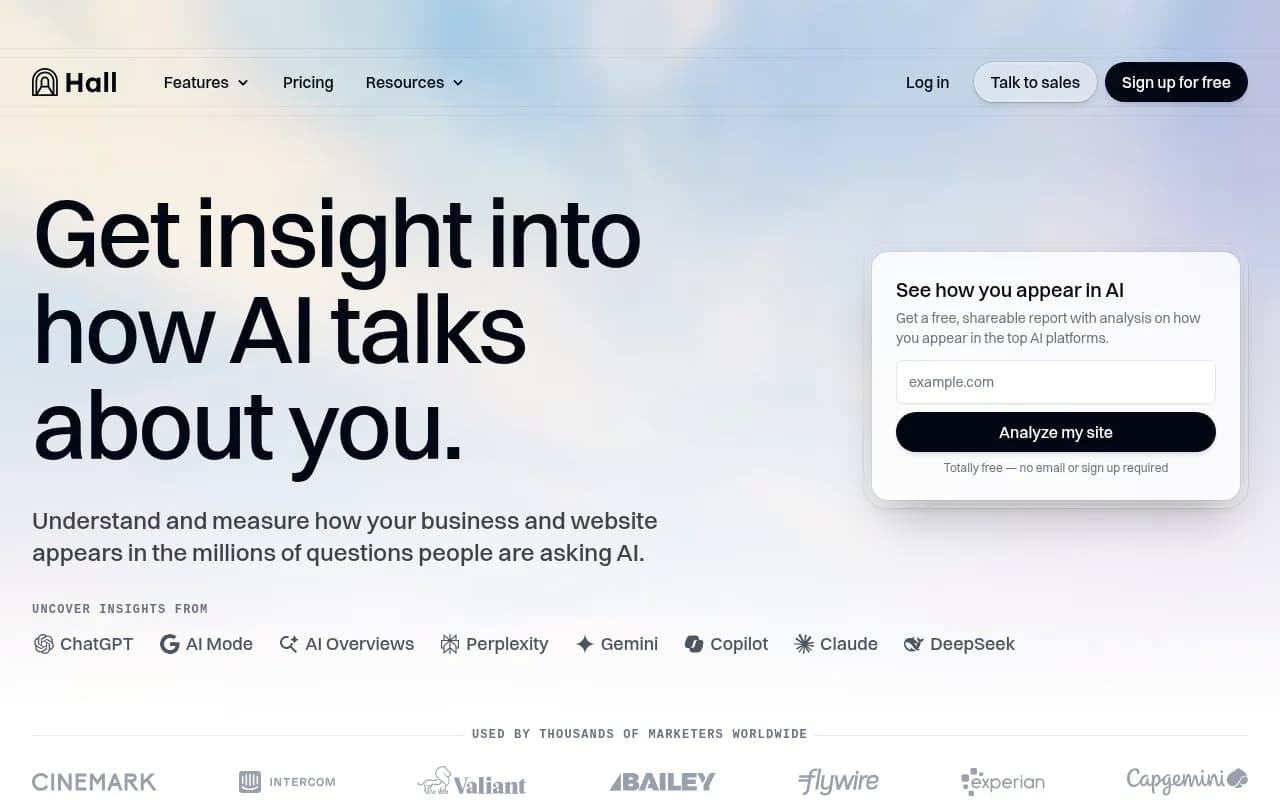
Hall AI takes a different approach: show you exactly how AI platforms talk about your brand, which pages they cite, and how AI agents crawl your site. The platform monitors 8 AI engines -- ChatGPT, Perplexity, Claude, Gemini, Copilot, AI Overviews, AI Mode, and DeepSeek. Hall AI's standout feature is the free shareable report: paste your URL, get a detailed analysis of how you appear in AI conversations, no email or signup required. It's a smart way to let people try before they buy.
The platform emphasizes three pillars: generative answer insights (how your brand appears in AI responses, sentiment, share of voice), website citation insights (which pages get cited and in what contexts), and agent analytics (how AI crawlers browse your site in real time). Hall AI is used by "thousands of marketers worldwide" according to their site, though specific customer names aren't listed. Pricing isn't publicly disclosed beyond "free tier available" and paid plans that likely start in the $50-150/mo range based on competitive positioning.
If you're tracking AI visibility and also want to understand how AI models discover your content in the first place, Promptwatch offers similar crawler log tracking plus content gap analysis and optimization tools in one platform.

Side-by-Side Comparison
| Feature | GetMint | Hall AI |
|---|---|---|
| Starting price | €99/mo (Starter) | Free tier + paid plans (~$50-150/mo) |
| Free tier | No (trial only) | Yes (shareable report, no signup) |
| AI engines tracked | ChatGPT, Gemini, Perplexity, "all major LLMs" | ChatGPT, Perplexity, Claude, Gemini, Copilot, AI Overviews, AI Mode, DeepSeek (8 total) |
| Content generation | ✓ Built-in AI writing agent | ✗ Not included |
| Citation tracking | ✓ Yes | ✓ Yes (detailed page-level) |
| AI crawler logs | ✓ Detailed request logs | ✓ Agent analytics |
| Sentiment analysis | Limited mention | ✓ Explicit sentiment tracking |
| Share of voice | Competitor heatmaps | ✓ Explicit SOV metrics |
| Content gap analysis | ✓ Yes | ✗ Not mentioned |
| Prompt intelligence | ✓ Volume/difficulty data | ✗ Not mentioned |
| Team collaboration | Unknown | Unknown |
| API access | Unknown | Unknown |
| Target audience | Brands wanting content creation + monitoring | Marketers wanting deep visibility insights |
Pricing comparison
| Plan | GetMint | Hall AI |
|---|---|---|
| Free | Trial only | Free shareable report (no signup) |
| Starter/Entry | €99/mo (~$105/mo) | Likely $50-100/mo (not disclosed) |
| Mid-tier | €229/mo (~$243/mo) Growth | Likely $100-150/mo (not disclosed) |
| High-tier | €499/mo (~$530/mo) Pro | Unknown |
| Enterprise | Custom | Unknown |
GetMint's pricing is transparent but steep. €99/mo gets you in the door, but serious usage likely requires the €229/mo Growth plan or higher. Hall AI's opaque pricing is frustrating -- the free report is great for testing, but you can't budget without contacting sales. Based on their positioning as accessible and used by "thousands of marketers," I'd guess their paid plans start around $50-100/mo, making them roughly half the cost of GetMint's entry tier.
The value equation: GetMint charges more because it includes content generation. Hall AI charges less (presumably) because it's monitoring and analysis only. If you already have a content team and just need visibility data, Hall AI's pricing makes more sense. If you're a small team that needs help creating content, GetMint's higher price might be justified.
Feature deep-dive
AI engine coverage
Hall AI wins on breadth: 8 engines explicitly listed including Claude, Copilot, and DeepSeek. GetMint lists ChatGPT, Gemini, Perplexity, and "all major LLMs" -- vague but likely covers the same ground. The practical difference: Hall AI's marketing is clearer about what you're getting. GetMint's "all major LLMs" claim needs specifics.
Both platforms track the engines that matter most in 2026 -- ChatGPT and Perplexity dominate AI search usage, with Gemini and Claude growing fast. DeepSeek's inclusion in Hall AI is forward-looking given its rapid adoption in early 2026. Neither platform mentions Grok or Mistral explicitly, which is a gap if you're targeting those audiences.
Verdict: Hall AI for transparency and confirmed DeepSeek support. GetMint if you trust "all major LLMs" means what you need.
Citation and answer tracking
Both platforms show which pages get cited in AI responses. GetMint calls this part of their monitoring suite. Hall AI breaks it into "website citation insights" (page-level data on what gets cited) and "generative answer insights" (how your brand appears in AI conversations). The distinction is useful -- knowing your page was cited is different from knowing how your brand was positioned in the answer.
Hall AI explicitly tracks sentiment and share of voice. Their dashboard shows how your brand compares to competitors in AI responses and whether the sentiment is positive, neutral, or negative. GetMint mentions competitor heatmaps but doesn't emphasize sentiment tracking in their marketing. If you're in a reputation-sensitive industry (finance, healthcare, legal), sentiment tracking is critical.
Verdict: Hall AI for detailed sentiment and share-of-voice analysis. GetMint if you care more about which pages are cited than how your brand is framed.
AI crawler and agent tracking
GetMint offers "detailed crawler request logs with error tracking" -- you see which AI crawlers hit your site, which pages they read, errors they encounter, and how often they return. This is infrastructure-level visibility. Hall AI calls their version "agent analytics" and frames it as observing how AI agents browse your website in real time, connecting agent activity with conversation data.
The difference is framing more than functionality. GetMint's approach feels more technical (logs, errors, requests). Hall AI's approach feels more analytical (browsing patterns, connection to conversations). Both give you the data to fix indexing issues and understand how AI models discover your content.
One edge for GetMint: error tracking. If AI crawlers are hitting 404s or getting blocked by robots.txt, you need to know. Hall AI's marketing doesn't mention error diagnostics explicitly.
Verdict: GetMint for technical depth and error tracking. Hall AI for connecting crawler activity to actual AI responses.
Content optimization and generation
This is where the platforms diverge completely. GetMint includes an AI writing agent that generates articles, listicles, and comparisons based on citation data and competitor analysis. The workflow: identify content gaps (prompts competitors rank for but you don't), generate content to fill those gaps, track whether AI models start citing your new pages. It's a closed loop.
Hall AI doesn't do content generation. You get the visibility data -- which topics you're missing, which pages competitors have that you don't -- but you're on your own to create content. For teams with writers and editors, this is fine. For small teams or solo marketers, it's a gap.
The quality of GetMint's AI-generated content is the big unknown. AI writing tools in 2026 are good at structure and research synthesis but still produce generic prose unless heavily edited. If GetMint's output needs 30 minutes of editing per article, the time savings shrink. If it's publish-ready, it's a huge advantage.
Verdict: GetMint if you need content creation help. Hall AI if you have a content team and just need data.
Prompt intelligence and gap analysis
GetMint explicitly mentions prompt intelligence: volume estimates, difficulty scores, and query fan-outs that show how one prompt branches into sub-queries. This helps you prioritize high-value, winnable prompts instead of guessing. GetMint also does content gap analysis -- showing which prompts competitors are visible for but you're not.
Hall AI's marketing doesn't mention prompt volume data or difficulty scoring. They focus on showing you the current state (how you appear now, which pages are cited now) rather than helping you decide what to optimize next. This is a strategic difference: GetMint is prescriptive ("here's what to fix"), Hall AI is descriptive ("here's what's happening").
Verdict: GetMint for actionable prioritization. Hall AI if you prefer to make your own strategic decisions based on raw data.
User interface and reporting
Neither platform has detailed UI screenshots in their public marketing, so this is harder to compare. Hall AI's free shareable report is a smart UX move -- it lets prospects see real data about their brand before committing. GetMint requires a trial signup, which is more friction.
Hall AI emphasizes "thousands of marketers worldwide" using the platform, suggesting a focus on accessibility and ease of use. GetMint's marketing is more feature-dense and technical, which could mean a steeper learning curve or just more capabilities packed in.
Verdict: Hall AI for lower-friction onboarding. GetMint if you want depth over simplicity.
Pros and cons
GetMint pros
- Built-in AI content generation saves time for small teams
- Detailed crawler logs with error tracking for technical SEO
- Prompt intelligence (volume, difficulty, fan-outs) helps prioritize work
- Content gap analysis shows exactly what competitors have that you don't
- Closed-loop workflow: find gaps → create content → track results
GetMint cons
- 2x the cost of likely Hall AI pricing with no free tier
- Fewer AI engines explicitly listed (vague "all major LLMs")
- Less emphasis on sentiment and share-of-voice tracking
- AI-generated content quality is unknown -- may need heavy editing
- Higher barrier to entry (trial required, no free report)
Hall AI pros
- Free shareable report with no signup -- easiest way to test
- Tracks 8 AI engines explicitly including Claude, DeepSeek
- Strong sentiment and share-of-voice analysis for reputation management
- Likely 50% cheaper than GetMint based on positioning
- Agent analytics connects crawler activity to AI conversation data
Hall AI cons
- No content generation -- you're on your own to create optimized content
- Opaque pricing (have to contact sales for paid plan details)
- No mention of prompt volume data or difficulty scoring
- Less prescriptive -- shows you the state but doesn't tell you what to fix
- Unknown API access or team collaboration features
Who should pick which tool
Pick GetMint if:
- You're a small team (1-3 people) that needs help creating content, not just tracking visibility
- You want a prescriptive platform that tells you what to optimize and helps you do it
- Technical SEO matters to you -- you need detailed crawler logs and error tracking
- You're willing to pay €229-499/mo for an all-in-one solution
- You prefer depth and control over simplicity
Pick Hall AI if:
- You already have a content team and just need visibility data to inform their work
- You want to test for free before committing (the shareable report is a huge advantage)
- Sentiment analysis and share of voice are critical for your brand (reputation-sensitive industries)
- You're budget-conscious and want to pay $50-150/mo instead of €99-499/mo
- You prefer a descriptive tool that shows you the landscape and lets you make strategic calls
Pick neither if:
- You need a platform that also tracks traditional SEO metrics (rankings, backlinks, keyword volume) -- both GetMint and Hall AI are AI-search-only
- You want a proven enterprise solution with case studies and named customers -- both platforms are relatively new and light on public proof
- You need deep integrations with your existing martech stack -- neither platform lists integrations in their public marketing
Final verdict
GetMint and Hall AI solve different parts of the AI visibility problem. Hall AI is a diagnostic tool: it shows you how AI talks about your brand, which pages get cited, and how crawlers interact with your site. It's excellent at painting a clear picture of your current state, especially sentiment and share of voice. The free report makes it easy to start, and the likely lower pricing makes it accessible.
GetMint is an optimization platform: it shows you the gaps, helps you create content to fill them, and tracks whether it works. The built-in AI writing agent is the key differentiator -- if you're a small team drowning in content needs, GetMint's higher price might be worth it. The prompt intelligence and content gap analysis are also strong if you want the platform to tell you what to do next.
The decision comes down to whether you need help creating content. If yes, GetMint. If no, Hall AI is probably the better value. Both platforms are young enough that features will evolve quickly in 2026 -- check their current capabilities before committing to annual billing.
One-liner: Hall AI tells you the story; GetMint helps you change it.