Key Takeaways
- GetMint starts at €99/mo and focuses on brand visibility monitoring across AI engines, while Rankability starts at $149/mo and is built specifically for SEO agencies managing multiple clients
- Rankability includes a full content production workflow (research, brief, draft, optimize) -- GetMint focuses on monitoring and reputation management with lighter content tools
- GetMint tracks 6+ AI engines including ChatGPT, Perplexity, Gemini, Claude, and Copilot. Rankability covers traditional search plus AI platforms but emphasizes Google alongside AI tracking
- For agencies: Rankability offers white-label reporting, multi-client dashboards, and team seats at $19-29/mo. GetMint's agency features are less developed
- GetMint is European-based (pricing in euros) with GDPR-first approach. Rankability is US-focused with dollar pricing
- Both offer free trials, but Rankability's workflow is more opinionated -- you follow their research-to-publish system. GetMint gives you monitoring data and lets you decide what to do with it
Overview
GetMint
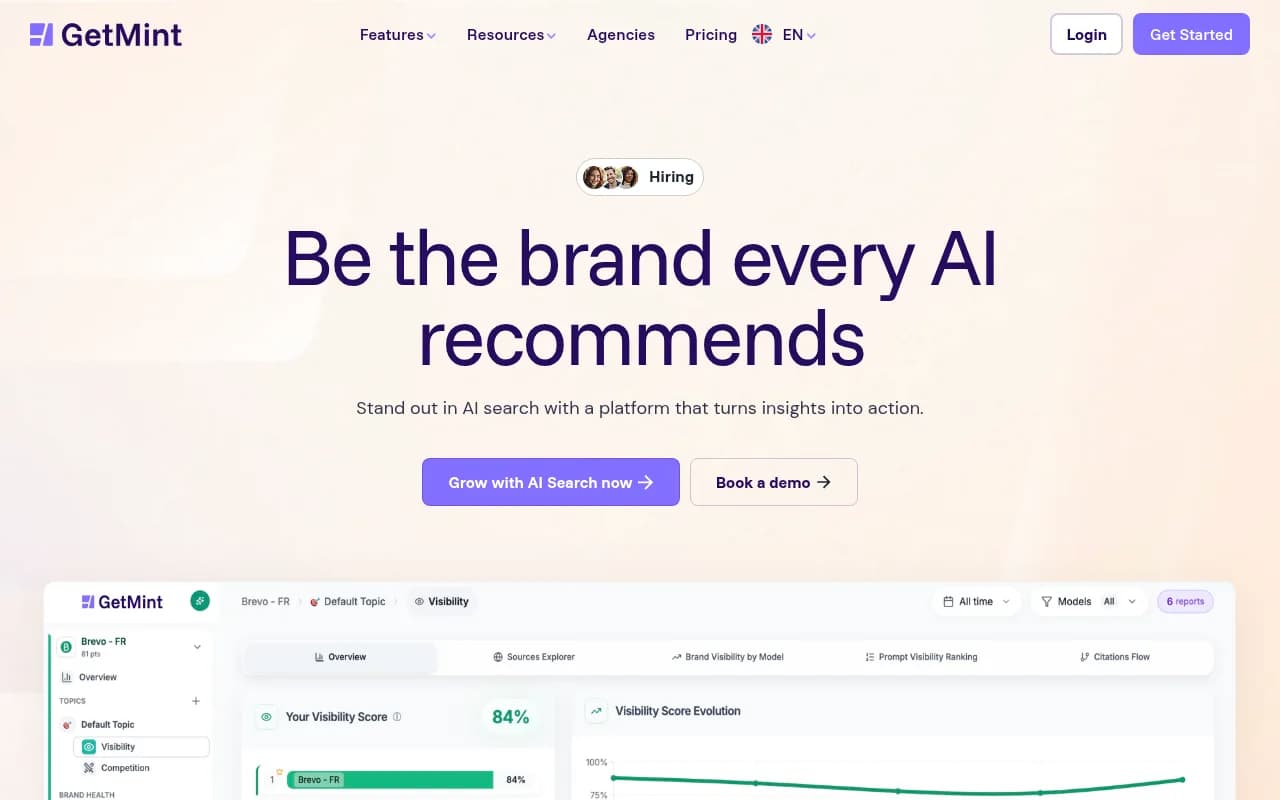
GetMint positions itself as the first platform for Generative Engine Optimization (GEO). The core pitch: monitor how your brand shows up when people ask ChatGPT, Perplexity, Gemini, and other AI engines for recommendations, then improve that visibility with targeted content. It's a European company (pricing in euros, GDPR-compliant infrastructure) that launched to address a specific gap -- brands had no way to know if AI models were recommending them or burying them.
The platform tracks mentions, sentiment, and citation patterns across major LLMs. You can see which prompts trigger your brand, how you're described, and where competitors appear instead. GetMint includes content creation tools to help you fill gaps, but the emphasis is on visibility monitoring and reputation management first.
Rankability
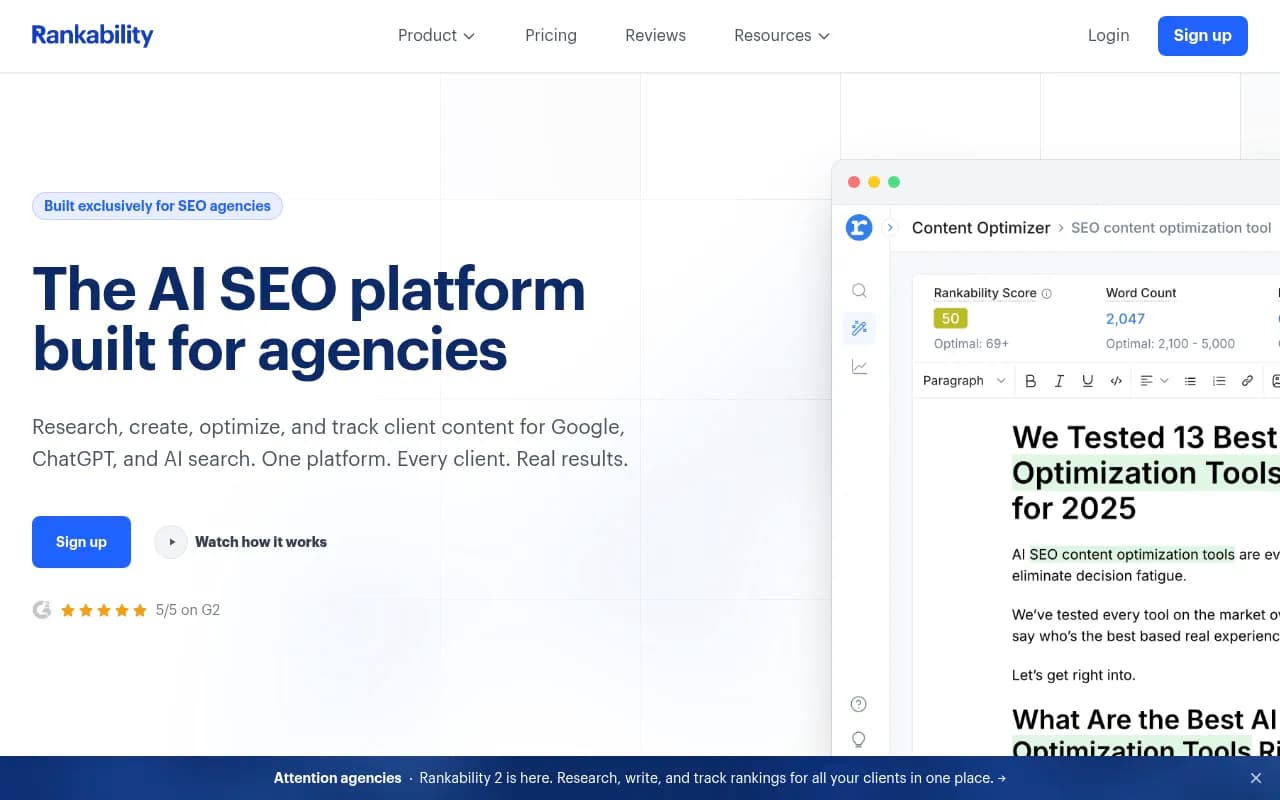
Rankability takes a different angle. It's an agency-focused SEO platform that added AI search tracking as part of a broader workflow. The value proposition: give agencies one system to research keywords, produce optimized content, track rankings in both Google and AI platforms, and report results to clients. It's not just a tracker -- it's a production system.
The platform includes a Researcher for finding opportunities, a Copywriter for drafting content with built-in optimization, an Optimizer for scoring existing pages, and a Reporter for white-label client dashboards. AI visibility tracking sits inside this workflow as one metric among several. Rankability is US-based, built for agencies running 10-50+ client accounts, and priced accordingly.
Side-by-Side Comparison
| Feature | GetMint | Rankability |
|---|---|---|
| Starting price | €99/mo (Starter) | $149/mo (SEO Specialist) |
| Free trial | Yes | Yes |
| AI engines tracked | ChatGPT, Perplexity, Gemini, Claude, Copilot, Meta AI (6+) | Google AI Overviews, ChatGPT, Perplexity, Claude, others |
| Traditional SEO tracking | No | Yes (Google rankings, GSC integration) |
| Content production workflow | Basic content tools | Full workflow (research, brief, draft, optimize) |
| Multi-client management | Limited | Built-in (unlimited clients on all plans) |
| White-label reporting | No | Yes |
| Team collaboration | Basic | Team seats $19-29/mo, role-based access |
| Keyword research | AI-focused prompts | Traditional + AI keyword research |
| Content optimizer | Yes | Yes (scored against competitors) |
| Citation tracking | Yes | Yes |
| Sentiment analysis | Yes | Limited |
| API access | Not mentioned | Not mentioned |
| Target audience | Brands, in-house teams | SEO agencies |
Monitoring and tracking capabilities
AI engine coverage
GetMint monitors 6+ AI platforms: ChatGPT, Perplexity, Google AI Overviews, Gemini, Claude, Copilot, and Meta AI. The focus is entirely on generative AI -- you won't find traditional SERP tracking here. For each engine, GetMint shows you when your brand appears, in what context, and with what sentiment. You can track specific prompts ("best CRM for small business") and see if you're mentioned in the AI's response.
Rankability covers AI platforms but treats them as one part of a broader visibility picture. You get AI mention tracking across ChatGPT, Perplexity, Claude, and Google AI Overviews, but the platform also tracks traditional Google rankings, local pack positions, and featured snippets. The AI tracking is less granular than GetMint's -- you see whether you're mentioned and how often, but the detailed sentiment analysis and citation breakdowns are lighter.
Verdict: GetMint wins for pure AI visibility depth. Rankability wins if you need traditional SEO metrics alongside AI tracking.
Prompt and query tracking
GetMint lets you define custom prompts to monitor. You can track "best project management software for remote teams" or "top accounting firms in Austin" and see exactly how AI models respond. The platform shows prompt volume estimates (how often people ask this), difficulty scores, and historical trends. You can organize prompts into campaigns and track them over time.
Rankability approaches this differently. Instead of custom prompt tracking, it emphasizes keyword research that spans both traditional search and AI contexts. The Researcher tool finds opportunities from Google, YouTube, Reddit, and trending topics, then clusters them into content briefs. You're not tracking individual AI prompts as much as tracking whether your content ranks in Google and gets cited in AI responses for related queries.
Verdict: GetMint is more precise for AI-specific prompt monitoring. Rankability is better for integrated keyword strategy across channels.
Reporting and dashboards
GetMint's dashboards show visibility scores, mention trends, sentiment breakdowns, and competitor comparisons. You can filter by AI engine, date range, and prompt category. The interface is clean but not white-labelable -- it's designed for internal use, not client presentations.
Rankability's Reporter is built for agencies showing results to clients. You get white-label dashboards with custom branding, client-specific visibility scores (Search Performance Index), and automated reporting. The dashboards combine traditional rankings, AI mentions, and AI citations into one view. You can export reports as PDFs or share live links. For agencies billing clients monthly, this is the core value -- one report that explains both Google and AI performance.
Verdict: Rankability dominates for client reporting. GetMint is fine for internal dashboards but lacks white-label options.
Content creation and optimization
Content production workflow
GetMint includes content tools to help you respond to visibility gaps. If you're not showing up for a prompt, you can generate content targeting that query. The tools are AI-powered but not deeply integrated into a workflow -- you get content suggestions and drafts, but you're managing the production process yourself.
Rankability's entire platform is a content workflow. Start in the Researcher to find opportunities. Move to the Copywriter to generate a brief, draft the article, check uniqueness, optimize against competitors, and finalize. The Copywriter grounds drafts in a client Knowledge Base (you upload brand docs, past content, style guides) so output matches the client's voice. The Optimizer scores content against top-ranking pages and AI citation patterns, then suggests specific improvements.
This is the biggest difference between the two platforms. GetMint tells you what's missing. Rankability tells you what's missing and then walks you through creating it.
Verdict: Rankability is a full production system. GetMint is a monitoring platform with content helpers.
Optimization scoring
Both platforms score content, but differently.
GetMint's optimizer focuses on AI visibility -- does this content have the signals that make AI models cite it? You get recommendations around structure, entity coverage, and citation-worthiness. The scoring is AI-centric.
Rankability's Optimizer scores content against both traditional SEO factors (keyword usage, readability, internal linking) and AI citation patterns. You see a composite score and specific suggestions: add this entity, restructure this section, include this data point. The tool compares your draft to top-ranking competitors and shows gaps.
Verdict: Rankability's optimizer is more comprehensive. GetMint's is more specialized for AI.
Agency and team features
Multi-client management
GetMint's agency features are basic. You can manage multiple brands, but there's no dedicated multi-client dashboard or white-label reporting. If you're an agency, you're essentially running separate instances for each client and manually compiling reports.
Rankability is built for agencies managing 10-100+ clients. Unlimited clients on all plans. Each client gets their own workspace with separate keyword tracking, content projects, and reporting. You can switch between clients with one click. Team members can be assigned to specific clients with role-based permissions (admin, editor, viewer).
Verdict: Rankability wins decisively. GetMint isn't designed for agency workflows.
Team collaboration
GetMint supports basic team access but doesn't have granular roles or collaboration features. You can add team members, but everyone sees everything.
Rankability offers team seats at $19-29/mo depending on plan. Each seat gets role-based access (admin can manage billing and clients, editor can create content, viewer can only see reports). The Copywriter includes approval workflows -- drafts move from writer to editor to client review. Comments and version history are built in.
Verdict: Rankability is built for teams. GetMint is built for individuals or small in-house teams.
Pricing comparison
| Plan | GetMint | Rankability |
|---|---|---|
| Entry tier | €99/mo (Starter) | $149/mo (SEO Specialist) |
| Mid tier | €229/mo (Growth) | $249/mo (SEO Expert) |
| Top tier | €499/mo (Pro) | $449/mo (SEO Master) |
| Team seats | Included (unclear limits) | $19-29/mo per additional seat |
| Clients | Limited by plan | Unlimited on all plans |
| AI engines | 6+ | 4+ |
| Content tools | Basic | Full workflow |
| White-label | No | Yes |
| Free trial | Yes | Yes |
| Annual discount | Likely (not specified) | Yes |
GetMint's pricing is in euros, which matters if you're US-based (exchange rates fluctuate). The Starter plan at €99/mo (~$108/mo at current rates) is cheaper than Rankability's $149/mo entry point, but you're getting less -- no traditional SEO tracking, no white-label reporting, no multi-client management.
Rankability's $149/mo SEO Specialist plan includes unlimited clients, which is huge for agencies. Add team seats at $19-29/mo and you have a scalable agency system. GetMint's €499/mo Pro plan is more expensive than Rankability's $449/mo SEO Master plan, and you still don't get white-label reporting or unlimited clients.
Verdict: GetMint is cheaper at the entry level if you only need AI monitoring for one brand. Rankability is better value for agencies managing multiple clients.
Integration and workflow fit
Traditional SEO integration
GetMint doesn't track traditional search rankings. It's AI-only. If you're running SEO campaigns, you'll need a separate tool (Ahrefs, Semrush, etc.) for Google tracking.
Rankability integrates traditional SEO and AI visibility in one platform. You track Google rankings, connect Google Search Console, monitor local pack positions, and see AI mentions side-by-side. For agencies, this means one report instead of stitching together data from multiple tools.
Verdict: Rankability wins if you need both. GetMint is fine if you already have traditional SEO covered.
Content management system compatibility
Neither platform is a CMS. Both generate content that you copy into WordPress, Webflow, or wherever you publish. GetMint doesn't have direct CMS integrations. Rankability doesn't either, but the Copywriter exports optimized HTML that you can paste directly into most CMSs.
Verdict: Tie. Both require manual publishing.
Pros and cons
GetMint pros
- Deep AI visibility tracking across 6+ engines
- Prompt-level monitoring with volume and difficulty scores
- Sentiment analysis for brand reputation management
- European company with GDPR-first approach
- Lower entry price (€99/mo)
- Clean, focused interface
GetMint cons
- No traditional SEO tracking
- Limited agency features (no white-label, weak multi-client support)
- Content tools are basic compared to full production platforms
- Pricing in euros may complicate budgeting for US agencies
- Smaller user base and community compared to established SEO tools
Rankability pros
- Full content workflow from research to publish
- Unlimited clients on all plans
- White-label reporting for agencies
- Combines traditional SEO and AI visibility in one platform
- Strong content optimizer with competitor analysis
- Team collaboration with role-based access
- 5/5 rating on G2
Rankability cons
- Higher starting price ($149/mo vs GetMint's €99/mo)
- AI tracking is less granular than dedicated AI platforms
- Opinionated workflow may feel restrictive if you have your own process
- Team seats cost extra ($19-29/mo)
- Less emphasis on sentiment analysis and brand reputation
Who should choose which tool
Choose GetMint if you:
- Run an in-house marketing team focused on brand visibility in AI search
- Need deep, granular tracking of how AI models mention your brand
- Want prompt-level monitoring with sentiment analysis
- Don't need traditional SEO tracking (you already use Ahrefs, Semrush, etc.)
- Prefer a European vendor with GDPR-first infrastructure
- Manage 1-3 brands and don't need white-label reporting
Choose Rankability if you:
- Run an SEO agency managing 10+ clients
- Need one platform for traditional SEO and AI visibility
- Want a full content production workflow (research, draft, optimize, publish)
- Require white-label reporting and multi-client dashboards
- Have a team that needs role-based access and collaboration features
- Value an opinionated workflow that standardizes output across clients
- Want to consolidate tools and reduce your tech stack
Consider both if you:
- Are an agency that wants best-in-class AI monitoring (GetMint) alongside production tools (Rankability)
- Have the budget to run specialized tools for different parts of your workflow
- Serve clients who specifically care about AI brand reputation (GetMint) and others who care about rankings and traffic (Rankability)
If you're also tracking how your brand appears in AI search results more broadly -- across ChatGPT, Claude, Perplexity, and other models -- Promptwatch offers a complementary angle with citation analysis, crawler logs, and content gap identification that can work alongside either platform.

Final verdict
These tools solve different problems.
GetMint is a specialist AI visibility monitor. If your primary concern is "Does ChatGPT recommend us when people ask for [product category]?" and you want granular, prompt-level tracking with sentiment analysis, GetMint is the better choice. It's built for brand reputation in AI search, not for agencies juggling 50 clients.
Rankability is an agency production system that happens to include AI tracking. If you're an agency that needs to research, produce, optimize, and report on content for multiple clients -- and you want AI visibility as one metric in a broader performance dashboard -- Rankability is the obvious pick. The white-label reporting and unlimited clients make it a no-brainer for agencies.
For solo consultants or small in-house teams: GetMint if you're AI-obsessed, Rankability if you need a full SEO workflow. For agencies: Rankability unless you have a specific client who demands deep AI reputation monitoring, in which case you might run both.