Key takeaways
- GetMint is a solid AI visibility and reputation tracker, but it's monitoring-focused. It doesn't give you server-level AI crawler logs, so you can't see which pages ChatGPTBot, ClaudeBot, or PerplexityBot actually fetch.
- Google Analytics is architecturally blind to AI bots. They don't execute JavaScript, so they never trigger your tracking script. One site logged 10,932 AI crawls in three weeks that GA4 reported as essentially zero.
- Crawler logs answer the "why" behind your visibility scores. If bots hit errors, paywalls, or WAF blocks, no amount of content optimization will get you cited.
- The strongest alternatives with real crawler log monitoring are Promptwatch, Profound, LLM Pulse, and DarkVisitors, plus free DIY options like raw server log parsing and Cloudflare bot analytics.
Why your analytics can't see AI crawlers
Here's the uncomfortable part most marketers haven't internalized yet: AI bots don't execute JavaScript. They fetch raw HTML and leave. Your GA4 tag never fires, no session starts, no cookie gets set. From Google Analytics' point of view, the visit never happened.
This isn't a bug you can patch. It's architecture.
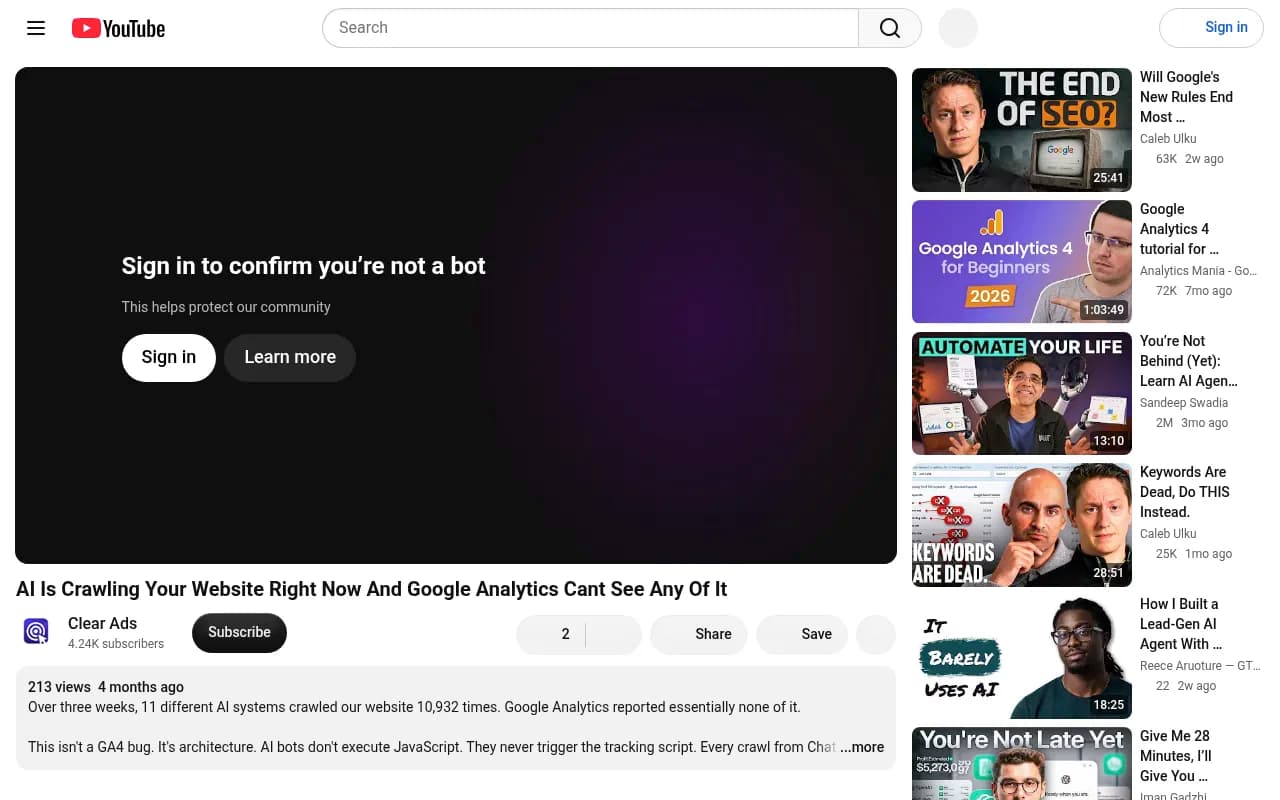
A team at Clear Ads ran the numbers on their own site and the result is worth sitting with: over three weeks in early 2026, 11 different AI systems crawled their website 10,932 times. Google Analytics reported essentially none of it. That works out to roughly 47 AI visits for every human click. ClaudeBot was up 107% over the period, and SearchGPT crawls were up 833% in a single week.
So when people ask "is AI traffic real?" the honest answer is that it's already happening at scale on your site, right now, and you have almost no visibility into it unless you're looking at server logs.
There's a second layer too, and it matters more than raw crawl counts. Being crawled is not the same as being cited. A bot can fetch your page, hit a 403 from your WAF, read a stale cached version, or get blocked by a robots.txt directive you forgot about. Prompt-based monitoring will then show "no citations" forever, no matter how good your content is. Crawler logs are how you find out which of these is happening.
What GetMint does well, and where it stops
GetMint is an AI visibility and reputation management platform. It tells you whether ChatGPT, Gemini, Perplexity, and Claude mention your brand, how sentiment trends over time, and where you stand against competitors. For brand teams that want a mention tracker with reputation context, it does that job fine.
What it doesn't do is connect to your server or CDN and show you the actual crawl traffic. You get the output side of the equation (mentions, sentiment, share of voice) without the input side (what bots fetched, what they read, what errors they hit). That's a real gap in 2026, because the input side is where a lot of visibility problems actually live. A misconfigured robots.txt, an aggressive Cloudflare bot rule, or a JavaScript-rendered page that returns an empty shell to non-browser agents will quietly kill your AI visibility, and a mention tracker will just keep reporting zeros with no explanation why.
If you've hit that wall with GetMint, or you want to prevent it, here are the alternatives worth your time.
What to look for in a crawler-log-capable alternative
Before the list, a quick checklist. Not every tool that claims "AI analytics" actually logs crawler traffic. Some just infer bot activity from citation patterns. You want:
- Real server or CDN log ingestion, ideally via Cloudflare, Fastly, Vercel, Netlify, Akamai, or a custom HTTP endpoint
- Per-page drilldown, not just aggregate bot counts. "ClaudeBot visited 400 times" is trivia. "ClaudeBot fetched this page 12 times and it returned a 403" is a to-do item.
- Error detection, so you catch 4xx and 5xx responses, redirect chains, and robots.txt blocks
- A crawl-to-citation connection, showing which crawled pages eventually get cited and which never do
- Bot coverage beyond the big three. There are 400+ AI crawlers now, including Bytespider, Amazonbot, CCBot, and Meta's agents, and the long tail matters
The best GetMint alternatives with AI crawler log monitoring
1. Profound — enterprise-grade agent analytics
Profound is the enterprise option, and its Agent Analytics feature is genuinely good. It tracks which pages AI crawlers hit and how models reuse your content at the server level, then ties that back to citation and mention data across ChatGPT, Gemini, Perplexity, and Google's AI surfaces. The citation tracking identifies the specific pages AI crawlers reference, which makes it easier to see the crawl-to-citation path for large sites.
The catch is price. Profound sits at the high end of the market, and per the 2026 comparison of 21 GEO platforms, it lacks Reddit citation tracking, ChatGPT Shopping data, and agentic content execution. If you're an enterprise with budget and a dedicated team, it's a strong choice. If you're a mid-market brand or agency, the next option probably fits better.
2. Promptwatch — crawler logs plus the tools to act on them
Promptwatch is the one I'd point most teams toward, because it solves the problem GetMint leaves you with on both ends. On the input side, its Agent Analytics gives you real-time logs of ChatGPTBot, ClaudeBot, PerplexityBot, GoogleOther, Google-Agent, Meta AI, and 400+ other crawlers hitting your site: which pages they read, what errors they encounter, and a citation rate per page. You can pipe logs in through Cloudflare, AWS CloudFront, Fastly, Vercel, Netlify, Akamai, Google Cloud CDN, or a custom endpoint, so it works with basically any stack.
On the output side, it doesn't stop at monitoring. Content gap analysis maps your pages against actual AI responses, Content Agents plan and publish GEO-optimized articles straight to Webflow, Framer, or WordPress, and Unified Actions turns your visibility, citation, and crawler data into a prioritized to-do list. That last part is the difference between knowing ChatGPTBot is hitting a 403 on your key landing page and having something actually fix the content problem behind it.
The numbers back it up: 1,840+ brands and agencies use it, it's rated 4.7/5 on G2, and its dataset covers more than 4.5 billion citations, clicks, and prompts analyzed. Pricing starts at $95/month with a 7-day free trial, and there's a free tier if you just want to poke at it. Compared to Profound it's considerably cheaper, and unlike monitoring-only trackers it includes Reddit and YouTube citation tracking plus ChatGPT Shopping and Ads Radar.
3. LLM Pulse — ChatGPT tracking with crawler data on higher tiers
LLM Pulse positions itself as a ChatGPT-first tracker, and its Agent Analytics feature shows aggregate AI crawler traffic from your own server or CDN logs. The limitation is the plan structure: crawler analytics only unlock on the Scale plan or above, and per-page drilldown through Cloudflare is an Enterprise-only feature. For teams whose primary concern is ChatGPT visibility and who want crawler data as a supporting signal rather than the main event, it's a reasonable middle ground. If per-page crawler detail is the whole reason you're switching away from GetMint, the tier gating may frustrate you.
4. DarkVisitors — the crawler specialist
DarkVisitors takes the opposite approach from most tools on this list: it's purely about tracking AI agents, bots, and LLM referrals visiting your website, not about prompt tracking or brand mentions. Think of it as the crawler-log layer you can bolt onto any visibility tool, including GetMint itself if you want to keep using it for mentions. It also maintains a solid directory of AI agents and user agents, which is handy when you're configuring robots.txt and trying to figure out whether some unfamiliar bot string is worth allowing. The weakness is obvious: no citation tracking, no content optimization, no connection between what bots read and what AI answers say. It's a component, not a platform.
5. ZipTie — visibility analysis with user-facing results
ZipTie doesn't lead with crawler logs, but it earns a spot here for a different reason: instead of relying on API outputs, it tracks user-facing results, capturing what a real customer actually sees in AI answers, including live citations and sentiment trends. That matters because user-facing answers and citations can differ from what APIs return. If your GetMint frustration is less about server logs and more about "the data doesn't match what I see when I open ChatGPT myself," ZipTie is worth a look. Pair it with DarkVisitors or a free crawler log setup and you've covered both sides.
Comparison table
| Tool | Crawler logs | Per-page detail | Crawl-to-citation link | Content optimization | Best for |
|---|---|---|---|---|---|
| GetMint | No | No | No | No | Brand mention and reputation tracking |
| Profound | Yes (Agent Analytics) | Yes | Yes | Limited | Enterprises with budget |
| Promptwatch | Yes (400+ bots, CDN integrations) | Yes, with citation rate per page | Yes | Yes (Content Agents, CMS publishing) | Teams that want to fix issues, not just see them |
| LLM Pulse | Yes (Scale plan and up) | Enterprise only | Partial | No | ChatGPT-focused tracking |
| DarkVisitors | Yes (core feature) | Yes | No | No | Adding a crawler layer to any existing tool |
| ZipTie | No | N/A | Partial | No | Verifying user-facing AI results |
The free, hard way: raw server logs
If budget is the constraint, every web server already records every request, including AI bot visits, in its access logs. Parsing them gives you complete, unfiltered data about AI crawler activity, and it costs nothing but your time.
The workflow looks like this: export your access logs, filter by user agent strings like GPTBot/1.0, ClaudeBot/1.0, OAI-SearchBot/1.0, PerplexityBot, and Google-Extended, then group by URL and response code. Tools like Screaming Frog can do log file analysis if you'd rather not write grep commands. Cloudflare's free tier also gives you basic bot visibility through Bot Management, and its firewall logs show you when a bot rule is blocking an AI crawler you meant to allow.
The honest downside: raw logs tell you what happened but not what to do about it. You'll see that GPTBot fetched your pricing page and got a 301 redirect chain, but connecting that to your citation rate across 200 prompts, prioritizing fixes, and generating replacement content is manual work. That's the gap between free log analysis and a platform like Promptwatch, and it's why most teams that start with raw logs end up buying a tool within a quarter.
How to choose
A few rules of thumb based on what's actually driving your search for a GetMint alternative:
- If you're debugging a visibility problem (citations flat or falling, no idea why), you need crawler logs first. Promptwatch or Profound. Start with Promptwatch's free tier or trial to confirm the diagnosis before committing.
- If you're an enterprise with multiple brands and a dedicated SEO team, Profound's Agent Analytics holds up at scale.
- If you love GetMint's mention tracking and just want the crawler layer added, keep GetMint and bolt on DarkVisitors.
- If your real complaint is that API-based data doesn't match what you see in the actual ChatGPT interface, ZipTie's user-facing tracking addresses that directly.
- If you have zero budget, parse your server logs or use Cloudflare's free bot analytics, and revisit paid tools once you know what you're looking for.
One last thing worth checking before you evaluate anything: pull up your robots.txt and your WAF rules and confirm you're not blocking GPTBot, ClaudeBot, or PerplexityBot by accident. It's the single most common crawler-log finding, it takes five minutes to check, and no tool on this list can help you if the front door is locked.