Key Takeaways
- Otterly.AI is significantly cheaper -- $29/mo entry point vs GetMint's €99/mo, making it the budget pick for small teams or solo marketers
- GetMint includes AI content creation tools built into the platform; Otterly.AI focuses purely on monitoring and auditing
- Both track the same core AI engines (ChatGPT, Perplexity, Google AI Overviews, Gemini, Copilot), but neither offers crawler logs or real-time indexing insights
- Otterly.AI's GEO Audit analyzes 25+ on-page factors; GetMint emphasizes reputation management and brand positioning
- Neither platform provides prompt volume data, difficulty scoring, or Reddit/YouTube citation tracking -- if you need those, Promptwatch covers that ground
- GetMint uses euro pricing and appears more Europe-focused; Otterly.AI uses dollar pricing and targets a broader market
Overview: Two monitoring platforms with different angles
Otterly.AI

Otterly.AI positions itself as the affordable entry point into AI search monitoring. It tracks brand mentions and website citations across six major AI platforms: ChatGPT, Google AI Overviews, Perplexity, Google AI Mode, Gemini, and Microsoft Copilot. The platform's core value is visibility tracking -- you see where your brand shows up, which competitors get mentioned, and which of your pages get cited. The GEO Audit feature analyzes your website against 25+ on-page factors to identify what's blocking better AI visibility. Pricing starts at $29/mo for 15 prompts, making it one of the cheapest ways to start monitoring AI search.
Otterly.AI doesn't try to be an all-in-one optimization suite. It's a monitoring dashboard with audit capabilities. You get the data, you get the analysis, but the actual content creation and optimization work happens outside the platform.
GetMint
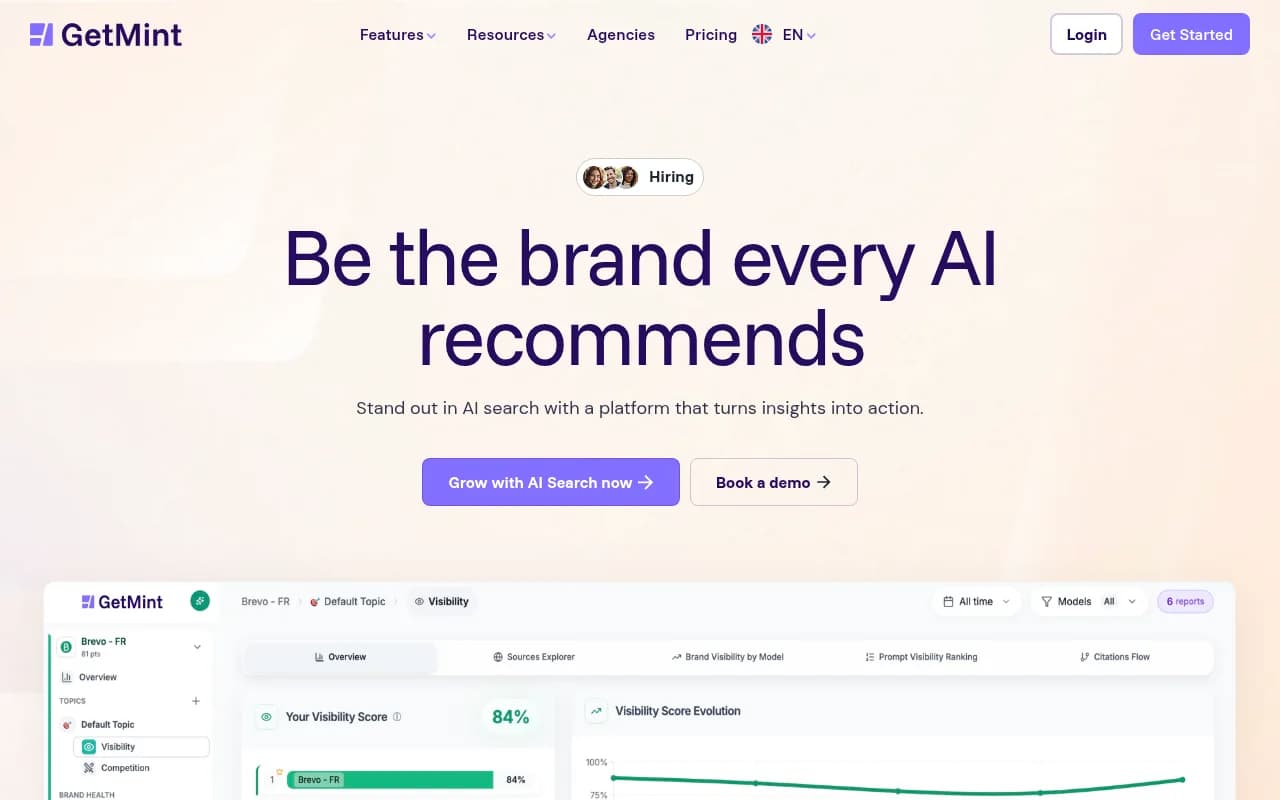
GetMint calls itself "the first platform for Generative Engine Optimization" and takes a broader approach. It monitors the same AI engines as Otterly.AI but adds content creation tools directly into the platform. The pitch is reputation management and brand positioning -- not just tracking where you appear, but actively shaping what AI models say about you. Pricing starts at €99/mo (roughly $108 at current exchange rates), positioning it as a mid-tier option.
GetMint's differentiator is the integrated content workflow. You identify gaps, then use their AI writing tools to generate optimized content without leaving the platform. Whether that's worth the price premium over Otterly.AI depends on how much you value having everything in one place versus using separate tools for monitoring and content creation.
Side-by-side comparison
| Feature | Otterly.AI | GetMint |
|---|---|---|
| Starting price | $29/mo | €99/mo (~$108) |
| Free trial | 14 days | Yes (duration not specified) |
| AI engines monitored | 6 (ChatGPT, Perplexity, AI Overviews, AI Mode, Gemini, Copilot) | 6+ (same core engines) |
| Prompt limits (entry tier) | 15 prompts | Not specified |
| Content creation tools | No | Yes (AI writing assistant) |
| GEO audit | Yes (25+ factors) | Yes (approach differs) |
| Competitor tracking | Yes | Yes |
| Citation tracking | Yes | Yes |
| Brand mention alerts | Yes | Yes |
| Crawler logs | No | No |
| Prompt volume data | No | No |
| Reddit/YouTube tracking | No | No |
| API access | Not mentioned | Not mentioned |
Monitoring capabilities: Same engines, different depth
Both platforms track the big six AI search engines. You connect your brand, add prompts you care about, and the platform runs those prompts across ChatGPT, Perplexity, Google AI Overviews, Google AI Mode, Gemini, and Copilot. You see which engines mention your brand, which competitors show up, and which URLs get cited.
Otterly.AI presents this as a straightforward monitoring dashboard. You get visibility scores, share of voice metrics, and citation counts. The interface shows you where you rank for each prompt across each engine. It's clean and focused -- no feature bloat, just the core tracking data.
GetMint covers the same ground but frames it through a reputation management lens. The dashboard emphasizes brand positioning and sentiment alongside raw citation counts. You see not just whether you're mentioned, but how you're positioned relative to competitors.
Neither platform offers real-time crawler logs showing when AI engines actually visit your website. They don't track which pages AI bots read, how often they return, or what errors they encounter. That's a significant gap if you're trying to diagnose indexing issues or understand how AI models discover your content. Tools like Promptwatch fill that gap with live crawler monitoring.

Both also lack prompt intelligence features -- no volume estimates, no difficulty scores, no query fan-outs showing how prompts branch into sub-queries. You're choosing prompts based on intuition rather than data about which prompts actually matter.
Content optimization: Audit vs creation
This is where the platforms diverge most clearly.
Otterly.AI's GEO Audit approach
Otterly.AI gives you a GEO Audit tool that analyzes your website against 25+ on-page factors. It looks at things like content structure, entity mentions, topical authority signals, and technical elements that influence whether AI models cite your pages. You get a scored report showing strengths and weaknesses.
The audit tells you what's wrong. It doesn't help you fix it. You take the findings and go optimize your content manually, or use other tools to generate new content. Otterly.AI stays in its lane as a monitoring and diagnostic platform.
GetMint's integrated content tools
GetMint includes AI writing tools directly in the platform. Once you identify gaps or opportunities, you can generate optimized content without switching tools. The content generator is trained on GEO best practices -- it understands what AI models look for when deciding which sources to cite.
This is convenient if you want everything in one place. It's also limiting if you already have a content workflow you like or if you need more sophisticated content generation than GetMint's built-in tools provide. The quality and flexibility of GetMint's content generator isn't clear from their marketing materials -- you'd need to test it yourself.
For teams that want monitoring, gap analysis, and content generation in a single integrated loop, platforms like Promptwatch offer that workflow with content grounded in 880M+ citations analyzed, plus prompt volumes and competitor data to guide what to write.
Pricing breakdown
| Plan | Otterly.AI | GetMint |
|---|---|---|
| Entry tier | $29/mo (Lite: 15 prompts) | €99/mo (Starter) |
| Mid tier | $189/mo (Standard: 100 prompts) | €229/mo (Growth) |
| High tier | Custom (Premium: unlimited prompts) | €499/mo (Pro) |
| Free trial | 14 days | Yes |
| Annual discount | Not specified | Not specified |
Otterly.AI wins on price. $29/mo gets you in the door with 15 prompts -- enough to monitor a handful of key queries and see if AI search matters for your brand. The $189/mo Standard plan with 100 prompts is reasonable for a small marketing team tracking a broader set of queries.
GetMint starts at €99/mo (roughly $108), which is 3.7x more expensive than Otterly.AI's entry tier. You're paying for the integrated content tools and the reputation management framing. Whether that's worth it depends on how much you value convenience over cost.
Both platforms offer custom enterprise pricing for larger teams. Neither publishes details about what you get at the enterprise level -- you have to contact sales.
User experience and workflow
Otterly.AI keeps things simple. You add prompts, the platform runs them, you check the dashboard to see results. The GEO Audit gives you a to-do list of fixes. The workflow is: monitor, audit, then go optimize elsewhere.
GetMint tries to close the loop by keeping you in the platform for content creation. The workflow is: monitor, identify gaps, generate content, publish, monitor again. This is smoother if the content tools are good. It's frustrating if they're not, because you're paying for a feature you don't use.
Neither platform has a steep learning curve. Both are dashboard-based tools where you spend most of your time looking at charts and tables. The complexity comes from interpreting the data and deciding what to do about it, not from navigating the interface.
What's missing from both platforms
Both Otterly.AI and GetMint are monitoring-first tools. They show you where you stand but leave significant gaps in the optimization workflow:
- No crawler logs or indexing diagnostics
- No prompt volume data or difficulty scoring
- No Reddit or YouTube citation tracking
- No ChatGPT Shopping monitoring
- No traffic attribution to connect AI visibility to actual revenue
- Limited competitor analysis beyond basic share of voice
These aren't fatal flaws for basic monitoring, but they limit how actionable the platforms are. You see the problem, but you're missing context about which problems matter most and how to prioritize fixes.
Pros and cons
Otterly.AI pros
- Cheapest entry point in the AI monitoring space ($29/mo)
- Clean, focused interface without feature bloat
- GEO Audit provides concrete on-page optimization guidance
- 14-day free trial to test before committing
- Tracks all major AI search engines
Otterly.AI cons
- No content creation tools -- monitoring only
- No prompt intelligence or volume data
- No crawler logs or indexing insights
- Limited competitor analysis depth
- Prompt limits feel restrictive on lower tiers
GetMint pros
- Integrated content creation tools in the platform
- Reputation management framing fits brand-focused teams
- Covers all major AI engines
- Free trial available
- European company if that matters for data residency
GetMint cons
- 3.7x more expensive than Otterly.AI's entry tier
- Content tool quality unclear without hands-on testing
- No crawler logs or prompt intelligence
- Euro pricing may complicate budgeting for US teams
- Less transparent about feature limits on each tier
Who should pick which tool
Pick Otterly.AI if:
- You're on a tight budget and need basic AI visibility monitoring
- You already have content creation tools you like and just need tracking
- You want a simple dashboard without extra features you won't use
- You're testing whether AI search matters for your brand before investing heavily
- You're comfortable taking audit findings and optimizing content manually
Pick GetMint if:
- You want content creation integrated with monitoring in one platform
- You're focused on brand reputation and positioning, not just citation counts
- The price difference doesn't matter and you value convenience
- You don't have existing content tools and want an all-in-one solution
- You prefer working with a European company
Consider alternatives if:
- You need crawler logs and indexing diagnostics -- neither platform offers this
- You want prompt volume data and difficulty scoring to prioritize what to optimize
- You need Reddit and YouTube citation tracking
- You want traffic attribution to connect AI visibility to revenue
- You need a more complete optimization workflow beyond monitoring and basic audits
Final verdict
Otterly.AI wins on price and simplicity. GetMint wins on integrated workflow if you value having content tools in the same platform.
For most small teams or solo marketers just starting with AI search monitoring, Otterly.AI's $29/mo entry point makes it the obvious choice. You get the core monitoring features without paying for content tools you might not need. The GEO Audit gives you enough guidance to start optimizing.
GetMint makes sense if you're already convinced AI search matters, you have budget for a mid-tier tool, and you want to streamline your workflow by keeping everything in one platform. The content creation tools are the main differentiator -- if you don't plan to use them, you're overpaying.
Both platforms are monitoring-first tools that leave gaps in the optimization workflow. They show you where you stand but don't provide the depth of data or tooling to systematically improve. If you need a more complete platform that connects monitoring to content creation to traffic attribution, you'll want to look at tools that close the full optimization loop.