Key Takeaways
- GetMint is significantly cheaper -- €99/mo starter plan vs Omnia's custom pricing (typically higher)
- Omnia focuses heavily on share of voice analytics and competitive benchmarking; GetMint emphasizes content creation tools and reputation management
- GetMint's pricing is transparent with three clear tiers; Omnia requires a sales call for pricing details
- Both track the same core AI engines (ChatGPT, Perplexity, Gemini, Copilot), but GetMint explicitly mentions Google AI Overviews
- Omnia positions itself as "built for SEO and marketing experts" with a more analytics-heavy approach; GetMint calls itself "the first platform for Generative Engine Optimization" with a content-first angle
- Neither platform offers a truly free tier -- both require paid plans after trial periods
Overview
Omnia
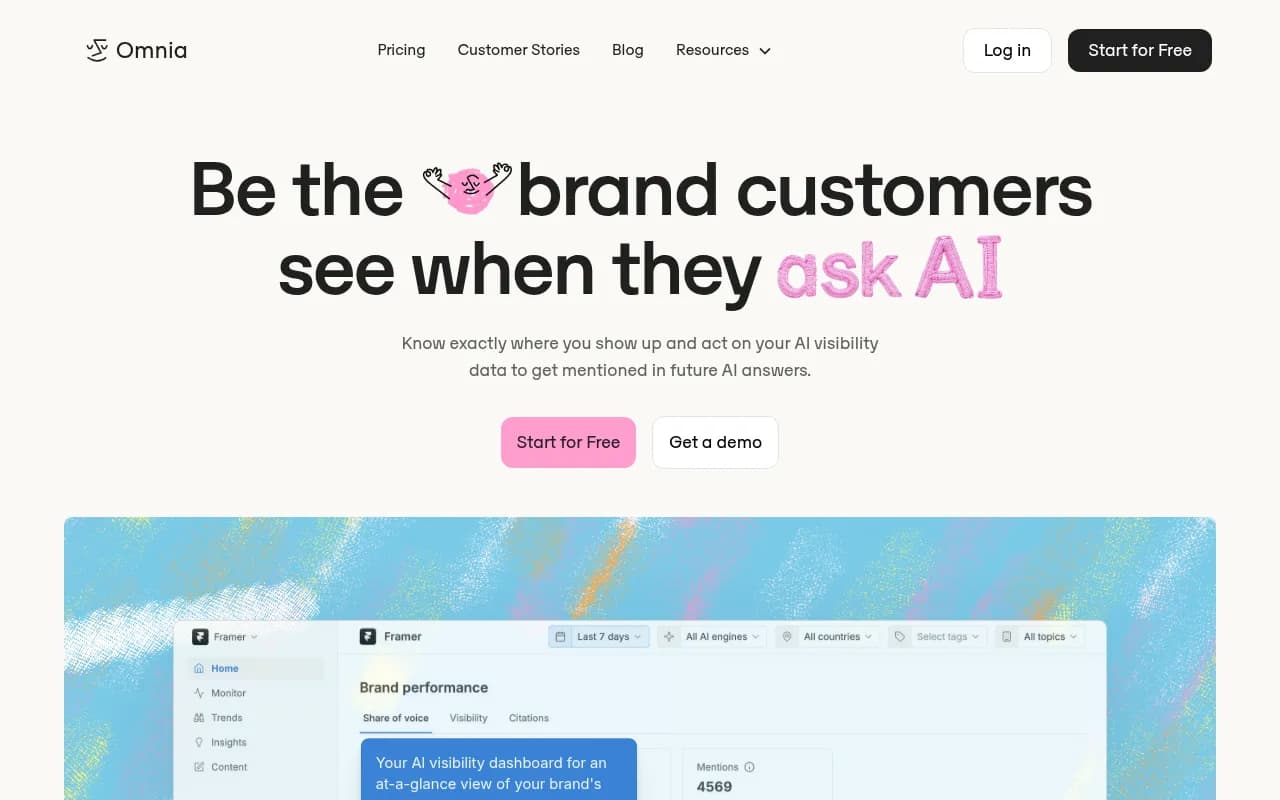
Omnia is an AI visibility platform that zeroes in on share of voice analytics. The pitch: see how your brand stacks up against competitors across AI search engines, understand what citations AI models pull from, and get a roadmap for improving your position. The platform monitors ChatGPT, Perplexity, Gemini, and Copilot, with a focus on competitive benchmarking and citation tracking.
Omnia's website emphasizes three core capabilities: discovering real customer questions, monitoring brand visibility and competitor performance, and translating tracking data into an "AI visibility roadmap" covering content creation, technical SEO, and content placement.
GetMint
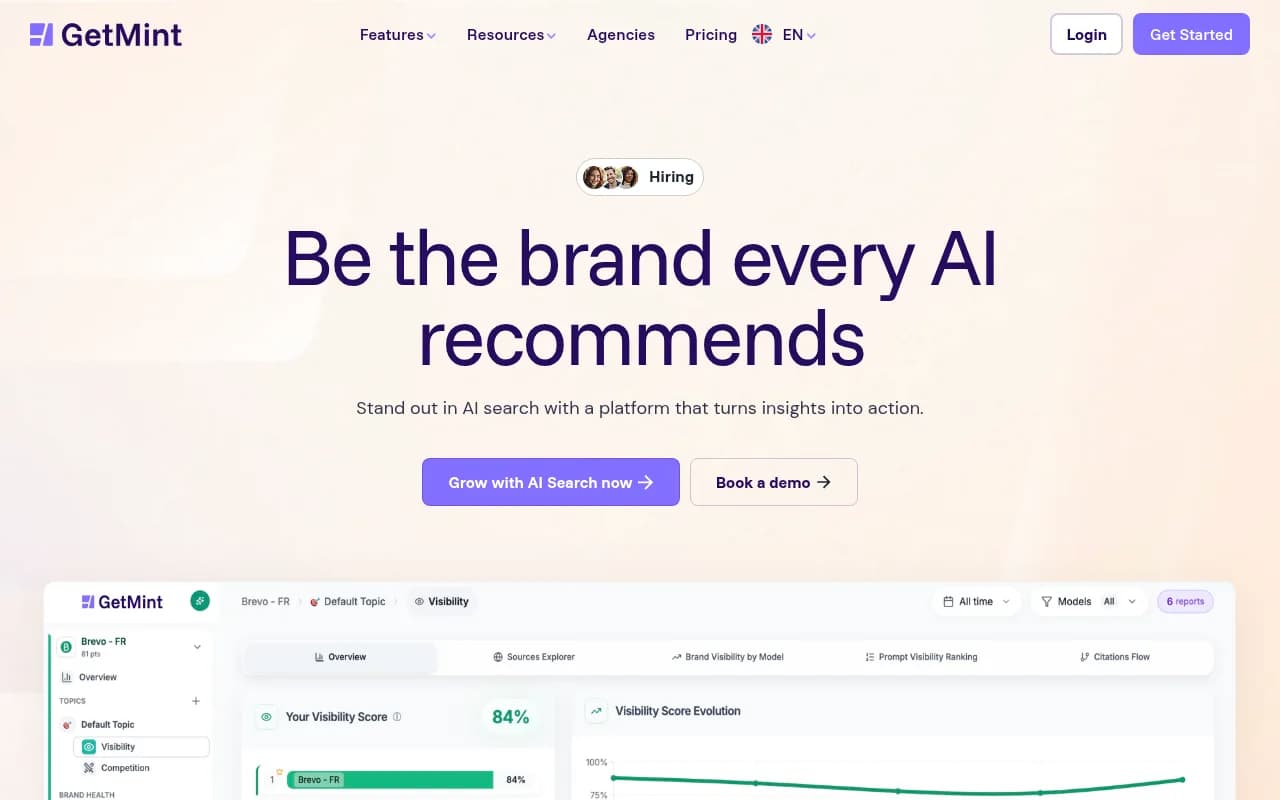
GetMint positions itself as "the first platform for Generative Engine Optimization (GEO)" -- a bold claim in a crowded market. The platform monitors brand presence across ChatGPT, Gemini, Perplexity, Google AI Overviews, and other LLMs, with built-in content creation tools to help you act on the data.
GetMint's angle is reputation management plus optimization. You track where you show up, then use their tools to create content that improves your visibility. Pricing starts at €99/mo for the Starter plan, with Growth (€229/mo) and Pro (€499/mo) tiers above that.
Side-by-Side Comparison
| Feature | Omnia | GetMint |
|---|---|---|
| Starting Price | Custom pricing (sales call required) | €99/mo (Starter) |
| Free Trial | Yes | Yes |
| Free Tier | No | No |
| AI Engines Monitored | ChatGPT, Perplexity, Gemini, Copilot | ChatGPT, Perplexity, Gemini, Copilot, Google AI Overviews, other LLMs |
| Share of Voice Analytics | ✓ (core feature) | ✓ |
| Competitive Benchmarking | ✓ (emphasized) | ✓ |
| Citation Tracking | ✓ | ✓ |
| Content Creation Tools | Roadmap/recommendations | Built-in tools |
| Prompt Discovery | ✓ ("real questions customers ask") | Not explicitly mentioned |
| Pricing Transparency | Low (custom quotes) | High (three public tiers) |
| Target Audience | SEO and marketing experts | Brands focused on AI reputation |
| API Access | Not mentioned | Not mentioned |
| Multi-language Support | Not specified | Not specified |
Pricing comparison
This is where things get frustrating with Omnia. Their website says "Pricing available on request" with a "Pro Plan available for advanced features" -- no numbers, no tiers, just a contact form. GetMint, on the other hand, lays it all out.
| Plan | Omnia | GetMint |
|---|---|---|
| Starter/Entry | Custom pricing | €99/mo |
| Mid-tier | Custom pricing | €229/mo (Growth) |
| High-tier | Custom pricing (Pro Plan) | €499/mo (Pro) |
| Free Trial | Yes | Yes |
| Annual Discount | Unknown | Not specified |
GetMint wins on transparency. You know exactly what you're paying before you talk to anyone. Omnia's custom pricing model might work for enterprise buyers who expect to negotiate, but for smaller teams or agencies trying to budget, it's a barrier.
Worth noting: if you're also looking to track how your brand shows up in AI search results with more advanced capabilities like crawler logs and content gap analysis, Promptwatch starts at $99/mo and includes features both platforms lack -- like real-time AI crawler monitoring and an AI writing agent that generates content grounded in citation data.

User interface and experience
Omnia's screenshots show a clean, analytics-heavy dashboard. The "Trends" view displays prompt volume and share of voice metrics. The "Monitor" section breaks down topic-level visibility with competitor comparisons. The "Insights" area translates data into recommended actions -- content gaps, SEO fixes, placement opportunities.
The interface feels built for people who live in dashboards. Lots of charts, percentages, and competitor heatmaps. If you're an SEO manager or agency analyst, this is your language.
GetMint's website is lighter on interface screenshots, which makes it harder to judge. The emphasis on "content creation tools" suggests a more action-oriented UI -- less time staring at graphs, more time generating and optimizing content. But without seeing the actual platform, it's tough to say how intuitive it is.
Verdict: Omnia shows more of its hand with detailed UI previews. GetMint needs to do the same if they want to compete on transparency.
AI engine coverage
Both platforms cover the big four: ChatGPT, Perplexity, Gemini, and Copilot. GetMint explicitly mentions Google AI Overviews, which is a key channel for brands trying to show up in traditional Google search results enhanced by AI. Omnia doesn't call out AI Overviews specifically, though it's possible they track it under "Gemini" or another label.
Neither platform mentions tracking DeepSeek, Grok, Meta AI, or Mistral -- engines that matter if you're monitoring a global brand or targeting specific demographics. Platforms like Promptwatch cover 10+ AI models, including those newer entrants.
Verdict: Roughly tied, with GetMint slightly ahead for explicitly mentioning AI Overviews.
Share of voice and competitive analysis
Omnia makes share of voice its headline feature. The platform shows you what percentage of AI responses mention your brand vs competitors, broken down by topic, prompt, and AI engine. You can see which competitors dominate specific queries and what citations they're pulling from.
This is Omnia's strength. If your main goal is understanding competitive positioning -- "Are we losing ground to Competitor X in AI search?" -- Omnia's analytics are built for that question.
GetMint also tracks share of voice and competitive benchmarking, but it's not the lead story. The emphasis is more on "be the brand every AI recommends" through content optimization, not just tracking who's winning today.
Verdict: Omnia wins if competitive intelligence is your priority. GetMint is better if you want to track competitors but spend more time fixing your own visibility.
Content creation and optimization
GetMint includes "content creation tools" as a core feature. The website doesn't detail exactly what those tools do, but the implication is clear: you can generate or optimize content directly in the platform to improve your AI visibility.
Omnia offers an "AI visibility roadmap" that recommends content creation, technical SEO, and content placement actions. It's more of a recommendation engine than a content generator. You get the strategy; you execute it elsewhere.
This is a meaningful difference. GetMint wants to be an all-in-one platform where you track and fix visibility in the same place. Omnia wants to tell you what to fix, then you go use your CMS, SEO tools, and content team to do the work.
Verdict: GetMint wins if you want integrated content tools. Omnia wins if you already have a content workflow and just need strategic direction.
Prompt discovery and intelligence
Omnia explicitly highlights prompt discovery: "Know what prompts you should monitor and discover real questions customers are asking about your industry or product." This suggests some kind of prompt research tool or database that surfaces high-value queries.
GetMint doesn't mention prompt discovery on their homepage. That doesn't mean they lack it, but it's not a selling point they're leading with.
For context, advanced platforms like Promptwatch offer prompt intelligence with volume estimates, difficulty scores, and query fan-outs that show how one prompt branches into related sub-queries. That level of detail helps you prioritize which prompts to target first.
Verdict: Omnia appears stronger on prompt discovery, though both platforms could be more transparent about this capability.
Citation and source tracking
Both platforms track citations -- the sources AI engines pull from when they mention your brand or competitors. Omnia's website shows this as part of the "Monitor" feature: "what citations AI engines pull information from."
GetMint mentions monitoring brand presence but doesn't explicitly call out citation tracking in their homepage copy. Again, they might have it, but they're not shouting about it.
Citation tracking is critical. If you know AI models are citing a competitor's blog post or a Reddit thread instead of your site, you know exactly what content to create or where to engage.
Verdict: Omnia is clearer about citation tracking as a feature.
Reporting and integrations
Neither platform mentions API access, Looker Studio integration, Google Search Console sync, or other data export options on their public-facing pages. This is a gap for both.
Agencies and larger teams need to pull AI visibility data into their existing reporting dashboards. If you're stuck exporting CSVs manually, that's a workflow killer.
Verdict: Tie, and both platforms lose points for not addressing this.
Customer base and social proof
Omnia lists 12 customer logos on their homepage: Exoticca, Mio, Ironhack, The Power Business School, Growth Hackers, Iberia Cards, Tuio, Okticket, Europa Press, Pleo, Embat, and Elogia. Mix of European brands, mostly B2C and education.
GetMint's website doesn't show customer logos or case studies. That's a red flag for buyers who want proof the platform works.
Verdict: Omnia wins on social proof.
Pros and cons
Omnia pros
- Strong focus on share of voice and competitive benchmarking
- Prompt discovery feature helps you find high-value queries
- Citation tracking shows exactly what sources AI models use
- Clean, analytics-heavy interface for data-driven teams
- Customer logos provide some social proof
Omnia cons
- No transparent pricing -- requires sales call
- Roadmap recommendations, not built-in content creation tools
- Limited information about API, integrations, or data export
- Doesn't explicitly mention Google AI Overviews or newer LLMs
GetMint pros
- Transparent pricing starting at €99/mo
- Built-in content creation tools for acting on insights
- Explicitly tracks Google AI Overviews
- Positions itself as an all-in-one GEO platform
- Lower barrier to entry for smaller teams
GetMint cons
- No customer logos or case studies on website
- Less detail about prompt discovery and citation tracking
- Fewer UI screenshots make it hard to evaluate the platform
- Unclear what "content creation tools" actually include
Who should pick Omnia
Pick Omnia if you're an SEO manager, marketing director, or agency analyst who lives in competitive intelligence dashboards. You want detailed share of voice breakdowns, competitor heatmaps, and strategic recommendations you can hand off to your content team.
Omnia makes sense if you already have a content creation workflow and just need the data layer. You're comfortable with custom pricing and sales calls. You value analytics depth over integrated content tools.
Also pick Omnia if prompt discovery is critical -- understanding what questions customers are actually asking AI engines, not just tracking your brand mentions.
Who should pick GetMint
Pick GetMint if you're a smaller team or solo marketer who wants to track and fix AI visibility in one platform. You need transparent pricing you can budget for without a sales call. You want content creation tools built in, not just recommendations.
GetMint works if you're focused on reputation management and want to quickly generate content that improves your AI search presence. You're less interested in deep competitive analytics and more interested in "what do I need to publish this week to rank better?"
Also pick GetMint if you're tracking Google AI Overviews specifically -- they call it out, Omnia doesn't.
Final verdict
GetMint wins on accessibility and transparency. €99/mo starting price, clear tier structure, and built-in content tools make it easier to get started and see value fast. Omnia wins on competitive intelligence and analytics depth, but the custom pricing and recommendation-only approach create friction.
For most teams trying to improve AI visibility in 2026, GetMint is the safer bet. You know what you're paying, you can create content in-platform, and the barrier to entry is lower. Omnia makes sense for larger organizations or agencies that need deep competitive analysis and already have content workflows in place.
One sentence summary: GetMint is the accessible all-in-one option; Omnia is the analytics powerhouse for teams that want competitive intelligence and strategic direction.