Key takeaways
- Ceyo AI, Hall AI, Promptmonitor, and Trakkr.ai are all entry-level AI brand trackers aimed at teams who want LLM visibility without enterprise pricing
- All four are primarily monitoring tools -- they show you where you stand, but none close the full loop from gap analysis to content creation to traffic attribution
- Hall AI has the most polished citation UI; Ceyo AI covers the most AI models for its price; Trakkr.ai is the most SMB-friendly; Promptmonitor sits comfortably in the middle
- If you outgrow any of these quickly, that's a signal you need an optimization platform, not just a tracker
- For teams serious about actually improving AI visibility (not just watching it), Promptwatch is worth a direct look
The lightweight AI brand tracker market has gotten crowded fast. Eighteen months ago there were maybe a dozen tools doing this. Now there are dozens more, and a new one seems to launch every few weeks. Most look similar at a glance: connect your brand, set some prompts, watch a dashboard fill up with mentions across ChatGPT, Perplexity, Claude, and Gemini.
But "looks similar" and "works the same" are very different things.
Ceyo AI, Hall AI, Promptmonitor, and Trakkr.ai are four of the more talked-about lightweight options in 2026. They're all targeting roughly the same buyer: a marketing manager or SEO lead who wants to understand AI visibility without committing to a $500+/month platform. So which one is actually worth your time? Let's go through them honestly.
What "lightweight" actually means here
Before comparing, it's worth being clear about what we mean by lightweight. These tools are:
- Priced for small teams or solo marketers (roughly $0-$99/month entry points, with Trakkr.ai at $79/month being the upper end of this group)
- Focused primarily on monitoring -- tracking brand mentions, sentiment, and citation frequency across AI models
- Not built around content generation, gap analysis, or traffic attribution
That's not a criticism. Monitoring is a legitimate starting point. But it does mean you should go in with realistic expectations. These tools will tell you where you stand. Most won't tell you what to do about it.
Ceyo AI
Ceyo AI monitors your brand's visibility across ChatGPT, Perplexity, Claude, and Gemini. For a lightweight tool, the model coverage is genuinely good -- four major LLMs is more than some tools twice the price bother to support.
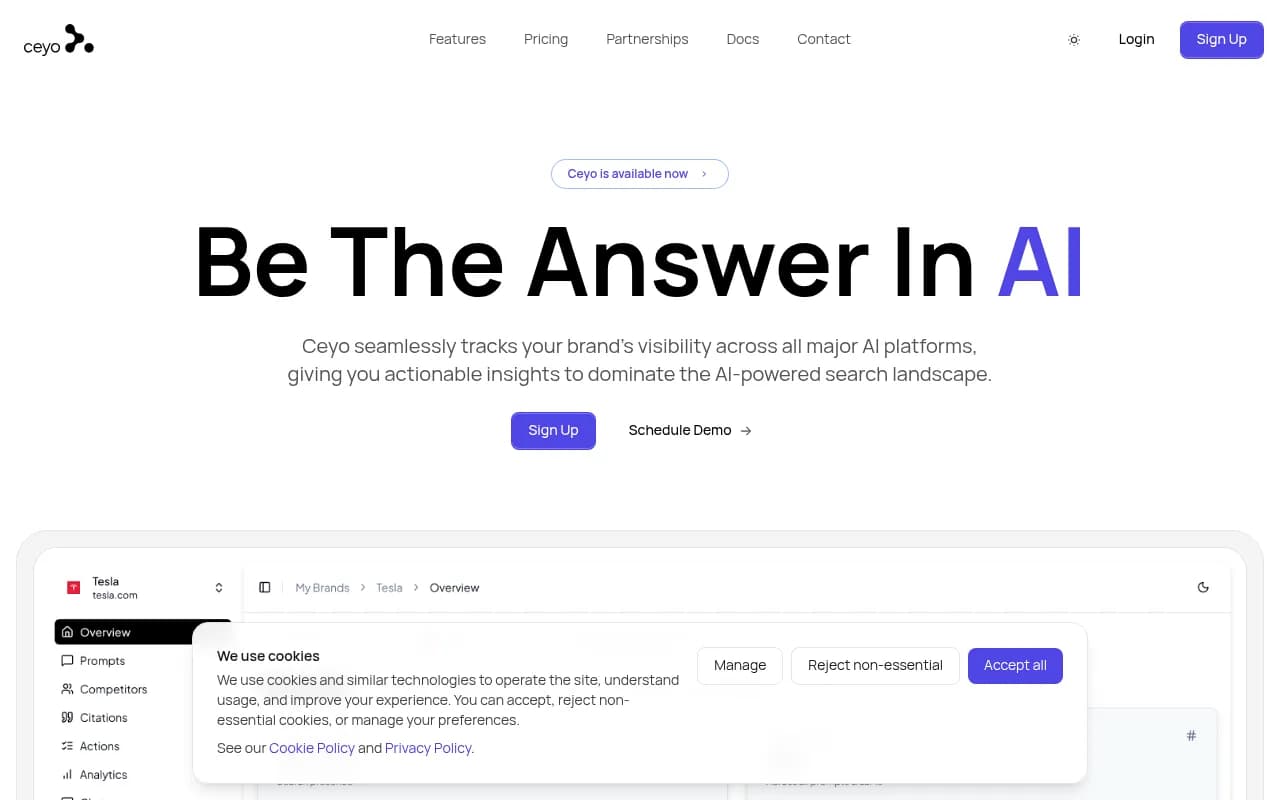
The interface is clean and focused. You set up your brand, define a set of prompts relevant to your category, and Ceyo starts tracking how often and how favorably you appear. Sentiment scoring is included, which helps you spot not just whether you're being mentioned, but whether those mentions are positive, neutral, or negative.
Where Ceyo AI is limited: there's no content gap analysis, no crawler logs, and no way to connect visibility to actual website traffic. You're essentially watching a scoreboard. That's useful context, but it doesn't tell you what to write or fix.
Best for teams who want broad model coverage at an accessible price and are comfortable doing their own analysis on top of the data.
Hall AI
Hall AI (usehall.com) is probably the most polished of the four when it comes to citation tracking. The UI is genuinely well-designed -- you can see exactly which sources AI models are citing when they mention your brand, which is more granular than most lightweight tools bother to provide.

The citation-level detail is Hall AI's real differentiator at this price point. Knowing that ChatGPT is citing a specific competitor's blog post when answering questions in your category is genuinely actionable information -- even if Hall AI doesn't help you act on it directly.
The tradeoff: Hall AI's prompt coverage and model breadth are narrower than Ceyo AI's. And like the others in this group, there's no built-in content generation or gap analysis. You get the data, then you're on your own.
Best for teams who care most about understanding citation sources and want a clean, readable interface to do it.
Promptmonitor
Promptmonitor (promptmonitor.io) sits in the middle of this group -- not the most polished, not the most model-complete, but a solid all-rounder for teams just getting started with AI visibility tracking.
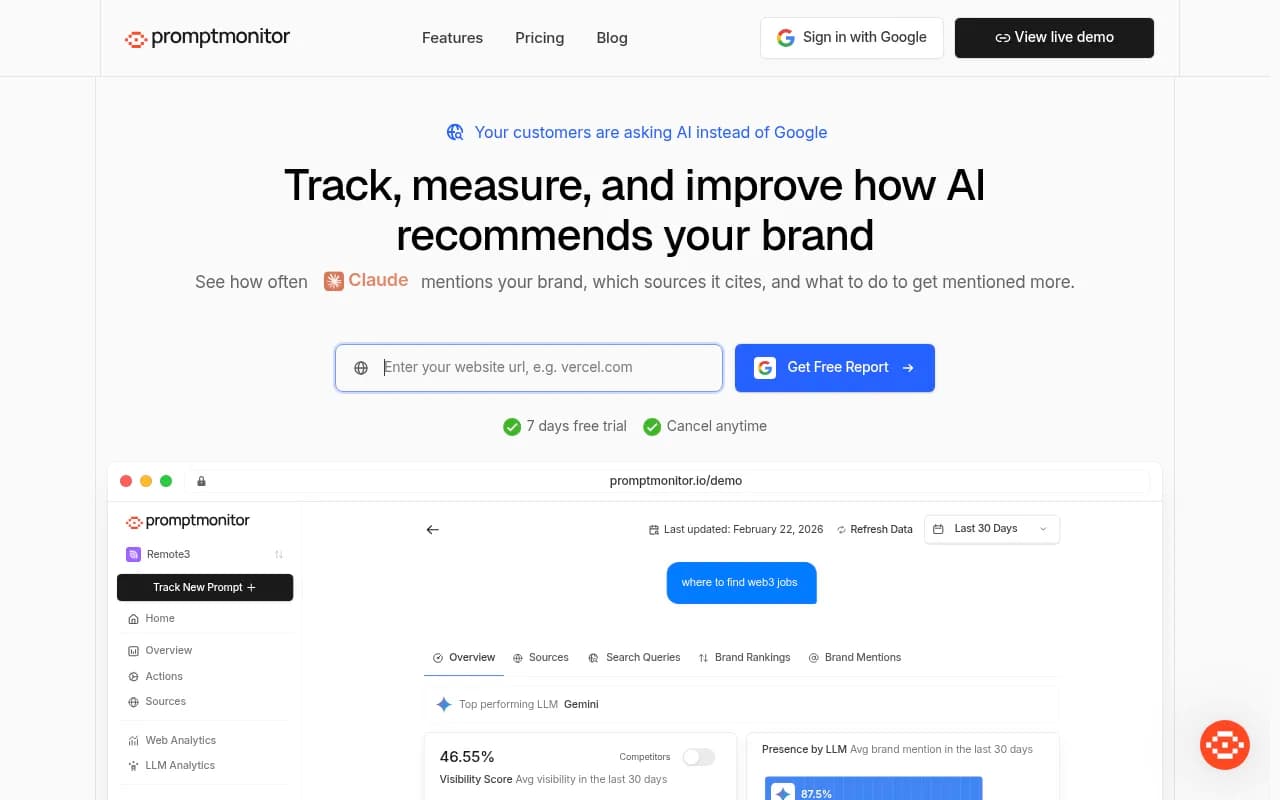
It tracks brand mentions across the major LLMs, provides sentiment analysis, and gives you a reasonable view of how your visibility changes over time. The onboarding is straightforward, and the reporting is clear enough to share with stakeholders who aren't deep in the GEO weeds.
What Promptmonitor doesn't do: anything beyond monitoring. No content tools, no crawler visibility, no traffic attribution. It's a clean tracker, nothing more.
Best for teams who want a no-fuss starting point and aren't yet sure how deeply they'll invest in AI visibility work.
Trakkr.ai
Trakkr.ai is the most SMB-oriented of the four, and it shows. The setup is fast, the dashboard is approachable, and the pricing ($79/month with a 14-day free trial) is positioned squarely at small business owners and solo marketers who want to understand AI visibility without a steep learning curve.
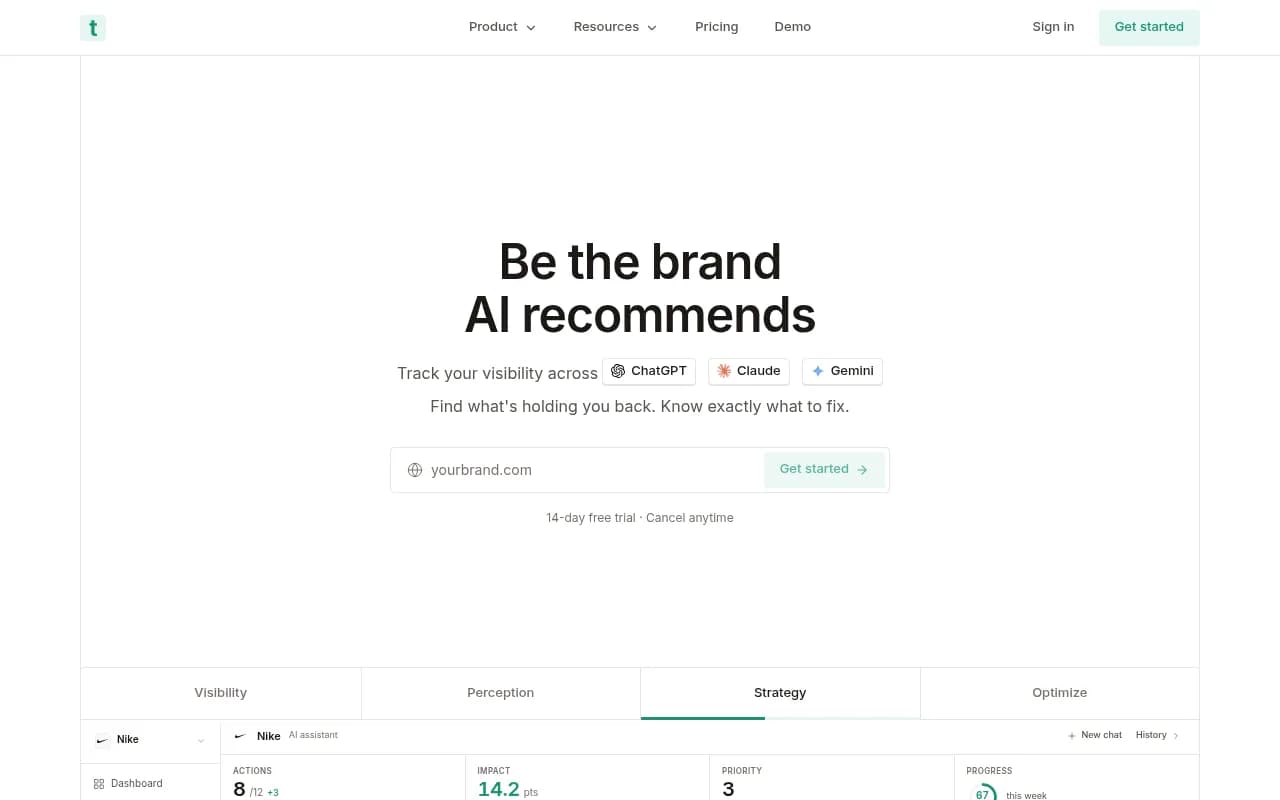
Trakkr.ai covers the main AI platforms and gives you prompt-level tracking -- you can see which specific questions your brand shows up for (or doesn't). The 14-day free trial is a genuine advantage here; you can validate whether the tool is picking up your brand before committing.
The limitations are similar to the others: monitoring-only, no content generation, no gap analysis. Trakkr.ai is honest about being a tracker, and for its price point, it delivers on that promise reasonably well.
Best for small businesses and solo marketers who want a quick, affordable way to check their AI visibility pulse.
Side-by-side comparison
Here's how the four tools stack up across the dimensions that matter most for a lightweight tracker:
| Feature | Ceyo AI | Hall AI | Promptmonitor | Trakkr.ai |
|---|---|---|---|---|
| AI models covered | ChatGPT, Perplexity, Claude, Gemini | ChatGPT, Perplexity, Claude | ChatGPT, Perplexity, Gemini | ChatGPT, Claude, Perplexity |
| Citation source tracking | Basic | Detailed | Basic | Basic |
| Sentiment analysis | Yes | Yes | Yes | Yes |
| Prompt-level tracking | Yes | Yes | Yes | Yes |
| Content gap analysis | No | No | No | No |
| AI content generation | No | No | No | No |
| Crawler logs | No | No | No | No |
| Traffic attribution | No | No | No | No |
| Free trial | Yes | Yes | Yes | 14 days |
| Starting price | ~$49/mo | ~$49/mo | ~$39/mo | $79/mo |
| Best for | Broad model coverage | Citation detail | All-round simplicity | SMBs |
What all four are missing
It's worth being direct about the shared gap here, because it affects every tool in this category.
Monitoring tells you your score. It doesn't help you improve it.
None of these tools will show you which prompts your competitors are visible for that you're not. None will generate content designed to get cited by ChatGPT or Perplexity. None will tell you which pages AI crawlers are actually reading on your site, or whether those crawlers are hitting errors. And none will connect AI visibility to actual revenue.
That's not a knock on any individual tool -- it's just the honest ceiling of the lightweight monitoring category. If you're a small team doing early-stage AI visibility research, these tools are a reasonable place to start. But the moment you want to move from "watching" to "improving," you'll hit a wall.
When to consider a more complete platform
If you find yourself asking "okay, so what do I actually do with this data?" after a few weeks with any of these tools, that's the signal. The question isn't whether lightweight trackers are bad -- it's whether monitoring alone is enough for what you're trying to accomplish.
Teams that are actively trying to improve their AI visibility (not just track it) tend to need:
- Answer gap analysis: which prompts are competitors winning that you're not?
- Content creation tools: what should you write to get cited by AI models?
- Crawler log access: are AI bots actually reading your pages?
- Traffic attribution: is any of this actually driving revenue?
Promptwatch is one of the few platforms that covers all of these in one place -- it monitors 10 AI models, surfaces content gaps, includes a built-in AI writing agent trained on citation data, and connects visibility to actual traffic through crawler logs and GSC integration. It's a different category from the tools above, and the price reflects that (starting at $99/month for the Essential plan). But if you're serious about GEO rather than just curious about it, the gap between "tracker" and "optimization platform" matters.

How to choose
The honest answer is: start with what matches your current stage.
If you're just getting started and want to understand whether your brand is showing up in AI search at all, any of the four tools above will give you that answer. Ceyo AI is the best pick if model breadth matters to you. Hall AI is the right call if you want to understand citation sources in detail. Promptmonitor is the simplest onramp. Trakkr.ai is the most approachable for small businesses.
If you're past the "am I visible?" question and into "how do I get more visible?", the lightweight category isn't built for that. You'll want a platform with content gap analysis and optimization tools built in.
The good news: most of these tools offer free trials. There's no reason not to test one before committing. Just go in knowing what you're testing for -- and what the tool can and can't tell you.
Other tools worth knowing about
The lightweight tracker space is broader than just these four. A few others worth checking out depending on your needs:
- Otterly.AI is another affordable monitoring option with a clean interface and a 7-day free trial.

- Peec AI covers multi-language tracking, which matters if your brand operates in multiple markets.

- Goodie is similar in positioning to the four tools above -- fast onboarding, clean dashboard, monitoring-focused.
- If you want something between lightweight and enterprise, Profound ($99/month) and SE Ranking's AI visibility toolkit are both worth a look.

None of these change the fundamental dynamic: monitoring is the starting point, not the destination. The teams getting real traction with AI visibility in 2026 are the ones who've moved from tracking mentions to systematically creating content that earns them.