Key Takeaways
- Price gap is massive: Bluefish starts around $4,000/month with annual contracts vs Promptmonitor's $29/month starter plan -- a 138x difference that makes them serve completely different markets
- Target audience split: Bluefish is built for Fortune 500 marketing teams with dedicated budgets; Promptmonitor targets startups, agencies, and SMBs who need basic tracking without enterprise overhead
- Feature depth vs accessibility: Bluefish offers custom audiences, tailored prompts, and deep segmentation for competitive markets; Promptmonitor provides straightforward monitoring with visibility scores and source tracking
- Enterprise requirements: Bluefish passes infosec reviews and offers custom data segmentation; Promptmonitor has a 7-day free trial and month-to-month billing with no security audit process mentioned
- Optimization approach: Bluefish includes GEO optimization workflows and agentic commerce tracking; Promptmonitor focuses on monitoring and measurement without built-in optimization tools
- Scale and complexity: If you're managing multiple brands across global markets with a six-figure marketing budget, Bluefish makes sense. If you're a single brand or agency testing AI visibility for the first time, Promptmonitor is the practical starting point.
Overview
Bluefish: Enterprise AI marketing platform
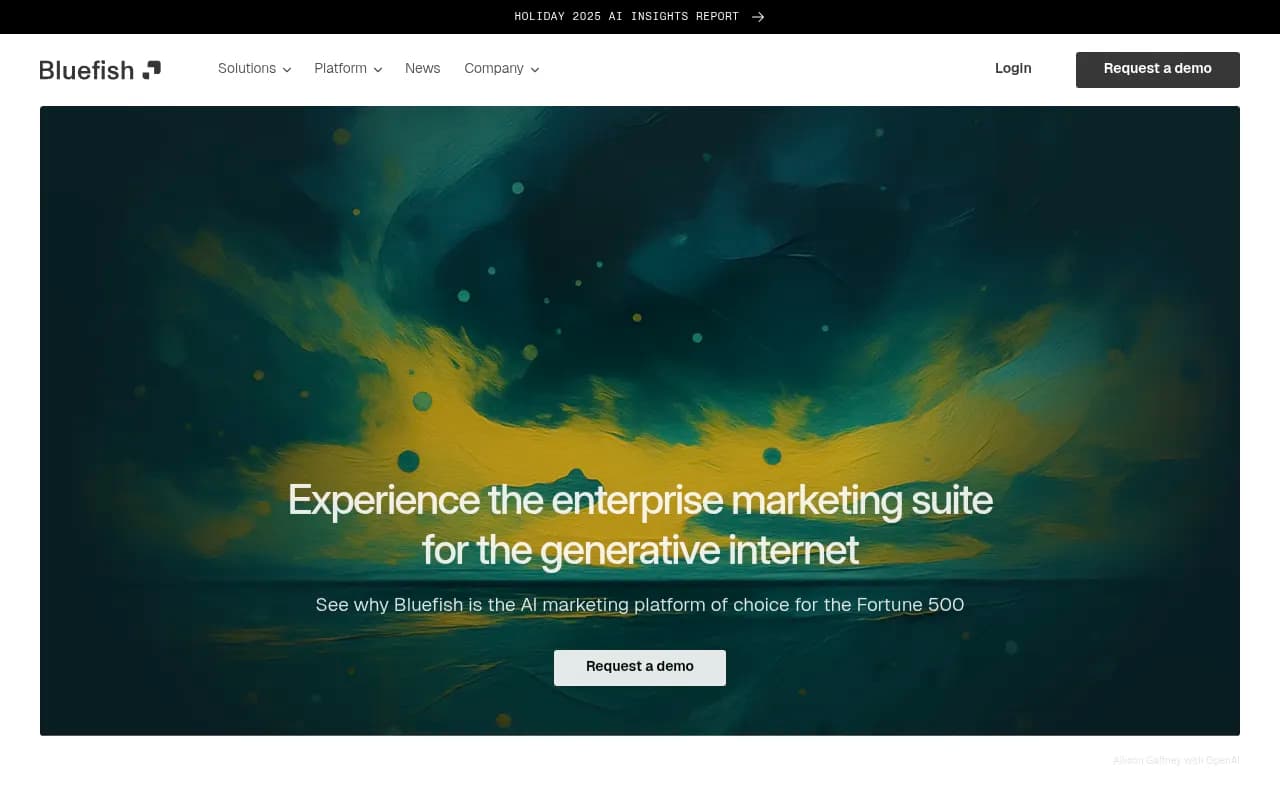
Bluefish positions itself as "the AI marketing platform of choice for the Fortune 500." It's an enterprise-grade solution designed for large marketing teams that need deep control over brand presence across AI search engines like ChatGPT, Perplexity, and others. The platform emphasizes going "beyond superficial metrics" with custom audiences, tailored prompts, and advanced performance tools. Pricing starts around $4,000/month with annual contracts and custom enterprise plans based on the number of brands and markets you're tracking.
The platform covers four main areas: AI monitoring (real-time brand reputation tracking), AI optimization (GEO workflows), GEO measurement (performance frameworks), and AI commerce (agentic commerce visibility). Bluefish's pitch is that in competitive markets, generic datasets aren't enough -- you need the depth and customization that only an enterprise platform can provide.
Promptmonitor: Accessible AI visibility tracking
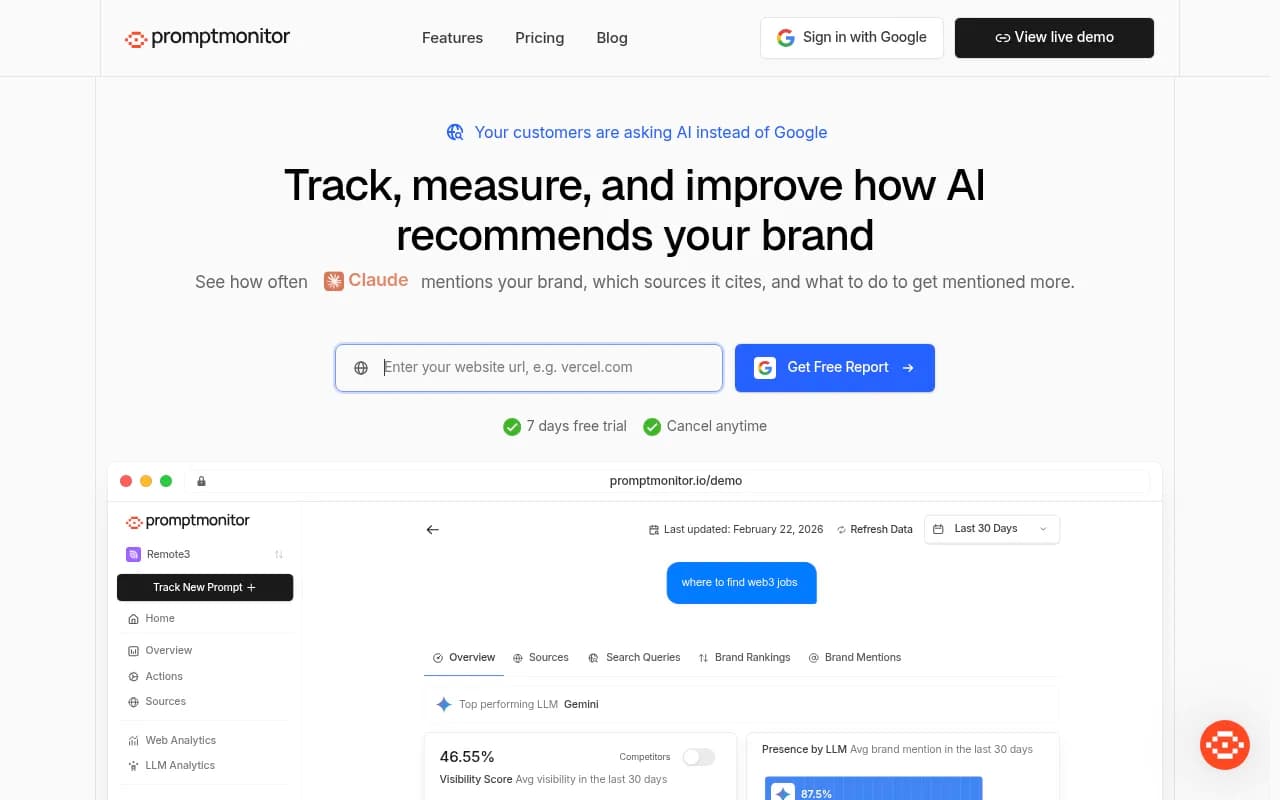
Promptmonitor takes a simpler approach: track how often ChatGPT, Claude, Perplexity, and other AI models mention your brand, see which sources they cite, and figure out what to do next. It's a freemium tool with a 7-day free trial, then pricing from $29/month for the Starter plan up to $129/month for Pro. There's also an Agency plan with custom pricing, but the core offering is designed for startups, small marketing teams, and agencies who want to dip into AI visibility without enterprise budgets.
The interface is straightforward: you set up prompts to track, Promptmonitor runs them across multiple LLMs, and you get visibility scores, brand mention percentages, and source analysis. The live demo shows a clean dashboard with presence-by-LLM breakdowns, competitor tracking, and historical trends. It's monitoring-focused -- you won't find built-in content generation or optimization workflows, but you will get the data you need to understand where you stand.
Side-by-Side Comparison
| Feature | Bluefish | Promptmonitor |
|---|---|---|
| Starting price | ~$4,000/month | $29/month |
| Free trial | Demo only | 7 days |
| Billing | Annual contracts | Monthly, cancel anytime |
| Target market | Fortune 500, enterprise | Startups, SMBs, agencies |
| LLM coverage | ChatGPT, Perplexity, others | ChatGPT, Claude, Gemini, Perplexity |
| Custom audiences | ✓ Yes | ✗ No |
| Tailored prompts | ✓ Yes | Limited (user-defined) |
| GEO optimization | ✓ Built-in workflows | ✗ Monitoring only |
| Agentic commerce | ✓ Yes | ✗ No |
| Source tracking | ✓ Yes | ✓ Yes |
| Competitor analysis | ✓ Deep segmentation | ✓ Basic tracking |
| Infosec/compliance | Enterprise-grade | Not specified |
| Data export/API | ✓ Custom integrations | Not specified |
| Onboarding | Dedicated support | Self-service |
Pricing: The 138x gap
This is where the two platforms diverge completely.
| Plan | Bluefish | Promptmonitor |
|---|---|---|
| Entry point | ~$4,000/month (annual contract) | $29/month (Starter) |
| Mid-tier | Custom enterprise pricing | $39/month (Growth) |
| High-tier | Custom (likely $10k-50k+/month) | $129/month (Pro) |
| Agency/Enterprise | Custom quotes | Custom pricing |
| Free trial | Demo/consultation | 7 days, full access |
| Contract terms | Annual standard | Month-to-month |
Bluefish's pricing reflects its enterprise positioning. You're not buying a SaaS tool -- you're buying a platform with dedicated support, custom data segmentation, and the ability to pass Fortune 500 infosec reviews. The $4,000/month starting point is a floor, not a ceiling. If you're tracking multiple brands across dozens of markets with custom audiences and tailored prompt sets, expect to pay significantly more.
Promptmonitor's pricing is designed for accessibility. $29/month gets you started with basic tracking. $129/month (Pro) is still less than 3% of Bluefish's entry price. The 7-day free trial lets you test before committing, and month-to-month billing means you can cancel if it's not working. For a startup or small agency, this is the difference between "we can try this" and "we need board approval."
Feature depth: Enterprise control vs practical monitoring
Custom audiences and tailored prompts
Bluefish's core differentiator is customization. The platform lets you define custom audiences (e.g., "CMOs in healthcare," "Gen Z sneaker buyers") and tailor prompts to match how those audiences actually query AI models. This matters in competitive categories where generic prompts don't capture the nuance of how different buyer personas search.
Promptmonitor uses user-defined prompts -- you type in the queries you want to track. It's simpler but less sophisticated. You're not segmenting by persona or building audience-specific prompt libraries. You're tracking the prompts you care about and seeing how often your brand shows up.
Verdict: If you're in a competitive market where different audiences use different language (e.g., B2B software with technical and executive buyers), Bluefish's custom audiences are worth the investment. If you're tracking a straightforward set of queries, Promptmonitor's approach is plenty.
Optimization vs monitoring
Bluefish includes GEO (Generative Engine Optimization) workflows -- automated processes to help you optimize content and improve AI visibility. The platform also tracks agentic commerce, which is AI models making purchase recommendations or facilitating transactions. This is forward-looking: as AI models start acting as shopping assistants, you want to know when and how they recommend your products.
Promptmonitor is monitoring-first. You get visibility scores, brand mention percentages, and source analysis. The platform shows you where you stand but doesn't include built-in tools to help you improve. You'll need to take the data and act on it elsewhere -- whether that's updating your website, creating new content, or adjusting your SEO strategy.
Verdict: Bluefish's optimization features justify the price for teams with resources to act on them. Promptmonitor is honest about what it is: a tracker, not an optimizer. If you just need to know where you stand, that's fine. If you need help closing the gap, you'll want more.
Data depth and segmentation
Bluefish emphasizes that "data teams get more ways to customize, segment, and optimize data in ways competitors can't match." This means custom reporting, advanced filtering, and the ability to slice data by market, audience, time period, and more. Enterprise marketing teams often need to report up to executives or integrate AI visibility data into broader dashboards -- Bluefish is built for that.
Promptmonitor's dashboard is clean and functional. You get visibility scores over time, presence by LLM, and competitor comparisons. The live demo shows a straightforward interface with historical trends and source breakdowns. It's not built for complex segmentation or custom reporting frameworks, but it covers the basics well.
Verdict: If you need to integrate AI visibility data into executive dashboards or run complex multi-market analyses, Bluefish's data tools are essential. If you're a small team that just needs to check the numbers and move on, Promptmonitor's simplicity is an advantage.
LLM coverage and monitoring accuracy
Both platforms track major AI models: ChatGPT, Perplexity, Claude, Gemini. Bluefish mentions "all AI native experiences" without specifying the full list. Promptmonitor explicitly lists ChatGPT, Claude, Gemini, and Perplexity in its marketing and demo.
Neither platform publicly shares how often they re-run prompts or how they handle model drift (when AI models change their outputs over time). Bluefish's enterprise focus suggests more frequent monitoring and custom refresh schedules. Promptmonitor's demo shows daily data points, which is standard for this category.
Verdict: Both platforms cover the major LLMs. Bluefish likely offers more granular control over monitoring frequency and custom model coverage for enterprise clients. For most users, Promptmonitor's coverage is sufficient.
Ease of use and onboarding
Bluefish requires a demo and sales consultation. You're not signing up with a credit card and getting started in 10 minutes. The onboarding process involves understanding your brand, markets, audiences, and goals, then configuring the platform accordingly. This makes sense for enterprise software but adds friction.
Promptmonitor has a 7-day free trial with immediate access. You sign up, add your prompts, and start tracking. The interface is self-explanatory -- no training required. The live demo link on the homepage lets you explore a real project before committing.
Verdict: Promptmonitor wins on ease of use. Bluefish's onboarding process is appropriate for its market but not fast.
Infosec and compliance
Bluefish explicitly mentions that it "consistently passes infosec reviews with ease." For Fortune 500 companies, this is non-negotiable. Enterprise procurement processes require security audits, compliance certifications, and vendor risk assessments. Bluefish is built to handle this.
Promptmonitor doesn't mention infosec, compliance, or enterprise security features. That doesn't mean it's insecure -- it means it's not targeting buyers who need to pass those audits. For a startup or small agency, this isn't a concern. For a regulated industry or large enterprise, it's a dealbreaker.
Verdict: If you need to pass infosec reviews, Bluefish is the only option here. If you don't, it's irrelevant.
Pros and cons
Bluefish pros
- Built for enterprise scale with custom audiences and tailored prompts
- Includes GEO optimization workflows, not just monitoring
- Tracks agentic commerce (AI-driven purchase recommendations)
- Passes Fortune 500 infosec reviews
- Deep data segmentation and custom reporting
- Dedicated support and onboarding
Bluefish cons
- Pricing starts around $4,000/month -- inaccessible for most companies
- Annual contracts required
- No self-service trial or transparent pricing
- Overkill for small teams or single-brand monitoring
Promptmonitor pros
- Affordable entry point at $29/month
- 7-day free trial with full access
- Month-to-month billing, cancel anytime
- Clean, intuitive interface with no training required
- Covers major LLMs (ChatGPT, Claude, Gemini, Perplexity)
- Live demo available to explore before signing up
Promptmonitor cons
- Monitoring-only -- no built-in optimization tools
- No custom audiences or advanced segmentation
- Limited data export and API options (not specified)
- Not built for enterprise compliance or infosec audits
- Lacks agentic commerce tracking
Who should pick which tool
Choose Bluefish if:
- You're a Fortune 500 brand or large enterprise with a six-figure marketing budget
- You need to track multiple brands across global markets with custom audiences
- Your procurement process requires infosec audits and compliance certifications
- You want built-in GEO optimization workflows, not just monitoring data
- You're tracking agentic commerce and need to know when AI models recommend your products
- You have a dedicated team to act on the insights and justify the investment
Choose Promptmonitor if:
- You're a startup, SMB, or agency testing AI visibility for the first time
- Your budget is under $500/month for monitoring tools
- You need straightforward tracking without enterprise complexity
- You want to start immediately with a free trial and self-service onboarding
- You're comfortable taking the data and building your own optimization strategy
- You don't need to pass Fortune 500 infosec reviews
Consider alternatives if:
- You want monitoring plus optimization but don't have an enterprise budget: Tools like Promptwatch sit in the middle -- more optimization features than Promptmonitor (content gap analysis, AI content generation, crawler logs) but more accessible pricing than Bluefish ($99-579/month range). Worth exploring if you need the action loop without the enterprise price tag.

Final verdict
Bluefish and Promptmonitor aren't really competitors -- they serve completely different markets. Bluefish is enterprise software for Fortune 500 marketing teams with the budget and resources to justify $4,000+/month. Promptmonitor is a practical monitoring tool for startups, agencies, and SMBs who need to understand AI visibility without breaking the bank.
The choice isn't about which platform is "better" -- it's about which market you're in. If you're at a large company with multiple brands, custom audience needs, and infosec requirements, Bluefish is built for you. If you're a small team that needs to track AI mentions and figure out what to do next, Promptmonitor gives you the data at a price you can actually afford.
One-liner: Bluefish is enterprise-grade AI marketing infrastructure for Fortune 500 budgets; Promptmonitor is accessible AI visibility tracking for everyone else.