Key Takeaways
- Rankshift costs €69/mo for 150 prompts/day (4,500/month) while Promptmonitor starts at $29/mo for limited tracking -- Rankshift gives you 155x more prompt volume at 2.4x the price
- Promptmonitor offers a 7-day free trial vs Rankshift's 30-day trial -- you get 4x longer to test before committing
- Rankshift includes unlimited users and projects on all plans; Promptmonitor charges more for team features on higher tiers
- Both track ChatGPT, Perplexity, Claude, and Gemini, but neither shows real-time AI crawler logs or content gap analysis like optimization-focused platforms
- Rankshift is built for agencies and large-scale tracking (850 prompts/day on Business plan); Promptmonitor targets smaller teams and individual brands
- If you need monitoring plus optimization (content generation, gap analysis, crawler tracking), tools like Promptwatch cover that angle alongside either option
Overview
Rankshift
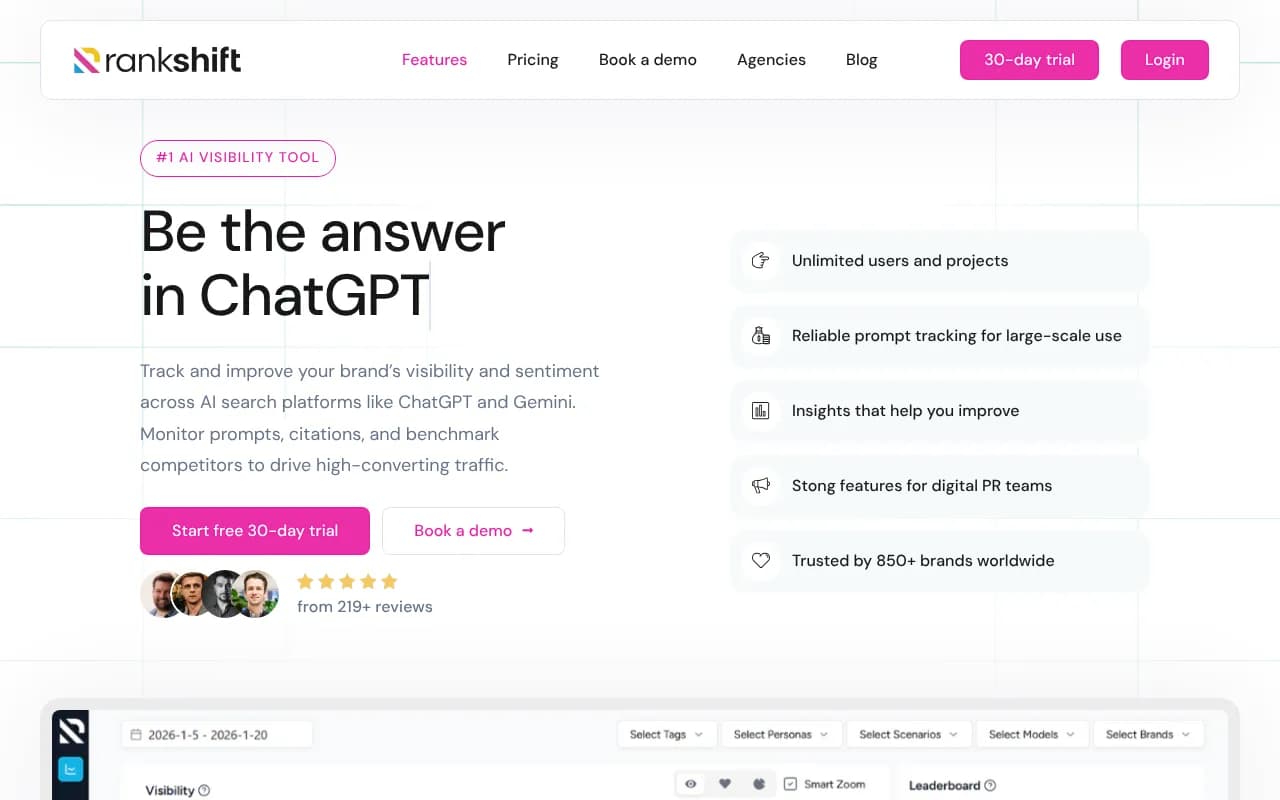
Rankshift positions itself as the "#1 AI visibility tool" for tracking brand mentions across ChatGPT, Perplexity, Claude, and Gemini. It's designed for agencies and brands running large-scale monitoring -- the Starter plan alone gives you 150 prompts per day, which works out to 4,500 prompt checks monthly. The platform emphasizes reliability for high-volume use and includes features like competitor benchmarking, citation tracking, and sentiment analysis. Rankshift is trusted by 850+ brands including Coolblue, Orange, and Salesflare.
The platform's pricing starts at €69/mo and scales up to €359/mo for the Business tier (850 prompts/day). All plans include unlimited users and projects, which makes it appealing for teams and agencies managing multiple clients. Rankshift offers a 30-day free trial and 10% off annual billing.
Promptmonitor
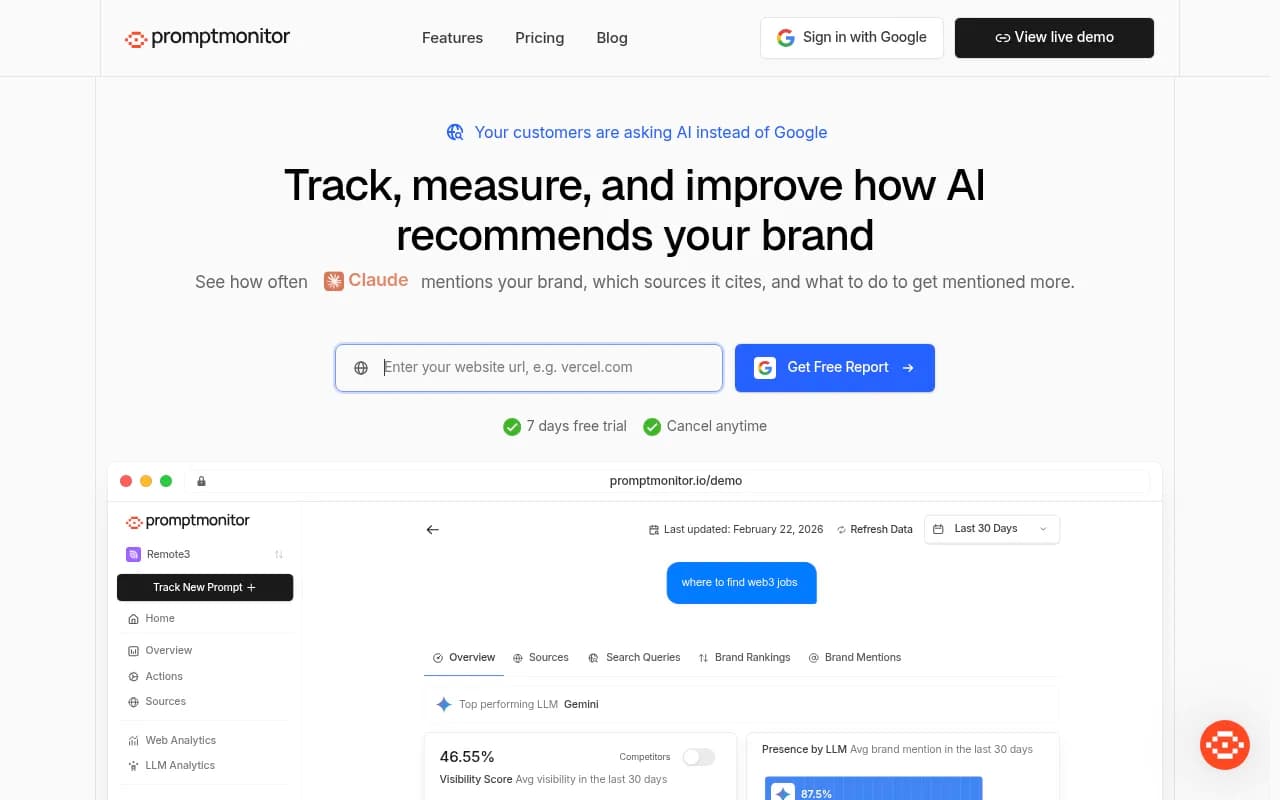
Promptmonitor takes a simpler approach to AI visibility tracking. It monitors how often AI models like ChatGPT, Claude, and Perplexity mention your brand, which sources they cite, and provides recommendations on improving visibility. The platform includes a public demo project that shows real tracking data, which is helpful for understanding what you're buying before you commit.
Pricing is more accessible: $29/mo for the Starter plan, $39/mo for Growth, and $129/mo for Pro. There's also an Agency plan with custom pricing. Promptmonitor offers a 7-day free trial. The platform targets smaller teams and individual brands rather than agencies running massive tracking operations.
Side-by-Side Comparison
| Feature | Rankshift | Promptmonitor |
|---|---|---|
| Starting price | €69/mo (~$75/mo) | $29/mo |
| Prompts per month | 4,500 (Starter: 150/day) | Limited (not disclosed for Starter) |
| Free trial length | 30 days | 7 days |
| Users included | Unlimited on all plans | Limited on lower tiers |
| Projects included | Unlimited on all plans | Limited on lower tiers |
| AI models tracked | ChatGPT, Perplexity, Claude, Gemini, AI Overviews | ChatGPT, Perplexity, Claude, Gemini |
| Competitor benchmarking | Yes | Yes |
| Citation/source tracking | Yes | Yes |
| Sentiment analysis | Yes | Not mentioned |
| Public demo available | No | Yes (live demo project) |
| Target audience | Agencies, large brands, high-volume users | Small teams, individual brands |
| Annual discount | 10% | Not disclosed |
| Custom enterprise pricing | Yes | Yes (Agency plan) |
Pricing comparison
Here's how the plans stack up:
| Plan | Rankshift | Promptmonitor |
|---|---|---|
| Entry tier | €69/mo (Starter: 150 prompts/day, 9,500 credits, unlimited users/projects) | $29/mo (Starter: limited prompts, basic features) |
| Mid tier | €179/mo (Professional: 450 prompts/day, 28,000 credits) | $39/mo (Growth: expanded tracking) |
| High tier | €359/mo (Business: 850 prompts/day, 53,000 credits) | $129/mo (Pro: full features) |
| Agency/Enterprise | Custom pricing | Custom pricing (Agency plan) |
| Free trial | 30 days | 7 days |
| Annual discount | 10% | Not disclosed |
The pricing structures are fundamentally different. Rankshift is expensive upfront but gives you massive prompt volume and unlimited team access. Promptmonitor is cheaper to start but you'll hit limits faster if you're tracking dozens of prompts or managing multiple brands.

Prompt volume and scale
This is where the two platforms diverge sharply.
Rankshift's Starter plan includes 150 prompts per day -- that's 4,500 prompt checks per month. The Professional plan jumps to 450/day (13,500/month) and Business hits 850/day (25,500/month). If you're an agency tracking visibility for 10 clients with 20 prompts each, you need 200 prompts tracked regularly. Rankshift handles that easily even on the Starter tier.
Promptmonitor doesn't disclose exact prompt limits on its pricing page, which is a red flag. The $29/mo Starter plan is described as having "limited" tracking. Based on the pricing gap (Rankshift charges 2.4x more for its entry tier), I'd estimate Promptmonitor's Starter plan caps out somewhere around 50-100 prompts per month. That's fine if you're a solo founder tracking 5-10 key prompts, but it won't scale.
Verdict: Rankshift wins on volume and transparency. If you need to track more than a handful of prompts, Rankshift's pricing makes more sense per-prompt.
User and project limits
Rankshift includes unlimited users and unlimited projects on every plan, including the €69/mo Starter. This is huge for agencies -- you can onboard your entire team and set up separate projects for each client without paying extra.
Promptmonitor's pricing page mentions that higher tiers unlock more team features, which implies the lower tiers restrict users or projects. The $29/mo plan likely limits you to 1-2 users and a handful of projects. You'll need to upgrade to Growth ($39/mo) or Pro ($129/mo) to add team members.
Verdict: Rankshift is the clear winner for teams and agencies. Promptmonitor's user restrictions make it better suited for solo users or very small teams.
AI models and tracking coverage
Both platforms track the major AI search engines:
- ChatGPT (OpenAI)
- Perplexity
- Claude (Anthropic)
- Gemini (Google)
Rankshift explicitly mentions tracking Google AI Overviews (the AI-generated summaries in Google search results), which is a nice addition. Promptmonitor doesn't list AI Overviews on its feature set, though it's possible they track it without highlighting it.
Neither platform tracks some of the newer or niche models like DeepSeek, Grok, Meta AI, or Mistral. If you need broader LLM coverage, you'll want to look at platforms like Promptwatch that monitor 10+ models.
Verdict: Roughly tied, with a slight edge to Rankshift for explicitly including AI Overviews.
Competitor benchmarking
Both platforms let you track competitor mentions alongside your own brand. You can see which brands AI models recommend for the same prompts, how often competitors get cited, and where you're losing visibility.
Rankshift emphasizes this feature heavily in its marketing -- the homepage shows competitor comparison charts and visibility scores. Promptmonitor includes competitor tracking but doesn't spotlight it as much. Based on the live demo, Promptmonitor's competitor view shows brand rankings and mentions over time, which is solid but not as visually polished as Rankshift's interface.
Verdict: Both platforms handle this well. Rankshift has a more refined UI for competitor analysis.
Citation and source tracking
When an AI model mentions your brand, both platforms show you which sources it cited -- the websites, articles, Reddit threads, or YouTube videos that influenced the AI's response. This is critical for understanding where to focus your content and PR efforts.
Rankshift's citation tracking is straightforward: you see the sources, their URLs, and how often they appear. Promptmonitor offers similar functionality and includes a dedicated "Sources" tab in its interface (visible in the live demo). Both platforms let you drill down into individual prompts to see source-level details.
Neither platform offers Reddit-specific insights or YouTube tracking as standalone features, which is a gap. If you want to see which Reddit discussions or YouTube videos are driving AI citations, you'll need a more specialized tool.
Verdict: Tied. Both platforms cover the basics but lack depth on social sources.
Sentiment analysis
Rankshift explicitly mentions sentiment analysis as a feature -- you can track whether AI models are mentioning your brand positively, negatively, or neutrally. This is useful for reputation management and understanding how your brand is positioned in AI responses.
Promptmonitor doesn't list sentiment analysis on its feature set. The live demo doesn't show sentiment scores, so it's likely not included or is limited to higher-tier plans.
Verdict: Rankshift wins here. Sentiment tracking is a meaningful differentiator.
Ease of use and onboarding
Rankshift's homepage promises "setup in just 3 minutes" with a three-step process: add prompts and brands, choose AI models, get insights. The interface looks clean and modern based on the screenshots, though I haven't used it hands-on.
Promptmonitor offers a public live demo project, which is a huge advantage. You can click through the actual interface, see real tracking data, and understand exactly what you're getting before signing up. The demo shows a well-organized dashboard with tabs for Overview, Sources, Search Queries, Brand Rankings, and Analytics. The UI is functional but less polished than Rankshift's marketing materials suggest.
Verdict: Promptmonitor wins on transparency (live demo is great), but Rankshift likely has a smoother onboarding flow.
Reporting and analytics
Both platforms provide visibility scores, trend charts, and breakdowns by AI model. Rankshift's analytics focus on high-level metrics like overall visibility, presence by LLM, and competitor comparisons. Promptmonitor includes similar features plus dedicated tabs for Web Analytics and LLM Analytics in its demo.
Neither platform appears to offer Looker Studio integration, API access, or custom reporting on their standard plans. If you need to export data or build custom dashboards, you'll likely need to contact both vendors about enterprise features.
Verdict: Roughly tied. Both platforms cover the basics but lack advanced reporting options on standard plans.
What's missing from both platforms
Here's what neither Rankshift nor Promptmonitor offers:
- AI crawler logs: Real-time tracking of which AI crawlers (ChatGPT, Perplexity, Claude bots) are hitting your website, which pages they read, and how often they return. This is critical for understanding how AI models discover your content.
- Content gap analysis: Identifying which prompts competitors rank for but you don't, then showing you exactly what content you need to create to close the gap.
- AI content generation: Built-in tools to create articles, listicles, or comparisons optimized for AI search based on citation data and prompt analysis.
- Traffic attribution: Connecting AI visibility to actual website traffic and conversions. Neither platform shows you how many visitors came from AI search results.
- Prompt intelligence: Volume estimates, difficulty scores, or query fan-outs that help you prioritize which prompts to target.
Both platforms are monitoring-first tools. They show you where you stand but don't help you fix the gaps. If you want to go beyond tracking and actually optimize your AI visibility, you'll need a platform that combines monitoring with content creation and gap analysis.
Pros and cons
Rankshift pros
- Massive prompt volume even on the Starter plan (4,500/month)
- Unlimited users and projects on all plans -- perfect for agencies
- 30-day free trial gives you plenty of time to test
- Sentiment analysis included
- Tracks Google AI Overviews
- Trusted by 850+ brands with recognizable names
Rankshift cons
- Higher starting price (€69/mo vs $29/mo)
- No public demo to preview the interface
- Lacks optimization features (content generation, gap analysis, crawler logs)
- No API or advanced reporting on standard plans
Promptmonitor pros
- Lower entry price ($29/mo)
- Public live demo lets you test-drive the platform before signing up
- Clean, functional interface
- Covers the core tracking features most brands need
Promptmonitor cons
- Prompt limits not disclosed -- likely very restrictive on lower tiers
- User and project limits on cheaper plans
- Shorter free trial (7 days vs 30 days)
- No sentiment analysis
- Less polished UI compared to Rankshift
- Lacks optimization and content creation tools
Who should pick which tool
Choose Rankshift if:
- You're an agency managing multiple clients and need unlimited projects
- You're tracking 50+ prompts per month and need high volume
- You want sentiment analysis to monitor brand reputation
- You have a team that needs access (unlimited users is a big deal)
- You can afford €69/mo and want a 30-day trial to fully evaluate
Choose Promptmonitor if:
- You're a solo founder or small team tracking 5-20 prompts
- Budget is tight and you need to start at $29/mo
- You want to see a live demo before committing
- You don't need advanced features like sentiment tracking or high prompt volume
- You're okay with upgrading later as your tracking needs grow
Look elsewhere if:
- You need AI crawler logs, content gap analysis, or built-in content generation -- both platforms are monitoring-only
- You want to track 10+ AI models including DeepSeek, Grok, Meta AI, etc.
- You need API access or Looker Studio integration on a standard plan
- You want traffic attribution to connect AI visibility to actual conversions
Final verdict
Rankshift is the better platform for agencies and teams that need scale. The unlimited users, unlimited projects, and massive prompt volume (4,500/month on Starter) make it a no-brainer if you're managing multiple brands or clients. The 30-day trial is generous and the sentiment analysis feature is genuinely useful.
Promptmonitor is the better choice for solo users or very small teams on a tight budget. The $29/mo entry price is hard to beat, and the public demo is a smart move that builds trust. But you'll outgrow it quickly if your tracking needs expand.
Both platforms are solid monitoring tools, but they're just that -- monitors. They show you where you stand but don't help you improve. If you're serious about AI visibility, you'll eventually need a platform that combines tracking with optimization: content gap analysis, AI content generation, crawler logs, and traffic attribution. That's where tools like Promptwatch come in -- they close the loop between monitoring and action.
For pure monitoring in 2026, Rankshift wins on features and scale. Promptmonitor wins on price and transparency. Pick based on your budget and how many prompts you need to track.