Key takeaways
- Most AI visibility tools are monitoring dashboards first -- they show you data but don't connect to your CMS, GSC, or reporting stack out of the box.
- Integration depth varies wildly: some tools offer native GSC connections and GA4 support; others rely entirely on Zapier or manual CSV exports.
- Platforms like Profound have GA4 integration for attribution; Promptwatch goes further with a code snippet, GSC integration, and server log analysis.
- If you need content to flow directly into your CMS, very few tools handle that natively -- most require a middleware layer like Zapier or Make.
- The right choice depends on your stack: a WordPress blog has different needs than a headless CMS or an enterprise Looker Studio setup.
There's a question that comes up in almost every conversation about AI SEO tools, and it's not "does this track ChatGPT?" It's: "does this actually connect to anything I already use?"
That's the right question. A dashboard that shows you AI visibility scores is useful. A dashboard that pushes those insights into your GSC data, your CMS workflow, and your weekly Looker Studio report is genuinely valuable. The gap between those two things is where a lot of teams get burned.
This guide is specifically about integrations -- what connects to what, how deep those connections actually go, and which platforms are worth evaluating if you care about your existing tech stack.
Why integrations matter more than they used to
A year ago, most teams were happy just to know whether ChatGPT mentioned their brand. That was enough to justify the tool. Now the bar is higher.
Marketing teams want AI visibility data sitting next to their organic traffic data. SEO managers want content recommendations that flow into their editorial calendar. Agencies want client-facing reports that pull from multiple sources without manual assembly.
The tools that built monitoring-first architectures are starting to feel the strain. When your AI visibility platform is a silo -- no API, no native integrations, no way to connect it to your reporting stack -- you end up with a tab that gets checked occasionally and ignored the rest of the time.
The platforms that are pulling ahead are the ones that thought about the workflow, not just the data.
The integration categories that matter
Before comparing specific tools, it helps to be clear about what "integrations" actually means in this context. There are four distinct categories:
CMS integrations -- Can the tool publish content directly to WordPress, Webflow, Contentful, or your headless CMS? Or does it just generate content you then copy-paste?
Google Search Console and Analytics -- Can the tool pull GSC data to correlate AI visibility with organic performance? Does it connect to GA4 for attribution?
Reporting and BI tools -- Is there a Looker Studio connector, a Tableau export, or an API you can query from your own dashboards?
Workflow automation -- Does the tool have native Zapier, Make, or n8n support so you can build custom automations without waiting for the vendor to ship a native integration?
Most tools do one or two of these well. Very few do all four.
Tool-by-tool breakdown
Promptwatch
Promptwatch is the most integration-complete platform in this comparison. It covers all four categories to some degree.
For traffic attribution specifically, it offers three methods: a JavaScript code snippet (similar to how you'd install Google Analytics), a Google Search Console integration, and server log analysis. That last one is unusual -- most tools don't touch server logs at all, but it's the most reliable way to measure AI-driven traffic when you can't rely on referrer data.
On the reporting side, there's a Looker Studio integration and a full API, which means you can pull Promptwatch data into whatever BI setup you're already running. For agencies managing multiple clients, this matters a lot -- you're not building separate reports for each client, you're feeding data into a unified reporting layer.
Content generated by Promptwatch's built-in AI writing agent doesn't auto-publish to your CMS, but the workflow is designed to be CMS-agnostic: you generate, review, and then push to wherever you publish. For teams that want more automation here, the API makes it possible to build that bridge yourself.

Profound
Profound is one of the more mature platforms in the space, and its GA4 integration is genuinely useful. You can connect your GA4 property and start attributing traffic from AI search engines to specific pages -- which is something most tools don't offer at all.
The GSC connection is also present, letting you compare traditional organic performance against AI visibility scores in the same view. For teams that already live in GA4, this is a meaningful advantage.
Where Profound is lighter is on the content side. It's primarily a monitoring and analytics platform. There's no built-in content generation, so the workflow stops at "here's what you should fix" rather than "here's the content to fix it."

Peec.ai
Peec.ai has built a solid reputation for multi-language, multi-region tracking -- it's one of the better options if you're running campaigns across multiple markets and need visibility data in different languages.
On the integration front, it's more limited. There's API access, which gives you the flexibility to pull data into your own tools, but native integrations with GSC, GA4, or reporting platforms aren't a strong suit. For teams that want plug-and-play connectivity, Peec.ai requires more custom work.
It's a good fit for enterprise teams with developer resources who want to build custom integrations on top of solid underlying data. Less ideal if you need something that connects to Looker Studio out of the box.

SE Ranking
SE Ranking has been expanding its AI visibility features, and it has a meaningful advantage over pure-play GEO tools: it's an all-in-one SEO platform that already integrates with GSC, GA4, and has a white-label reporting module that agencies use heavily.
The AI visibility tracking is newer and less deep than dedicated platforms -- it doesn't have the prompt volume data or citation analysis that tools like Promptwatch offer. But if your team is already in SE Ranking for traditional SEO and you want to add AI visibility tracking without adding another tool, it's a reasonable choice.
Semrush
Semrush has added AI visibility features to its platform, but the implementation uses fixed prompts rather than letting you define your own. That's a meaningful limitation -- your customers don't search in fixed prompts, and the prompts that matter for your brand are specific to your category and positioning.
The integration story is strong, though. Semrush already connects to GSC, has a Looker Studio connector, and has an API that a lot of agencies already use. If you're evaluating Semrush for AI visibility specifically, the question is whether the fixed-prompt approach gives you enough signal to act on.
Otterly.AI
Otterly.AI is one of the more affordable options in the space and is popular with smaller teams and solo operators. The monitoring features are solid for the price point.
The integration story is thin. There's no native GSC connection, no GA4 attribution, and no Looker Studio connector. You can export data manually, and there's some Zapier support for basic automations, but if you need your AI visibility data to live inside your existing reporting stack, Otterly.AI will require workarounds.

AthenaHQ
AthenaHQ covers a wide range of AI models and has a clean interface for monitoring brand visibility. Like Otterly.AI, it's primarily a monitoring tool -- the focus is on showing you where you stand, not on connecting that data to your broader stack.
API access is available, which is the main path to custom integrations. Native connections to GSC or reporting tools aren't a current strength.

Scrunch AI
Scrunch AI is positioned more toward enterprise and has a stronger feature set than some of the lighter tools. It tracks AI visibility across multiple models and has some content optimization features.
Integration-wise, it's in the middle of the pack. There's API access and some reporting exports, but the native integration ecosystem isn't as developed as Promptwatch or SE Ranking.
Comparison table
| Tool | GSC integration | GA4 / attribution | Looker Studio | API | CMS publishing | Content generation |
|---|---|---|---|---|---|---|
| Promptwatch | Yes | Yes (snippet + logs) | Yes | Yes | No (manual) | Yes |
| Profound | Yes | Yes (GA4 native) | Limited | Yes | No | No |
| Peec.ai | No | No | No | Yes | No | No |
| SE Ranking | Yes | Yes | Yes (white-label) | Yes | No | Limited |
| Semrush | Yes | Yes | Yes | Yes | No | Limited |
| Otterly.AI | No | No | No | Limited | No | No |
| AthenaHQ | No | No | No | Yes | No | No |
| Scrunch AI | No | Limited | No | Yes | No | Limited |
CMS integrations: the honest picture
Here's something worth saying plainly: no major AI visibility platform has a deep, native CMS integration in 2026. None of them have a WordPress plugin that automatically publishes AI-optimized articles, or a Contentful connector that pushes content into your content model.
What exists instead is a spectrum:
Some tools generate content and let you copy it. Some have an API you can use to build your own publishing pipeline. A few (Promptwatch included) have enough structure in their content output that building a Make or Zapier workflow to push articles to your CMS is feasible.
If you're on a headless CMS like Contentful or Sanity, you'll almost certainly need to build a custom integration using the tool's API. If you're on WordPress, a Zapier workflow connecting to the WordPress REST API is the most practical path.
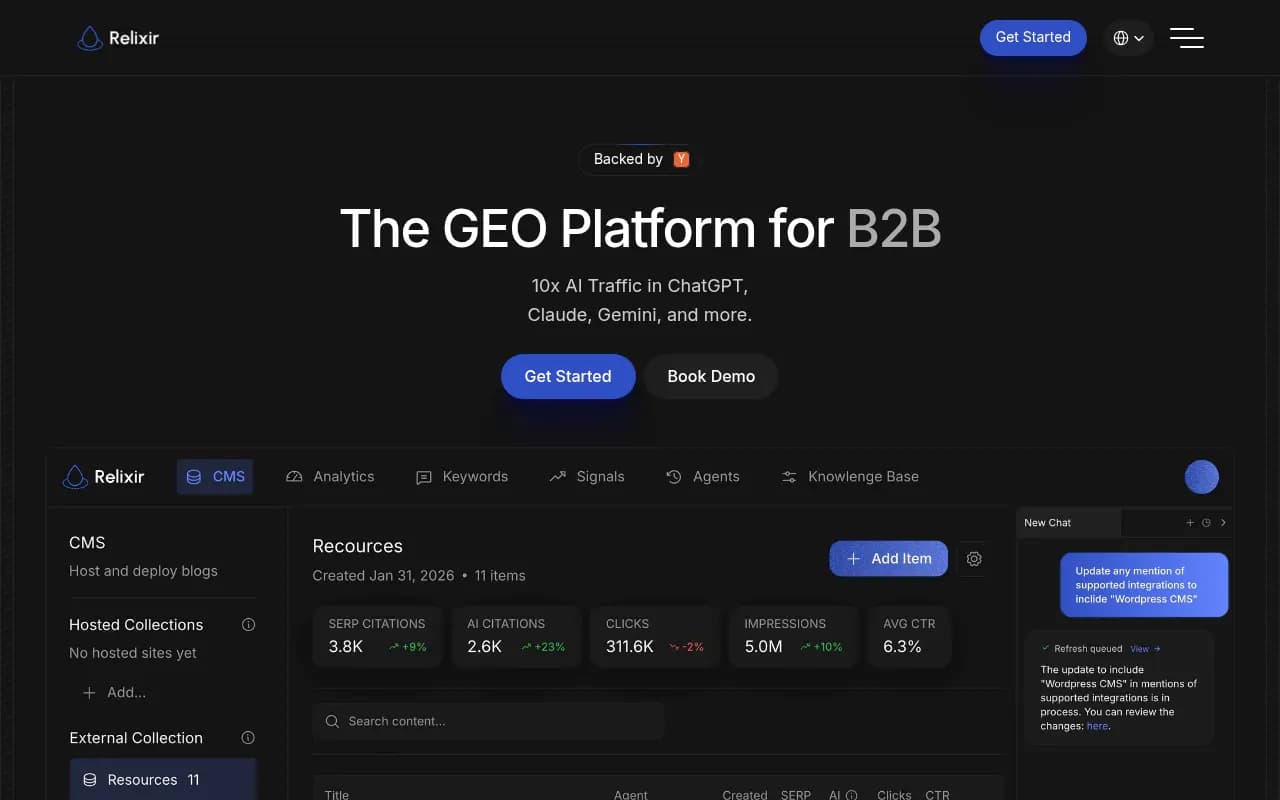
For teams that want a more automated content-to-CMS pipeline, tools like Relixir are worth looking at -- it's built around an AI-native CMS concept where content generation and publishing are more tightly coupled.
Reporting stack integrations: what to look for
If your team reports in Looker Studio, the shortlist gets short quickly. Promptwatch and SE Ranking both have Looker Studio connectors. Semrush has one too, though it's primarily for traditional SEO data with AI visibility as an add-on.
For Tableau or Power BI users, you're almost always going to need the API. Most platforms in this space have REST APIs, but the quality varies. Before committing to a tool, it's worth asking the vendor for API documentation and checking whether the endpoints expose the specific data you need (prompt-level visibility, citation sources, page-level tracking) rather than just aggregate scores.
One thing worth noting: Promptwatch's API is designed to support custom workflows, not just data export. That means you can build automations that trigger content creation based on visibility drops, or push weekly reports to Slack without manual intervention.
The GSC question
Google Search Console integration is where a lot of teams have unrealistic expectations. GSC doesn't expose AI-driven traffic as a separate segment -- Google doesn't give you a "came from ChatGPT" filter. So what does a GSC integration actually give you?
The honest answer: it gives you a baseline. When you connect GSC to an AI visibility platform, you can correlate changes in your AI visibility scores with changes in organic traffic. If your AI visibility for a set of prompts improves and your GSC traffic for related queries also improves, that's signal (not proof, but signal) that AI visibility is driving organic lift.
Profound's GA4 integration goes a step further by trying to attribute traffic from AI referrers directly. Promptwatch's server log analysis is the most rigorous approach -- server logs capture every request, including those from AI crawlers and AI-referred visitors, without relying on JavaScript or referrer strings that can be stripped.
If accurate attribution matters to your team (and it should), the server log approach is worth the setup effort.
Workflow automation: building your own integrations
For teams that need integrations the tools don't natively support, workflow automation platforms are the practical answer.
Zapier connects to most of the tools in this space and can handle simple automations: new citation detected → Slack notification, weekly visibility report → Google Sheets, content brief generated → Notion task created.
Make (formerly Integromat) is more powerful for complex workflows and is a better fit if you're building multi-step automations with conditional logic.
n8n is the open-source option, worth considering if you want to self-host your automation layer and have developer resources.
The limitation with all of these is that you're dependent on the AI visibility tool having a usable API or Zapier trigger. Before building a workflow, verify that the specific data you need is actually accessible programmatically.
Which tool fits which stack
The right answer depends on what you're already using and what you're trying to accomplish.
If you're an agency running Looker Studio reports for clients and need AI visibility data to sit alongside organic performance data, Promptwatch is the most complete option -- it has the Looker Studio connector, the API, and the content generation to close the loop from insight to action.
If you're already deep in the Semrush or SE Ranking ecosystem and want to add AI visibility without adding another tool, those platforms are the path of least resistance, even if the AI visibility features are less deep.
If you're an enterprise team with developer resources and need multi-language, multi-region tracking with a custom integration layer, Peec.ai's API-first approach gives you flexibility.
If you're a smaller team that just wants to start monitoring AI visibility without worrying about integrations yet, Otterly.AI or AthenaHQ are reasonable starting points -- just go in knowing you'll hit integration walls as your needs grow.
The bigger picture
The integration question is really a question about how seriously you're treating AI search as a channel. If it's still experimental, a standalone monitoring tool is fine. If it's becoming a real part of your acquisition strategy, you need it connected to the rest of your stack.
The tools that are investing in integrations -- GSC, GA4, Looker Studio, APIs, attribution -- are the ones that are betting AI search becomes a first-class channel. That bet looks increasingly correct. The tools that are still monitoring-only dashboards are going to face pressure to either build integrations or get left behind as teams consolidate their stacks.
For most teams in 2026, the practical advice is: pick a tool that has at least a working API and a GSC connection, even if you don't use them immediately. You'll want them sooner than you think.