Key takeaways
- GeoGen is dramatically cheaper than Goodie -- entry plans start at €20/month vs Goodie's ~$495/month, a difference that matters a lot for smaller teams
- Both tools are primarily monitoring platforms; neither offers built-in content generation or answer gap analysis to help you act on what you find
- Goodie covers Claude; GeoGen covers Grok and Copilot -- so the model coverage differs slightly depending on which AI engines matter most to you
- Goodie's sentiment analysis and "topic dominance" features give it an edge for brand reputation work; GeoGen's credits-based system makes it more flexible for variable usage
- The goodie.ai domain appears to be listed for sale as of early 2026, which raises legitimate questions about the product's continuity -- worth factoring into any long-term decision
- For teams that want to go beyond tracking and actually improve their AI visibility, neither tool fully delivers -- that's where a platform like Promptwatch fills the gap with content gap analysis and AI content generation
Overview
Goodie
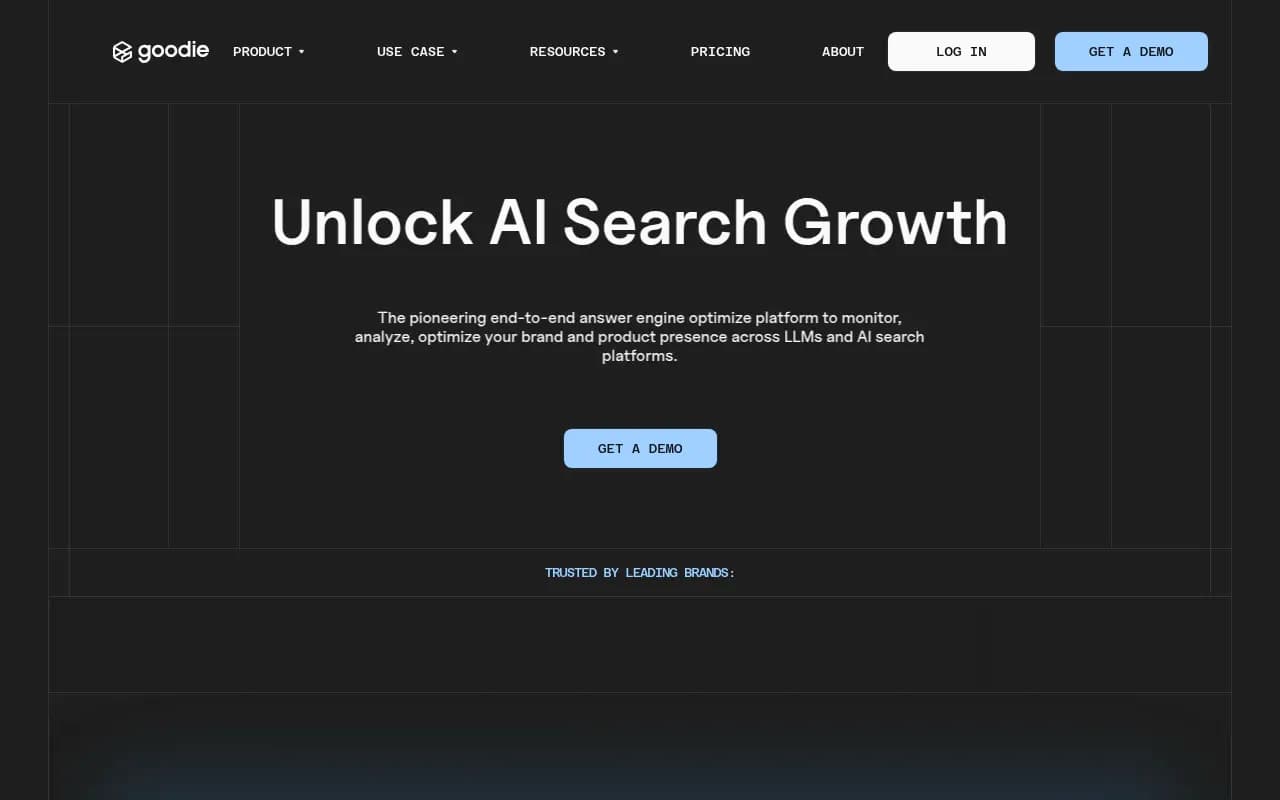
Goodie positions itself as a brand tracking tool for mid-market and enterprise teams who want to know how their brand is being mentioned across the major AI chat engines. The core pitch is visibility scoring combined with sentiment analysis -- not just "are we mentioned?" but "how are we being described?" It also surfaces topic dominance gaps, showing where competitors are getting AI recommendations that you're missing.
The product has been reviewed positively for its semantic coverage analysis, which goes a step beyond raw mention counts. That said, at ~$495/month as an entry point, it's priced for companies with a dedicated marketing or SEO budget. One notable concern: as of April 2026, the goodie.ai domain appears to be listed for sale on Spaceship.com for $80,000, which is an unusual signal for an active SaaS product. Prospective buyers should verify the product's current operational status before committing.
GeoGen
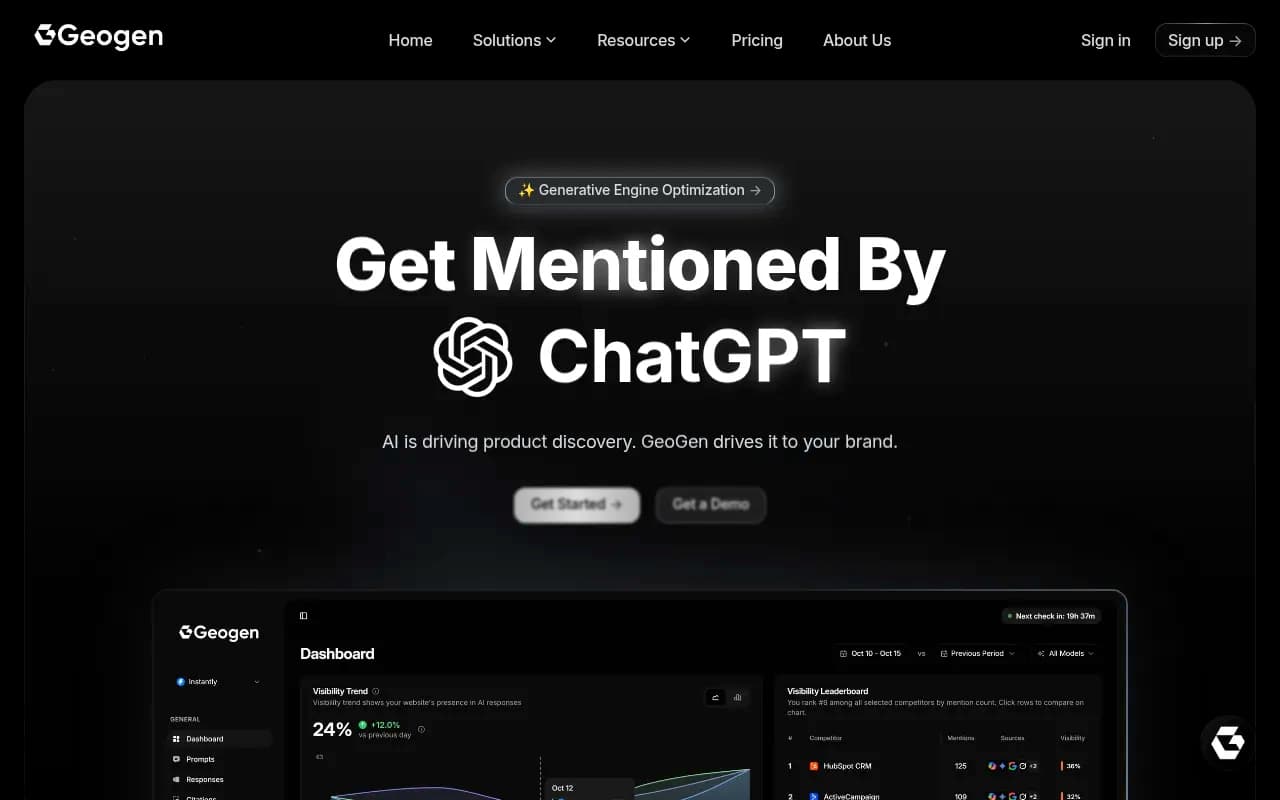
GeoGen describes itself as a Generative Engine Optimization (GEO) platform -- a broader framing than pure brand tracking. It covers ChatGPT, Gemini, Perplexity, Grok, and Microsoft Copilot, and its credits-based pricing model means you pay roughly in proportion to how much you query. The entry plan at €20/month (billed annually) makes it accessible to startups and solo marketers in a way that Goodie simply isn't.
The platform includes brand mention tracking, citation analysis, and competitor ranking comparisons. It's trusted by companies like TextBroker and ProxyScrape, which suggests a lean toward content-heavy and technical audiences. The interface looks clean from what's publicly visible, and the sign-up flow is self-serve -- no sales call required to get started.
Side-by-side comparison
| Feature | Goodie | GeoGen |
|---|---|---|
| Entry price | ~$495/mo | €20/mo (billed annually) |
| Free tier | No | No |
| AI models covered | ChatGPT, Perplexity, Gemini, Claude | ChatGPT, Gemini, Perplexity, Grok, Copilot |
| Brand mention tracking | Yes | Yes |
| Sentiment analysis | Yes | Not confirmed |
| Topic/gap analysis | Yes (topic dominance) | Limited |
| Citation analysis | Partial | Yes |
| Competitor tracking | Yes | Yes |
| Content generation | No | No |
| AI crawler logs | No | No |
| Credits-based usage | No | Yes |
| Self-serve signup | Unclear | Yes |
| Enterprise pricing | Yes (on request) | Yes (custom) |
| Product status (2026) | Domain listed for sale -- verify | Active |
Head-to-head feature deep-dive
Pricing
This is the biggest practical difference between the two tools. GeoGen's Micro plan at €20/month is genuinely entry-level -- you can test the platform without a significant budget commitment. The Pro plan at €399/month is still well below Goodie's starting price.
Goodie's ~$495/month entry point puts it in a different category entirely. That's not inherently bad -- enterprise tools often justify higher prices with deeper data, dedicated support, and more sophisticated analytics. But it does mean Goodie isn't a realistic option for most startups or small marketing teams.
| Plan tier | Goodie | GeoGen |
|---|---|---|
| Entry / Micro | ~$495/mo | €20/mo (annual) |
| Mid-tier | Not published | ~€99-199/mo (estimated) |
| Pro / Top tier | Not published | €399/mo (annual) |
| Enterprise | Custom | Custom |
Verdict: GeoGen wins on price at every tier. Goodie's pricing only makes sense if its feature depth justifies the premium -- and for many teams, it won't.
AI model coverage
Goodie covers ChatGPT, Perplexity, Gemini, and Claude. GeoGen covers ChatGPT, Gemini, Perplexity, Grok, and Copilot. The difference is Claude vs Grok/Copilot.
Claude is increasingly important for enterprise AI use cases, so Goodie's coverage there is a real advantage for teams whose customers use Claude-powered products. On the other hand, Grok (X's AI) and Microsoft Copilot have significant user bases, particularly in B2B contexts where Microsoft 365 integration drives Copilot adoption.
Neither tool covers the full spectrum. For comparison, platforms like Promptwatch monitor 10+ models including DeepSeek, Meta AI, and Mistral alongside the mainstream ones.
Verdict: Roughly a draw -- depends on which models your audience actually uses.
Brand monitoring and sentiment
Goodie's standout feature is sentiment analysis combined with topic dominance mapping. It doesn't just tell you whether your brand appears -- it tells you whether the AI is saying positive, neutral, or negative things about you, and which semantic topics you're being left out of. That's genuinely useful for brand reputation management, not just SEO.
GeoGen's monitoring is more focused on citation tracking and competitor ranking comparisons. It shows you where you appear relative to competitors across different prompts, which is useful for competitive intelligence. Sentiment analysis isn't prominently featured in GeoGen's public materials.
Verdict: Goodie has the edge here, particularly for brand reputation use cases. GeoGen is stronger for competitive positioning.
Content optimization and gap analysis
This is where both tools fall short. Neither Goodie nor GeoGen offers built-in content generation, answer gap analysis, or tools to help you actually fix the visibility problems they identify. You get the data; you figure out what to do with it.
That's a meaningful limitation. Knowing you're invisible for a set of prompts is only useful if you can act on it. Goodie's topic dominance feature at least points you toward the right content areas, but it doesn't generate anything or tell you specifically what to write.
If content optimization is a core requirement, both tools will leave you needing additional resources. Platforms like Promptwatch are built around this exact problem -- find the gaps, generate content engineered to get cited, then track whether it worked.

Verdict: Neither tool wins here. Both are monitoring-only.
Ease of use and setup
GeoGen's self-serve signup and credits-based model suggest a product designed for quick onboarding. You can get started without talking to sales, which matters for teams that want to evaluate before committing.
Goodie's onboarding process is less clear from public information. At $495/month, it likely involves a sales or onboarding conversation, which adds friction but also means more hands-on support.
Verdict: GeoGen is easier to get started with. Goodie may offer more support once you're in.
Reporting and integrations
GeoGen mentions dashboard views with multiple interface screens, suggesting a reasonably complete reporting experience. No specific integrations (Looker Studio, Slack, etc.) are confirmed in public materials.
Goodie's reporting includes visibility scores and sentiment breakdowns. Specific integration details aren't prominently published.
Both tools appear to be standalone dashboards without deep integration ecosystems, at least at the publicly documented level.
Verdict: Hard to call without hands-on access. Neither appears to have a strong integration story.
Pricing comparison
| Plan | Goodie | GeoGen |
|---|---|---|
| Entry | ~$495/mo | €20/mo (annual billing) |
| Pro | Not published | €399/mo (annual billing) |
| Enterprise | Custom (on request) | Custom |
| Free trial | Not confirmed | Not confirmed |
| Billing model | Subscription | Credits-based subscription |
GeoGen's credits-based system is worth understanding before you sign up. Credits-based pricing can be economical if your usage is variable, but can get expensive if you're running high query volumes consistently. Make sure to model your expected prompt volume against the credit allocations before choosing a plan.
Pros and cons
Goodie
Pros:
- Sentiment analysis is a genuine differentiator for brand reputation monitoring
- Topic dominance mapping helps identify semantic gaps in your AI coverage
- Covers Claude, which GeoGen doesn't
- Likely includes more hands-on support at its price point
Cons:
- ~$495/month entry price excludes most small and mid-size teams
- The goodie.ai domain being listed for sale in 2026 is a red flag for product continuity
- No content generation or optimization tools
- Pricing transparency is low -- hard to evaluate without a sales conversation
- Limited AI model coverage compared to broader platforms
GeoGen
Pros:
- €20/month entry plan makes it genuinely accessible
- Covers Grok and Copilot, which Goodie doesn't
- Self-serve signup -- no sales call required
- Credits-based model suits variable usage patterns
- Active product with clear customer base
Cons:
- No sentiment analysis (at least not prominently featured)
- No content generation or gap analysis
- Credits-based pricing can be unpredictable at scale
- Smaller brand and less established than some competitors
- Limited information on integrations and API access
Who should pick which tool
Choose Goodie if...
- Your primary concern is brand reputation, not just visibility -- you need to know how AI models describe you, not just whether they mention you
- Claude coverage is important for your use case
- You're at a mid-market or enterprise company with budget to match
- You want sentiment analysis built into your monitoring workflow
- You can verify the product is still actively maintained before signing up
Choose GeoGen if...
- You're a startup, small team, or agency that can't justify $495/month for a monitoring tool
- Grok or Copilot coverage matters for your audience
- You want to get started quickly without a sales process
- Variable usage makes a credits-based model appealing
- You need basic competitive tracking and citation analysis without the premium price
Consider neither if...
- You need to actually improve your AI visibility, not just measure it -- both tools are monitoring-only, and you'll quickly hit the ceiling of "interesting data, now what?"
- You need coverage across 10+ AI models including DeepSeek, Meta AI, and Mistral
- You want AI crawler logs, content generation, or traffic attribution built into the same platform
Final verdict
GeoGen is the more practical choice for most teams in 2026. The price difference is stark, the product appears active and self-serve, and the model coverage is comparable. Goodie's sentiment analysis and topic dominance features are genuinely interesting, but the ~$495/month entry price is hard to justify when you can't verify the product's current operational status -- and when neither tool helps you actually fix the visibility gaps they find.
If you're serious about AI search visibility as a channel, the honest answer is that both tools will eventually leave you wanting more. Monitoring is step one; the real work is closing the gap between "we're invisible here" and "we're getting cited here." That's a different kind of platform.