Key Takeaways
- Bluefish starts around $4,000/month with annual contracts and targets Fortune 500 brands. GeoGen starts at €20/month (about $22) with monthly billing and serves SMBs to mid-market companies.
- GeoGen is a hands-on optimization platform with content recommendations and actionable insights. Bluefish focuses on monitoring, measurement, and reporting for large marketing teams.
- Bluefish emphasizes brand safety, custom audiences, and deep enterprise integrations. GeoGen prioritizes accessibility, fast setup, and direct optimization workflows.
- GeoGen tracks 5 major AI models (ChatGPT, Gemini, Perplexity, Grok, Copilot). Bluefish covers AI search plus agentic commerce channels but doesn't specify exact model coverage publicly.
- For small teams or agencies testing AI visibility: GeoGen's credit-based pricing and lower entry point make more sense. For enterprise brands with dedicated AI marketing budgets: Bluefish's white-glove service and custom reporting justify the premium.
- Neither platform offers content generation or crawler log analysis -- tools like Promptwatch fill that gap if you need to create AI-optimized content or track how AI crawlers interact with your site.
Overview
Bluefish: Enterprise AI marketing suite
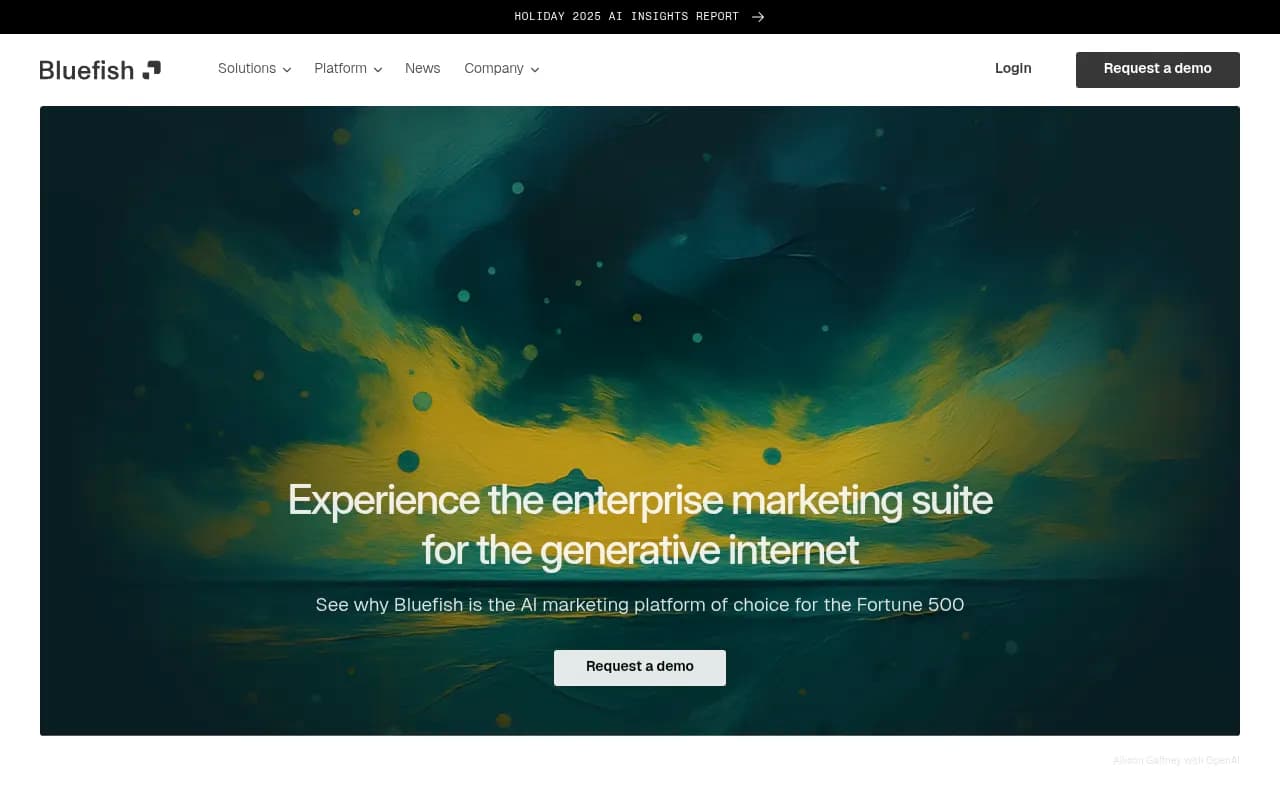
Bluefish positions itself as the AI marketing platform for Fortune 500 brands. It's built for large marketing teams that need visibility into how their brand appears across AI search engines and agentic commerce platforms. The focus is on measurement, control, and brand safety at scale. Expect white-glove onboarding, custom audience segmentation, and deep integrations with enterprise martech stacks. Pricing starts around $4,000/month with annual contracts -- this is not a self-serve tool.
Bluefish covers four main areas: AI monitoring (track brand mentions across AI platforms), GEO optimization (improve your AI search presence), GEO measurement (quantify ROI from AI channels), and AI commerce (monitor product recommendations in shopping-enabled AI tools). The platform recently launched Collections, a feature that lets you measure the impact of specific marketing campaigns on AI visibility.
GeoGen: Accessible GEO platform for growing brands
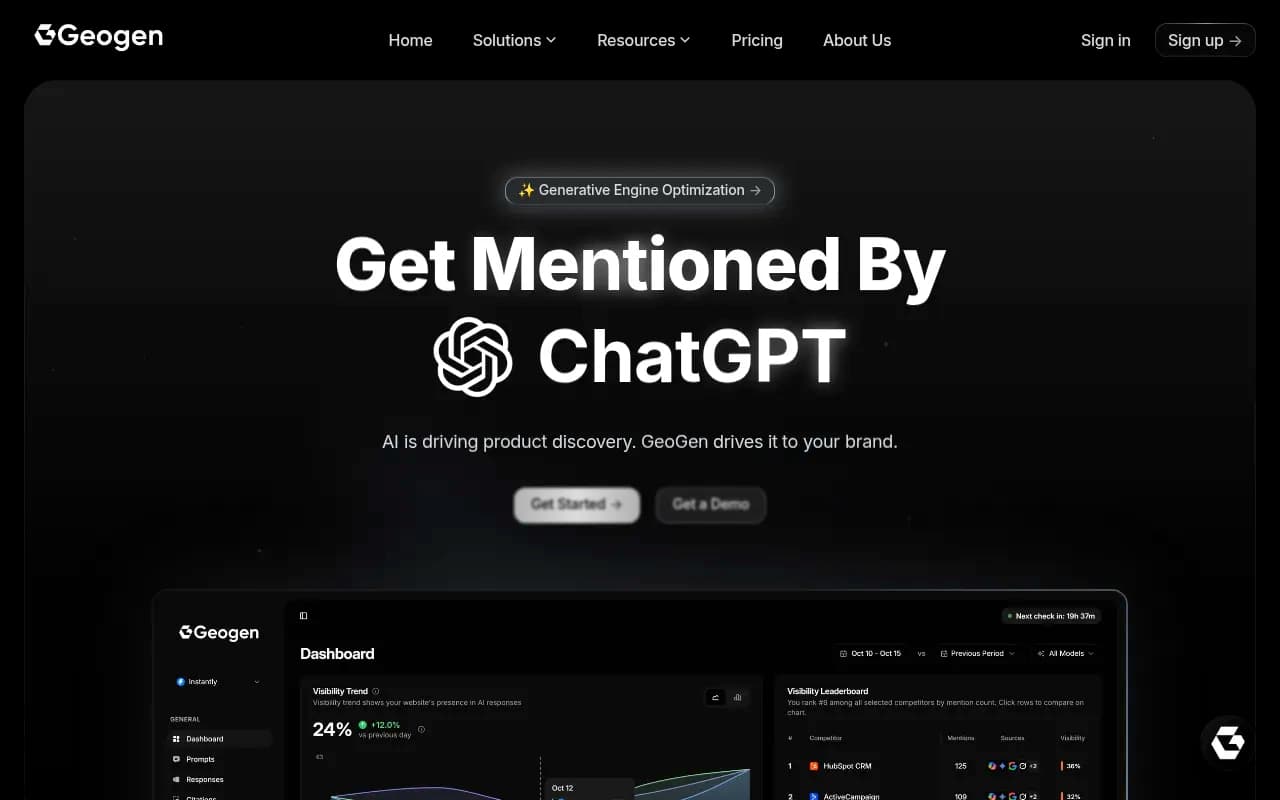
GeoGen is a Generative Engine Optimization platform that helps brands track and improve their presence in AI-powered search engines. It monitors ChatGPT, Gemini, Perplexity, Grok, and Microsoft Copilot. The platform uses a credit-based pricing model starting at €20/month, making it accessible to small teams, agencies, and mid-market companies.
GeoGen's strength is hands-on optimization. You get visibility into where your brand appears (or doesn't), competitor comparisons, citation analysis, and specific recommendations for improving your AI search rankings. The interface is designed for marketers who want to take action themselves rather than rely on a managed service. Setup is fast -- you can start tracking within minutes.
Side-by-side comparison
| Feature | Bluefish | GeoGen |
|---|---|---|
| Starting price | ~$4,000/mo (annual contract) | €20/mo (~$22, monthly billing) |
| Target audience | Fortune 500, enterprise marketing teams | SMBs, agencies, mid-market brands |
| AI models tracked | AI search + agentic commerce (specific models not disclosed) | ChatGPT, Gemini, Perplexity, Grok, Copilot |
| Setup complexity | White-glove onboarding, custom implementation | Self-serve, minutes to start |
| Optimization approach | Measurement and reporting focus | Hands-on recommendations and tools |
| Brand safety features | ✓ Advanced (core differentiator) | Basic monitoring |
| Custom audiences | ✓ Yes | Limited |
| API access | ✓ Enterprise plans | Not specified |
| Competitor tracking | ✓ Yes | ✓ Yes |
| Citation analysis | ✓ Yes | ✓ Yes |
| Content recommendations | Limited | ✓ Yes |
| Free trial | No (demo required) | Not specified |
| Billing | Annual contracts standard | Monthly or annual |
Pricing: $4,000/month vs €20/month
The pricing gap here is enormous and tells you everything about who these tools are for.
Bluefish pricing
Bluefish uses quote-based pricing starting around $4,000/month. You'll need to request a demo and go through a sales process. Pricing scales based on number of brands, markets, geographic coverage, and feature access. Annual contracts are standard. This is enterprise software pricing -- you're paying for white-glove service, custom integrations, dedicated support, and the ability to pass infosec reviews.
For a Fortune 500 brand managing multiple product lines across global markets, $50,000-$100,000+ annually is reasonable if AI visibility is a strategic priority. For a startup or small agency, it's a non-starter.
GeoGen pricing
GeoGen uses a credit-based system with four tiers:
| Plan | Price (annual) | Credits/month | Best for |
|---|---|---|---|
| Micro | €20/mo | 100 credits | Testing, small brands |
| Starter | €99/mo | 600 credits | Growing companies |
| Growth | €199/mo | 1,400 credits | Agencies, multiple clients |
| Pro | €399/mo | 3,000 credits | Larger teams, high-volume tracking |
Credits are consumed when you run queries across AI models. The exact credit cost per query depends on complexity, but the system is transparent -- you see credit usage in real-time.
Custom enterprise pricing is available if you need more than 3,000 credits/month or want dedicated support.
Verdict: GeoGen is 200x cheaper at the entry level. Bluefish's pricing makes sense only if you have enterprise needs and budget.
Target audience and positioning
Bluefish explicitly targets Fortune 500 brands. The website name-drops enterprise clients and emphasizes passing infosec reviews, custom data segmentation, and integration with existing martech stacks. The messaging is about "control and differentiation" in competitive markets where "generic datasets aren't enough."
This is a platform for brands that already have dedicated AI marketing budgets, multiple stakeholders, and complex reporting requirements. If you're a CMO at a publicly traded company trying to justify AI marketing spend to the board, Bluefish's measurement framework helps you do that.
GeoGen targets growing companies, agencies, and mid-market brands. The pricing starts at €20/month. The interface is self-serve. The messaging is about getting mentioned by ChatGPT and Perplexity, not about "influence and control in the age of AI." This is for marketers who want to roll up their sleeves and optimize, not for teams that need a managed service.
Verdict: If you're a 3-person marketing team at a SaaS startup, GeoGen is the obvious choice. If you're managing AI visibility for Coca-Cola across 50 markets, Bluefish makes sense.
Feature depth: Monitoring vs optimization
Both platforms track brand mentions across AI search engines, but the depth and focus differ.
Bluefish's approach
Bluefish emphasizes "understanding how AI thinks" and going "beyond superficial metrics." The platform offers:
- Custom audience segmentation (tailor tracking to specific customer personas)
- Advanced brand safety monitoring (catch negative or incorrect brand mentions)
- GEO measurement tools (quantify ROI from AI channels)
- Collections feature (measure impact of specific campaigns on AI visibility)
- Agentic commerce tracking (monitor product recommendations in shopping-enabled AI)
The focus is on measurement and reporting. You get deep visibility, but the platform doesn't hand you a list of content gaps to fix or generate optimized articles. It tells you what's happening, not necessarily what to do about it.
GeoGen's approach
GeoGen is more hands-on. The platform provides:
- Brand mention tracking across 5 major AI models
- Citation analysis (see which sources AI models cite when mentioning you)
- Competitor comparison (rank your visibility vs competitors)
- Content recommendations (specific suggestions for improving AI search rankings)
- Query-level insights (understand which prompts trigger your brand mentions)
The interface is designed for action. You see where you're invisible, why competitors are winning, and what to change. It's less about boardroom reporting and more about day-to-day optimization.
Verdict: Bluefish gives you measurement depth and control. GeoGen gives you actionable optimization paths. Pick based on whether you need to report or improve.
Brand safety and enterprise features
Bluefish's core differentiator is brand safety. The platform is built to catch negative mentions, incorrect information, and reputational risks across AI channels. For PR teams and brand managers at large companies, this matters. A single incorrect ChatGPT response about your product can spread fast.
Bluefish also emphasizes enterprise-grade features: passing infosec reviews, custom data segmentation, API access, and integration with existing martech tools. The platform is designed to fit into complex enterprise workflows.
GeoGen offers basic monitoring but doesn't position brand safety as a core feature. The platform is lighter weight -- you get visibility and optimization tools, but not the deep enterprise integrations or white-glove support.
Verdict: If brand safety is a top priority (pharmaceuticals, finance, consumer goods with reputational risk), Bluefish is the better choice. If you just want to improve AI visibility, GeoGen is sufficient.
AI model coverage
GeoGen explicitly tracks 5 AI models: ChatGPT, Gemini, Perplexity, Grok, and Microsoft Copilot. This covers the major consumer-facing AI search engines.
Bluefish mentions "AI search and agentic commerce" but doesn't list specific models publicly. The platform covers AI search engines plus shopping-enabled AI tools, but you'll need to ask during the sales process which models are included.
Verdict: GeoGen is more transparent about model coverage. Bluefish likely covers more (given the enterprise positioning), but the lack of public detail is frustrating.
Ease of use and setup
GeoGen is self-serve. You sign up, add your brand, configure tracking, and start monitoring within minutes. The interface is straightforward -- no training required.
Bluefish requires a demo and sales process. Onboarding is white-glove, which means you get dedicated support but also means weeks of setup time. The platform is built for teams that want custom configuration, not plug-and-play simplicity.
Verdict: GeoGen wins on speed and simplicity. Bluefish wins if you need custom setup and training.
What's missing from both platforms
Neither Bluefish nor GeoGen offers content generation or AI crawler log analysis. If you want to create AI-optimized content or track how AI crawlers interact with your website, you'll need a complementary tool. Promptwatch covers that angle with an AI writing agent that generates content grounded in citation data, plus real-time logs of AI crawlers hitting your site.

Both platforms also lack Reddit and YouTube tracking, which influence AI recommendations more than most brands realize. Promptwatch surfaces those discussions as part of its citation analysis.
Pros and cons
Bluefish pros
- Built for enterprise scale and complexity
- Strong brand safety and reputation monitoring
- Custom audience segmentation and reporting
- White-glove support and onboarding
- Agentic commerce tracking (product recommendations in AI shopping)
Bluefish cons
- Pricing starts around $4,000/month -- inaccessible for most companies
- Annual contracts required
- Slower setup (weeks, not minutes)
- Less focus on hands-on optimization vs measurement
- Model coverage not transparent publicly
GeoGen pros
- Affordable entry point (€20/month)
- Self-serve setup in minutes
- Hands-on optimization tools and content recommendations
- Transparent model coverage (ChatGPT, Gemini, Perplexity, Grok, Copilot)
- Credit-based pricing scales with usage
GeoGen cons
- Limited enterprise features (no advanced brand safety, custom integrations)
- Less depth in measurement and reporting
- No white-glove support at lower tiers
- Smaller team and less established brand vs Bluefish
Who should pick which tool
Pick Bluefish if:
- You're a Fortune 500 brand or large enterprise with a dedicated AI marketing budget
- Brand safety and reputation monitoring are top priorities
- You need custom audience segmentation, advanced reporting, and enterprise integrations
- You want white-glove support and are willing to pay for it
- You're tracking AI visibility across multiple brands, product lines, or global markets
- You need to justify AI marketing spend to executives with detailed ROI measurement
Pick GeoGen if:
- You're a small to mid-market company, agency, or startup
- You want to test AI visibility tracking without a massive upfront investment
- You prefer hands-on optimization over measurement and reporting
- You need to start tracking quickly (minutes, not weeks)
- You're managing 1-5 brands and don't need complex segmentation
- You want transparent pricing and the ability to scale up or down monthly
Pick something else if:
- You need content generation or AI crawler logs: Promptwatch offers an AI writing agent that creates content optimized for AI search, plus real-time logs of how AI crawlers interact with your site. It also tracks Reddit and YouTube discussions that influence AI recommendations.
- You're an agency managing dozens of clients: GeoGen's Growth plan (€199/month) works, but you might outgrow it. Promptwatch's agency pricing or Bluefish's enterprise plans scale better.
- You want a free tool to start: Neither Bluefish nor GeoGen offers a free tier. Promptwatch has a free trial.
Final verdict
Bluefish and GeoGen serve completely different markets. Bluefish is enterprise software for Fortune 500 brands with $50,000+ annual budgets. GeoGen is an accessible optimization platform for everyone else.
If you're a large brand with complex needs, brand safety concerns, and enterprise requirements, Bluefish is worth the premium. If you're a growing company that wants to improve AI visibility without breaking the bank, GeoGen is the clear choice.
The 200x price difference isn't just about features -- it's about who the tool is built for. Bluefish is a managed service for teams that need control and measurement. GeoGen is a self-serve platform for teams that want to optimize and improve. Pick based on your budget, team size, and whether you need to report or take action.