Adobe Brand Visibility Review 2026
Formerly LLM Optimizer. Measures AI visibility, citations and share of voice, then deploys changes, including edge-served versions aimed at LLM crawlers. Aimed at enterprises.
Key takeaways
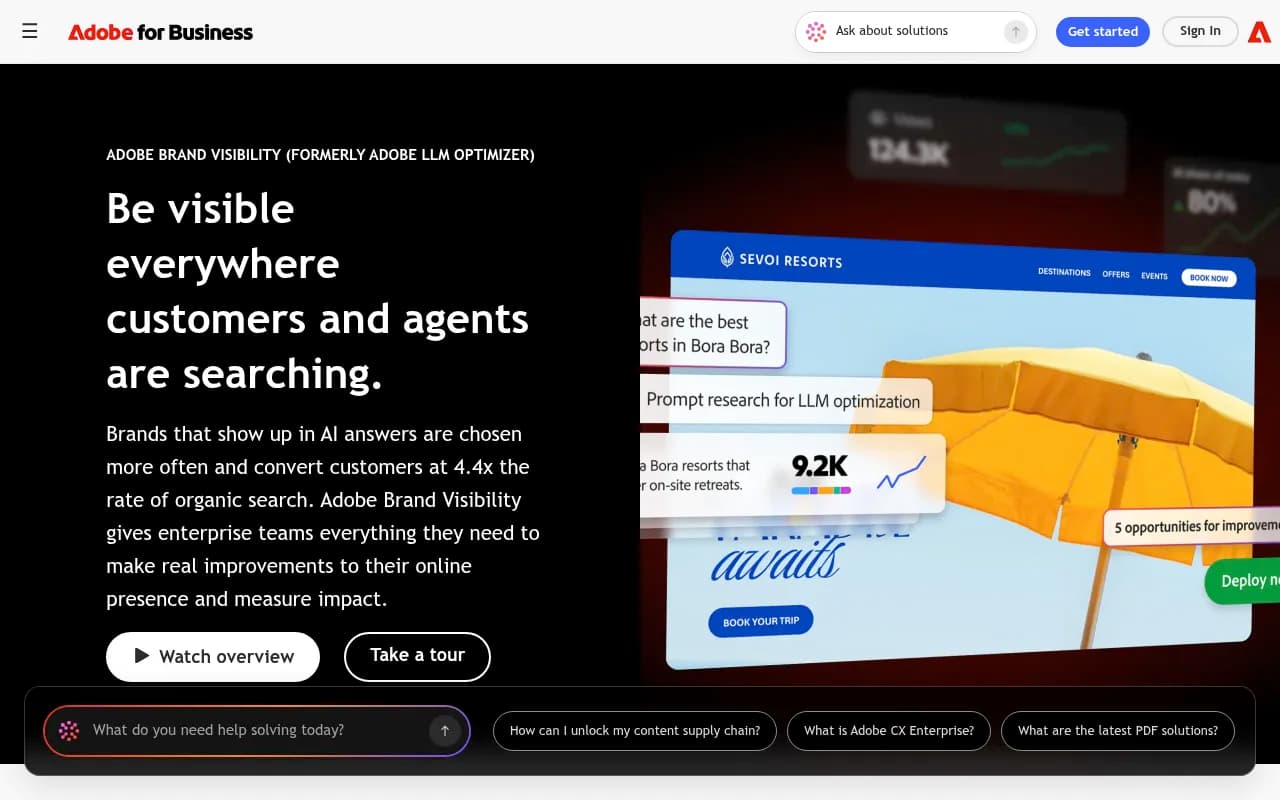
- Adobe Brand Visibility (formerly Adobe LLM Optimizer) is an enterprise GEO product that measures AI citations and share of voice, then deploys fixes at the CDN edge without engineering tickets.
- Compared with Promptwatch, it lacks a publicly documented Content Agent with CMS publishing, IP-verified crawler logs with citation-rate-per-page, Reddit, YouTube and LinkedIn citation reports, AI Shopping and Ads Radar, and self-serve pricing. Promptwatch is the stronger pick if you want optimization with transparent pricing.
- The strongest differentiator is native attribution inside Adobe Analytics and Customer Journey Analytics, plus bot verification and controlled experiments.
- Pricing is not published. Expect a sales-led enterprise contract, and expect the product to make most sense if you already run Adobe.
- Best for large brands with Adobe, Fastly, Akamai or Cloudflare in place. Poor fit for small teams or agencies that want a self-serve tool.
Adobe Brand Visibility is the new name for Adobe LLM Optimizer, the generative engine optimization (GEO) product Adobe introduced at Cannes Lions in June 2025. Per the research I gathered, LLM Optimizer reached general availability in October 2025. The product page now carries the Brand Visibility name, though at least one third-party article claimed the rename was still "coming soon" as of late June 2026. I couldn't verify that against Adobe, so check with your sales rep which SKU you are actually buying.
The pitch is simple. AI answers are replacing clicks, so brands need to be cited inside ChatGPT, Claude, Perplexity, Google AI Mode and Microsoft Copilot. Adobe's page cites Bain & Company for the claim that 60% of searches end without a click, and Semrush (now an Adobe company) for a 4.4x conversion rate on AI-referred traffic. Treat those as vendor-selected figures, not neutral benchmarks.
The audience is enterprise: SEO teams, content strategists, web experience teams, analytics practitioners and brand leaders at large companies. Lovesac and Kellogg's are the logos on the page. That is a very different buyer from the freelancer or mid-market team picking up a prompt tracker for a few hundred dollars.
Key features
AI visibility measurement. Adobe says the product tracks ten LLM families, including ChatGPT, Perplexity, Google AI Mode, Anthropic Claude and Microsoft Copilot. Share-of-voice benchmarking covers up to five direct competitors. Coverage runs across more than 25 languages with state and city-level breakdowns. The five-competitor cap is worth noting, because some rivals allow more.
Prompt data at scale. Adobe advertises access to nearly 300 million AI search prompts, enriched with cross-platform clickstream data. In practice that should help you build a prompt strategy from trending topics instead of guessing. You can see categories where you lead, where you are missing, and which prompts competitors win today.
Crawl visibility. The page promises to show how AI systems crawl your site, not only what they say about you. Adobe doesn't detail which bots are logged or how spoofed traffic is filtered, so I would ask for a demo of the log view before assuming parity with dedicated crawler analytics.
SEO-informed opportunity analysis. This is where Adobe's heritage shows. The tool combines AI visibility with SEO signals to find places where your SEO authority should be producing AI citations but isn't. It also groups prompts into topic clusters and produces prioritized briefs, so one piece of content can lift an entire cluster.
CDN-edge deployment. The headline feature. Brand Visibility intercepts AI agent requests at the CDN layer and serves optimized versions of pages, with no CMS update and no engineering sprint. Changes ship in minutes and can be rolled back instantly. Adobe says the optimizations target AI agents only, leaving the human visitor experience and existing SEO signals untouched. It works with Fastly, Akamai and Cloudflare, so Adobe Experience Manager is not required.
There is a real question here that you should raise with your SEO lead. Serving different content to bots than to people is something search engines have historically frowned on. Adobe frames it as AI-agent optimization, and the claim is that SEO signals are unaffected, but governance and risk teams will want to review it.
Technical GEO fixes. The tool aims to resolve blocked crawlers, missing structured data and 404s without developer help, and to find on-site content gaps tied to real customer prompts with recommendations for blogs and pages.
Off-site content generation. Adobe says it can generate content for Wikipedia, YouTube, Reddit and earned media to expand citation authority. The detail is thin. Promptwatch's own data shows how volatile those channels are: reddit.com's share of ChatGPT citations fell from roughly 4% to 0.5% on August 14, 2026 (Promptwatch Data), and ChatGPT drew just 0.46% of citations from social platforms between Sep 28 and Oct 4, 2026 versus 12.2% for Google AI Overviews (Promptwatch Data). A tool that pushes social content needs to follow those shifts.
Revenue attribution. Native integration with Adobe Analytics and Customer Journey Analytics connects GEO to conversions without custom tagging. CDN log verification confirms that AI bots read the updated content. Controlled experimentation and baseline comparison are meant to prove which changes drove results. For Adobe shops this is the best reason to buy.
Cross-team workspace. PR, social and affiliate teams share one workspace with progress tracking and automated issue routing.
Who is it for
The sweet spot is a large brand with a heavy Adobe footprint: an enterprise retailer or consumer brand with a web team, an SEO team and an analytics team that all report on Adobe Analytics already. If your CDN is Fastly, Akamai or Cloudflare and engineering sprints are the bottleneck for SEO changes, the edge deployment saves real time.
It also suits organizations where the CMO wants GEO results inside the same reporting stack as the rest of digital, rather than a separate dashboard that someone has to reconcile.
Who should skip it? Small and mid-sized businesses, startups and most agencies. Pricing is not published, the buying motion is sales-led, and the value depends on enterprise infrastructure. Agencies running dozens of client workspaces will want white-label reports and per-client billing, and I found no evidence of those. Teams that want to start tracking 50 prompts this afternoon are better served elsewhere.
Integrations and ecosystem
- Adobe Analytics and Customer Journey Analytics for attribution.
- Fastly, Akamai and Cloudflare for CDN-edge deployment, per Adobe's FAQ.
- Adobe Experience Manager works, but is not required.
- Adobe publishes documentation at experienceleague.adobe.com, but I did not review it. I found no public information on an API, MCP server, Slack integration, Looker Studio connector or CMS publishing to WordPress, Webflow or Framer. Ask for these in a demo.
For other GEO options, the directory at bestgeosoftware.com is a useful starting point.
Pricing and value
Adobe does not publish Brand Visibility pricing. The Creative Cloud and Acrobat prices that show up in search are for unrelated products and do not apply. One comparison page mentioned self-serve pricing starting at a euro figure, but the snippet was cut off and I could not confirm it. Assume a quote-based enterprise agreement and ask about volume discounts and multi-year terms, which Adobe offers elsewhere in its enterprise line.
For context, Promptwatch lists public pricing: a free Explore tier, Essential at $95/mo, Professional at $245/mo and Business at $579/mo, with agency plans from $199/mo. Confirm at promptwatch.com/pricing. Whether Adobe is good value depends entirely on whether you would use the Adobe Analytics integration and the edge layer. If you would, it can justify a premium. If not, you are paying for infrastructure you don't need.
Strengths and limitations
Strengths
- Edge deployment means GEO fixes ship without engineering queues, with rollback.
- Native Adobe Analytics and Customer Journey Analytics attribution is hard for non-Adobe vendors to match.
- Bot verification, experiments and baseline comparison give a credible measurement story.
- SEO and AI visibility signals sit in one place, which helps explain why strong-ranking pages are not cited.
- Broad language and geo coverage, with 25+ languages and city-level breakdowns.
Limitations
- No public pricing, no obvious self-serve entry point and no free tier that I could find.
- Naming and availability are muddy, since LLM Optimizer and Brand Visibility are used interchangeably.
- The five-competitor limit and the thin detail on off-site content generation.
Gaps compared with Promptwatch
Promptwatch is a direct competitor, and it covers several things I could not find in Adobe's materials:
- A Content Agent that plans, writes and publishes GEO content to WordPress, Webflow or Framer on a schedule, with a review inbox.
- IP-verified AI crawler logs (GPTBot, ClaudeBot, PerplexityBot and others) with spoofed bots filtered out and a citation rate per page.
- Dedicated Reddit, YouTube and LinkedIn citation reports, plus Offsite Mentions.
- AI Shopping tracking in ChatGPT and Amazon Alexa, and Ads Radar for sponsored AI placements.
- Prompt volumes, difficulty scores and query fan-outs.
- Google Search Console and Bing Webmaster data overlaid on AI data, and page-level tracking.
- Agent Chat and a prioritized Action Board.
- Real-UI tracking across 15+ AI engines, including coding agents like Codex and Claude Code.
Adobe's counter is real: the edge layer and the Adobe Analytics tie-in. But for teams that want a complete optimization loop at transparent prices, Promptwatch is ahead.
Bottom line
Adobe Brand Visibility is a serious enterprise play. If you already pay Adobe for analytics or experience management, run a supported CDN, and have a procurement process that tolerates quote-based pricing, it deserves a place on the shortlist. The edge deployment is the genuinely different idea.
Everyone else should look at Promptwatch first. It is the stronger alternative for teams who want optimization, not just monitoring, with content gap analysis, publishing, crawler logs and clear pricing. Best use case in one sentence: a large Adobe-centric brand that wants GEO fixes deployed at the CDN and proven in Adobe Analytics.

Prices and product naming change quickly, so verify details with Adobe sales before buying.
Frequently asked questions
What is Adobe Brand Visibility?
How much does Adobe Brand Visibility cost?
Do I need Adobe Experience Manager to use it?
Which AI platforms does it track?
How does it compare with Promptwatch?
Is there a free plan?
Similar and alternative tools to Adobe Brand Visibility