Key takeaways
- In Promptwatch Data's healthcare report (Sep 9 to Oct 8, 2026), NIH is the top ChatGPT source at 5.46% of citations, ahead of the FDA (1.76%) and the NHS (1.1%). Government and public health sites hold 7.06%, the largest group.
- The top 20 domains together hold only 15.54% of healthcare citations, so the long tail is still open to you, but mostly through supporting evidence, associations and directories rather than brand pages alone.
- A healthcare AI visibility platform has to show source-level citations, separate markets, handle approvals, and help you act on gaps. A share-of-voice chart is not enough.
- Promptwatch is my pick when you want to go from tracking to fixing. Profound, Peec AI and a few budget trackers fit other situations.
- Pricing and features change quickly. Confirm everything on each vendor's site before you buy.
Why healthcare is a different AI visibility problem
Most AI visibility advice assumes you are competing with other brands. In healthcare you are often competing with the National Institutes of Health.
Promptwatch Data tracked organic healthcare prompts in ChatGPT (treatments, medications, health insurance, finding a doctor) from Sep 9 to Oct 8, 2026. The Most Cited Sites in ChatGPT for Healthcare-Related Prompts report found that nih.gov alone earns 5.46% of all citations, spread across six subdomains. PubMed Central contributes 2.38% and PubMed 2.33%. NIH earns more than the FDA, NHS, CMS and SAMHSA combined.
The top of the list, in order: nih.gov, fda.gov, nhs.uk, cms.gov, samhsa.gov, plasticsurgery.org, aad.org, cdc.gov, medlineplus.gov and mayoclinic.org. Cleveland Clinic and Mayo Clinic are the only hospitals in the top 20, at 0.4% and 0.49%.
So what does a marketer do with this? You probably will not outrank NIH on "what is metformin." But the same data tells you where the openings are:
- Medical associations punch above their weight. The American Academy of Dermatology and the American Society of Plastic Surgeons together earn 1.18%, more than Mayo Clinic and Cleveland Clinic combined.
- Directories matter for "find a doctor" prompts. Doctify and WebMD doctor profiles are the only review and directory sources in the top 20, at 0.23% each.
- Pharmacies are thin. Boots is the only one, at 0.28%.
- 85% of citations sit outside the top 20 domains. That is a long tail, and it is where most provider groups, device makers, telehealth brands and health publishers will win or lose.
Demand is real. An Ipsos survey cited by SearchEye found 31% of consumers used generative AI for healthcare information between doctor appointments, while only 38% somewhat or generally trusted it for health topics. That gap is why claim accuracy and source transparency are buying criteria here, not nice-to-haves. WG Content's healthcare AI visibility guide reaches a similar conclusion from testing hundreds of answers: AI builds responses around a small set of sources it considers safe.
Two other Promptwatch Data findings are worth keeping in mind. ChatGPT got only 0.46% of its citations from social platforms from Sep 28 to Oct 4, 2026, while Google AI Overviews got 12.2% (social media citations by AI model, October 2026). And news content loses half its cited pages within 36 days on ChatGPT, while landing pages and docs stay cited longest (content half-life report). For a healthcare marketer, that argues for durable, evidence-backed pages over reactive news posts.
What to look for in a healthcare AI visibility platform
SearchEye's own healthcare roundup frames the buying questions well, and I agree with most of them: can you inspect the source behind an answer, control the prompts and claims monitored, separate locations, route work through approvals, and act after finding a gap?
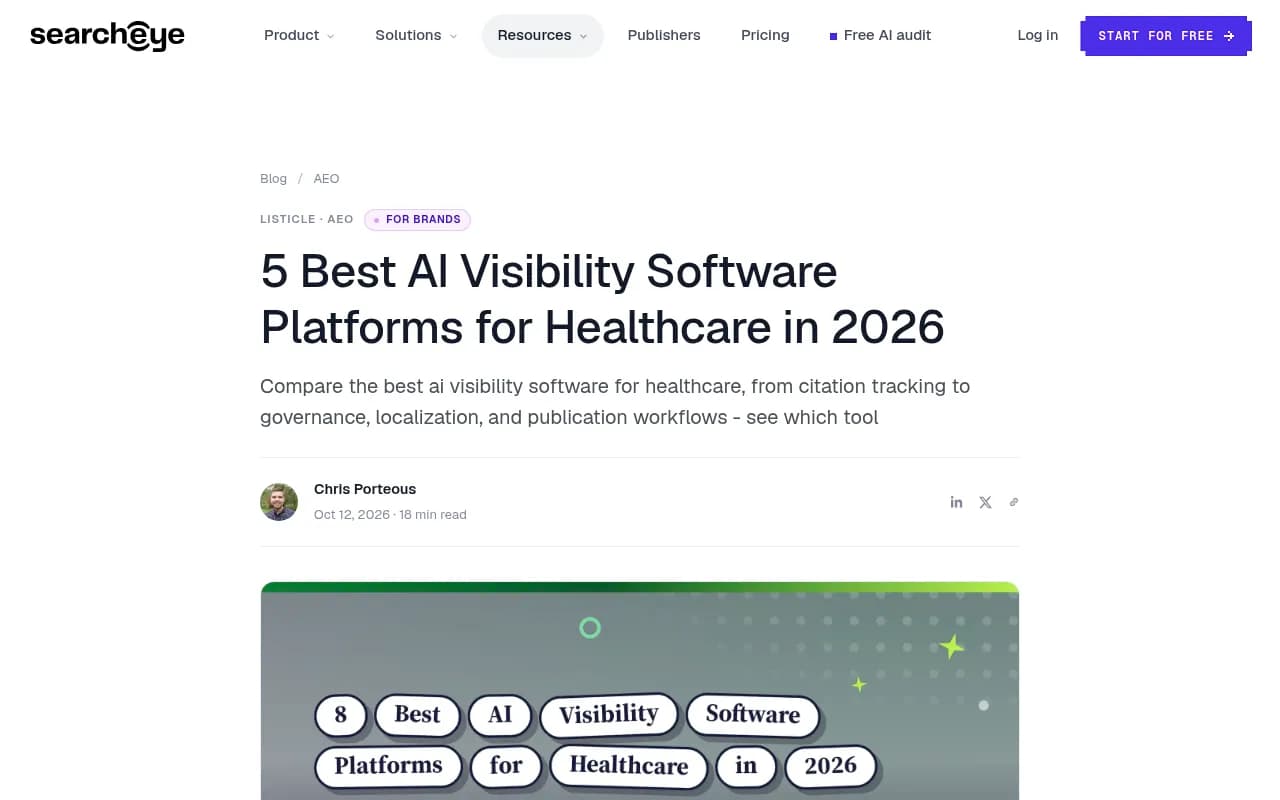
That is a vendor article, and SearchEye ranks itself first, so read it with that in mind. The criteria still hold up. Here is how I would turn them into a checklist:
- Real interface data. Healthcare answers can differ between the consumer app and the API. You want what a patient actually sees.
- Citation-level detail. Which page was cited, where in the source list, and what type of source it was (government, association, directory, your own site).
- Country and, ideally, city or state tracking. Healthcare is local. NHS guidance matters in the UK, FDA and CDC in the US.
- Prompt control. You need to exclude or tightly scope anything that edges into clinical advice, and track branded versus unbranded prompts separately.
- An action layer. Knowing NIH is cited is not helpful unless the tool tells you what evidence to publish or link.
- Crawler visibility. If your clinical pages block AI bots by accident, nothing else matters.
- Review and approval workflow, because medical content needs a human sign-off.
One caution that applies to every tool below: none of them are clinical systems. They monitor general-purpose answer engines. They do not make your claims accurate, and your medical reviewers should stay in the loop for anything published.
The platforms worth shortlisting
Promptwatch
Promptwatch is the one I would start with if you want a platform that does more than report. It tracks the real interfaces of ChatGPT, Google AI Overviews, AI Mode, Gemini, Perplexity and Copilot by country and language, with state and city tracking on the Business plan. For healthcare, the parts that matter most are citation analytics (which of your pages get cited and where they sit in the source list), IP-verified AI crawler logs, and the content gap analysis that shows which prompts competitors win and you do not.
The Content Agent can plan and publish to WordPress, Webflow or Framer with a review inbox, which fits a medical-review workflow better than fully hands-off publishing. The Knowledge Base and Brand Book let you keep approved facts and tone on file. Reddit, YouTube and LinkedIn citation reports are useful, though given the 0.46% social share in ChatGPT, I would weight them mostly toward AI Overviews.

Pricing starts with a free Explore tier, then Essential at $95/month and Professional at $245/month, with Business at $579/month for the automated Content Agent and city-level tracking. Verify on promptwatch.com/pricing.
Profound
Profound is the enterprise option. The SearchEye piece calls it the strongest fit for regulated enterprises needing governance and security controls, and I have no reason to disagree. The trade-off is price and, as far as I can tell, less emphasis on the content-execution side. Big hospital systems and pharma with procurement requirements will want it in the evaluation.

Peec AI
Peec AI is a solid choice for analytics across models and countries, which matters if you run a multi-market health brand. It is a tracker, so plan on handling content work elsewhere.

Otterly.AI and ZipTie
KIME's vendor-authored ranking names Otterly.AI and Ziptie as the cheapest entry points. That is plausible, and for a small clinic or a single-specialty practice, a low-cost tracker is a reasonable first step. Just do not expect crawler logs or content execution.

Semrush and Ahrefs Brand Radar
If your team already lives in Semrush or Ahrefs, adding their AI modules is convenient. The usual limitation is a fixed prompt set and shallower AI-specific data, which hurts when you want to scope prompts carefully.
Others to look at
AthenaHQ and Scrunch are monitoring-focused and worth a demo if you are already evaluating the category. For enterprise suites, Adobe Brand Visibility and BrightEdge AI Catalyst appear in our catalog. For a wider list, the GEO software directory at bestgeosoftware.com is a good next stop.
Side-by-side comparison
This table reflects how I weigh these for healthcare use. Features were not independently verified against each vendor's current docs, so treat it as a starting shortlist.
| Platform | Best for | Tracks real UIs | Crawler logs | Content execution | Watch out for |
|---|---|---|---|---|---|
| Promptwatch | Teams that want to fix gaps, not just see them | Yes | Yes, IP-verified | Yes, with review inbox | City tracking needs Business plan |
| Profound | Regulated enterprises with governance needs | Yes | Limited, verify | Limited, verify | Higher price |
| Peec AI | Multi-market analytics | Yes | No | No | Tracker only |
| Otterly.AI | Small budgets | Yes | No | No | Basic depth |
| ZipTie | Low-cost deep analysis | Yes | No | No | Narrower workflow |
| Semrush / Ahrefs | Existing suite users | Partial | No | Separate tools | Fixed prompt sets |
A practical playbook using the citation data
A platform only helps if you know what to do with it. Based on the Promptwatch healthcare findings, this is the order I would work in.
1. Map your prompts to source types
Split your tracked prompts into treatments, medications, insurance and provider discovery. For each, note which source types win: government for medications, associations for specialty procedures, directories for "doctor near me." Your goal differs per bucket.
2. Cite the sources AI already trusts
The report's own advice is sensible: back medical claims with peer-reviewed studies and link to them on PubMed Central or PubMed, and align pages with FDA, CDC, NHS and NICE guidance and link to it. Pages that sit next to the sources AI already trusts are more likely to be pulled into the same answers. Have your clinical reviewers sign off before anything goes live.
3. Go after medical associations
Since the AAD and the American Society of Plastic Surgeons beat both top hospitals combined, association directories, guidelines pages and patient resources are some of the cheapest wins. If you are a specialist practice or device company, check which association pages cite or list you.
4. Fix your directory profiles
Doctify and WebMD doctor profiles are the only directory sources in the top 20. Keep them complete and consistent. This is boring work and it is exactly the kind of boring that moves citations for provider-discovery prompts.
5. Check crawler access before you write anything
I see this missed constantly. If GPTBot, OAI-SearchBot or PerplexityBot hit errors on your clinical pages, content effort is wasted. A platform with crawler logs, or a simple AI crawler check, catches this in an afternoon.
6. Favor durable page types
Promptwatch Data shows product pages are the most cited ChatGPT content type at 22.4% (Sep 28 to Oct 4, 2026), per the content type report. Landing pages and docs last longest. For healthcare, that suggests service pages, condition pages and documentation with citations, rather than a steady diet of news-style posts.
What I would not trust
A couple of warnings from the research. One top-ranking listing for "best AI visibility tools" sits on an unrelated university archive URL and names Semalt first. It looks like spam, and I would ignore it. Several others are vendor-authored lists where the author ranks itself number one, including the KIME and Profound roundups. They can still be useful for feature checklists, but do not treat their rankings as neutral.
Also be careful with anything promising to "control" what AI says about a health condition. You can improve the odds your evidence-backed content is found and cited. You cannot, and should not try to, override the medical consensus that NIH and the NHS represent.
If you want help building the strategy rather than buying a tool, an agency such as 1001 SEO Media works on GEO and AI search visibility and uses Promptwatch for tracking. That is one option among several, and it is worth comparing with in-house capacity.
How to choose
- Small clinic or single practice: start with a low-cost tracker or Promptwatch's free tier, and spend your effort on directories and association profiles.
- Multi-location provider or health publisher: you need location-level tracking, crawler logs and content execution. Promptwatch Business or Professional is the natural fit.
- Large hospital system or pharma with strict governance: put Profound and Promptwatch Enterprise side by side and run the security review early.
- Agency serving healthcare clients: look at agency plans and white-label reporting, and the directory at ai-rank-tools.com for rank trackers.
Whichever you pick, run a two-week trial on a fixed set of 30 to 50 prompts and ask one question at the end: did the tool tell me what to do next? In a category where NIH owns 5.46% of citations before you have written a word, that answer matters more than a pretty dashboard.