Key takeaways
- Sitecore acquired Scrunch on June 3, 2026, reportedly for around $225 million (per Bloomberg; neither company confirmed terms), folding an AI visibility platform into an enterprise content stack.
- The deal is part of a consolidation wave: Adobe closed its $1.9B Semrush acquisition in April 2026, Optimizely partnered with Conductor in June, and Profound hit a $1B valuation in February.
- Scrunch's differentiator is its Agent Experience Platform (AXP), which serves AI crawlers a machine-optimized version of your pages while humans see the original. Akamai reported a 364% brand presence lift using it.
- The acquisition validates GEO as a budget line but raises real questions for Scrunch's self-serve customers, who now sit inside an enterprise DXP company's roadmap.
- If you're evaluating GEO tools in late 2026, the market has split into three camps: monitoring pure-plays, execution platforms, and now DXP-embedded suites.
The deal, in plain terms
On June 3, 2026, Sitecore announced it had acquired Scrunch, an AI visibility platform founded in 2023 in Salt Lake City by Chris Andrew and Robert MacCloy. Bloomberg reported the price at roughly $225 million, though neither company confirmed it. For context, Scrunch had raised about $19 million across a $4M seed (March 2025) and a $15M Series A (July 2025) led by Decibel. If the Bloomberg figure holds, Sitecore paid more than ten times Scrunch's total funding.

That multiple tells you most of what you need to know about the strategic logic. Sitecore, majority-owned by EQT, sells CMS, personalization, and digital experience software to large enterprises. Its customers have deep, well-governed content estates. What they increasingly lack is any idea how that content performs when an AI model, rather than a human, is the one reading it.
Scrunch answers that question. Its monitoring layer tracks where a brand appears, is missing, or is misrepresented across ChatGPT, Gemini, Perplexity, and other engines. Its recommendations layer tells teams what to fix. And its Agent Experience Platform (AXP) serves AI crawlers a purpose-built, compressed rendering of a page while human visitors see the unchanged original.
Sitecore CEO Eric Stine's framing was blunt: "the internet must be written for machines to understand if we want humans to experience it." That's a strong statement from the head of a company whose entire business was, until recently, built around human experiences.
Why now? The numbers behind the deal
The timing wasn't random. A few data points explain why an enterprise DXP vendor felt it had to own this capability rather than partner for it:
- AI agents now outnumber human visitors. On the same day the deal was announced, Cloudflare CEO Matthew Prince confirmed that bot and AI agent traffic had overtaken human traffic for the first time, at roughly 57.4% bots to 42.6% humans on Cloudflare's public Radar dashboard.
- AI-referred buyers convert better. Scrunch CEO Chris Andrew has cited AI search conversion rates running 3 to 5x higher than traditional organic search. Runpod reported a 400% increase in paying customers tied to its AI search optimization work; Clerk reported a 9x increase in AI-driven sign-ups.
- The shortlist forms before the first click. Scrunch cites Forrester research showing up to 90% of B2B buyers use generative AI during purchasing, with the evaluation stage compressing dramatically.
There's a subtler reason too, and it's about what AI systems actually cite. Promptwatch's data on average sources per response shows ChatGPT cites roughly 5 sources per web-search-triggered response, versus about 10 for Google AI Overviews and Perplexity. Five slots is a brutally small stage. Every brand in your category is competing for the same handful of citations, and the winners are increasingly decided before a buyer ever types your brand name.
The content mix is also shifting in ways that favor companies with structured product content. Promptwatch's July 2026 citation-type data shows product pages became the single most-cited content type in ChatGPT at roughly a third of all citations, nearly doubling from about 18% in March. Enterprises sitting on rich product and documentation content suddenly have an asset that AI search rewards, if it's machine-readable. That's exactly the gap Scrunch's AXP claims to close.
What Scrunch actually brings to Sitecore
Scrunch was never just a prompt tracker, and that's presumably what made it worth nine figures. Three layers matter:
Visibility and gap analysis
Scrunch tracks brand presence, competitor positioning, and content gaps across the major engines. Its named clients include Lenovo, Skims, Headspace, and Penn State University, and the company claims 500+ brands and agencies. Its differentiator per several independent rankings is misinformation and hallucination detection, catching not just when you're absent from an answer but when an AI model states something wrong about you.
The Agent Experience Platform
This is the interesting part. AXP detects what AI crawlers actually receive from your site, fixes crawl errors they hit, and serves them a machine-optimized rendering of your pages without changing what humans see. Akamai's analysis found AXP-enabled pages achieved a 364% increase in brand presence for non-branded prompts and a 218% increase in citations, compared with comparable non-AXP pages, without a site rebuild.
Workflow execution
Scrunch's recommendations will be automated inside SitecoreAI's Content Management, Content Marketing, and DAM products. That's the piece standalone tools can't replicate: a report nobody actions is worthless, and the acquisition wires the findings directly into the systems where enterprise content teams already work.
The consolidation wave this deal belongs to
Sitecore-Scrunch didn't happen in a vacuum. If you've been watching the GEO market, the last twelve months read like a countdown to consolidation:
| Event | Date | Signal |
|---|---|---|
| Profound raises $96M Series C at $1B valuation | February 2026 | First GEO unicorn; category gets Wall Street's attention |
| Adobe closes Semrush acquisition (~$1.9B) | April 28, 2026 | Search-data scale meets enterprise CX stack |
| Bluefish raises $43M Series B | April 2026 | Fortune 500 positioning, $68M total raised |
| Sitecore acquires Scrunch (~$225M reported) | June 3, 2026 | DXP vendor buys GEO pure-play |
| Optimizely partners with Conductor on AEO platform | June 2026 | Competing DXP makes the same move via partnership |
| HubSpot ships AEO at $50/month | 2026 | Mid-market gets a cheap bundled option |
Analysts had been predicting exactly this. One widely-cited piece written before the Sitecore deal argued the first major acquisition, an SEO incumbent buying a funded GEO pure-play, would land within twelve months, naming Adobe, Salesforce, HubSpot, and Semrush as likely buyers. Sitecore got there first.
The category itself is crowded and well-funded: roughly 100+ tools and more than $200M raised across a few dozen startups in 18 months, with Profound at $155M total, Peec AI at $29.1M, AthenaHQ backed by Y Combinator, and Evertune at around $19M. Market-size estimates vary wildly depending on who's counting, from $1.09 billion (Dimension Market Research, projecting $17.1B by 2034 at a 40.6% CAGR) to $2.7 billion (Coherent Market Insights, projecting $26.85B by 2033). Treat both as directional, not gospel. The honest summary: it's a real market, growing fast, and nobody agrees on how big it is yet.
What this means for the GEO market
Validation, with a catch
The single biggest effect of this deal is legitimacy. When an enterprise DXP vendor pays a reported nine figures for a GEO tool, GEO stops being an experimental line item and becomes infrastructure. Budgets follow. The same quarter saw a PR firm, Mazarine, acquire Bacchus with GEO explicitly cited as the rationale, which tells you the idea has spread beyond martech into adjacent service industries.
The catch: validation cuts both ways. If every CMS, DXP, and marketing platform bundles AI visibility natively, the standalone tool market gets squeezed from above. Why pay $250/month for a specialist tracker if your CMS includes one?
The market is splitting into three camps
This is the structural shift worth paying attention to:
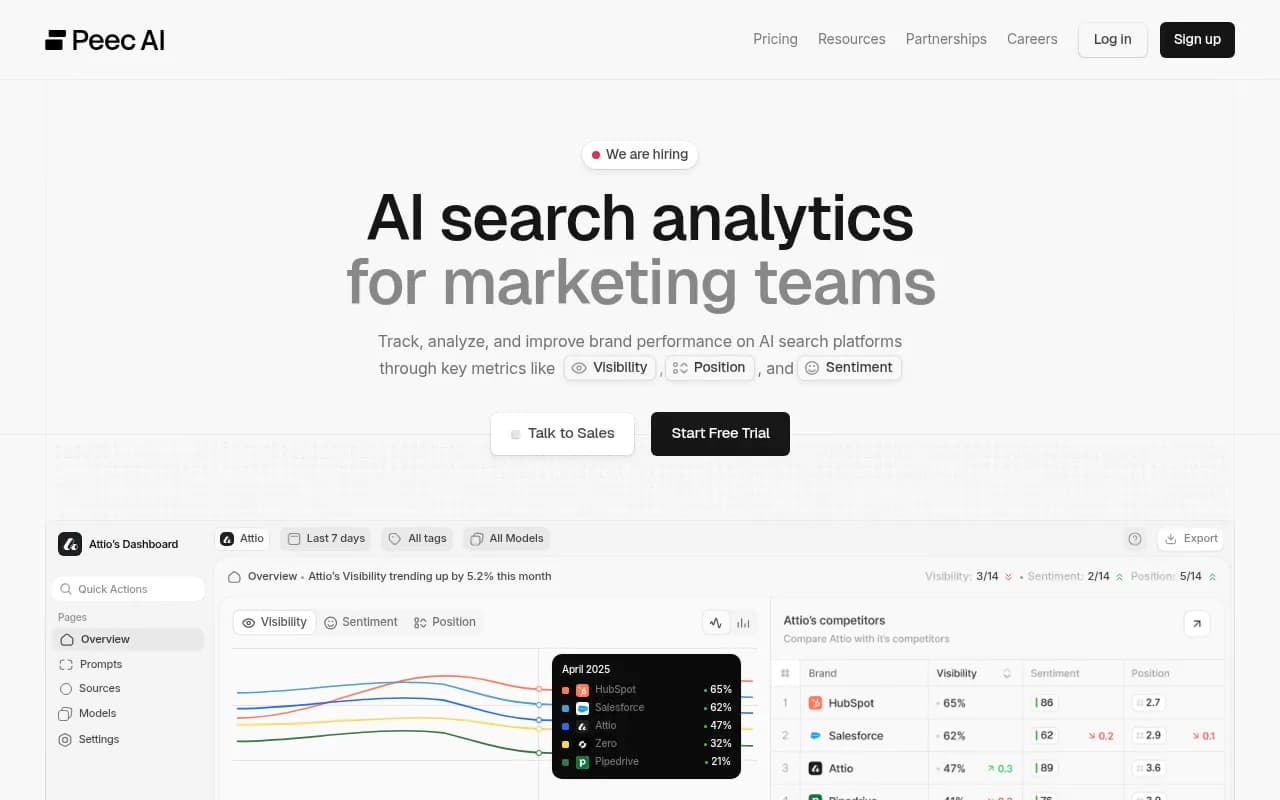
- Monitoring pure-plays (Otterly.AI, Peec AI, AthenaHQ, and dozens more) compete on price and coverage. Peec cut pricing to $80/month in mid-2026 amid the pressure.
- Execution platforms that go beyond tracking to actually help you fix things, with content generation, CMS publishing, and crawler analytics. Promptwatch sits here, with AI crawler logs, content gap analysis, and automated content agents that plan, write, and publish GEO-optimized content, alongside Reddit and YouTube citation tracking that most competitors lack.
- DXP-embedded suites (Sitecore + Scrunch, Adobe + Semrush, Optimizely + Conductor, HubSpot AEO) that wire visibility data into the content workflow itself.

If you're a pure-play in camp one, this deal is bad news. If you're in camp two or three, it's confirmation that the category has legs.
Pricing pressure is coming
Scrunch's $250/month entry point already sat 181% above the category median of $89/month. HubSpot's AEO at $50/month and Peec at $80/month are pulling the floor down, while the DXP bundles make "included with your platform" the default enterprise answer. Expect standalone GEO pricing to compress over the next 18 months, with differentiation shifting from monitoring features to execution and attribution.
The self-serve question nobody's answering
Here's the part current Scrunch customers should think about. When a $250/month self-serve tier and a seven-figure enterprise platform live under one roof, self-serve rarely gets the roadmap attention. Nobody has announced changes to Scrunch's standalone plans, and I'm not predicting a shutdown. But Scrunch's own site was notably quiet about the acquisition, and reviewers are already flagging "roadmap uncertainty" as a risk. If you're signing an annual contract, ask about the self-serve roadmap in writing.
A skeptical note on the AXP pitch
I want to flag something, because the acquisition press coverage won't. Scrunch's AXP is built on a compelling premise: serve AI agents a special machine-optimized format, and they'll cite you more. The Akamai numbers suggest it works. But Promptwatch's research on markdown and content formats in AI search complicates the broader "write for machines" narrative: across 1.67 million citations analyzed in one week, 99.94% went to standard rendered HTML pages, versus 0.05% for markdown files. AI search engines overwhelmingly cite normal web pages, not alternative machine-readable formats.
That doesn't invalidate AXP, which is more about fixing what crawlers receive than inventing a new format. But it does mean you should be skeptical of any vendor whose pitch is "publish in our special format and AI will find you." The evidence says well-structured HTML, fast pages, and clean crawl access do most of the work. Test claims like Akamai's against your own data before betting a content migration on them.
It's also worth watching where citations actually flow. Promptwatch's June 2026 ChatGPT citation share data shows no domain exceeds 4% of citations, a long-tail distribution far less winner-takes-all than classic Google rankings. And Reddit's share of ChatGPT citations collapsed from roughly 4% to 0.5% by mid-August 2026. Any GEO strategy built on last year's assumptions about which sources matter is already stale. This is why crawler logs and live citation data, not static best practices, should drive your decisions.
What to do now, depending on who you are
If you're an enterprise on Sitecore (or considering it)
This deal is genuinely good news for you. The insight-to-action loop that standalone tools struggle with, a dashboard flags a gap, someone has to go fix the CMS, gets collapsed into one workflow. If your CMS conversation and your AI visibility conversation are about to become the same procurement, being early on the acquired product is an advantage. Ask Sitecore hard questions about pricing packaging and integration timelines, since nothing has been announced yet.
If you're evaluating GEO tools right now
Don't let the acquisition headlines rush you. Match the tool to your actual problem:
| Your situation | What to look for | Examples to evaluate |
|---|---|---|
| Enterprise, heavy CMS investment | DXP-embedded visibility and workflow automation | Sitecore + Scrunch, Adobe Brand Visibility, Optimizely + Conductor |
| Need to know why you're invisible, not just that you are | Crawler logs, citation analytics, AI traffic attribution | Promptwatch, Profound |
| Small team, tight budget | Affordable multi-engine tracking | Peec AI ($80/mo), Otterly.AI, AthenaHQ's free tier |
| Agency managing many clients | Unlimited projects, white-label reporting | Promptwatch agency plans, Rankability |
| Content production is the bottleneck | Content gap analysis with automated publishing | Promptwatch Content Agents, AirOps, Writesonic |
For a fuller picture of what's out there, the GEO software directory at bestgeosoftware.com covers the category, and ai-rank-tools.com focuses specifically on rank tracking options.

If you're a GEO startup
The window for being "a dashboard that shows your AI visibility" is closing. Sitecore, Adobe, and HubSpot will own the bundled market, and price competition is eating the low end. What survives is what the DXPs can't easily replicate: proprietary data (real prompt volumes, crawler logs, citation analytics), execution (content that actually gets published), and attribution (proving AI visibility drives revenue, not just mentions). If your roadmap is monitoring features, you're acquiring churn.
The bottom line
Sitecore buying Scrunch is the moment GEO stopped being a niche discipline and became part of the enterprise content stack. That's good for the category's credibility and probably good for Sitecore customers. It's less good for standalone trackers, whose value proposition now has to survive both bundling pressure from above and price compression from below.
The deal also settles an argument that was still live eighteen months ago: whether AI search visibility is a fad or a line item. The answer, apparently, is about $225 million. The next argument, over whether visibility tools or content execution platforms capture the budget, is just getting started, and the winners will be the ones that can prove AI-driven traffic turns into revenue rather than just mentions.