Key takeaways
- Most GEO platforms stop at monitoring — they show you visibility gaps but don't help you close them.
- Promptwatch, Relixir, and Whitebox each offer some degree of content automation, but they differ significantly in how much of the workflow they own end-to-end.
- Searchable is primarily a monitoring and analytics tool; it has content features but they're not its core strength.
- If your goal is a complete loop from gap analysis to published content to traffic attribution, the platforms aren't equal — and the differences matter more than the feature checklists suggest.
- Pricing, depth of citation data, and how much human judgment the platform preserves are the real differentiators.
The GEO category has a dirty secret: most tools are just dashboards. They'll tell you that a competitor appears in 73% of ChatGPT responses for "best project management software" while you appear in 12%. That's useful. But then what? You're left staring at a gap with no clear path to closing it.
That's the problem this guide is actually about. Not "which tool tracks the most AI models" or "which has the prettiest UI" -- but which platforms genuinely automate the journey from "we're invisible here" to "we published something that AI models now cite."
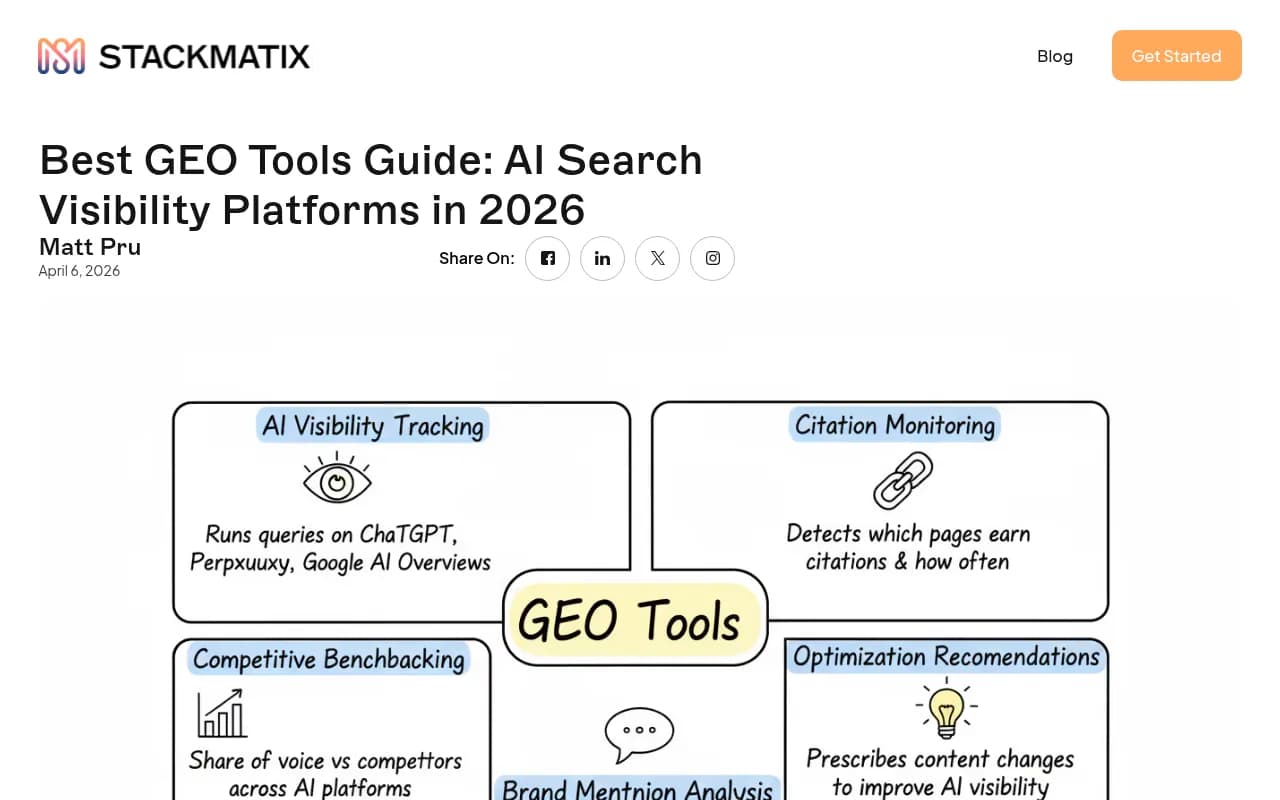
Four platforms are worth examining seriously in 2026: Searchable, Promptwatch, Relixir, and Whitebox. They each claim to do more than monitor. Let's see what that actually means in practice.
What "automating the gap-to-content path" actually means
Before comparing tools, it's worth being precise about what we're evaluating. The full workflow has five stages:
- Discover which prompts competitors rank for that you don't
- Understand why (what content exists, what's missing, what AI models want)
- Generate a content brief or draft based on that analysis
- Publish or push that content somewhere useful
- Track whether it moved the needle
Most tools handle stage one reasonably well. A few handle stages one and two. The interesting question is which platforms get you to stage four and five without requiring you to stitch together three other tools.
The four platforms at a glance
Searchable
Searchable positions itself as an AI search visibility platform with both monitoring and content tools. It tracks brand mentions across major AI models, provides share-of-voice analytics, and has some content optimization features built in.
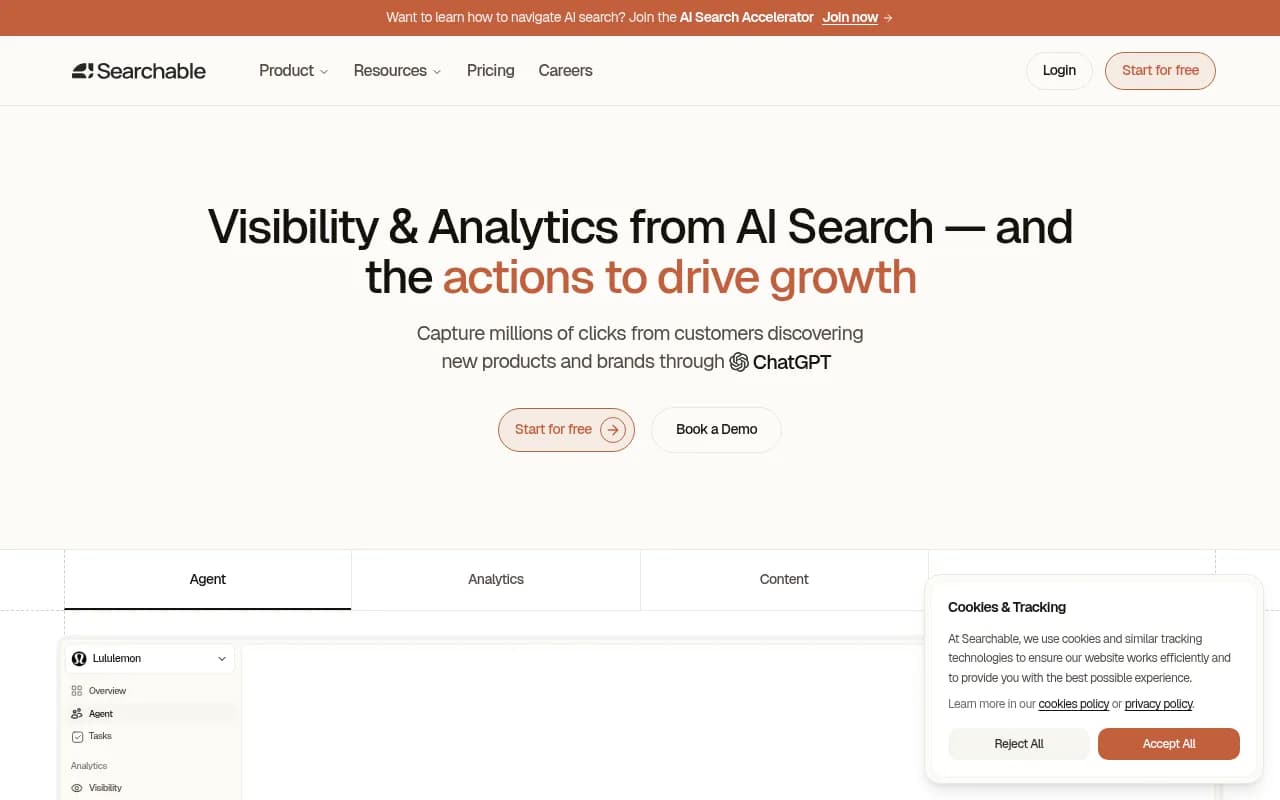
The monitoring side is solid. Searchable covers the main AI models you'd care about -- ChatGPT, Perplexity, Gemini, Claude -- and gives you a reasonable view of where you appear and where competitors do. The content features exist, but they feel more like a bolt-on than a core workflow. You can get recommendations for what to write, but the path from "here's a gap" to "here's a draft" to "here's the published page" isn't seamless.
For teams that primarily want visibility data and are comfortable writing content themselves, Searchable works. For teams that want the gap-to-published workflow automated, it falls short.
Promptwatch
Promptwatch is the most complete end-to-end platform in this comparison. It's built around what it calls an "action loop": find gaps, generate content, track results. That framing matters because it means the content generation isn't a side feature -- it's structurally central to how the product works.

The Answer Gap Analysis shows you exactly which prompts competitors appear for that you don't, with prompt volume estimates and difficulty scores so you can prioritize. The built-in AI writing agent then generates articles, listicles, and comparisons grounded in actual citation data -- over 880 million citations analyzed. That's not generic SEO content; it's content engineered around what AI models have actually cited in real responses.
What separates Promptwatch from the others is the closing of the loop. Page-level tracking shows which of your pages are being cited, by which models, how often. Traffic attribution (via a code snippet, Google Search Console integration, or server log analysis) connects AI visibility to actual revenue. Most competitors stop at step one or two. Promptwatch runs all five stages.
The AI Crawler Logs feature is worth calling out specifically. You can see in real time which AI crawlers (ChatGPT, Claude, Perplexity) are hitting your site, which pages they're reading, and what errors they're encountering. That's a level of technical depth that monitoring-only tools simply don't have.
Pricing starts at $99/month for the Essential plan (1 site, 50 prompts, 5 articles), $249/month for Professional (2 sites, 150 prompts, 15 articles, crawler logs), and $579/month for Business (5 sites, 350 prompts, 30 articles). A free trial is available.
Relixir
Relixir takes a different angle. It describes itself as an "AI-native CMS" for GEO, which means content creation and publishing are genuinely first-class features rather than monitoring add-ons. The platform is built around the idea of autonomous content -- it can generate and ship content with minimal human intervention.
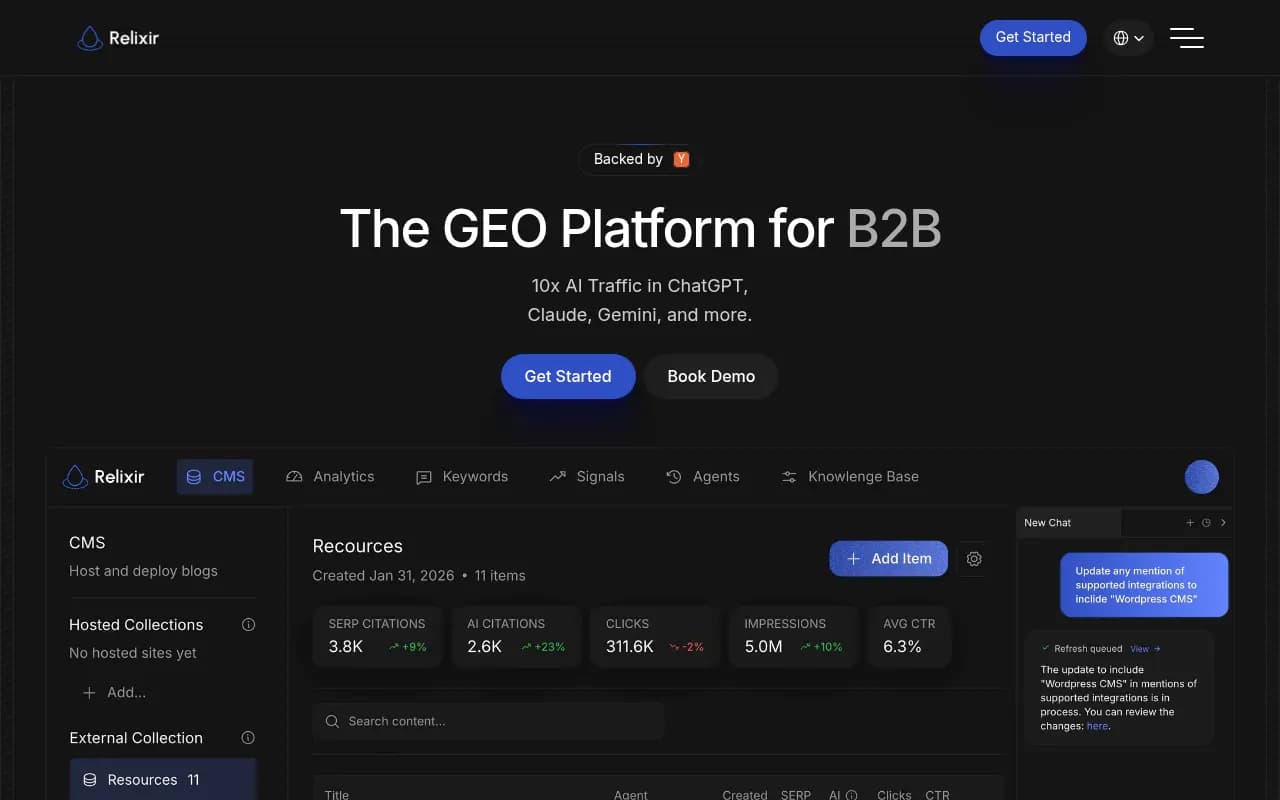
That autonomy is both the appeal and the risk. If you want a platform that can run a content pipeline largely on autopilot, Relixir is designed for that. The tradeoff is control. Fully autonomous content generation means you need strong brand guidelines baked into the system, or you'll end up with content that's technically optimized but tonally off.
Relixir's monitoring capabilities are more limited than Promptwatch's. It covers fewer AI models and lacks some of the deeper analytics features like crawler logs and prompt fan-outs. But if your bottleneck is content production volume rather than insight depth, that trade-off might be worth it.
Whitebox
Whitebox calls itself an "agentic GEO platform." The core idea is that it doesn't just identify narrative gaps -- it generates fixes and ships them automatically. The "agentic" framing means the platform takes more initiative than a typical content tool: it monitors AI responses, identifies where your brand narrative is wrong or missing, and generates corrective content.
This is genuinely interesting for brand-sensitive use cases. If an AI model is consistently describing your product incorrectly, or citing a competitor instead of you for a specific claim, Whitebox is designed to detect that and generate content that corrects the narrative. It's less about broad content strategy and more about targeted narrative repair.
The limitation is scope. Whitebox is strong at the "fix what's broken" use case but less suited for broad content strategy or building visibility from scratch in a new category. It also has less depth on the analytics side compared to Promptwatch.
Side-by-side comparison
| Feature | Searchable | Promptwatch | Relixir | Whitebox |
|---|---|---|---|---|
| AI model coverage | ChatGPT, Perplexity, Gemini, Claude | 10 models incl. DeepSeek, Grok, Copilot, Meta AI | Core models (ChatGPT, Perplexity, Gemini) | Core models |
| Prompt volume & difficulty scores | Limited | Yes (full scoring) | Partial | No |
| Answer gap analysis | Basic | Full (competitor-level) | Yes | Yes (narrative-focused) |
| Content brief generation | Yes | Yes | Yes | Yes |
| AI content drafting | Limited | Yes (citation-grounded) | Yes (autonomous) | Yes (narrative repair) |
| Publishing / CMS integration | No | No (exports) | Yes (AI-native CMS) | Yes (auto-ships) |
| AI crawler logs | No | Yes | No | No |
| Page-level citation tracking | Partial | Yes | Partial | No |
| Traffic attribution | No | Yes (3 methods) | No | No |
| Reddit & YouTube insights | No | Yes | No | No |
| ChatGPT Shopping tracking | No | Yes | No | No |
| Multi-language / multi-region | Limited | Yes | Limited | No |
| Free trial | Yes | Yes | Yes | Limited |
| Starting price | ~$99/mo | $99/mo | Custom | Custom |
How each platform handles the five-stage workflow
Stage 1: Discovering gaps
All four platforms do this. Promptwatch's version is the most detailed -- you get prompt volume estimates, difficulty scores, and query fan-outs that show how a single prompt branches into sub-queries. That matters for prioritization. Knowing that "best CRM for startups" has 40x the prompt volume of "best CRM for bootstrapped founders" changes what you work on first.
Searchable and Relixir give you gap data but without the same depth of prompt intelligence. Whitebox focuses specifically on narrative gaps -- places where AI models are saying something wrong about you -- rather than broad coverage gaps.
Stage 2: Understanding why
This is where Promptwatch pulls ahead most clearly. The citation and source analysis shows exactly which pages, Reddit threads, YouTube videos, and domains AI models are citing. You don't just know you're missing -- you know what's filling the gap instead of you, and why those sources are being cited.
The AI Crawler Logs add another layer: you can see whether AI crawlers are even finding your content, or whether there are indexing issues preventing your pages from being considered. That's a diagnostic capability the other three platforms don't offer.
Stage 3: Generating content
All four platforms generate content, but the approach differs:
- Promptwatch generates content grounded in real citation data, so the output is calibrated to what AI models actually cite rather than generic SEO best practices.
- Relixir generates content autonomously at scale, which is fast but requires careful oversight.
- Whitebox generates targeted narrative corrections rather than broad content.
- Searchable generates content recommendations and briefs, but the drafting is more limited.
Stage 4: Publishing
This is the biggest gap in the market. None of these platforms publish directly to your CMS out of the box, with the partial exception of Relixir (which has its own AI-native CMS) and Whitebox (which can auto-ship content). Promptwatch exports content for you to publish; it doesn't push to WordPress or HubSpot automatically.
For most teams, that's fine -- you want a human reviewing content before it goes live. But if you're running a high-volume content operation, Relixir's autonomous publishing is genuinely useful.
Stage 5: Tracking results
Promptwatch is the only platform in this comparison with full traffic attribution. You can connect AI visibility to actual site traffic and revenue through three methods: a JavaScript snippet, Google Search Console integration, or server log analysis. Page-level tracking shows which specific pages are being cited and by which models.
The other three platforms track visibility changes over time, but they don't close the loop to revenue. That's a meaningful gap if you need to justify GEO investment to a CFO.
Which platform is right for which team
The honest answer is that these tools serve different needs, and the "best" one depends entirely on what your bottleneck is.
If your bottleneck is insight depth -- you want to understand exactly why you're invisible and what to do about it -- Promptwatch is the strongest choice. The combination of prompt intelligence, citation analysis, crawler logs, and content generation in one platform is hard to match.
If your bottleneck is content production volume -- you need to publish a lot of AI-optimized content quickly and you're willing to trade some control for speed -- Relixir's autonomous CMS approach makes sense.
If your bottleneck is narrative accuracy -- AI models are saying wrong things about your brand and you need to fix specific claims -- Whitebox's targeted approach is well-suited.
If you're just getting started with GEO and want a solid monitoring foundation with some content features -- Searchable is a reasonable entry point, though you'll likely outgrow it.
The monitoring-only trap
One thing worth saying directly: most teams shopping for GEO tools in 2026 are still buying monitoring-only platforms and wondering why their AI visibility isn't improving. Tracking that you're invisible doesn't make you visible. The platforms that actually move the needle are the ones that connect the data to action.
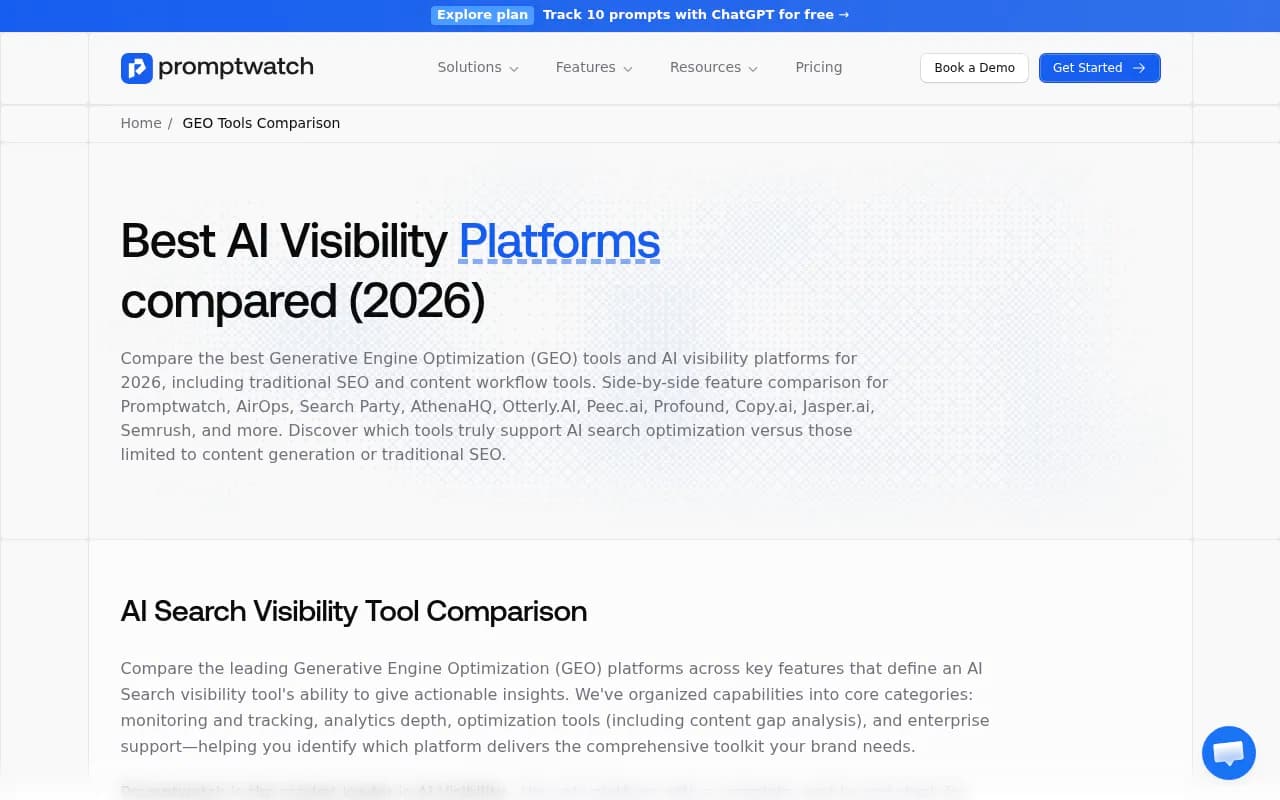
The quadrant above from Promptwatch's own comparison page illustrates the point: there's a meaningful difference between platforms that offer high functionality and high value versus those that are monitoring dashboards with a content feature bolted on.
The question to ask any GEO vendor is: "After you show me the gap, what happens next?" If the answer is "you get a report," that's a monitoring tool. If the answer is "we generate a draft, you review it, you publish it, and we track whether it got cited," that's an optimization platform.
A note on the broader GEO tool landscape
These four platforms aren't the only options. The GEO category has expanded significantly in 2026, with tools ranging from lightweight trackers to enterprise platforms.
For teams that want monitoring without content generation, tools like Otterly.AI and Peec AI are worth considering:


For enterprise teams that need deeper analytics and are already invested in traditional SEO tooling, Semrush and Ahrefs have added AI visibility features, though they're less specialized:

For teams specifically focused on competitive intelligence, Profound has strong analytics depth:

But none of these close the full gap-to-published-content loop the way the four platforms in this guide attempt to.
Bottom line
The GEO platform market in 2026 is maturing fast, and the gap between monitoring tools and optimization platforms is becoming clearer. Searchable, Promptwatch, Relixir, and Whitebox all claim to go beyond tracking -- but they do it in meaningfully different ways.
Promptwatch is the most complete end-to-end platform: it covers the widest range of AI models, has the deepest prompt intelligence, generates content grounded in real citation data, and closes the loop with traffic attribution. For most marketing and SEO teams, it's the strongest choice.
Relixir wins on publishing automation if you need high-volume content output and are comfortable with autonomous generation. Whitebox wins on targeted narrative repair if your problem is AI models saying wrong things about your brand. Searchable is a solid starting point but not where you want to end up.
The real question isn't which tool has the most features -- it's which one actually gets content published and tracks whether it worked. In 2026, that's the bar worth measuring against.