Key takeaways
- AI answer engines now handle local intent queries directly, often without sending users to a website -- if you're not cited, you're invisible
- Local AEO requires geography-aware tracking: zip-code-level monitoring, multi-location support, and local schema markup matter more than generic keyword rankings
- The best tools for local service businesses combine AI citation monitoring with content gap analysis and structured data support
- Monitoring alone isn't enough -- you need to know why you're not being cited and be able to fix it
- Budget-conscious local businesses can start with affordable monitoring tools, then layer in optimization as they grow
If someone in your city types "best HVAC company near me" into ChatGPT or Perplexity, what happens? Increasingly, they get a direct answer -- a short list of recommendations, sometimes with reasons, sometimes with links. No scrolling through a map pack. No clicking through to a review site. Just an answer.
That's the shift local service businesses are dealing with in 2026. And most of them have no idea it's happening, let alone how to respond to it.
This guide is for the plumbers, dentists, landscapers, law firms, and marketing agencies managing local clients who want to show up in those AI-generated answers. We'll cover what makes local AEO different from generic AEO, which tools actually support geographic tracking, and how to build a workflow that gets results.
Why local AEO is different from regular AEO
Most AEO content focuses on brands and publishers competing nationally or globally. Local service businesses have a different problem: they need to be cited specifically for their city, region, or service area -- not just for their category.
When someone asks "who's the best family dentist in Austin," the AI isn't just looking for the most authoritative dental content on the web. It's looking for signals that connect a specific business to a specific geography. That means:
- NAP consistency (name, address, phone) across directories and citations
- Local schema markup (LocalBusiness, ServiceArea, GeoCoordinates)
- Reviews and mentions on platforms AI models actually crawl (Google, Yelp, Reddit, local news)
- Content that explicitly ties your services to your location
The table below shows how traditional local SEO compares to local AEO:
| Signal | Traditional local SEO | Local AEO |
|---|---|---|
| Primary goal | Rank in Google Maps / local pack | Get cited in AI-generated answers |
| Core metric | Map pack position, clicks | Brand mentions, citation frequency |
| Geographic signal | Google Business Profile, citations | Schema markup, local content, review platforms |
| User query style | "plumber Austin TX" | "Who's the best plumber in Austin for a burst pipe?" |
| Content focus | Service pages with keywords | Structured answers to specific local questions |
| Key technical requirement | NAP consistency, GMB | LocalBusiness schema, FAQ schema, structured data |
| Success signal | Phone calls from Google Maps | Mentions in ChatGPT, Perplexity, Google AI Overviews |
The good news: a lot of the work overlaps. Strong local SEO foundations -- consistent citations, good reviews, clear service pages -- also help with AEO. But there are gaps you need to fill deliberately.
What to look for in a local AEO tool
Not every AEO tool is built with local businesses in mind. Here's what actually matters for local service contexts:
Geographic granularity. Can the tool track AI responses by city, state, or zip code? A national brand monitoring tool that only shows aggregate data is nearly useless for a business that only serves three counties.
Multi-location support. If you're an agency managing 20 roofing clients across different cities, you need a tool that handles multiple locations without making you rebuild everything from scratch.
Prompt customization. You need to be able to track prompts like "best electrician in [city]" or "who do locals recommend for [service] in [neighborhood]" -- not just generic category prompts.
Citation source visibility. Where is the AI pulling its local recommendations from? Yelp? Reddit? A local news site? Knowing the source tells you where to focus your off-site efforts.
Content gap analysis. Monitoring tells you you're not being cited. Gap analysis tells you why -- what questions competitors are answering that you're not.
Affordable entry points. Most local service businesses aren't enterprise brands. A tool that starts at $500/month is a non-starter for a two-person HVAC company.
The best AEO tools for local service businesses in 2026
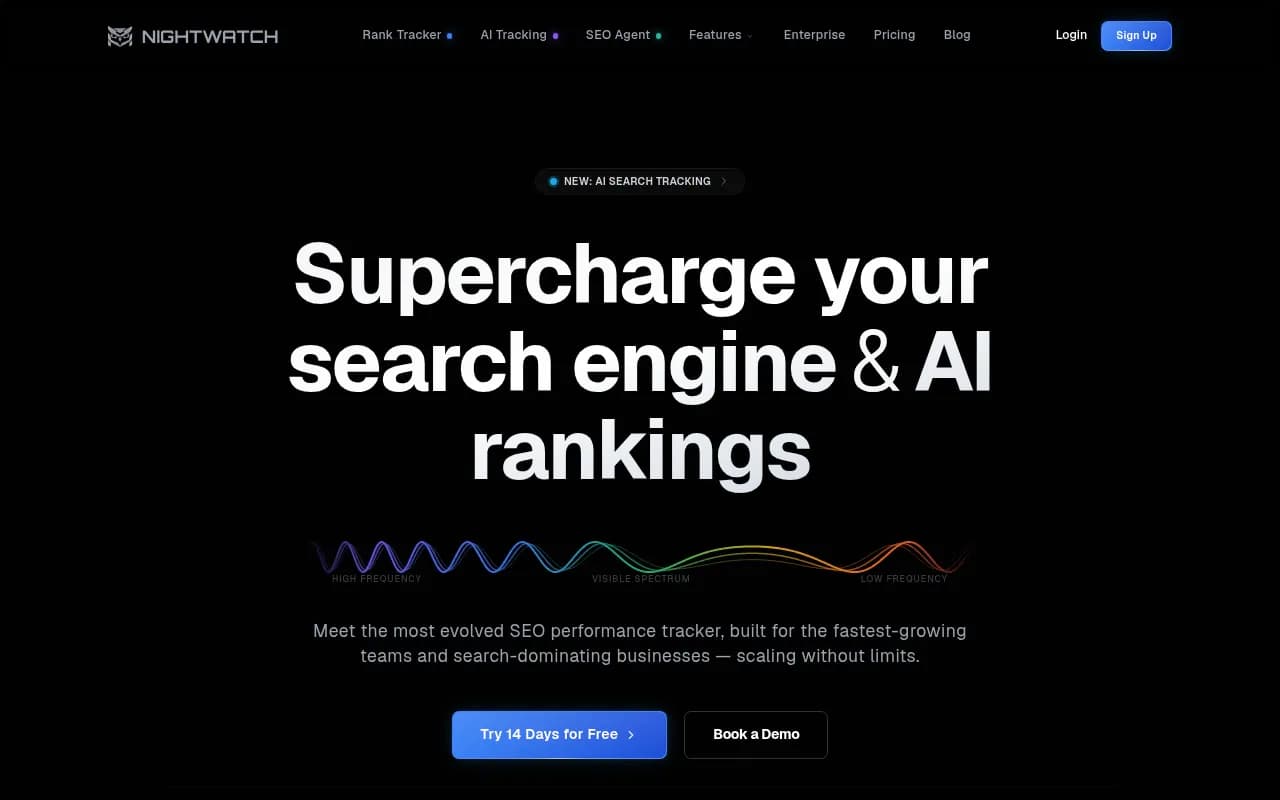
Nightwatch -- best for local SEO + AEO in one platform
Nightwatch is one of the few tools that explicitly supports zip-code-level AI tracking alongside traditional rank tracking. The AI add-on ($99/month on top of the base plan starting at $39/month) monitors ChatGPT, Google AI Overviews, Bing Copilot, Perplexity, and Claude.
What makes it useful for local businesses specifically: you can set up tracking at the city or zip-code level, which means you're seeing AI responses as they'd appear to someone searching from that location -- not a generic national view. For agencies managing multiple local clients, the multi-client structure is clean and reasonably priced.
The weakness: it's primarily a monitoring tool. It'll show you where you're not being cited, but it won't help you create the content to fix that.
SE Visible -- best for brand visibility analytics with local context
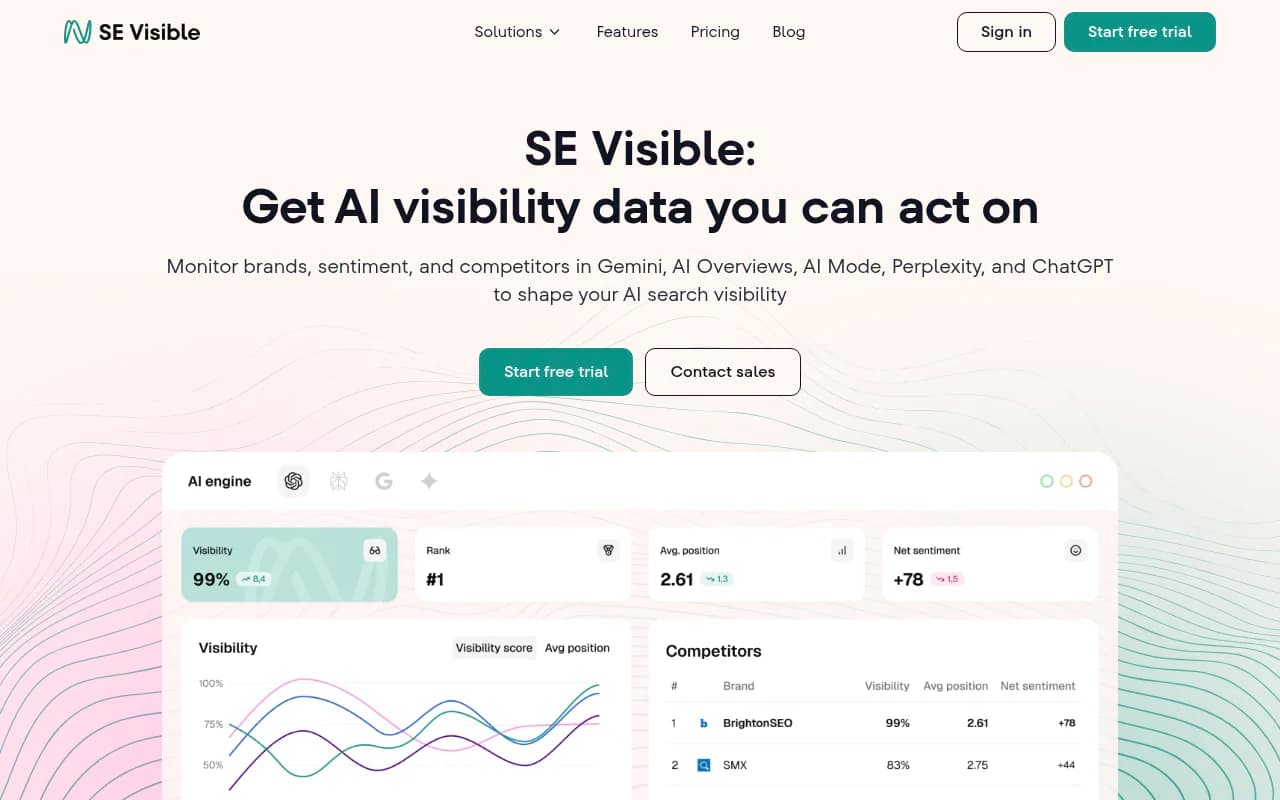
SE Visible (from SE Ranking) tracks AI responses across Google AI Overviews, AI Mode, Gemini, ChatGPT, and Perplexity. At $99/month, it's accessible for smaller businesses and includes sentiment scoring and competitor share-of-voice analysis.
For local businesses, the competitor intelligence is particularly useful -- you can see which local competitors are being cited more often and in what contexts. The source detection feature shows which external pages (review sites, directories, local press) are feeding AI recommendations, which directly informs your off-site strategy.
It's not the deepest tool on the market, but for a local service business that wants clear, actionable visibility data without a steep learning curve, it's a solid choice.
Promptwatch -- best for the full optimization loop
Promptwatch goes further than most tools in this space. Where Nightwatch and SE Visible show you monitoring data, Promptwatch closes the loop: it identifies which prompts your competitors are being cited for that you're not, then helps you create the content to fix those gaps.
For a local service business, that means you can see that a competitor HVAC company is getting cited when someone asks "what's the most energy-efficient heating system for older homes in [city]" -- and then generate a content brief or article targeting exactly that question, grounded in real prompt data and citation patterns.
The AI Crawler Logs feature is particularly useful for local businesses trying to understand why they're not being discovered: you can see which pages AI crawlers are visiting, how often, and whether those visits are translating into citations. If your service area page isn't being crawled, you'll know.
Pricing starts at $99/month (Essential) with the Professional plan at $249/month adding crawler logs and city/state-level tracking -- the latter being directly relevant for local businesses.

Otterly.AI -- best budget option for getting started
If you're a solo operator or a very small business that just wants to know whether AI engines are mentioning you at all, Otterly.AI is the most accessible entry point. It's affordable, straightforward, and covers the major AI platforms.
It won't give you deep local tracking or content optimization, but it answers the basic question: "Is ChatGPT recommending me when someone asks about [my service] in [my city]?" For businesses that haven't started tracking AI visibility at all, that's a reasonable first step.

Peec AI -- best for multi-language and multi-region local tracking
If you serve a market where multiple languages are spoken -- or if you're an agency with clients in different countries -- Peec AI's multi-language tracking is worth considering. It monitors AI responses across languages and regions, which matters for local businesses in bilingual markets or for agencies with international local clients.

Rankscale -- best for tracking AI search rankings with local prompts
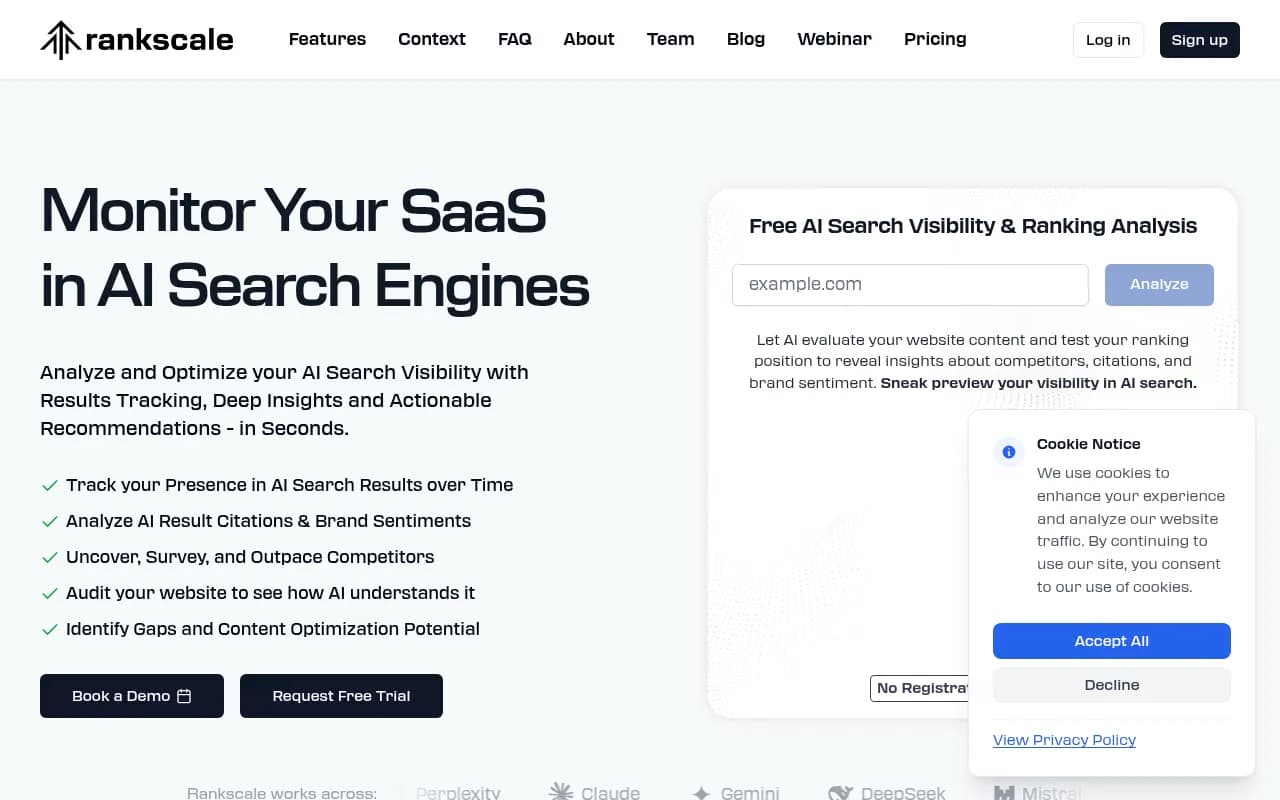
Rankscale focuses on AI search ranking specifically, with the ability to set up custom prompts. For local businesses, this means you can track exactly how you rank when someone asks a geographically specific question across different AI models. The platform is relatively lean, which keeps it affordable and fast to set up.
GetCito -- best for citation-focused tracking
GetCito is built specifically around citation tracking -- understanding which sources AI models are pulling from when they answer questions in your category. For local businesses, this is useful for identifying which directories, review platforms, and local content sources carry the most weight with AI models in your area.
Tool comparison: local AEO platforms at a glance
| Tool | Local/geo tracking | Content optimization | Crawler logs | Starting price | Best for |
|---|---|---|---|---|---|
| Promptwatch | City/state level (Pro+) | Yes (content agents) | Yes | $99/mo | Full optimization loop |
| Nightwatch | Zip-code level | No | No | $39/mo + $99 AI add-on | Combined SEO + AEO |
| SE Visible | Limited | No | No | $99/mo | Brand visibility analytics |
| Otterly.AI | Basic | No | No | Low | Budget monitoring |
| Peec AI | Multi-language/region | No | No | Varies | Multi-language markets |
| Rankscale | Custom prompts | No | No | Low | AI rank tracking |
| GetCito | Citation-focused | No | No | Varies | Citation source analysis |
How to build a local AEO workflow that actually works
Having the right tool is only part of the equation. Here's a practical workflow for local service businesses:
Step 1: Audit your current AI visibility
Before optimizing anything, find out where you stand. Set up tracking for 10-20 prompts that represent how your customers actually ask for your service. Include geographic qualifiers: "best [service] in [city]", "who do locals recommend for [service] near [neighborhood]", "[service] company with good reviews in [city]".
Run these across ChatGPT, Perplexity, and Google AI Overviews at minimum. Note which competitors appear and which sources the AI cites.
Step 2: Fix your structured data
If AI models can't clearly read what you do and where you do it, they won't recommend you. Implement LocalBusiness schema with accurate ServiceArea, GeoCoordinates, and OpeningHours markup. Add FAQ schema to service pages with questions that match how people actually ask about your service.
This is foundational -- no amount of content creation helps if AI crawlers can't parse your basic business information.
Step 3: Identify content gaps
Look at the prompts where competitors are being cited and you're not. What questions are they answering? What local content do they have that you don't? This is where a tool with gap analysis (like Promptwatch) saves significant time -- it surfaces these gaps automatically rather than requiring you to manually compare AI responses.
Common gaps for local service businesses:
- "How much does [service] cost in [city]?" -- local pricing content
- "What should I look for when hiring a [service provider] in [state]?" -- buying guide content
- "[Service] for [specific situation] in [city]" -- scenario-specific content
- Reviews and mentions on platforms AI models actually cite (Yelp, Google, Reddit, local news)
Step 4: Build local content that answers specific questions
Generic service pages don't get cited. Content that directly answers specific local questions does. Think:
- A page on "average cost of roof replacement in [city] in 2026" with real local data
- An FAQ page answering the 10 most common questions your customers ask before hiring you
- A neighborhood-specific service page if you serve distinct areas within a city
- A "why local homeowners choose [your business]" page that ties your services to local context
The goal is to be the clearest, most direct answer to the questions AI models are already fielding about your category in your area.
Step 5: Build off-site citations on AI-crawled sources
AI models don't just read your website. They pull from review platforms, Reddit, local news, and directories. Make sure you have:
- A complete, regularly updated Google Business Profile
- Consistent listings on Yelp, Angi, HomeAdvisor, and category-specific directories
- Responses to reviews (AI models pick up on engagement signals)
- Mentions in local press or community sites where possible
Tools like SE Visible and GetCito can show you which off-site sources are currently being cited in AI responses for your category -- prioritize those.
Step 6: Track and iterate
Set a monthly review cadence. Check your citation frequency across the prompts you're tracking. Look for movement -- both positive (new citations) and negative (competitors gaining ground). Adjust your content and off-site strategy based on what's working.
A note on budget
Local service businesses operate on tighter margins than enterprise brands. The good news: you don't need to spend $500/month to start seeing results.
A reasonable starting budget:
- $99/month for a monitoring tool (Nightwatch base + AI add-on, or SE Visible, or Promptwatch Essential)
- Time investment in structured data and content -- this is mostly free if you do it yourself
As you start seeing which prompts matter most and where your gaps are, you can invest more in content creation and deeper analytics. The key is starting -- most local businesses aren't tracking AI visibility at all, which means even basic monitoring gives you a competitive edge.
The bottom line
Local AEO in 2026 isn't optional for service businesses that depend on local leads. AI answer engines are handling more and more of the "who should I hire for X in my city" queries that used to flow through Google Maps and review sites.
The businesses that get cited are the ones that make it easy for AI models to understand what they do, where they do it, and why they're trustworthy. That means structured data, local content that answers real questions, consistent off-site citations, and -- critically -- a way to track whether any of it is working.
Pick a tool that matches your budget and complexity, set up tracking for the prompts that matter to your business, and start closing the gaps. The local businesses doing this now will have a meaningful head start over those who wait.