Key takeaways
- Peec.ai is a solid AI visibility tracker, but it stops at monitoring -- it won't help you create or optimize content to improve your rankings.
- Content teams in 2026 need platforms that close the loop: track visibility gaps, generate AI-optimized content, and measure the results.
- Promptwatch is the only platform in this comparison rated as a "Leader" across all GEO categories, combining tracking, content gap analysis, and an AI writing agent in one place.
- Tools like Scrunch AI and Profound are strong for enterprise monitoring but come at higher price points.
- Otterly.AI and SE Visible are good budget options if you only need basic tracking.
- Most alternatives in this list are monitoring-only -- know what you're buying before you commit.
Peec.ai does one thing well: it shows you where your brand appears (or doesn't) in AI search results across ChatGPT, Perplexity, Claude, and Gemini. For teams just getting started with GEO, that's genuinely useful.
But here's the problem most teams run into after a month or two of using it. You have a dashboard full of data. You can see that a competitor is getting cited for 40 prompts you're invisible for. And then... what? Peec.ai doesn't tell you what content to write, doesn't help you write it, and doesn't connect your visibility scores to actual traffic or revenue.
That gap -- between knowing you have a problem and being able to fix it -- is where most monitoring-only tools fall short. This guide covers 10 alternatives that content teams should actually consider in 2026, with honest notes on what each one does well and where it stops.
Why content teams are outgrowing Peec.ai
Peec.ai's pricing gives some context. The Starter plan runs around $95/month for 50 prompts across 3 AI models. The Pro plan is $245/month for 150 prompts. The Advanced plan, which adds multi-country tracking and GSC/GA integrations, is $495/month.
That's not unreasonable for pure monitoring. But content teams don't just need monitoring -- they need to act on what they find. When you're paying $245/month and still need separate tools for content research, writing, and traffic attribution, the total cost adds up fast.
The other common complaint: Peec.ai's prompt library is limited at lower tiers, and there's no built-in way to identify which prompts are worth targeting in the first place. You're essentially guessing at what to track.
The 10 best Peec.ai alternatives in 2026
1. Promptwatch
Promptwatch is the most complete option on this list, and the one I'd recommend first for any content team that wants to actually move the needle on AI visibility -- not just watch it.

The core difference from Peec.ai is the action loop. Promptwatch's Answer Gap Analysis shows you exactly which prompts your competitors rank for that you don't -- and more importantly, it tells you what content your site is missing that would let AI models cite you. From there, the built-in AI writing agent generates articles, listicles, and comparisons grounded in real citation data (880M+ citations analyzed). You're not getting generic SEO filler -- you're getting content engineered to get cited by specific AI models.
The tracking side is equally strong. Promptwatch monitors 10 AI models including ChatGPT, Perplexity, Claude, Gemini, Grok, DeepSeek, Copilot, and Google AI Overviews. Page-level tracking shows which specific pages are being cited, how often, and by which model. AI Crawler Logs let you see when ChatGPT or Perplexity's crawlers visit your site, which pages they read, and what errors they hit -- a feature most competitors don't offer at all.
Pricing starts at $99/month (Essential: 1 site, 50 prompts, 5 articles), $249/month (Professional: 2 sites, 150 prompts, 15 articles, crawler logs), and $579/month (Business: 5 sites, 350 prompts, 30 articles). A free trial is available.
For a content team that's serious about GEO, Promptwatch is the only platform that closes the full loop from gap identification to content creation to results tracking.
2. Scrunch AI
Scrunch AI targets enterprise teams that need broad AI monitoring across large brand portfolios. It covers the major AI engines and provides share-of-voice metrics, competitor comparisons, and some content guidance.
It's a capable monitoring platform, and the reporting is polished enough for stakeholder presentations. The trade-off is price -- Scrunch sits at the higher end of the market, and like most enterprise tools, the content optimization features are more advisory than hands-on. You'll still need a separate content workflow.
Best for: Large brands or agencies managing multiple clients who need clean reporting and don't mind handling content creation separately.
3. Profound
Profound has built a reputation for predictive AI search insights -- it tries to show you not just where you are now, but where AI visibility is trending. The dashboards are detailed and the competitor analysis is solid.

The limitation for content teams is the same as Scrunch: Profound is primarily a monitoring and analysis tool. It surfaces insights well but doesn't help you act on them. If your team has strong content writers who just need better data to brief from, Profound is worth considering. If you need the writing workflow built in, it's not the right fit.
Best for: Enterprise marketing teams with dedicated content resources who want sophisticated visibility analytics.
4. AthenaHQ
AthenaHQ tracks brand visibility across 8+ AI search engines and puts a strong emphasis on sentiment -- not just whether you're mentioned, but how you're being described. That's a genuinely useful angle for brand teams managing reputation alongside visibility.

The platform has improved its content optimization guidance over the past year, but it's still more monitoring-focused than action-focused. You'll get clear recommendations on what to fix, but the execution is up to you.
Best for: Brand and communications teams who care about how AI models describe their brand, not just how often.
5. Otterly.AI
Otterly.AI is one of the more affordable options in this space, which makes it popular with smaller teams and solo marketers. It tracks AI mentions across the main engines and gives you a reasonable view of share of voice.

The honest assessment: Otterly.AI is a monitoring dashboard. It doesn't have crawler logs, content generation, or traffic attribution. For teams that just want to check in on their AI visibility without a big budget commitment, it works. For teams that want to improve their visibility, you'll quickly hit its ceiling.
Best for: Small teams or individuals who want basic AI visibility tracking at a low price point.
6. SE Visible (by SE Ranking)
SE Visible is SE Ranking's dedicated AI visibility module, and it benefits from being part of a broader SEO platform. If your team is already using SE Ranking for traditional SEO, adding AI visibility tracking through SE Visible makes a lot of sense -- the data lives in one place and the learning curve is minimal.
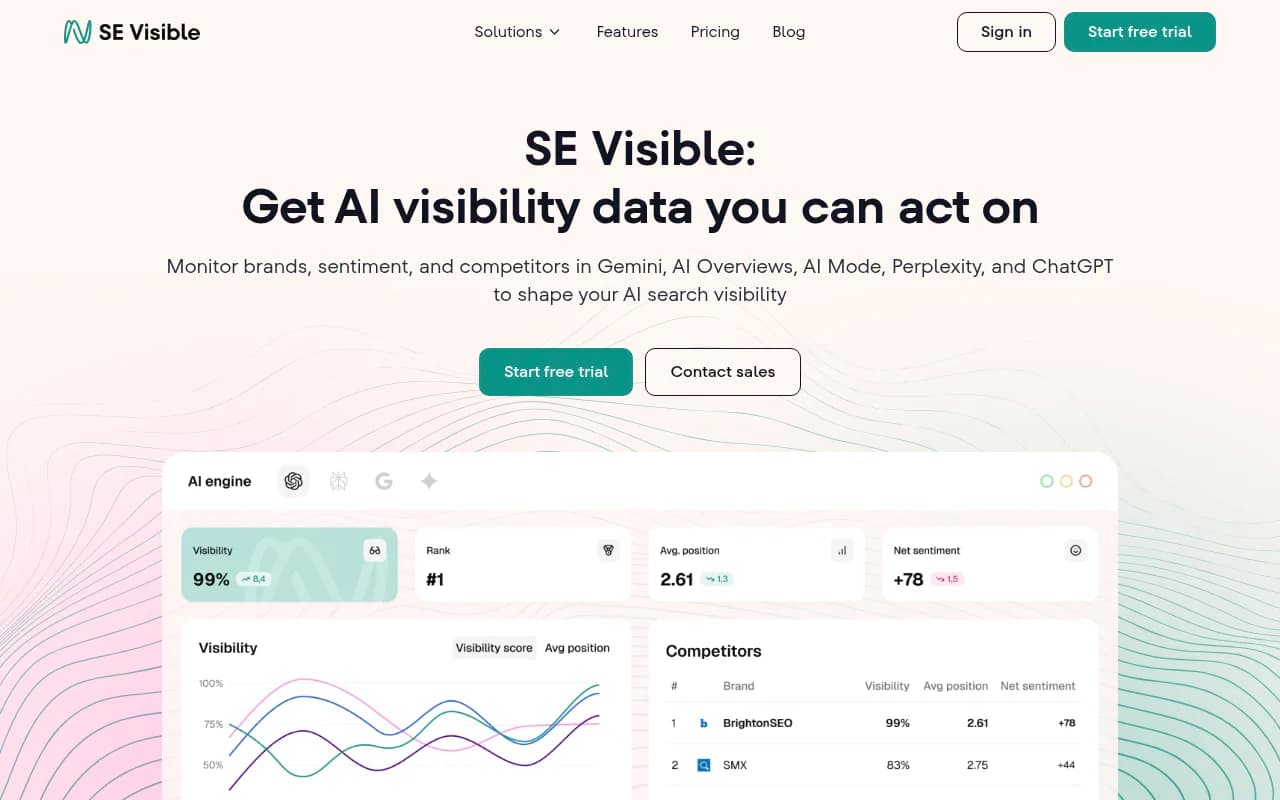
As a standalone GEO tool, it's competent but not exceptional. The prompt tracking is solid, the interface is clean, and the pricing is reasonable. It doesn't have the depth of Promptwatch or Profound, but it covers the basics well.
Best for: Teams already on SE Ranking who want to add AI visibility tracking without switching platforms.
7. Rankscale AI
Rankscale AI focuses on competitive AI visibility benchmarking -- it's particularly good at showing you where you stand relative to specific competitors across different AI models and prompt categories.
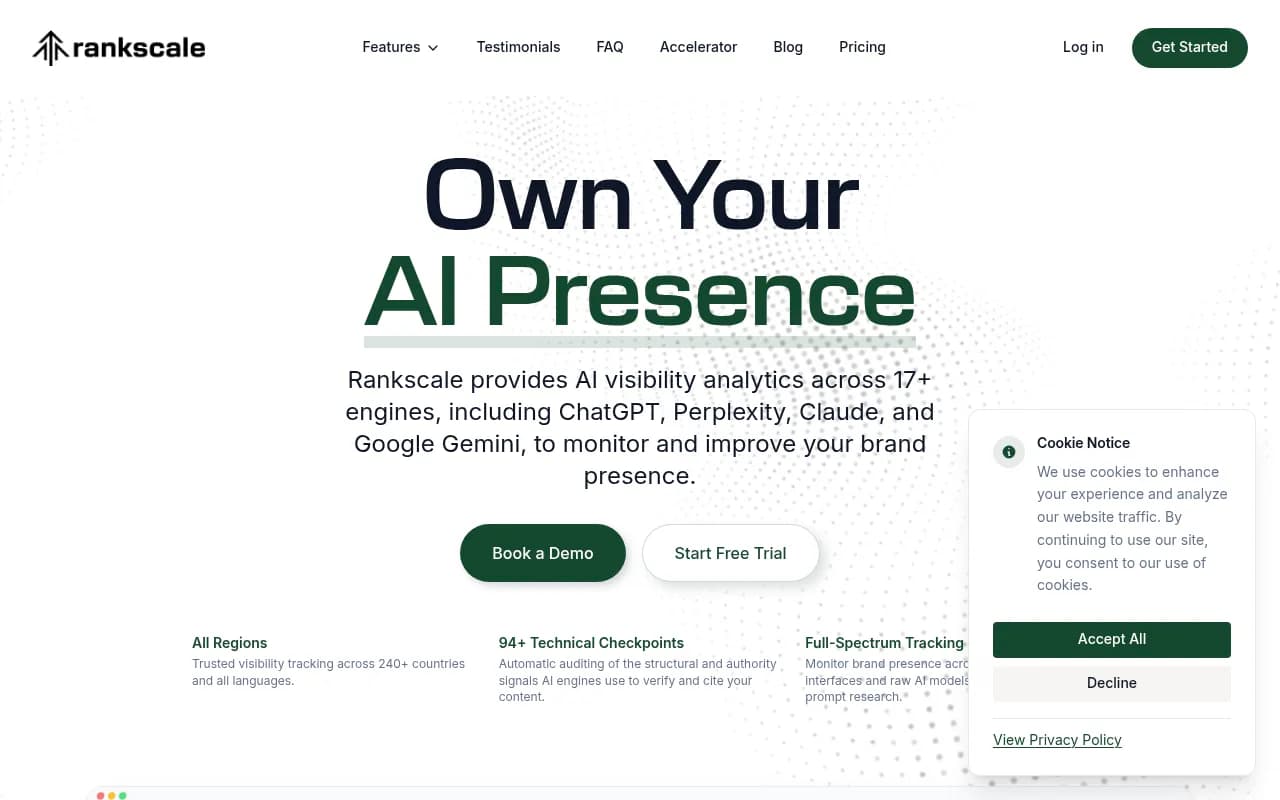
The competitive heatmaps are genuinely useful for identifying which content gaps matter most (i.e., the ones where a direct competitor is winning). The content optimization side is limited, but the competitive intelligence layer is stronger than most tools at this price point.
Best for: Teams that want to prioritize their GEO efforts based on competitive gaps rather than absolute visibility scores.
8. Writesonic
Writesonic has evolved from a pure AI writing tool into something closer to a GEO platform. It now includes AI search visibility tracking alongside its content generation capabilities, which makes it one of the few tools in this space that genuinely tries to combine both sides of the problem.
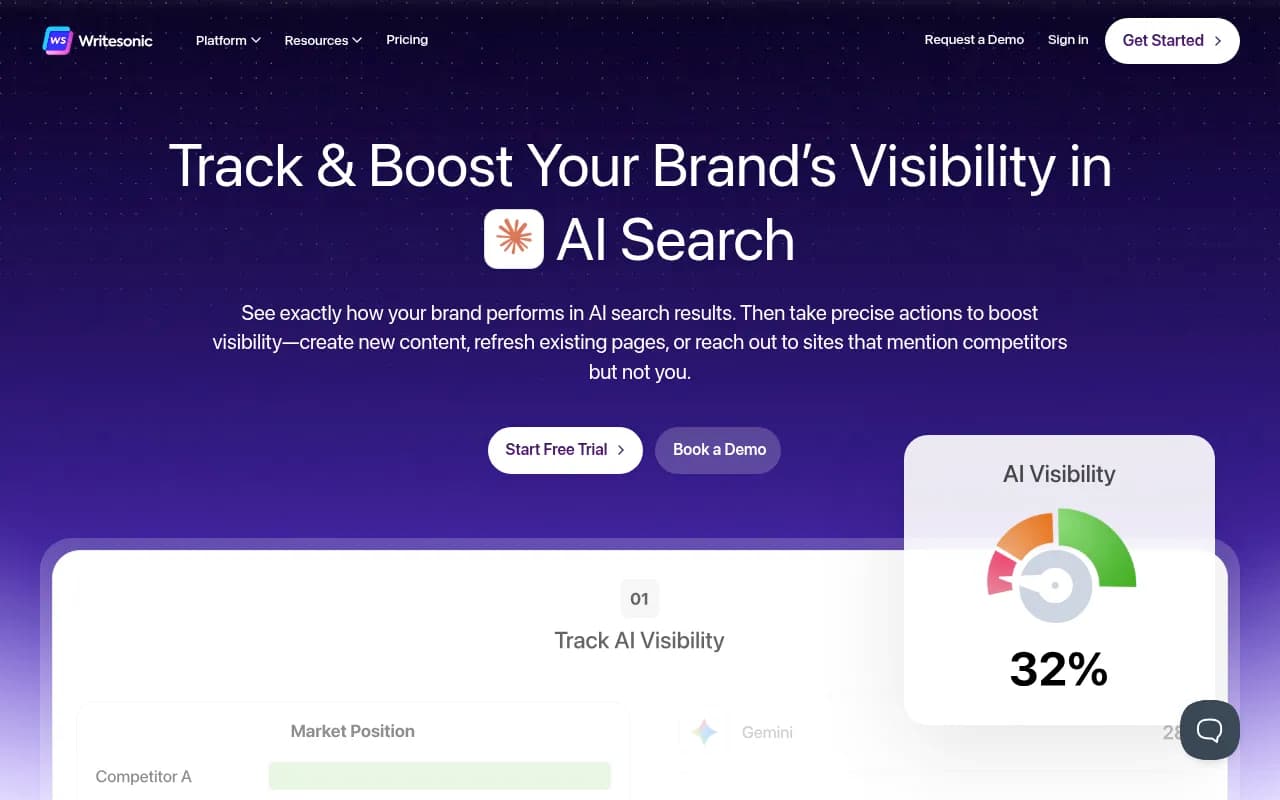
The tracking side is less mature than dedicated GEO platforms -- prompt coverage and model support are more limited than Promptwatch or Profound. But if your team's primary need is content production and you want some AI visibility data layered in, Writesonic's combined approach is worth a look.
Best for: Content-heavy teams that want AI writing tools with basic GEO tracking built in.
9. Semrush
Semrush has added AI visibility features to its platform, including some tracking of AI Overviews and brand mentions in AI responses. For teams already deep in the Semrush ecosystem, it's a convenient way to get some GEO data without adding another tool.
The limitations are real, though. Semrush's AI tracking uses fixed prompts, which means you can't customize what you're monitoring to match your actual customer queries. There's no AI traffic attribution, and the content generation features are generic SEO tools rather than GEO-specific. It's a starting point, not a complete solution.
Best for: Teams already using Semrush who want basic AI visibility data without adding a new platform to their stack.
10. Nightwatch
Nightwatch has traditionally been a rank tracking tool, and its AI search monitoring features are a newer addition. It covers the main AI engines and provides clean, straightforward reporting that's easy to share with clients or stakeholders.
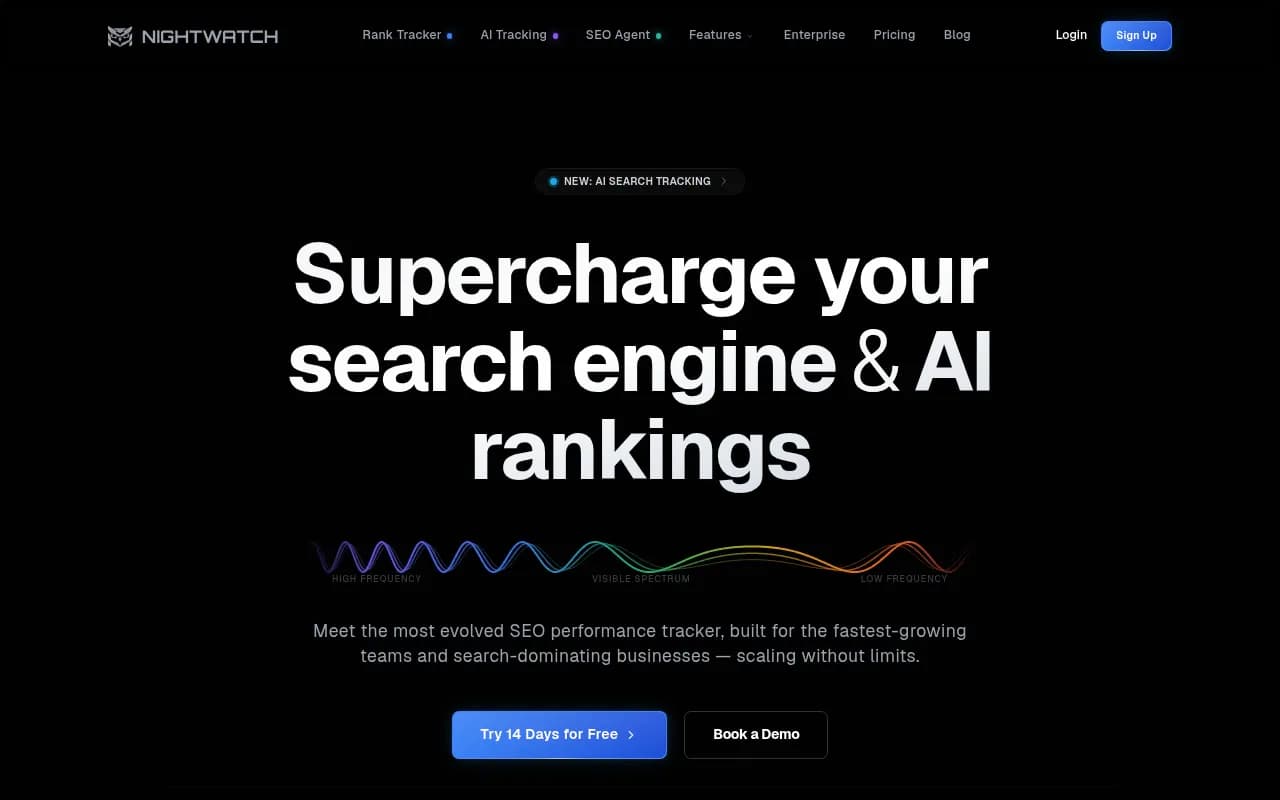
It's a solid choice for agencies that need to report on AI visibility alongside traditional SEO rankings without managing multiple platforms. The GEO-specific features are less deep than dedicated tools, but the overall package is well-designed and the pricing is competitive.
Best for: SEO agencies that want to add AI visibility reporting to existing client dashboards.
Head-to-head comparison
Here's how these 10 alternatives stack up on the dimensions that matter most for content teams:
| Tool | AI models tracked | Content generation | Crawler logs | Traffic attribution | Prompt customization | Starting price |
|---|---|---|---|---|---|---|
| Promptwatch | 10 | Yes (AI writing agent) | Yes | Yes | Yes | $99/mo |
| Scrunch AI | Multiple | Limited | No | No | Yes | High (custom) |
| Profound | Multiple | No | No | No | Yes | High |
| AthenaHQ | 8+ | No | No | No | Yes | Mid |
| Otterly.AI | Multiple | No | No | No | Yes | Low |
| SE Visible | Multiple | No | No | No | Yes | Low-mid |
| Rankscale AI | Multiple | No | No | No | Yes | Mid |
| Writesonic | Limited | Yes (writing-first) | No | No | Limited | Mid |
| Semrush | Limited | Basic SEO only | No | No | Fixed prompts | Mid-high |
| Nightwatch | Multiple | No | No | No | Yes | Low-mid |
The pattern is clear: most of these tools are monitoring dashboards. They show you data. Promptwatch and Writesonic are the only two that include content generation, and Promptwatch is the only one that combines generation with deep tracking, crawler logs, and traffic attribution.
How to choose the right tool for your team
The right choice depends on what your team actually needs to do with the data.
If you're a content team that needs to improve AI visibility (not just measure it), you need a platform with content gap analysis and some form of content generation built in. Promptwatch is the obvious choice here -- it's the only tool that takes you from "we're invisible for these prompts" to "here's the content that will fix it" to "here's proof it worked."
If you're an enterprise team with a large content operation and you just need better data to brief your writers, Profound or Scrunch AI give you sophisticated analytics with polished reporting.
If you're on a tight budget and just want to start tracking, Otterly.AI or SE Visible get you basic coverage without a big commitment.
If you're already in the Semrush or SE Ranking ecosystem, their native AI features are a reasonable starting point -- just know you'll likely need a dedicated GEO tool as your program matures.
One thing worth being direct about: most of the tools in this list will show you that you have a problem. Very few will help you solve it. Before you sign up for any platform, ask specifically: "After I see my visibility gaps, what does this tool do to help me close them?" The answer tells you a lot about whether you're buying a monitoring dashboard or an optimization platform.
What Peec.ai does well (and when to stick with it)
It's worth being fair here. Peec.ai is a well-designed tool with a clean interface and reliable tracking. If your team's only goal right now is to understand your current AI visibility baseline -- where you stand, how competitors compare, which AI models mention you -- Peec.ai does that job competently.
The case for switching comes when you're ready to move from measuring to improving. That's when the lack of content tools, crawler logs, and traffic attribution starts to cost you more than the subscription saves you.
Final thought
The GEO tool market in 2026 is crowded, and most platforms are competing on monitoring features -- more models, more prompts, cleaner dashboards. That's useful, but it's not what content teams actually need. What matters is whether a platform can help you show up in AI answers that matter to your customers, and then prove that it's working.
That's a much shorter list of tools. Promptwatch sits at the top of it.