WordMetrics Review 2026
Real-time AI content editor that guides writers toward better keyword coverage and topical relevance as they write, helping produce content optimized for search engines.
Key takeaways
- WordMetrics is a real-time semantic SEO editor that scores your content for topical relevance as you write, not after the fact
- Designed specifically for writers, not technical SEOs -- the interface is intentionally minimal with a claimed "1-minute onboarding"
- Works for both new content and optimizing existing posts by pasting in old text
- Still in private beta as of early 2026, which limits access and raises questions about long-term stability
- Does not generate content -- it guides and scores what you write yourself
- No AI search visibility monitoring, no LLM citation tracking, and no content gap analysis against AI engines -- if that's what you need, Promptwatch is built for that use case
WordMetrics is a cloud-based SEO writing assistant that sits alongside you as you write and tells you, in real time, whether your content is semantically aligned with your target keyword. The core idea is straightforward: modern search engines don't just look for exact keyword matches anymore. They use natural language processing to understand topical relevance, and WordMetrics tries to help writers keep up with that shift by surfacing the related terms and concepts that competing pages use -- then scoring your draft against them.
The tool is built by a small team and has been in private beta for a while. It's positioned squarely at content marketers, bloggers, and SEO writers who want to produce better-ranking content without needing to understand the technical mechanics of semantic search. The pitch is essentially: let the AI handle the analysis, you handle the writing.
The target audience is clear from the product's design philosophy. WordMetrics explicitly says it's "not an AI content generator" -- a deliberate positioning choice that separates it from tools like Jasper or Copy.ai. Instead, it functions more like a writing coach that watches over your shoulder and nudges you toward better topical coverage. That's a narrower but arguably more honest value proposition.
Key features
Semantic Index panel
The core of the product is a sidebar that displays a list of semantically related terms for your target keyword. These aren't just synonyms -- they're words and phrases that WordMetrics has identified as statistically associated with the target query based on analysis of competing pages. As you write, the tool tracks which of these terms appear in your document and which are still missing. You can click into any term to see its statistical relevance score and even view sample sentences from competing websites that use it. This is genuinely useful for understanding context, not just stuffing terms in.
Real-time relevance scoring
WordMetrics scores your document continuously as you type, giving you a letter grade (the goal is B+ or higher) that reflects how well your content covers the semantic territory of your target keyword. This live feedback loop is the product's main differentiator from tools that only analyze content after you've finished writing. The scoring is based on how many Semantic Index terms you've incorporated and how naturally they appear in context.
Semantic highlighting
As you write, WordMetrics highlights words in your document that it considers semantically important -- both terms you've already included from the index and terms that appear in your text that the engine recognizes as relevant. This visual layer helps writers see their content the way a search engine might, which is a useful mental model even if the underlying algorithm is a simplification.
Readability analysis
Beyond semantic relevance, WordMetrics tracks readability metrics in real time. The tool monitors sentence complexity, reading level, and other factors that affect how accessible your content is. This matters for SEO because search engines increasingly factor in user engagement signals, and content that's hard to read tends to have higher bounce rates. The readability feedback is integrated into the same writing environment, so you're not switching between tools.
Evergreen content optimization
One of the more practical use cases is pasting existing content into WordMetrics to audit and improve it. Old posts that once ranked well can lose ground as competing pages improve their topical coverage. WordMetrics lets you drop in existing text and immediately see where the semantic gaps are, which is a faster workflow than starting from scratch with a content audit spreadsheet.
Cloud-based writing environment
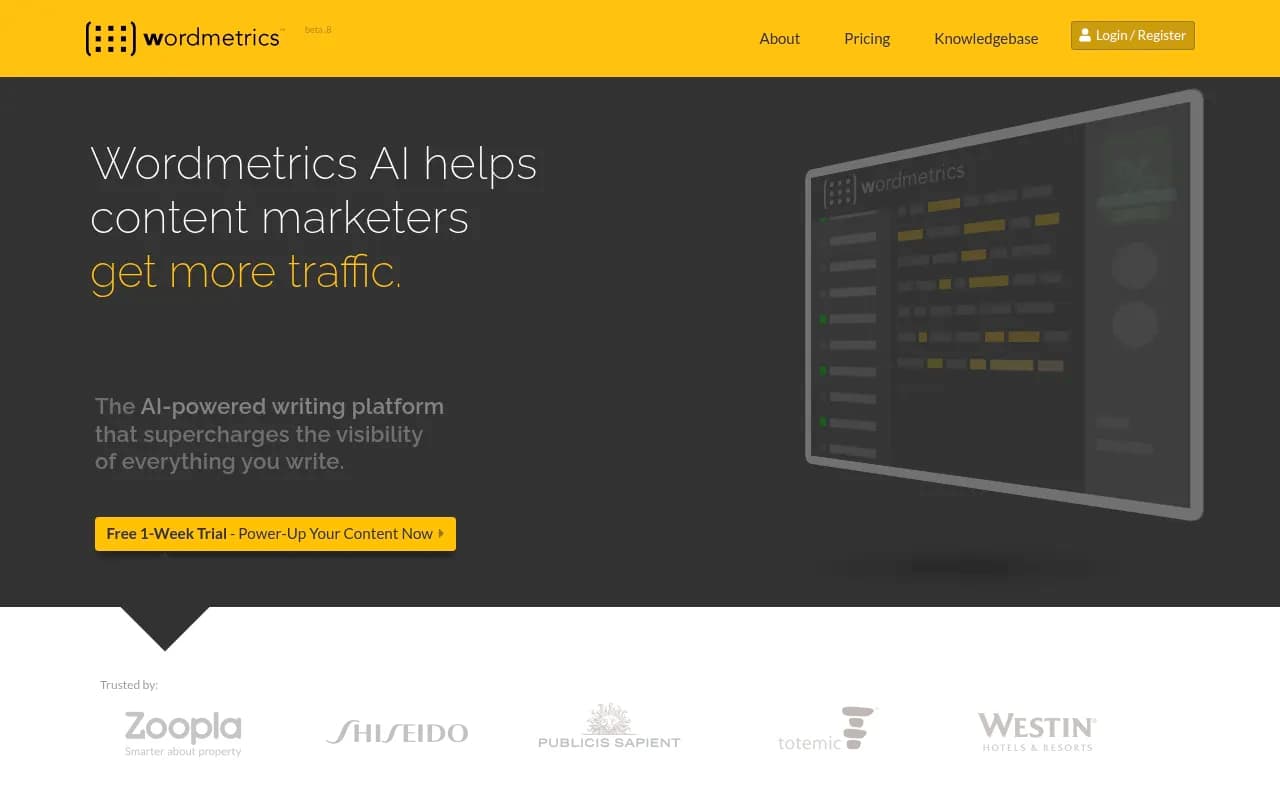
The editor is entirely browser-based, which means no installs, no plugins, and access from any device. The writing interface supports both a light and dark mode. The company emphasizes a "no learning curve" design philosophy, and from what's visible in screenshots, the interface is genuinely clean -- a writing area on one side, the Semantic Index panel on the other.
Live search data integration
WordMetrics pulls live search data to inform its semantic analysis, meaning the recommendations are based on what's currently ranking rather than a static database. This is important because search intent and competitive landscapes shift over time, and a tool that only uses historical data can give outdated guidance.
Who is it for
WordMetrics fits best for independent content writers, bloggers, and small in-house content teams who produce SEO-focused articles regularly and want a lightweight tool to improve their on-page relevance without a steep learning curve. Think a freelance writer managing 10-20 articles per month for clients, or a two-person content team at a SaaS startup trying to compete in organic search without a dedicated SEO strategist on staff.
It also has a clear use case for content marketing agencies that want to give their writers a guardrail tool -- something that enforces semantic completeness without requiring writers to understand keyword research methodology. The "1-minute onboarding" claim suggests it's designed to be handed to a writer with minimal training.
The tool is less suited for enterprise SEO teams or agencies managing large-scale content operations. There's no team collaboration features mentioned, no project management layer, no bulk content auditing, and no integrations with CMS platforms like WordPress or HubSpot. If you're running a content operation at scale, you'll quickly hit the ceiling of what WordMetrics offers.
It's also not the right tool for anyone whose primary concern is AI search visibility -- meaning how their brand or content appears in ChatGPT, Perplexity, Google AI Overviews, or other LLM-powered search experiences. WordMetrics is focused entirely on traditional search engine optimization. That's a legitimate and still-important use case, but it's worth being clear-eyed about the scope.
Integrations and ecosystem
WordMetrics is a standalone web application with no publicly documented integrations. There's no mention of a WordPress plugin, Google Docs add-on, or CMS connector. The workflow is copy-paste: you write in WordMetrics, then transfer your content to wherever it needs to go.
There's no public API documented on the site, no Zapier integration, and no browser extension. For a tool still in private beta, this is understandable, but it does mean WordMetrics adds a step to most content workflows rather than fitting into existing ones.
The cloud-based nature means it works in any modern browser, which is the extent of its cross-platform support. No mobile app is mentioned.
Pricing and value
WordMetrics offers a free 1-week trial, which is the main entry point given the tool is still in private beta. Beyond that, specific pricing tiers aren't publicly listed on the main website -- you're directed to a plans page, and TrustRadius references pricing details but the specific numbers aren't confirmed in publicly available sources.
The private beta status means pricing and plan structures may still be in flux. The free trial is a reasonable way to evaluate whether the tool fits your workflow before committing.
Compared to more established semantic SEO tools like Surfer SEO (which starts around $89/month) or Clearscope (which starts around $170/month), WordMetrics appears to be positioned as a more accessible, writer-focused alternative. Whether the feature depth justifies the price depends heavily on what tier you land on -- something worth clarifying directly with the team before signing up.
Strengths and limitations
What it does well
- The real-time semantic scoring and highlighting is genuinely useful for writers who want immediate feedback rather than a post-writing audit. Most competing tools in this space (Clearscope, MarketMuse) are more analytical and less integrated into the writing flow itself.
- The "no learning curve" design philosophy appears to be real. The interface is clean and the core workflow -- enter a keyword, write, watch your score improve -- is immediately understandable.
- The ability to paste in existing content for optimization is a practical feature that many content teams will use regularly. Evergreen content decay is a real problem, and having a fast way to identify semantic gaps in old posts is valuable.
- The sample sentences from competing pages, accessible by clicking into any Semantic Index term, give writers useful context for how to naturally incorporate terms rather than just stuffing them in.
Honest limitations
- Private beta status in early 2026 is a yellow flag. The tool has been in beta for a while, and it's unclear when or whether a full public launch is coming. This creates uncertainty about long-term support and feature development.
- No integrations with CMS platforms or writing tools means WordMetrics adds friction to most content workflows. Writers have to work in a separate environment and then copy their content elsewhere.
- The tool is focused entirely on traditional search engine optimization. It has no capability to help you understand or improve your visibility in AI-powered search experiences like ChatGPT, Perplexity, or Google AI Overviews. As AI search continues to grow as a traffic channel, this is a meaningful gap. Tools like Promptwatch are built specifically for that layer of the problem.
- No team features, project management, or bulk auditing capabilities limit its usefulness for agencies or larger content operations.
- Pricing transparency is low -- you have to go through a trial or contact the team to understand what you'll actually pay.
Bottom line
WordMetrics is a focused, writer-friendly tool for improving semantic SEO as you write. If you're a freelance content writer or a small team producing SEO articles and you want real-time guidance on topical relevance without a complex setup, it's worth trying the free week. The clean interface and live scoring genuinely differentiate it from tools that treat content optimization as a separate analytical step.
That said, the private beta status, lack of integrations, and absence of any AI search visibility features mean it's a partial solution for most modern content operations. For teams that also need to track and improve how their content performs in AI-powered search engines, WordMetrics doesn't address that problem at all -- that's a separate tool category entirely.
Best for: Freelance SEO writers and small content teams who want a clean, real-time semantic writing assistant for traditional search optimization.
Tags:
Frequently asked questions
What is WordMetrics?
Is WordMetrics an AI content generator?
How much does WordMetrics cost?
Who is WordMetrics best suited for?
Does WordMetrics help with AI search visibility (ChatGPT, Perplexity, etc.)?
Can I use WordMetrics to optimize existing content?
Similar and alternative tools to WordMetrics