Key takeaways
- Most AI visibility tools are monitoring dashboards — they show you data but don't help you act on it
- The tools that actually move rankings combine tracking with content gap analysis, AI writing, and citation optimization
- Searchable has useful monitoring features, but several alternatives go further by helping you create and optimize content for AI search
- The best choice depends on whether you need pure tracking, content generation, or a full optimization loop
- Promptwatch is the only platform in this comparison rated as a "Leader" across all categories in a 2026 review of 12 GEO platforms
Here's the thing about most AI visibility tools: they're really good at showing you a problem and really bad at helping you solve it.
You get a dashboard. You see your brand isn't appearing in ChatGPT responses for a bunch of valuable prompts. You see competitors are. And then... the tool just sits there, waiting for you to figure out what to do next.
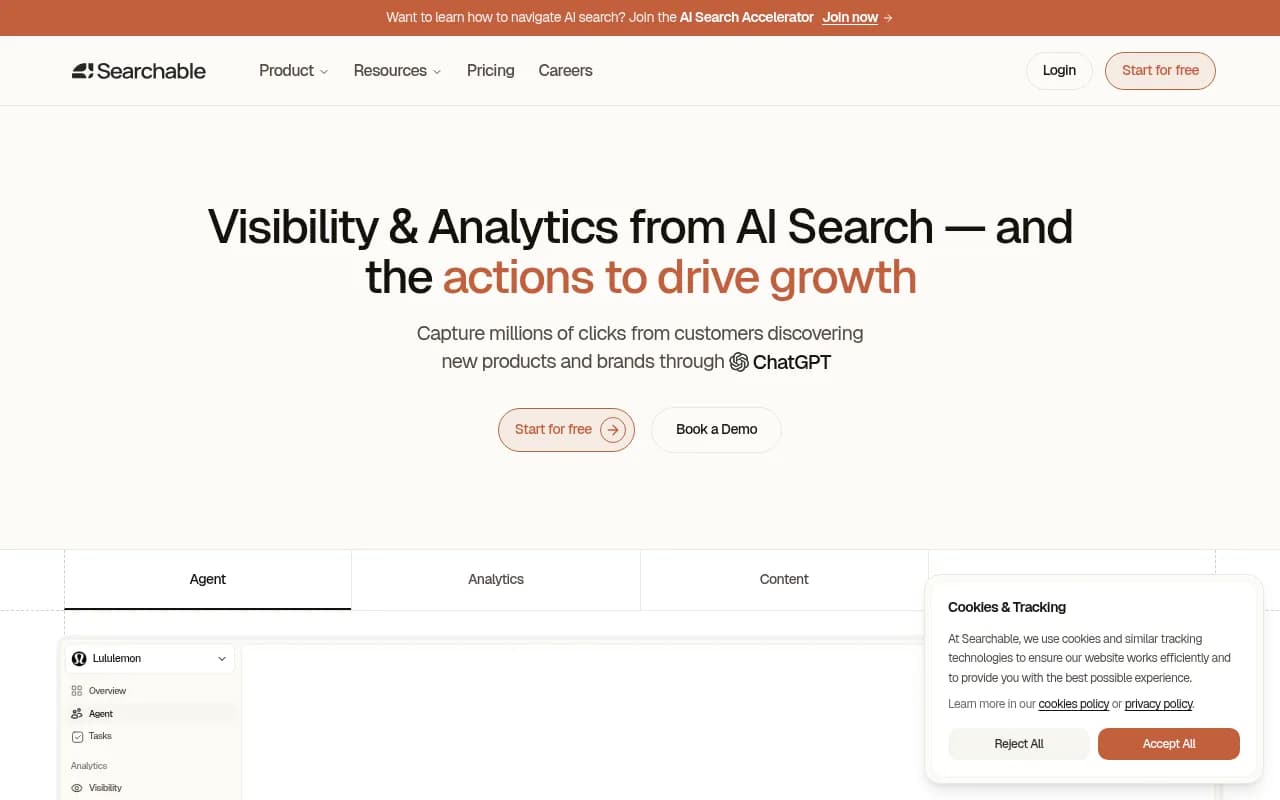
Searchable falls into this category for many users. It's a capable monitoring platform, but if you're looking for something that actually helps you close the gap rather than just measure it, you'll want to look elsewhere.
This guide ranks 10 alternatives by a simple criterion: how much do they actually help you rank, not just what they track.
How we ranked these tools
The ranking isn't based on feature counts or pricing alone. Each tool was evaluated on four dimensions:
- Monitoring depth: How many AI models does it cover? How granular is the data?
- Gap analysis: Does it show you which prompts competitors are winning that you're not?
- Content action: Does it help you create or optimize content based on that data?
- Attribution: Can you connect AI visibility to actual traffic and revenue?
Tools that only do monitoring rank lower. Tools that close the loop rank higher.
The comparison at a glance
| Tool | AI models tracked | Gap analysis | Content generation | Attribution | Best for |
|---|---|---|---|---|---|
| Promptwatch | 10+ | Yes | Yes (built-in AI writer) | Yes (GSC, logs, snippet) | Full optimization loop |
| AthenaHQ | 8+ | Partial | No | No | Monitoring-focused teams |
| Otterly.AI | 5+ | Basic | No | No | Budget monitoring |
| Peec AI | 6+ | No | No | No | Multi-language tracking |
| Profound | 6+ | Partial | No | No | Enterprise monitoring |
| Scrunch AI | 5+ | No | No | No | Brand monitoring |
| SE Ranking | 5+ | No | Content tools (separate) | Partial | Traditional SEO + AI |
| Semrush | 5+ | No | ContentShake (separate) | Partial | All-in-one SEO |
| Rankscale AI | 4+ | No | No | No | Lightweight tracking |
| Nightwatch | 4+ | No | No | No | Rank tracking + AI |
1. Promptwatch — the only tool that closes the loop
If you want to understand why most tools feel unsatisfying, it helps to think about what "ranking in AI search" actually requires. You need to know which prompts matter, which ones you're missing, what content would fill those gaps, and whether your new content is actually getting cited. That's four distinct problems. Most tools solve one of them.
Promptwatch solves all four.
The Answer Gap Analysis shows you exactly which prompts competitors appear for that you don't. Not in vague terms — specific questions and topics, with volume estimates and difficulty scores. The built-in AI writing agent then generates articles, listicles, and comparisons grounded in 880M+ citations analyzed, so the output is calibrated to what AI models actually cite rather than generic SEO filler. Then page-level tracking shows which of your pages are being cited, by which models, and how often. Traffic attribution (via a code snippet, GSC integration, or server log analysis) connects that visibility to real revenue.
That cycle — find gaps, generate content, track results — is what makes it an optimization platform rather than a tracker. It covers 10+ AI models including ChatGPT, Claude, Perplexity, Gemini, Grok, DeepSeek, and Google AI Overviews. The AI Crawler Logs feature is particularly useful: you can see exactly which pages ChatGPT or Perplexity's crawlers are reading, how often they return, and where they hit errors. Most competitors don't have this at all.
Pricing starts at $99/month for the Essential plan (1 site, 50 prompts, 5 articles), $249/month for Professional (2 sites, 150 prompts, crawler logs), and $579/month for Business (5 sites, 350 prompts). A free trial is available.

2. AthenaHQ — solid monitoring, limited action
AthenaHQ covers 8+ AI search engines and has decent share-of-voice tracking. The interface is clean and the data is reliable. Where it falls short is everything that comes after the data. There's no content generation, no gap analysis that tells you what to write, and no attribution layer to connect visibility to traffic.
It's a good choice if your team already has strong content processes and just needs reliable monitoring data to feed into them. If you're hoping the tool will tell you what to do next, you'll be disappointed.

3. Otterly.AI — affordable but monitoring-only
Otterly.AI is one of the more popular entry-level options, and for good reason: it's affordable, covers the main AI models, and is genuinely easy to set up. For small teams or individuals who just want to know whether their brand is showing up in AI responses, it does the job.
The ceiling is low, though. No crawler logs, no visitor analytics, no content gap analysis. It shows you the problem but hands you no tools to fix it. Fine as a starting point, less useful as you scale.

4. Peec AI — strong for multi-language, weak on action
Peec AI's main differentiator is multi-language and multi-region tracking. If you're running campaigns across multiple countries and need to know how your brand appears in AI responses in German, French, or Japanese, Peec AI handles this better than most.
Outside of that specific use case, it's a monitoring tool. Daily precision tracking is good, but there's no content generation, no gap analysis, and no attribution. Teams with international visibility needs might use it alongside a more action-oriented platform.

5. Profound — enterprise monitoring with a high price tag
Profound has a strong feature set and is genuinely well-regarded among enterprise teams. The data quality is good, the coverage is solid, and the reporting is polished enough for executive presentations.
The issue is price and scope. It's positioned at the higher end of the market, and for that price, you still don't get content generation or a built-in optimization workflow. Reddit tracking is absent, as is ChatGPT Shopping monitoring. For teams that need deep monitoring and have separate content teams to act on the data, it works. For teams that want one platform to handle both, it's incomplete.

6. Scrunch AI — brand monitoring without the optimization layer
Scrunch AI focuses on AI search visibility monitoring for brands. It's competent at what it does — tracking how your brand appears across AI models, flagging changes, and generating reports. The interface is reasonably clean.
What's missing is any path from "here's what's happening" to "here's what to do about it." No content tools, no gap analysis, no attribution. It's a monitoring dashboard, and a decent one, but not a platform that helps you improve.
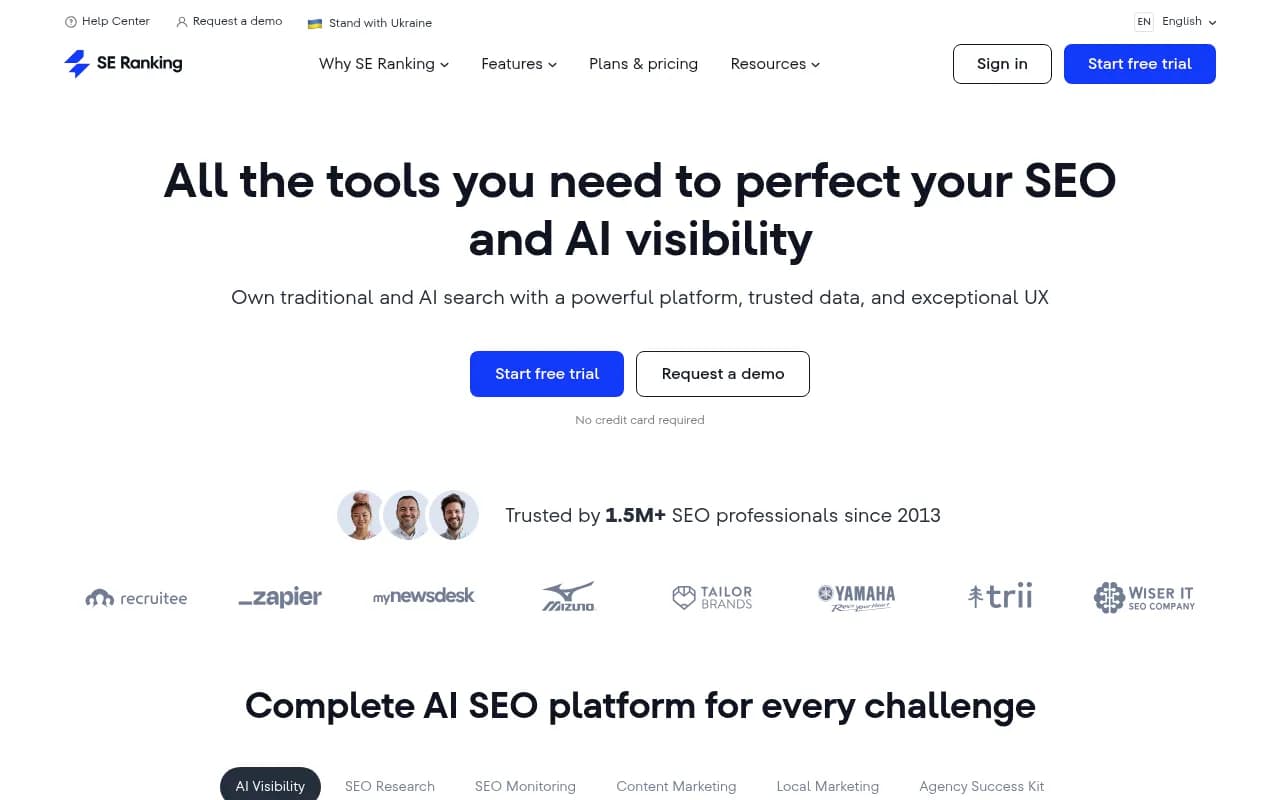
7. SE Ranking — traditional SEO suite with AI features bolted on
SE Ranking is a well-established SEO platform that has added AI visibility tracking to its existing suite. If you're already using it for traditional rank tracking, keyword research, and site audits, the AI monitoring features are a reasonable addition without switching tools.
The AI tracking feels like an add-on rather than a core capability, though. The coverage is narrower than dedicated GEO platforms, and the content tools exist separately from the AI monitoring workflow. It's a sensible choice for teams that want one tool for both traditional and AI search, but don't expect the AI features to be as deep as a specialist platform.
8. Semrush — broad but shallow on AI visibility
Semrush is the most widely used SEO platform in the world, and it has added AI visibility features over the past year. The advantage is obvious: if your team already lives in Semrush, having AI monitoring in the same interface reduces friction.
The depth isn't there yet, though. Semrush uses fixed prompts rather than letting you define your own, which limits how useful the data is for specific niches or long-tail queries. There's no AI traffic attribution, and the AI features feel like a response to market pressure rather than a core product investment. ContentShake exists as a separate content tool, but it's not integrated into an AI visibility workflow.
For teams that want a single platform and are willing to accept shallower AI coverage, Semrush works. For teams that take AI search seriously, it's a starting point at best.
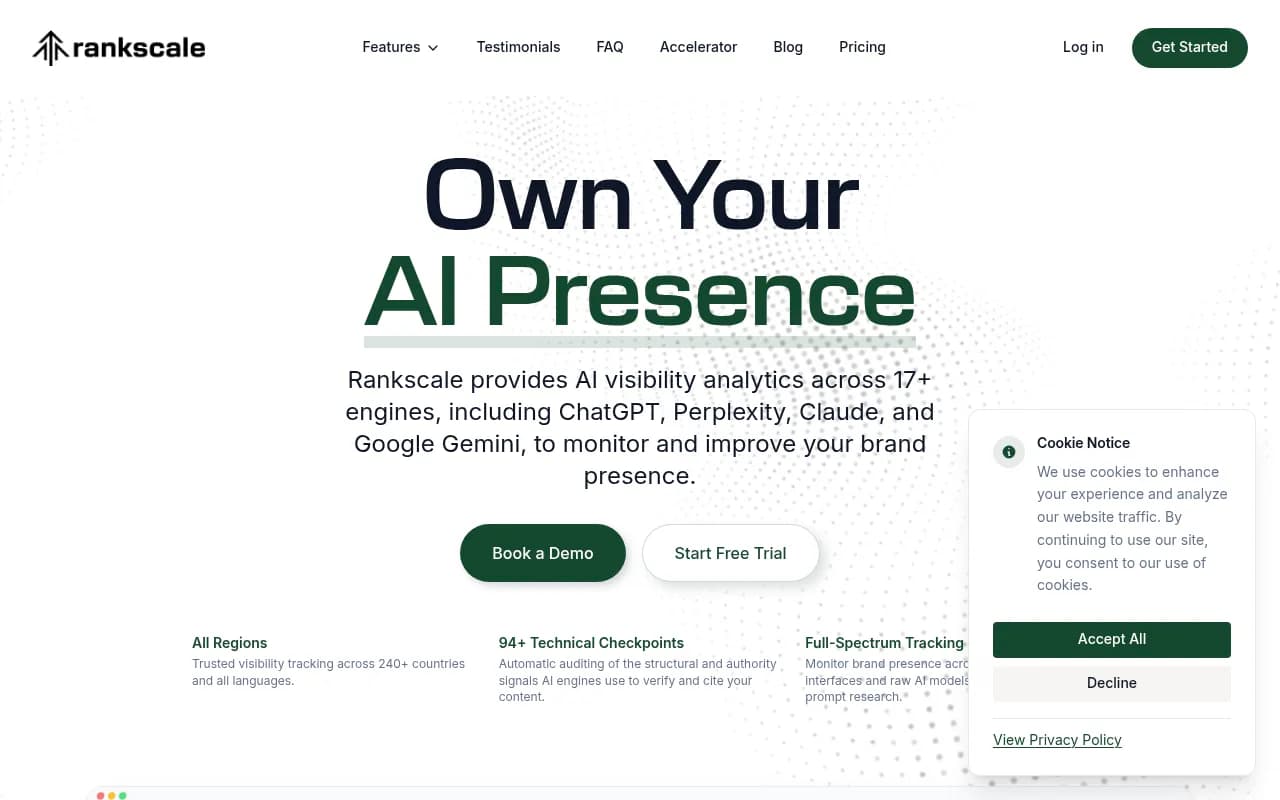
9. Rankscale AI — lightweight tracking for early-stage teams
Rankscale AI is a simpler, more affordable option for teams that are just starting to think about AI search visibility. The setup is fast, the interface is minimal, and it covers the main AI models at a basic level.
The trade-off is depth. Coverage is narrower than most alternatives, there's no gap analysis, no content tools, and no attribution. It's useful for getting a quick read on whether your brand is showing up in AI responses, but you'll outgrow it quickly if you're serious about optimization.
10. Nightwatch — rank tracking with AI monitoring added
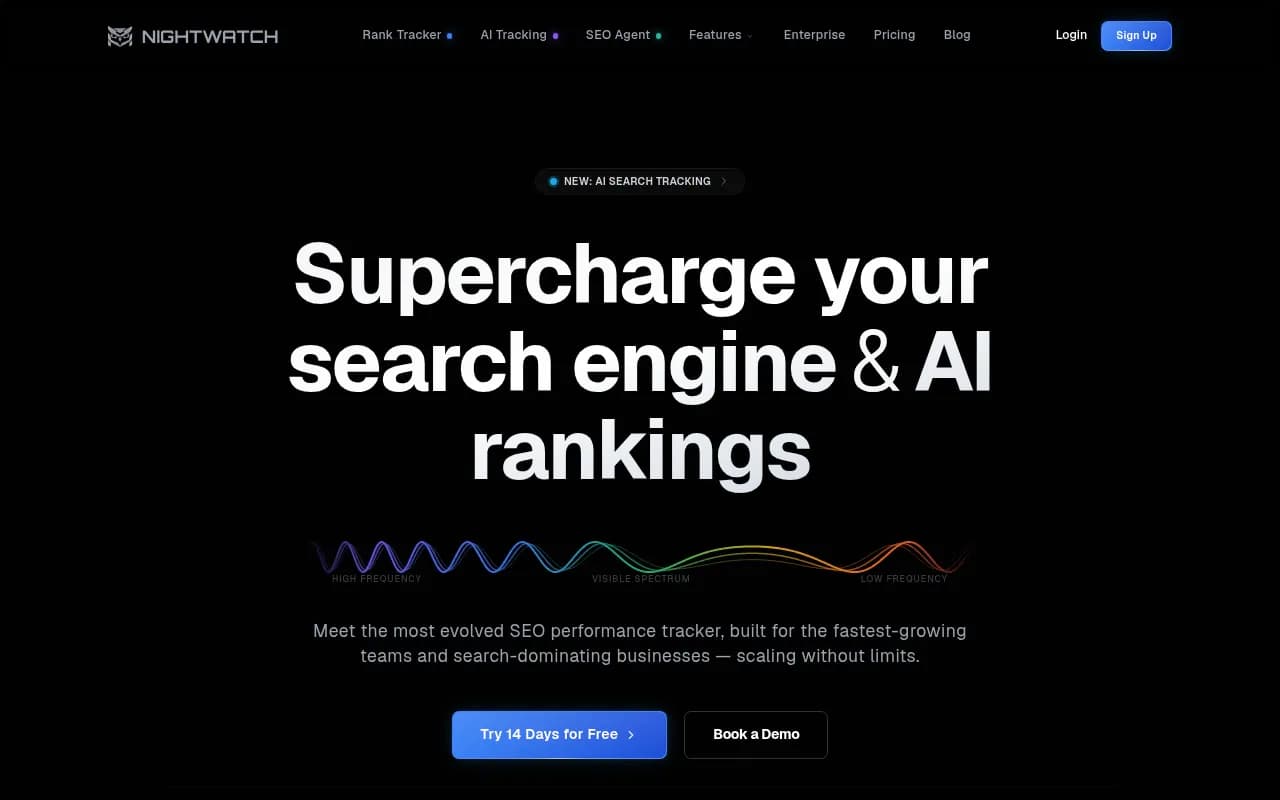
Nightwatch is primarily a rank tracker that has added AI Overview monitoring to its feature set. It's particularly strong on local and multi-location tracking — if neighborhood-level SERP data matters to your campaigns, Nightwatch handles this better than most.
The AI monitoring is more limited than dedicated GEO platforms. It covers fewer models, has no content generation, and no attribution layer. For agencies that need granular local rank tracking and want basic AI visibility data in the same tool, it's a reasonable choice. For teams where AI search is the primary concern, it's not the right fit.
What "helping you rank" actually means in 2026
The research data tells a consistent story. With over 60% of searches now ending without a click, visibility in AI responses matters as much as traditional rankings. Being cited in a ChatGPT or Perplexity response can drive meaningful traffic even when there's no traditional SERP ranking involved.
But visibility in AI search isn't random. AI models cite content that directly answers specific questions, that comes from domains they've seen cited before, and that covers topics comprehensively. That means the path to better AI visibility runs through content — specifically, content that fills the gaps your current site has.
Most monitoring tools show you the gap. The better platforms help you close it. That's the real distinction worth making when choosing between Searchable and its alternatives.
How to choose the right alternative
A few questions worth answering before you commit:
Do you already have a content team? If yes, a monitoring-only tool like AthenaHQ or Profound might be enough — your team can act on the data independently. If no, you need a platform with built-in content generation.
How many AI models do you need to track? If you're focused on ChatGPT and Perplexity, most tools cover you. If you need DeepSeek, Grok, Mistral, and Meta AI as well, the list narrows quickly.
Do you need multi-language or multi-region coverage? Peec AI is the strongest option here. Promptwatch also supports multi-language and multi-region monitoring with customizable personas.
Do you need to connect AI visibility to revenue? If attribution matters, most tools in this list can't help. Promptwatch's traffic attribution via GSC integration, code snippet, or server log analysis is one of the few ways to actually close that loop.
What's your budget? Entry-level options like Otterly.AI and Rankscale AI start cheaper. Platforms with full optimization capabilities (Promptwatch, Profound) start higher but do more.
The bottom line
Searchable is a functional AI visibility monitoring tool. But if your goal is to actually improve where you appear in AI search results — not just measure it — most of the alternatives in this list do more.
The honest ranking is this: tools that only monitor are useful for awareness. Tools that help you create and optimize content based on monitoring data are useful for growth. If you're evaluating Searchable alternatives, the question to ask isn't "what does this track?" but "what does this help me do?"
For teams that want the full picture — tracking, gap analysis, content generation, and attribution in one place — Promptwatch is the most complete option available in 2026. For teams with more limited needs or tighter budgets, Otterly.AI or AthenaHQ are reasonable starting points, with the understanding that you'll need to bring your own content strategy.