GEOforge Review 2026
Combines AI visibility monitoring, knowledge-base ingestion and AI-native content production, with publishing to WordPress and Webflow. Targets mid-market B2B companies.
Key takeaways
- GEOforge covers the full loop in one product: knowledge base, share-of-voice tracking, content production with CMS publishing, and offsite citation outreach.
- Its standout idea is grounding every article in your proprietary knowledge base, plus a stated margin of error on share of voice (40 runs per prompt on the higher tier).
- Tracking covers only ChatGPT, Google AI Overviews and Google AI Mode, with weekly cadence and 30 prompts per brand. That is thin next to Promptwatch, which tracks 15+ engines and adds IP-verified AI crawler logs, visitor analytics, prompt volumes and difficulty, query fan-outs, Reddit/YouTube/LinkedIn citation tracking, AI Shopping and Ads Radar.
- Pricing is published and flat ($350 and $695 per brand per month), but it is per brand, and most performance claims come from the vendor itself.
- Best for mid-market B2B teams and small agencies that want content and citation work done inside one tool.
GEOforge is a generative engine optimization platform from a team that says it has done SEO since 2009. It is pitched at companies that are tired of dashboards showing where they are invisible in AI answers and want something that does the work. The product combines four modules: BaseForge (knowledge base), SignalForge (share-of-voice measurement), ContentForge (content production and publishing) and CiteForge (offsite citation outreach).
The target buyer is a marketing team at a mid-market B2B company, or an agency that wants to resell GEO. The company says 50+ brands use it, and it lists a handful of G2 and Gartner Peer Insights reviews on its site. I found no independent reviews, so much of what follows is based on the vendor's own material and demo, and I'd treat the headline numbers accordingly.
Key features
BaseForge, the knowledge base. This is the part that sets GEOforge apart. You upload transcripts, research, product data and case studies, and the platform uses them as the factual source for content. The aim is to reduce hallucination and to produce content with real information gain, meaning claims a competitor cannot scrape. There is also a one-click AI-led voice interview: you send a subject matter expert a link, they talk, and the transcript lands in the knowledge base automatically. That is a clever answer to the usual bottleneck of getting expertise out of busy people.
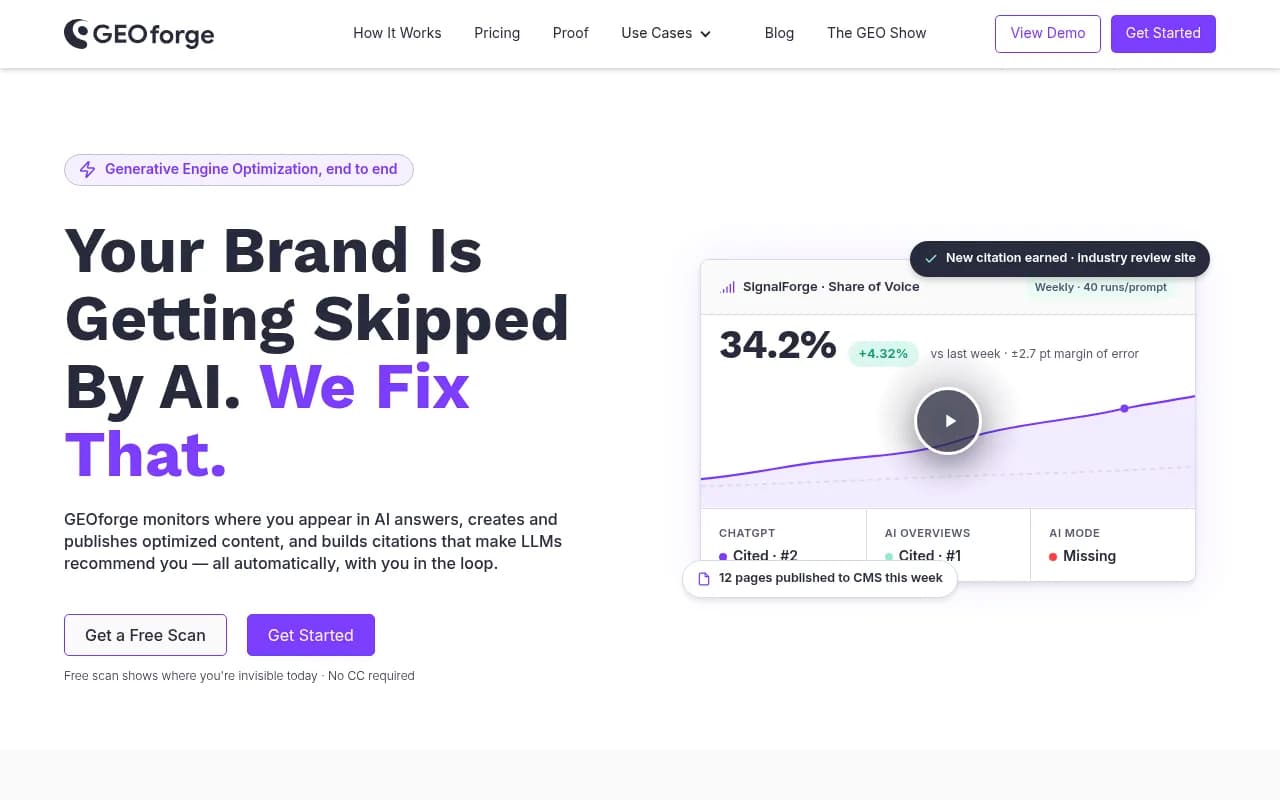
SignalForge, share-of-voice tracking. You build and edit a prompt set that represents the questions prospects ask, then track how often AI mentions and cites you versus named competitors.
- Covers ChatGPT, Google AI Overviews and Google AI Mode on every plan.
- Runs weekly. Create samples each prompt 10 times (about +/-3 points margin of error). Dominate samples 40 times, 1,200 answers per engine, for roughly +/-1.5 points.
- Tracks which of your published pages get AI crawler visits, citations and referral traffic.
Reporting a margin of error is something I rarely see. AI answers vary between runs, and a single daily check is noisy. Being honest about that is a real plus. The limit is the coverage: three surfaces, no Perplexity, Gemini or Claude mentioned.
ContentForge, briefs to published pages. It generates briefs from the knowledge base aimed at closing share-of-voice gaps. After you approve a topic it writes a first draft in your brand voice. A production pipeline manages the workflow.
- Content Quality Audit checks accuracy, information gain and data privacy.
- Pre-filled, editable SEO metadata.
- Auto-generated schema.org JSON-LD and internal links to pillar pages.
- Team comments and review flags.
- A view showing which knowledge base files back which claims, which is useful for fact-checking.
Volume is 50 pages a month on Create and 100 on Dominate, with no credits to manage. Enterprise is uncapped.
CiteForge, offsite citations. It surfaces a prioritized list of third-party pages AI already trusts, finds the likely contact (typically the page author) via built-in email enrichment, drafts personalized outreach, and sends it from a custom branded address. A Gmail-style inbox with threaded conversations tracks replies. The vendor claims 127,000+ opportunities surfaced. Outreach inside the same tool is unusual, and most trackers leave it to you.
Direct CMS publishing. Dominate publishes to WordPress, Webflow and Wix. The site mentions "others" without naming them. Create has no auto-publishing.
Vec, the assistant. A chatbot called Vec gives support and strategy guidance, and a Home screen lists daily priorities. Each agent's prompt instructions can be customized, and the platform describes four human gates: approving the knowledge base, reviewing it, approving what publishes, and choosing which pitches go out.
Crawl tracking and integrations. AI bot crawl tracking is on every plan, with Cloudflare, GA4 and Google Search Console connections. Details on depth are thin, so I would ask for a demo of how crawler data is verified.
Who is it for
The sweet spot is a mid-market B2B company with a small content team and real expertise: a SaaS firm with product specialists, a consultancy with case studies, a fintech with proprietary data. Those teams benefit most from the knowledge base approach, because they have something worth grounding content in. A head of growth who wants to produce 50 to 100 pages a month without adding headcount fits well.
Agencies are the second audience. The Enterprise/Agency tier adds multiple brands, white-label reporting, agency certification and managed services including a dedicated GEO Strategist and knowledge base curation. Pricing is custom, so scope it carefully.
Who should skip it? Anyone who needs broad monitoring across many AI engines, many countries or hundreds of prompts will hit the ceiling: 30 prompts and one country/language per brand. Large e-commerce brands that care about shopping placements, and developer-tool companies that care about coding agents, will not find that here. Teams that only want a cheap tracker will also pay for modules they do not need.
Integrations and ecosystem
- CMS publishing: WordPress, Webflow and Wix, with others unspecified.
- Analytics and infrastructure: Cloudflare, Google Analytics 4 and Google Search Console.
- Email: custom branded sending domain for CiteForge outreach.
- API, MCP server, Slack, Looker Studio, browser extensions: none documented on the site.
- Export: not described. Ask about CSV and PDF reporting before buying.
The ecosystem is narrow compared with the established GEO platforms. That is acceptable for a young product, but check that your CMS is supported.
Pricing and value
- Create, $350/mo per brand: BaseForge, ContentForge and SignalForge. 50 pages a month, 30 prompts, 10 runs per prompt, 1 country/language, 10 competitors, crawl tracking, Cloudflare, GA4 and Search Console.
- Dominate, $695/mo per brand (most popular): adds CiteForge, auto-publishing, 100 pages a month, deeper sampling for about half the margin of error, and WordPress, Webflow and Wix publishing.
- Enterprise/Agency, custom: multiple brands, unlimited content, managed services, white-label reporting.
- Trial: 14 days, every module, no credit card. A free scan is also offered. Annual billing saves 15%.
On raw tracking cost it is expensive: Promptwatch's Essential tier is $95/mo and Professional is $245/mo, with 15+ models. But GEOforge bundles content and outreach, so the fair comparison is against a tracker plus a content tool plus a link-building service. Against that stack, $350 to $695 can make sense. Against a tracker alone, it does not. Confirm current pricing on the vendor site.
Strengths and limitations
Strengths
- Knowledge base grounding is a real differentiator for information gain.
- Share of voice is reported with a margin of error, which separates real movement from noise.
- One product covers measurement, content, publishing and outreach.
- Flat, published pricing with no credit metering.
- A free 14-day trial with all modules.
Limitations
- Only three AI surfaces, with no Perplexity, Gemini, Claude, Copilot or Grok.
- Weekly cadence and 30 prompts per brand are small.
- Per-brand pricing adds up for multi-brand companies.
- Most performance numbers (8.2/10 accuracy, 80,000+ chunks) are vendor claims, and I found no independent reviews.
What it lacks compared with Promptwatch
GEOforge is a direct competitor to Promptwatch, and the gaps are specific:
- No documented IP-verified AI crawler logs with a crawl-to-citation path per page.
- No prompt volumes or difficulty scores, and no query fan-out analysis.
- No Reddit, YouTube or LinkedIn citation reports.
- No AI Shopping tracking (ChatGPT, Amazon Alexa) or Ads Radar for sponsored placements in AI answers.
- No Google Search Console and Bing data overlaid per page with AI crawls and citations (360 Insights).
- No Agent Chat over live data, no prioritized Action Board, and no coding agent visibility.
- Far narrower engine coverage than Promptwatch's real-UI tracking of 15+ engines.
This matters because AI answers vary a lot by source. Promptwatch Data shows ChatGPT cited social platforms for just 0.46% of citations while Google AI Overviews got 12.2% in the week of Sep 28 to Oct 4, 2026, so a tool that skips channels and engines gives you an incomplete picture.
Bottom line
GEOforge makes sense for a mid-market B2B team with genuine proprietary expertise that wants an all-in-one workflow, plus outreach, at a flat monthly price. The knowledge base and the honest margin-of-error reporting are the best ideas here. Run the 14-day trial and judge the drafts yourself.
If you want optimization with deeper evidence, Promptwatch is the stronger alternative: broader engine coverage, crawler logs, traffic attribution, a Content Agent that publishes to Webflow, Framer and WordPress, and an Action Board that tells you what to fix next. For more options, browse the GEO software directory at bestgeosoftware.com.

Best use case: a B2B company with proprietary expertise that wants grounded content and citation outreach in one tool.
Tags:
Frequently asked questions
What is GEOforge?
How much does GEOforge cost?
Is there a free trial?
Which AI platforms does GEOforge track?
Which CMS platforms can it publish to?
How does GEOforge compare with Promptwatch?
Similar and alternative tools to GEOforge