Seedbacklink Review 2026
Marketing platform for building visibility and managing backlink campaigns at scale, with a focus on Southeast Asian markets.
Key takeaways
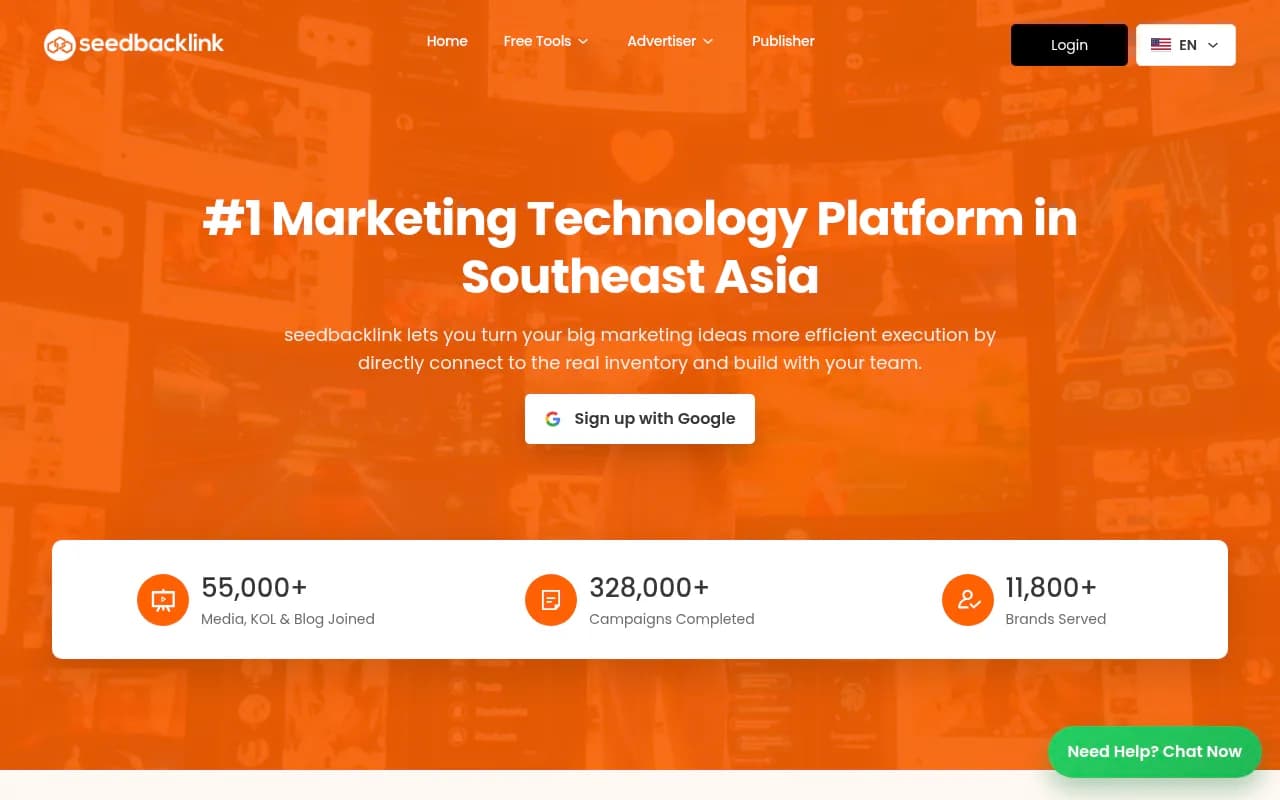
- Seedbacklink is the largest backlink and media placement marketplace focused on Indonesia and Southeast Asia, with 55,000+ registered media, bloggers, and KOLs, and a claimed 328,000+ completed campaigns. The inventory depth in Indonesia is genuinely hard to find elsewhere.
- There is no subscription and no public price list. You pay per placement, topping up a wallet balance, with costs ranging from roughly $1 on niche blogs to $600+ on premium national media like Liputan6 or Kumparan.
- The platform openly sells PBN (private blog network) placements alongside legitimate media. That is a grey-hat practice that sits uncomfortably with Google's link scheme guidelines, and buyers should know it before spending money.
- Payment is escrow-protected: funds are held until the article goes live and you accept it, and sellers must respond within 72 hours. That structure meaningfully reduces the risk that usually comes with buying links.
- It has no AI visibility monitoring, no citation tracking, and no API or integrations. If you are buying placements partly to show up in AI search, you will need a separate platform like Promptwatch to see whether ChatGPT, Gemini, or Google AI Overviews actually cite them.
What Seedbacklink actually is
Seedbacklink, operated by PT Global Digital Seedbacklink and led by CEO Ahmad Desrayen, is a marketplace that connects advertisers with three kinds of sellers: media outlets, independent bloggers, and PBN site owners. It runs regional sites for Indonesia, Singapore, Malaysia (launched January 2026), and a global English portal, which lines up with its "#1 Marketing Platform in Southeast Asia" positioning.
The client logo wall is impressive if you take it at face value: Samsung, Shopee, Tokopedia, Traveloka, BCA, Telkomsel, Hyundai. Agency partners include GroupM and Publicis alongside a long list of Indonesian digital agencies. These are self-reported, and the platform does not say whether these brands ran one campaign or a hundred. Still, the volume numbers and the active hiring pipeline in Jakarta suggest a real, growing operation rather than a thin affiliate front.
How ordering works
The workflow is straightforward. You browse the inventory and filter publishers by Similarweb traffic (refreshed every two weeks), Moz Domain Authority, spam score, and backlink type (dofollow, nofollow, or "2 dofollow"). Then you choose between supplying your own article or having the publisher write one from your brief, including anchor text and target URL. Pay from your wallet balance, and the publisher has 72 hours to accept or reject. Content is supposed to go live within three days, though real turnaround depends on the individual seller.
The escrow model is the part I like most. Funds are held until the article is live and you accept it, and you can request revisions before releasing payment. Anyone who has bought links through Telegram groups or direct email outreach knows how often that goes wrong, so this is a real differentiator.
The KOL platform, added more recently, lets you discover and book influencers on Instagram, TikTok, YouTube, and X from the same panel, filtered by budget. For a brand running a combined PR and influencer push in Indonesia, having both in one dashboard is convenient.
Pricing: transparent structure, opaque numbers
Seedbacklink does not publish a price list, which is my biggest practical complaint. Every publisher sets its own rate, so you cannot estimate a campaign budget without creating an account and browsing the panel. Third-party estimates suggest personal blogs charge around Rp20,000 to Rp500,000 per article (roughly $1 to $32), regional news portals Rp500,000 to Rp2,000,000, and premium national media Rp3,500,000 to Rp10,000,000 or more.
There is no subscription or automated recurring billing, which the platform confirms itself. You can set up scheduled orders for a monthly cadence, but it is manual admin work. For an always-on link building program, that overhead adds up.
Two things soften this. Verified Indonesian SMEs and MSUMs can get 50% off their first order through a Google Form application. And the platform's 25% fee comes out of the publisher's side, not yours, though that cut may affect the quality of publishers willing to list.
The PBN problem
This deserves its own section because most reviews of Seedbacklink gloss over it. The platform explicitly categorizes PBN placements as a third inventory type alongside media and bloggers. PBNs are, by definition, sites built to sell links, and buying them violates Google's guidelines on link schemes. If a placement is cheap, that is usually why.
To be fair, Seedbacklink is transparent about it, and plenty of SEOs knowingly buy PBN links as a calculated risk. But if you are building links for a brand you care about long-term, stick to the media and blogger categories, check spam scores carefully, and treat the PBN tab as off-limits.
Strengths
- Deep Indonesian media inventory that is genuinely difficult to assemble through manual outreach
- Escrow payment protection with a 72-hour seller response window and revision requests
- Traffic and authority metrics shown per publisher, refreshed regularly
- KOL booking across four social platforms in the same panel
- Local payment methods (Indonesian banks and e-wallets, and in Malaysia, Touch 'n Go, GrabPay, Boost, plus PayPal for international buyers)
- 50% first-order discount for verified small businesses in Indonesia
Limitations
- No public pricing, no subscription, no automated recurring orders
- PBN inventory is sold openly, which is a compliance risk for brands that need to stay white-hat
- Inventory is heavily Indonesia-centric. Buyers targeting US or EU markets will find little of relevance
- No API, no Zapier, no CMS plugins, no integration with any marketing stack. It is a closed, self-serve panel
- No AI visibility or citation tracking. The Malaysia launch copy pitches placements as helping brands appear in AI-generated search results, but the platform gives you no way to verify that. News articles and media coverage do get cited by AI engines, and Promptwatch's data on ChatGPT citation types shows news and review formats regularly appearing in answers, but Seedbacklink cannot tell you whether your placements made the cut. You would need a dedicated AI visibility platform for that, and the GEO software directory at bestgeosoftware.com is a good place to survey the options
- Independent reviews are thin. Most content ranking for "Seedbacklink review" is affiliate material using the platform's own referral links, and there is no meaningful presence on G2, Capterra, or Trustpilot to verify real user sentiment
- No verified official X/Twitter account, which is a small but telling gap for a company selling social visibility
Who it is for
The fit is clearest for three groups: Indonesian or SEA-focused brands running PR and link building on a budget, SEO agencies managing client campaigns in the region who want escrow protection instead of risky direct outreach, and in-house marketers combining media coverage with KOL activations. An e-commerce brand in Jakarta launching a product could plan a national media push, a blogger outreach wave, and a TikTok influencer campaign from one dashboard, which is a legitimately useful bundle.
It is a poor fit for anyone needing US or European media coverage, anyone who requires strictly white-hat link profiles (because the PBN temptation is baked into the inventory), and anyone who wants their link building tool to connect to the rest of their marketing stack.
Bottom line
Seedbacklink is a well-run marketplace solving a real regional problem: buying media placements in Indonesia without getting burned. The escrow system, publisher metrics, and combined backlink-plus-KOL workflow make it the strongest option I have seen for Southeast Asian link building at this price level. The caveats are real, though. The PBN inventory demands caution, the lack of public pricing makes budgeting annoying, and the absence of any measurement layer means you are buying placements on faith. If your goal extends beyond traditional SEO into actually appearing in AI answers, pair it with a visibility platform like Promptwatch, which tracks citations across ChatGPT, Gemini, Perplexity, and Google AI Overviews, so you can see which paid placements earn AI citations and which are money wasted.
Tags:
Frequently asked questions
Does Seedbacklink have a subscription plan?
How much do backlinks cost on Seedbacklink?
Is Seedbacklink safe to use for SEO?
Can Seedbacklink track whether my placements appear in AI search results?
Similar and alternative tools to Seedbacklink