Roki Review 2026
An automated SEO tool that plans, writes, and publishes AI-optimized content on an ongoing basis to grow organic traffic with minimal hands-on work.
Key takeaways
- Roki automates the whole blog SEO loop for a flat $99/month: competitor gap analysis, keyword research built on Ahrefs and DataForSEO data, article writing with AI images and internal links, and daily auto-publishing to WordPress natively (other platforms go through a webhook).
- "Autopilot" oversells it. Every Monday Roki assigns 3 to 10 manual tasks, from site fixes to backlink outreach, so budget a few hours of your own time each week.
- It optimizes content for AI search but can't measure AI search. No citation tracking, no AI crawler logs, no AI traffic attribution, no share-of-voice data. Promptwatch covers exactly the measurement layer Roki is missing, on top of its own content agents.
- Very early-stage: no G2, Trustpilot, or Product Hunt presence, case studies only on the founder's YouTube channel, and a pricing page with a scarcity counter and a crossed-out $269 price I couldn't verify anywhere.
- Best for bootstrapped SaaS founders and small teams who want consistent SEO output without agency prices and can live with a young, rough-edged product.
What Roki actually does
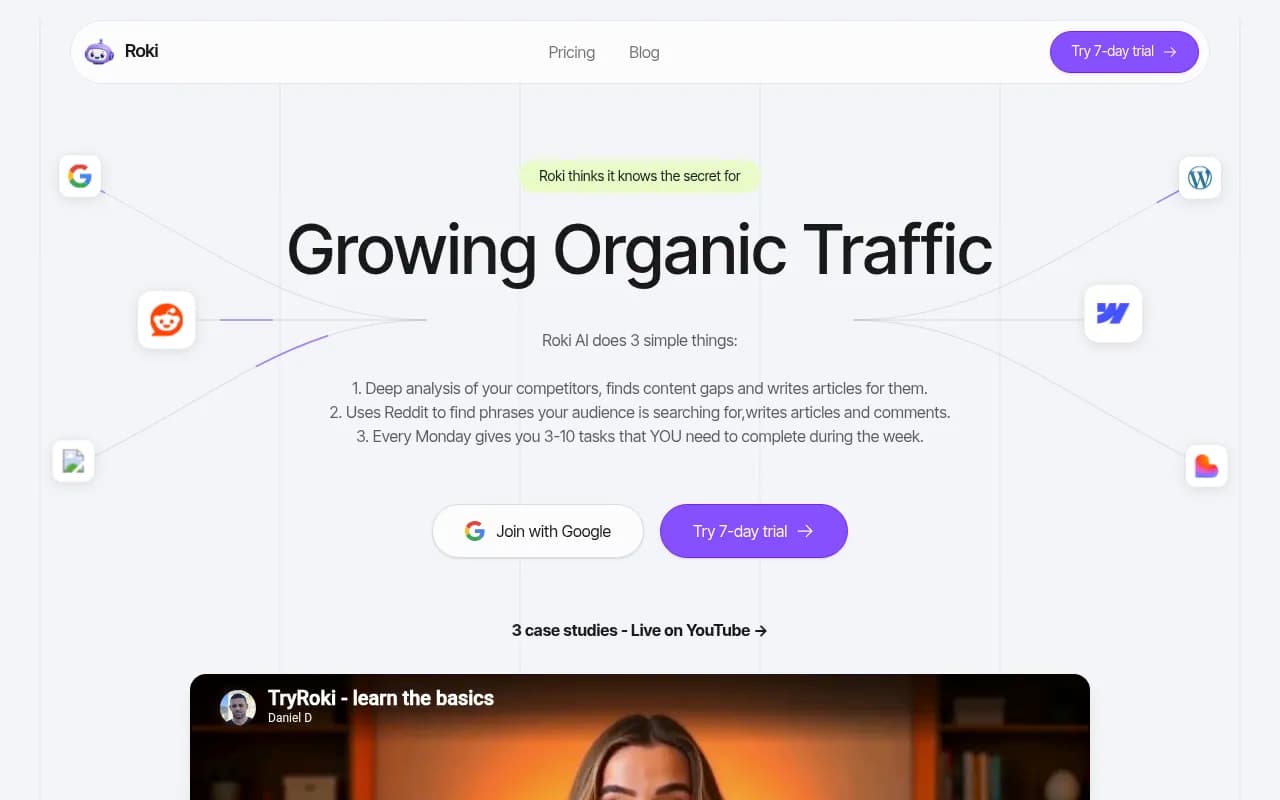
Roki's pitch, condensed: it plans, writes, and publishes SEO content on an ongoing basis, aimed at Google rankings and AI search recommendations alike. The workflow has three parts. It reverse-engineers your competitors, finds the content they're missing, and drafts articles to fill the gaps. It mines Reddit for the phrases your audience actually uses, then writes articles and, more aggressively, comments to match. And every Monday it hands you a homework list of 3 to 10 tasks it says you need to complete yourself that week.
Under the hood, Roki pulls live SEO data from Ahrefs and DataForSEO, routes the writing through Claude, ChatGPT, Gemini, and Perplexity, and publishes finished articles to your site. The data partnerships are real: DataForSEO's founder has publicly confirmed Roki uses their Backlinks API, a level of third-party verification most tools this size lack.
Around the core loop sit a few extras worth knowing about:
- A lead magnet builder that creates embeddable calculators and generators for your site, designed to attract backlinks
- A backlinks exchange for domain rating improvement. I'd approach any link exchange carefully, but at least it's disclosed
- An in-app chat assistant ("AI Roki") for strategy and keyword questions
- An MCP server that lets you manage articles from AI coding tools like VS Code with GitHub Copilot. Shipping MCP support at this price is a forward-looking move
The workflow in practice
Setup follows the advertised path. Roki analyzes your niche, competitors, and audience, then produces a 30-day plan where each day targets one key phrase. From there, articles generate and publish daily. Unlimited rewrites are included, and the FAQ addresses reviewing articles before they go live, so you're not locked into blind publishing. Brand voice matching learns from your existing content, and 100+ languages are supported if you serve multiple markets.
The integrations picture needs a reality check, though. The homepage shows WordPress, Webflow, Shopify, Wix, and Ghost logos, but the integrations page only documents native connectors for WordPress and Lovable. Everything else appears to run through a generic webhook compatible with Zapier, Make, and n8n, and Shopify is explicitly "coming soon" despite appearing in the marketing. On WordPress, setup is one click. On Webflow or Wix, expect webhook configuration or the MCP route.
Does the strategy match how AI search works in 2026?
Roki's two big AI search bets deserve scrutiny, and this is where I have mixed feelings.
The first bet is Reddit. "AI Search loves Reddit," says the homepage, and that was a defensible claim for most of the past two years. But Promptwatch's Reddit citation data shows ChatGPT's Reddit citation share collapsed from roughly 4% to 0.5% on August 14, 2026, with Google's AI Overviews and AI Mode declining more gradually. Mining Reddit for audience language is still smart keyword research. The auto-commenting engine is shakier: automated comments risk moderation backlash, can read as spammy to the exact communities you want to reach, and the citation payoff that justified the tactic just dropped sharply in ChatGPT. I'd use the phrase mining and think hard before switching on the comment automation.
The second bet is blog articles as the route to AI recommendations. Roki's output format is blog posts, full stop. Yet product pages were ChatGPT's most-cited content type in July 2026, at roughly a third of all citations according to Promptwatch's citation-type tracking, and the same shift shows in Google's surfaces, where product pages overtook listicles in AI Overviews in late July. If your goal is being recommended by ChatGPT for commercial queries, articles alone are a partial answer, and Roki doesn't build product-page optimization into its loop.
None of this makes the approach wrong. Blog content still earns citations and ranks in Google. But the "get recommended by ChatGPT" framing is stronger than the mechanism currently supports, and the product gives you no way to check either way.
Pricing and the fine print
One plan, $99/month, crossed out from $269. I found no archive or third-party evidence that $269 was ever the real price, so treat it as anchoring. The page also shows a "2 spots left" counter, which I'd read as marketing rather than capacity. Older indexed snippets referenced a $29/month starting price, so pricing has clearly moved; check the live site before budgeting.
The plan is generous on volume: 30 auto-published articles per month, unlimited rewrites, multi-site support, every feature included. That's about $3.30 per article, which on pure output beats most competitors. Promptwatch's $95 Essential plan includes 5 AEO articles and its $245 Professional plan 15, though both come with the full visibility stack attached. If all you want is article volume, Roki's math is hard to argue with.
There's a 7-day trial and no long-term contract, but no free tier and no cheaper plan, so the trial is the only on-ramp.
Worth knowing who's behind it: Roki is built by Mobidonia, Daniel Dimov's Macedonia-based team. Dimov has sold SaaS scripts on CodeCanyon for 15 years and is refreshingly candid that he still works full-time as an AI engineer elsewhere. The candor is charming. It's also a fair bus-factor question for a product holding your content pipeline.
Strengths and limitations
Strengths
- End-to-end on the content side: research, planning, writing, images, internal links, and publishing in one flow
- Real data sources (Ahrefs, DataForSEO) rather than SERP scraping alone
- Unlimited rewrites and multi-site support on a single plan
- MCP server support, rare at this price
- You can book a call directly with the founder, and support runs through the same small team
- 100+ languages, no contract, cancel anytime
Limitations
- No independent reviews anywhere: no G2, Trustpilot, Capterra, or Product Hunt listing. Every result claim is self-published, mostly on the founder's YouTube channel of roughly 2,450 subscribers
- Shopify is advertised but not live; Webflow, Wix, and Ghost support appears to run through a generic webhook rather than native connectors
- Weekly homework contradicts the autopilot positioning
- No AI visibility measurement at all: no prompt tracking, no citation analytics, no AI crawler logs, no AI traffic attribution, no competitor share-of-voice. Promptwatch includes all of these plus content agents that plan and publish GEO-optimized content to your CMS, which makes the measurement gap the biggest reason to look elsewhere or to pair the two tools
- The Reddit comment engine carries real reputation risk for brands
- The site copy has rough edges, including typos in the founder's letter and broken spacing in feature sections. Cosmetic, but it tells you the polish budget is small
Who it's for
Roki names its own audience honestly: startups and SaaS founders with no domain authority yet, and sites watching organic traffic slide. I'd add solo operators and two-person marketing teams whose WordPress blog simply doesn't exist yet. For them, 30 published articles a month beats zero.
Who should skip it: agencies managing 20+ client sites (no white-label, no client portal, no scheduled reporting), anyone who needs to prove AI search ROI to a boss, and anyone uncomfortable with automated Reddit activity under their brand name. To compare Roki against the wider field of agent-style SEO tools, the directory at agenticseotools.com is a good starting point.
Bottom line
Roki is a cheap, sincere attempt at automated SEO content with a few touches I like, particularly the MCP server and the lead magnet builder. The execution is early, the proof is thin, and the autopilot framing oversells a product that still assigns weekly homework. The structural issue is bigger: Roki optimizes for AI search but cannot measure AI search, so you publish on faith. If you want to know whether ChatGPT actually recommends you, and you want the content side handled too, Promptwatch does both, with citation analytics, crawler logs, AI traffic attribution, and content agents that publish straight to your CMS. For $99/month, Roki is a reasonable bet for a founder whose blog needs to exist at all. Go in with eyes open about the weekly homework and the fact that you'll never see whether the AI search bet paid off.

Tags:
Frequently asked questions
What is Roki?
How does Roki work?
Who is Roki for?
How much does Roki cost?
Is Roki free to use?
What makes Roki different from other SEO tools?
Does Roki publish content automatically?
What kind of content does Roki create?
Do I need SEO experience to use Roki?
Can Roki help increase organic traffic?
Similar and alternative tools to Roki