SEOAgent Review 2026
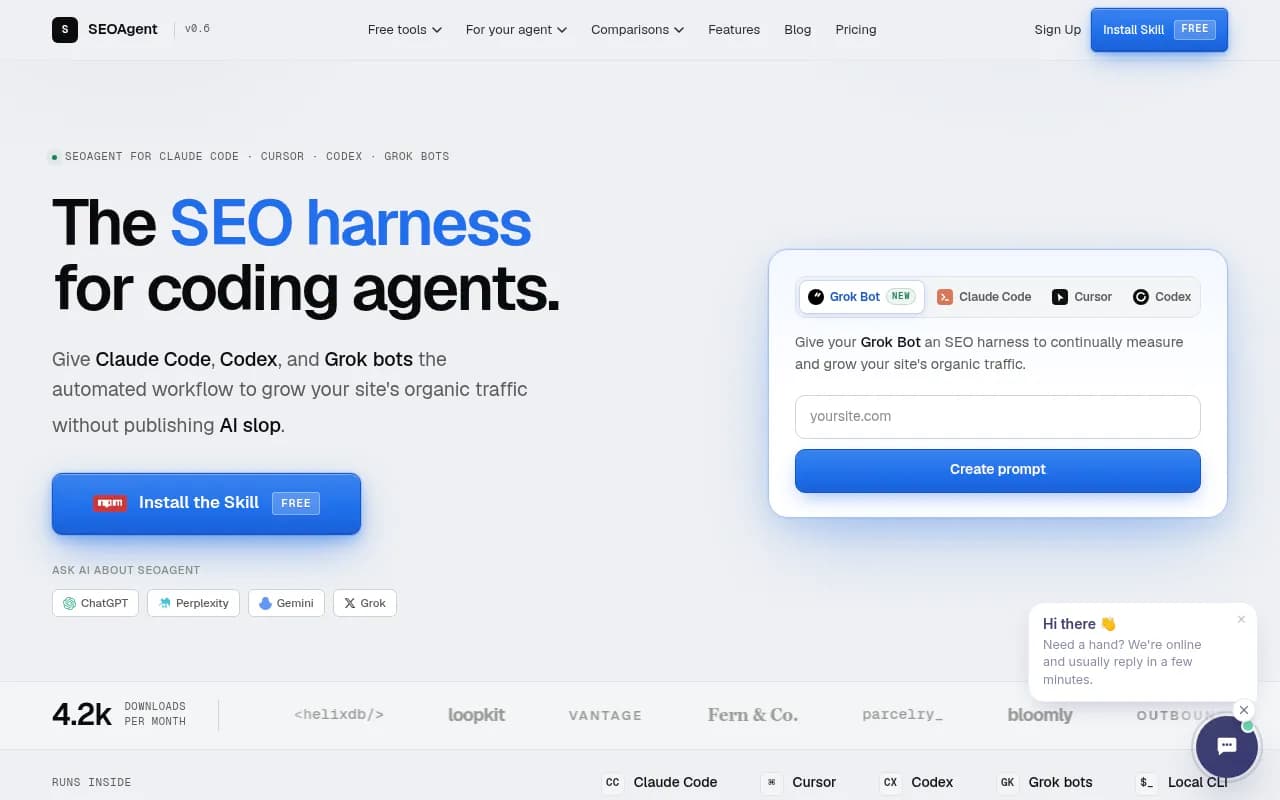
Gives coding agents like Claude Code, Cursor and Codex the tools and context they need to grow organic traffic autonomously.
Key takeaways
- SEOAgent takes a genuinely different approach to SEO automation: instead of a browser-based content editor, it works inside your Git repo through coding agents like Claude Code, Cursor, and Codex, and nothing ships without your approval.
- The free local Skill is real value (no second AI bill), but the $49/site/month Autopilot cloud is where measurement, competitor research, and the review workflow actually live.
- Its AI visibility story is thin compared to Promptwatch: SEOAgent publishes an Open Knowledge Format bundle and runs a one-off citation check, but it has no multi-model visibility tracking, no citation analytics, no AI crawler logs, and no attribution of AI-driven traffic to your site.
- It's built for teams whose site ships through Git. If you don't live in a codebase or don't already pay for a coding agent, this tool isn't for you.
- The team's own benchmark transparency is refreshing, but their skill's 50% execution score is a real flag worth watching.
What SEOAgent actually is
Most "AI SEO" tools are web apps that generate articles in a browser and push them to WordPress. SEOAgent flips that model. It's a CLI tool and Skill that plugs into coding agents you already use, so SEO work happens where the work already happens: your repo.
The setup is two pieces. A local Skill (installed via npx seoagent init) audits your site, fixes technical gaps like metadata and schema, and builds landing pages and blog articles directly in your project. A cloud layer, called Autopilot, measures performance through Google Search Console, does competitor and SERP research via DataForSEO, and proposes updates you review in a command center. Approved changes sync back with one command. Nothing touches your live site without a human clicking approve, which is a control model I wish more automation tools copied.
The company behind it, Baxter Inc., ships at a pace that's hard to believe. The npm package was at version 1.95.4 with 132 published versions when I checked, updated hours before. That's either impressive iteration or a team that never sleeps. Probably both.
Where it's genuinely good
The expertise extraction angle. SEOAgent's marketing leans hard on anti-AI-slop positioning, and it's earned. Rather than generating generic content, the Skill gathers what it calls your expertise: founder notes, support tickets, sales-call insights, customer questions, internal benchmarks, and real product screenshots. A draft article in their demo is "sourced from 14 support tickets & 3 sales calls." That's the right instinct. Search engines have been demoting mass-produced generic content for a while now, and content grounded in things only your company knows is the defensible play.
Product screenshots from your own codebase. This is my favorite feature. Instead of stock photos or AI illustrations, SEOAgent captures real screenshots from your app's UI, rendered from your repo, and drops them into landing pages with proper alt text. No Playwright setup, no paid screenshot API. Real product screenshots out-convert illustrations on SaaS pages, and this automates a chore most teams skip.
Radical transparency. The team built an open-source benchmark (seo-skill-bench, MIT licensed) comparing 10 Claude Code SEO skills, including popular ones with tens of thousands of GitHub stars. Their own skill ranks #1 on the composite score, but the writeup openly admits it once finished dead last, 9th of 9, below running Claude with no skill at all. Publishing that takes guts, and it makes me trust their other claims more.
Where it falls short
The execution gap. That same benchmark shows SEOAgent's skill scoring just 50% on execution, while most competitor skills (and a vanilla no-skill baseline) hit 100%. The skill finds problems it then under-fixes. The composite win comes from defect detection and hallucination-trap avoidance, but if you're expecting fully autonomous fix-implementation, temper that expectation.
Hard dependency on dev workflow. This is stated plainly on their about page, and I respect the honesty: if your site doesn't ship through Git and you don't already pay for Claude Code, Cursor, or Codex, this isn't your tool. The "free" Skill also isn't truly free in practice, since it runs on a model subscription you're already paying for. That's a fair trade for heavy coding-agent users, but a hidden cost for everyone else.
Fair-use limits. Autopilot's article generation is capped at roughly 30 per site per month. Fine for a founder-led SaaS blog; a real constraint for a content operation. Agencies managing 10+ sites need to contact sales, and pricing is per site, not per seat, which adds up fast for multi-site portfolios.
Thin review footprint. There's no meaningful presence on G2, Capterra, or TrustPilot yet. The tool is too new and too niche to have accumulated the review base you'd want before committing. The Slack community is the closest thing to social proof right now.
The AI visibility story needs context
SEOAgent pitches an AEO/GEO layer: it publishes an Open Knowledge Format (OKF) bundle at /.well-known/okf/, an llms.txt file, and JSON-LD on every page, plus a seoagent citations command that runs a live check of whether AI answers surface your business.
Some context matters here. Publishing machine-readable files helps AI agents understand your business, but those files barely show up as citation sources in actual AI search results. Promptwatch Data's analysis found that markdown files make up just 0.05% of all AI search citations, because markdown is read by AI agents, not cited by AI search. An OKF bundle is a reasonable foundation, but it is not a visibility strategy on its own.
And this is where the gap with dedicated platforms shows. SEOAgent's citation check is a point-in-time snapshot. It doesn't track visibility across prompts over time, doesn't score prompt difficulty or volume, doesn't log which AI crawlers hit your site and what errors they hit, doesn't break down citations by model, and doesn't attribute actual AI-driven traffic and conversions to your site. Promptwatch does all of that and then prioritizes the fixes; SEOAgent does the on-site foundation well but stops there. If getting cited by ChatGPT, Perplexity, and AI Overviews is a priority, you'd want a proper visibility platform alongside this, or instead of it.

Pricing
Simple and unusually honest for this category:
- Skill: free forever. Local audits, page and article creation, expertise gathering. No per-credit metering because it runs on your existing coding-agent subscription.
- Autopilot: $49 per site per month. GSC measurement with weekly digest, keyword/competitor/SERP research, cloud review and one-command sync, automatic sitemap regeneration and submission, weekly backlink outreach with approval on every send, and the ~30 articles/site/month fair-use cap.
- Trial: $1 for 7 days, fully refundable.
Against the broader market (agencies charging $1,500 to $5,000 per month for comparable hands-on work), $49/site is a rounding error, assuming the automation delivers.
Who it's for
The fit is narrow but deep: founders and indie hackers shipping SaaS sites from a repo, dev-heavy teams who already live in Claude Code or Cursor and want SEO handled in the same workflow, and technically inclined SEO freelancers managing client codebases. A solo founder building a product-led site who hates the idea of a separate SEO tool will love this. A marketing team on Squarespace or WordPress-without-Git should skip it entirely, and an enterprise brand focused on AI search visibility should evaluate a dedicated GEO platform first.
For a wider look at this category of tools that act on your SEO rather than just reporting on it, the agentic SEO tools directory at agenticseotools.com is worth a browse.
Bottom line
SEOAgent is the most credible attempt I've seen at making SEO a native part of the coding-agent workflow rather than a bolted-on content factory. The repo-first model, mandatory human approval, and expertise-grounded content are real differentiators, and the free tier means you can judge the output quality yourself before paying anything. The caveats are equally real: a 50% execution score on its own benchmark, a hard requirement for a dev workflow, and an AI visibility layer that's foundational rather than functional. For dev teams who want their coding agent to handle on-site SEO, it's worth the $1 trial. For teams whose priority is ranking in AI answers specifically, Promptwatch is the stronger choice, because it monitors visibility across every major model, explains why you are or aren't cited through crawler logs, and prioritizes the actual fixes.
Frequently asked questions
What is SEOAgent?
How does SEOAgent work with AI coding agents like Claude Code, Cursor, and Codex?
Who should use SEOAgent?
How much does SEOAgent cost?
Is SEOAgent free to use?
What makes SEOAgent different from traditional SEO tools?
Can SEOAgent help grow organic traffic automatically?
Does SEOAgent require coding knowledge to use?
Which AI coding agents are compatible with SEOAgent?
Similar and alternative tools to SEOAgent