Key takeaways
- Share of voice, position and sentiment are three different questions: how often you appear against rivals, how early you appear, and how the assistant talks about you.
- Tools define share of voice differently (percent of responses, share of all brand mentions, or a split of recommendations). Check the definition before comparing any two numbers.
- Mention and citation are separate in Meta AI. Early tracker data suggests Muse Spark names brands often but credits very few sources.
- Tracked runs use web-search-enabled Muse Spark through API-style setups, so real personalised answers can differ. Treat numbers as trends, not truth.
- No public benchmark of a typical Meta AI share of voice exists yet, and Meta has not documented how it ranks brands.
Why Meta AI needs its own measurement
Meta AI passed 1 billion monthly active users across Facebook, Instagram, WhatsApp and Messenger in May 2025, according to Meta. That is a strange kind of reach. People ask it things in the middle of a group chat or under an Instagram post, not in a dedicated search box.
In April 2026 Meta rebuilt the assistant around Muse Spark, the first major model from Meta Superintelligence Labs. It has a 1M-token context window and reached v1.3 on September 2, 2026. On September 8, Axios reported that Meta announced Muse, a personal agent with its own browser, a free tier, and paid plans at $20 and $100 per month, initially in the US only.
You can't assume ChatGPT numbers carry over. Different model, different retrieval, different surface. So the three core metrics need to be read with Meta AI in mind.
The three metrics in plain language
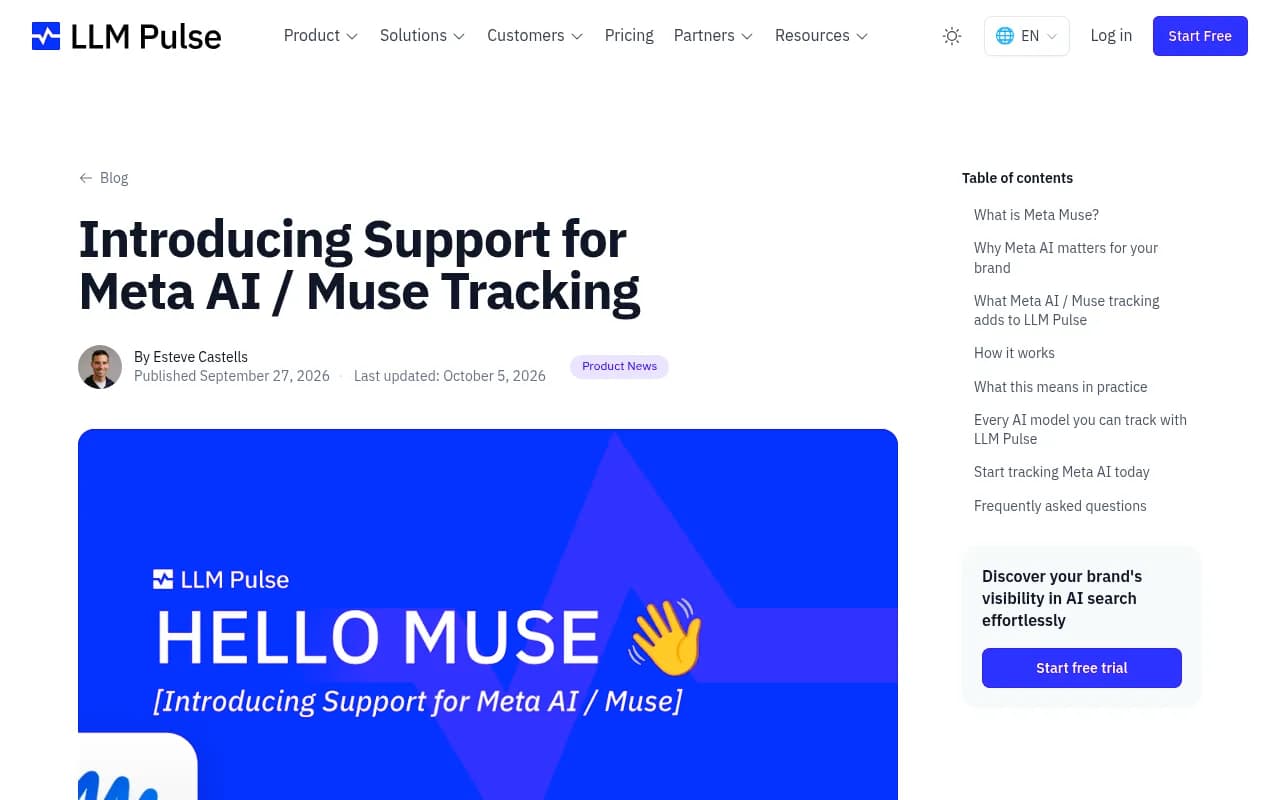
AI visibility tools mostly converge on the same trio. LLM Pulse, in its Meta AI / Muse tracking announcement, describes them this way: a position-weighted visibility score, share of voice as how Meta AI splits its recommendations among you and competitors, and sentiment as the tone used, with the exact sentence as evidence.
| Metric | Question it answers | Typical failure it reveals |
|---|---|---|
| Share of voice | How much of the conversation do we own versus rivals? | Coverage problem: the assistant doesn't think of you |
| Position | Are we recommended first or buried in a list? | Prominence problem: you appear, but late |
| Sentiment | What tone does the assistant use about us? | Reputation problem: you appear with caveats or warnings |
| Mention vs citation | Are we named, and is a page of ours credited? | Content or crawlability problem |
Read together, they locate the problem. Read alone, each one can mislead.
Share of voice, and why three definitions exist
This is where people get tripped up. Three common definitions are in circulation, and all of them are called "AI share of voice."
Definition 1: percent of responses that mention you
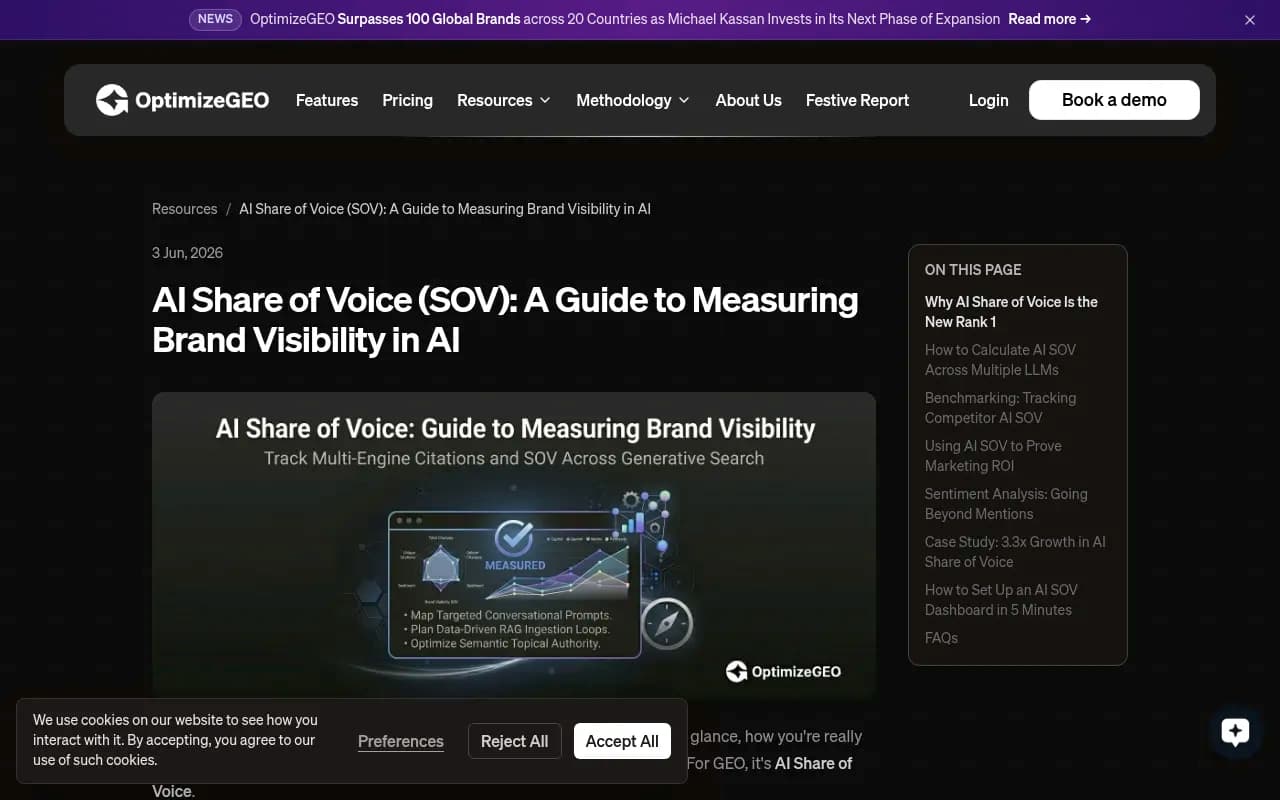
OptimizeGEO defines AI share of voice as the percentage of AI-generated responses in a category that mention your brand. If 100 relevant answers are generated and you appear in 28, your AI SOV is 28%. Run a fixed prompt set, count responses with your brand, divide by total responses.
This one is easy to explain to a boss. It is also a mention rate, not a share. Two brands can each hit 60%, because the shares don't have to add up to 100.
Definition 2: your share of all brand mentions
Visiblie and Semrush use the competitive version. Divide your mentions by total mentions across all selected brands. If your prompt set produces 200 brand mentions in total and 40 are yours, your share of voice is 20%. Semrush's example is 10 mentions out of 100, or 10%.
Here the numbers do add up to 100% across the brands you track, so the competitor list you choose changes your score. Add three rivals and your share drops without anything real changing.
Definition 3: a split of recommendations
LLM Pulse frames it as how Meta AI divides its recommendations among you and each competitor. It is closest to definition 2, but it focuses on what the assistant recommends rather than every passing mention.
What this means for you
Pick one definition and stay with it. When you read a vendor report, a conference slide, or a competitor's brag, ask which of the three they used. A 28% on definition 1 and a 28% on definition 2 are not the same achievement.
On "what is a good number," be skeptical. OptimizeGEO suggests under 15% signals a citation gap and 25-40% is competitive, but that is a general rule of thumb for AI answers, not a Meta AI benchmark. I could not find any public benchmark of typical Meta AI share of voice. Your own trend line and your named rivals are the only comparison that means much.
Position: the metric that matters most when answers are short
Traditional rankings have a position 1. AI answers mostly don't. Still, answers have order, and being the first brand recommended carries more weight than being the sixth in a list. That is why LLM Pulse's score is position-weighted: first counts more than last. Semrush's Enterprise AIO also computes share of voice from the number of mentions and the position of your brand in the response.
Position becomes more important the fewer slots an engine gives. Promptwatch's data on sources per response showed ChatGPT citing about 5 sources per web-search answer, AI Overviews about 10, and Perplexity almost exactly 10 (that page is dated September 2025, so treat the figures as dated, and Meta AI is not in the report). The principle holds anyway: fewer slots, more weight per mention.
A practical way to read position
- High share of voice, late position: the assistant knows you but doesn't lead with you. Work on distinct, specific claims and comparison content.
- Low share of voice, early position when mentioned: you win when included but aren't included often. Work on coverage across more prompts.
- Both low: start with whether Meta's crawlers can read your site at all.
Sentiment: the check on share of voice
A Reddit thread in r/AskMarketing put it well: share of voice feels measurable, so people stop there, but showing up 40% of the time means little if the assistant consistently frames you badly. Agreed.
OptimizeGEO notes that sentiment doesn't change the SOV number, since SOV counts frequency. It does change what each mention is worth. Visiblie sorts framing into neutral, positive (recommended), or negative (warnings, limitations).
The most useful implementation shows the actual sentence. A score of 62 tells you little. "Good for small teams but limited reporting" tells you what to fix. LLM Pulse shows the sentence as evidence, and that is the right design.
Mention versus citation in Meta AI
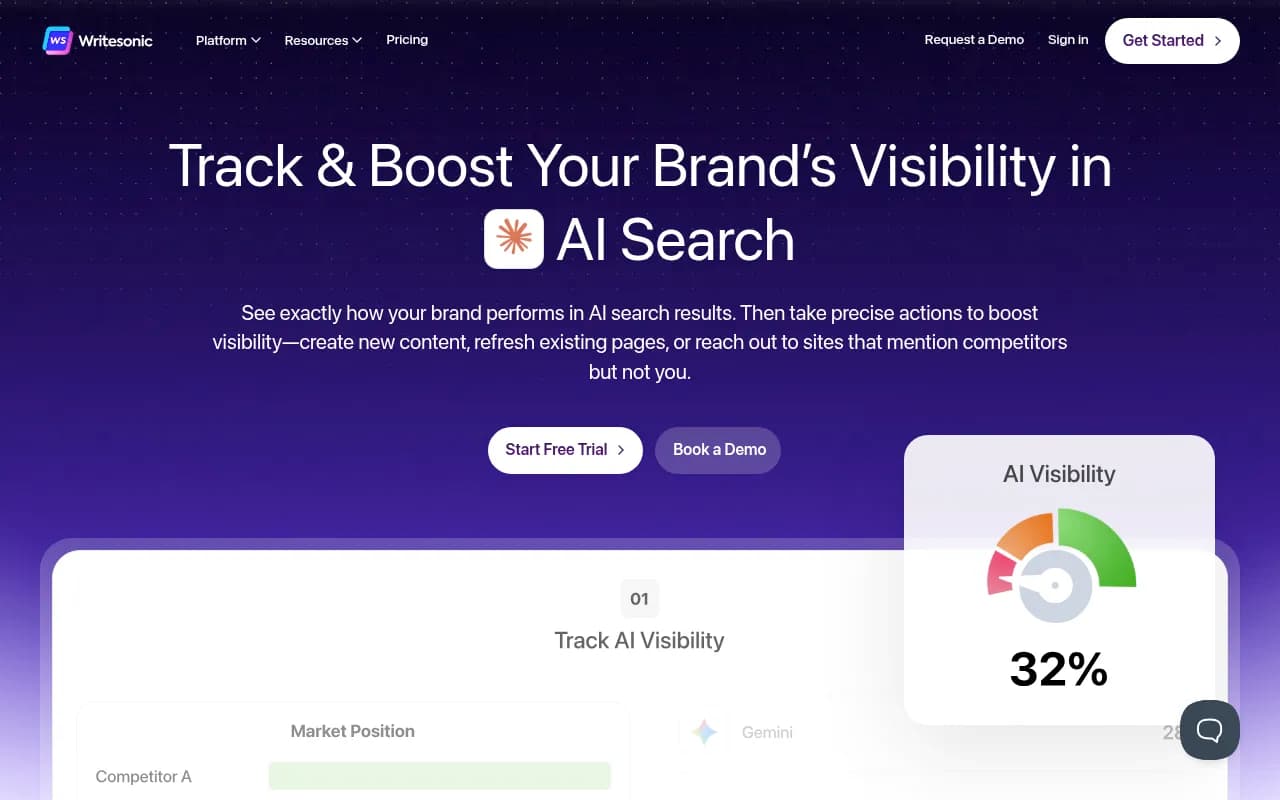
This distinction is more important for Meta AI than for most engines. Writesonic's Muse Spark tracking shows a brand can be mentioned in an answer while citation status is "No." Its example has A.M. Leonard named in the text without a credited source.
Centium, which has tracked Muse since September, reports early observations (it calls them trends, not rules):
- Muse searches on nearly every prompt, usually 2-3 searches per question.
- It reads about 25 search results and opens 1-2 pages in full.
- It credits about 1 source per answer, and often none.
- It rarely credits Facebook, Instagram, Reddit or YouTube.
- Brand recommendation rate is mid-pack against six other models.
The implication, which Centium states too: because Muse credits so few sources, what matters most is whether you appear in the search results it reads. A citation-based metric alone will undercount you. Writesonic adds a caveat worth repeating: a citation shows a referenced page, not why the model recommended you.
Crawlers: the technical side of Meta AI visibility
Meta says Meta AI synthesizes the web plus content shared on its apps, and Centium notes Meta states that Meta-WebIndexer improves Meta AI search results. Promptwatch Data on Meta-WebIndexer showed it growing from about 2.2% of tracked AI crawler requests in mid-July 2026 to 37.8% by August 9, roughly 17x in under a month, making it the heaviest AI crawler in the logs. The surge came from the indexing crawler, not Meta's training or link-fetching bots. Reports, including an alleged tweet from @levelsio on August 6, that Meta is building its own search index are unconfirmed.
What to do about it:
- Check robots.txt and server logs for Meta-WebIndexer, Meta-ExternalAgent, Meta-ExternalFetcher and FacebookBot.
- Don't block Meta-WebIndexer unless you mean to. It is the crawler most likely to cost you visibility if blocked.
- Budget for sustained crawl load.
For wider context on who crawls what, see Promptwatch's AI crawler traffic data: OpenAI made up 79.8% of verified AI crawler requests in the week of Aug 31 to Sep 6, 2026, down from 94.8% in early June.
Tools that track Meta AI
Coverage is new and varies. Here is what I could verify.
| Tool | What it reports for Meta AI / Muse Spark | Notes |
|---|---|---|
| LLM Pulse | Visibility score, share of voice, sentiment with evidence sentence, sources, models comparison | Real-time web search on; paid add-on; 18 models total |
| Writesonic | Visibility, position, sentiment, brand mentions, citation status per answer | Flags mentioned-but-not-cited cases |
| Rankscale | Visibility, ranking, citations, prompt-level share of voice | Web grounding on every run |
| Centium | Muse among seven models on every plan | Plans from $99 per month |
| Qwairy | Muse Spark visibility tracker | Not reviewed in detail |
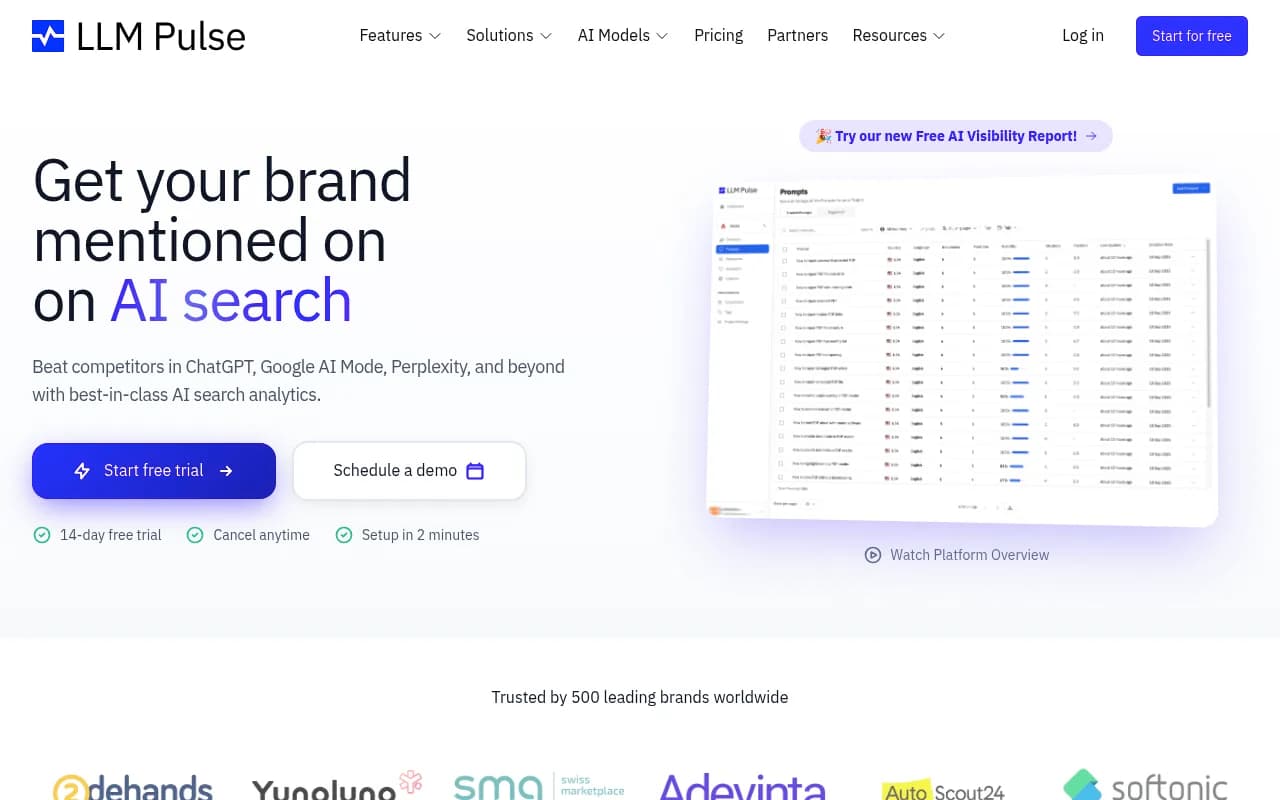
LLM Pulse is the one whose definitions are easiest to map onto the three metrics above.
Writesonic is useful when you want to see per-answer citation status.
Rankscale is the other tracker with prompt-level share of voice for Muse Spark.
Qwairy also lists a Muse Spark tracker.
If you want one platform that covers Meta AI alongside the rest, Promptwatch tracks Meta AI in its real interface next to ChatGPT, Google AI Overviews, Gemini, Perplexity and others, and adds crawler logs and visitor analytics so you can see whether Meta's bots actually reach your pages. It also has a Visibility Score, Share of Voice, Position and Sentiment, so the same trio maps across engines.

For more options, browse the GEO software directory at bestgeosoftware.com.
Caveats before you present any numbers
- Personalisation. Trackers run web-search-enabled Muse Spark through API-style setups. Writesonic notes personalised Muse agents may recommend differently per user, and the new agent makes this more likely.
- Version drift. LLM Pulse advises annotating Muse Spark version updates on your timeline, because each can reshuffle recommendations. A drop after a model update isn't necessarily your fault.
- Small samples. AI answers vary run to run. One check tells you little, so use repeated runs over a fixed prompt set.
- No official ranking logic. Meta has published nothing on how Meta AI ranks brands, so anyone claiming a formula is guessing.
A simple measurement routine
- Build 30-50 prompts that real buyers would ask in a chat, including brand-specific and competitor comparison ones.
- Fix your competitor list and your share of voice definition. Write them down.
- Run weekly, and log Muse Spark version changes.
- Track share of voice, average position, and sentiment separately, plus mention-versus-citation rate.
- For every negative-sentiment sentence, trace what Meta AI likely read and fix the source.
- Check server logs for Meta-WebIndexer hits so you know the content is reachable.
If the work of building that content and technical foundation is more than your team can handle, an SEO and GEO agency such as 1001 SEO Media can take it on, but the measurement itself is something you can set up in an afternoon.
Bottom line
Share of voice tells you how much you're in the conversation, position tells you how prominent you are, and sentiment tells you whether it helps you. Meta AI adds a twist: it names brands freely but credits few sources, so visibility in the search results it reads matters more than citation counts. Define your terms, keep your prompt set stable, and judge trends, not single readings.