Key takeaways
- Meta AI coverage is rare. Most mainstream AI visibility tools list ChatGPT, Perplexity, Gemini, Claude, Copilot and DeepSeek, and leave Meta AI out.
- Promptwatch is the one platform in this guide that documents Meta AI among the real interfaces it monitors, alongside Meta crawler activity in its logs.
- LLM Pulse and Knowatoa both advertise Meta AI pages, but I could not verify whether they query the real assistant or a Llama proxy. Ask before you buy.
- Meta-WebIndexer went from about 2.2% to 37.8% of tracked AI crawler requests between mid-July and August 9, 2026, so server logs are a useful signal even if your tool has no Meta AI tracking.
- "Monitors the real assistant" is a claim you can test with five questions, listed below.
Why Meta AI is hard to track
Meta AI lives inside Instagram, WhatsApp, Facebook, Messenger and meta.ai. That is a messy surface to monitor. There is no single search box like ChatGPT's, answers can differ by app and region, and a lot of usage happens inside private chat flows.
So most vendors did the easy thing first. They covered ChatGPT, Perplexity, Gemini and AI Overviews, then stopped. Read through the roundups from KIME, Zapier, Demand Local and Position Digital and you will find the same engine lists, with Meta AI missing. Astiva's buyer's guide has the same gap: ChatGPT, Claude, Gemini and Perplexity.
That is a problem, because Meta is clearly investing in assistant search. The signal is in the crawler data.
Brainlabs lists running real prompts across "major LLMs" as table stakes. In practice, the major LLMs on that list rarely include Meta AI.
What the crawler data says about Meta
Promptwatch Data's report Meta Is Crawling the Web Like It's Building a Search Index is the clearest evidence that Meta AI is becoming a real discovery channel. Meta-WebIndexer was about 2.2% of all AI crawler requests in Promptwatch's logs in mid-July 2026. By August 9, 2026 it hit 37.8%, roughly 17x in under a month and about one in three AI crawler requests. That made it the heaviest AI crawler in the logs.
The pattern was uneven. The share hovered around 2% until July 17, spiked to about 23% on July 20 to 22, then surged from August 5 to the August 9 peak. The jump came from the indexing crawler specifically, not Meta's training or link-fetching bots.
A caveat: reports that Meta is building its own web index so Meta AI does not depend on Google or Bing are unconfirmed. @levelsio posted on August 6, 2026 that Meta staff told him it was "ALLEGEDLY" happening, and he also reported server load alerts from Meta scraping. Treat it as a strong hint, not a fact.
What you can do today, regardless of which tool you buy:
- Check your server logs and robots.txt for the user agents
meta-webindexer,meta-externalagent,meta-externalfetcherandFacebookBot. - Decide on purpose whether to allow each one. Blocking the indexer may decide whether your content is in the index at launch.
- Look for crawl errors on your most important pages.
Agent-level crawler logs are the part most trackers lack. Prompt trackers tell you what Meta AI says. Logs tell you whether Meta can even read you.
The tools, sorted by Meta AI evidence
Here is the honest state of play. I separate what is documented from what is only advertised.
Promptwatch
Promptwatch monitors the actual user interfaces of ChatGPT, Google AI Overviews, Google AI Mode, Microsoft Copilot, Gemini, Perplexity, Amazon Alexa and Meta AI, per country and language. That matters because user-facing answers and citations often differ from API output. It also tracks API models (Claude, DeepSeek, Mistral, Grok and others) next to them, so you can see what a model believes from training versus what the live assistant says.
One detail to keep straight: Meta AI, the assistant, is a tracked surface. Meta Llama is not described as a tracked model.
The bigger reason it fits this topic is the crawler side. Its IP-verified AI crawler logs record bots including Meta-WebIndexer and Meta-ExternalAgent, which pairs with Meta AI answer tracking: you can see whether Meta's crawlers hit your pages and errors they hit, then check whether you appear in answers. It also runs weekly site audits, visitor analytics for AI-referred traffic, and a Content Agent that plans, writes and publishes fixes to Webflow, Framer or WordPress. Most competitors stop at monitoring.
Pricing starts with a free Explore plan (ChatGPT only, 10 prompts). Paid plans unlock all active models, starting at $95/month for Essential. Confirm at promptwatch.com/pricing.

LLM Pulse
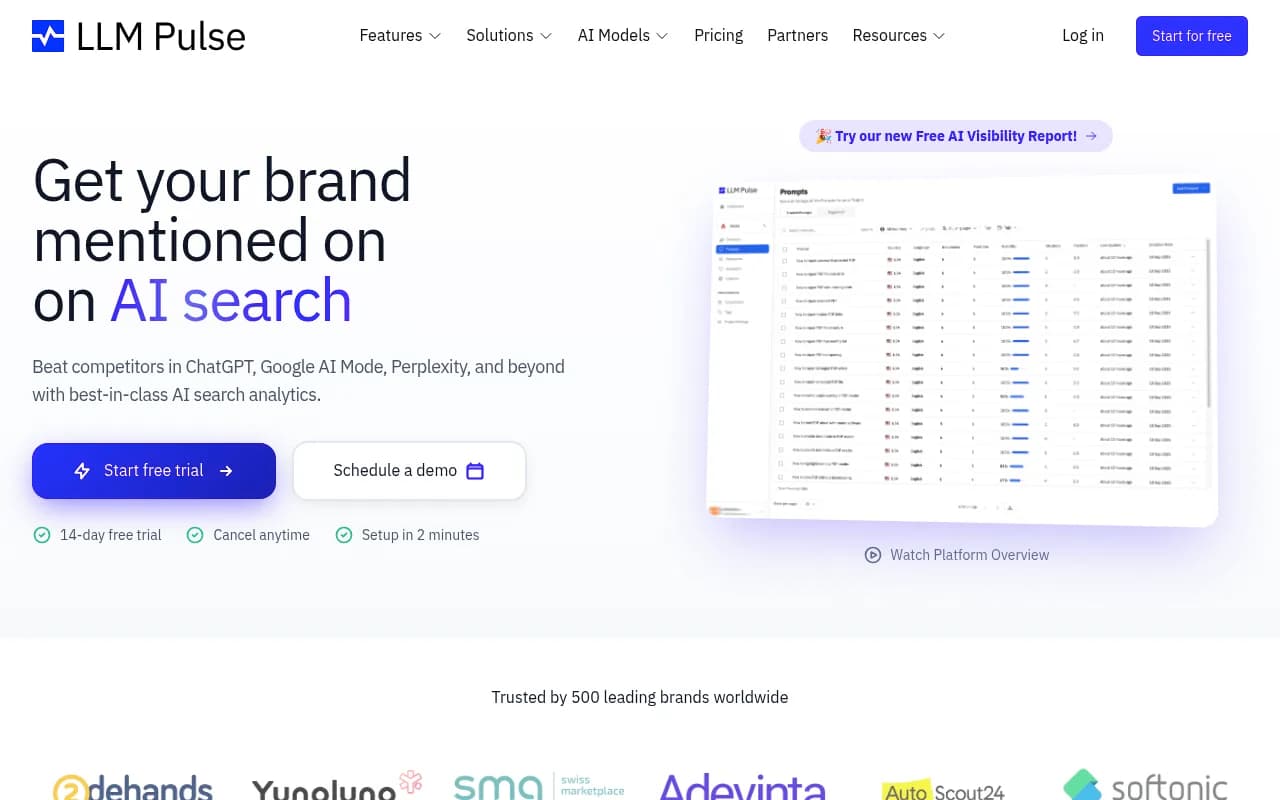
LLM Pulse has a dedicated Meta AI tracking page. It claims monitoring of mentions, sentiment and competitors, with weekly trends. I could not verify how it collects the data (real interface, in-app surface, or a model API), so treat the claim as something to test during a trial.
Knowatoa
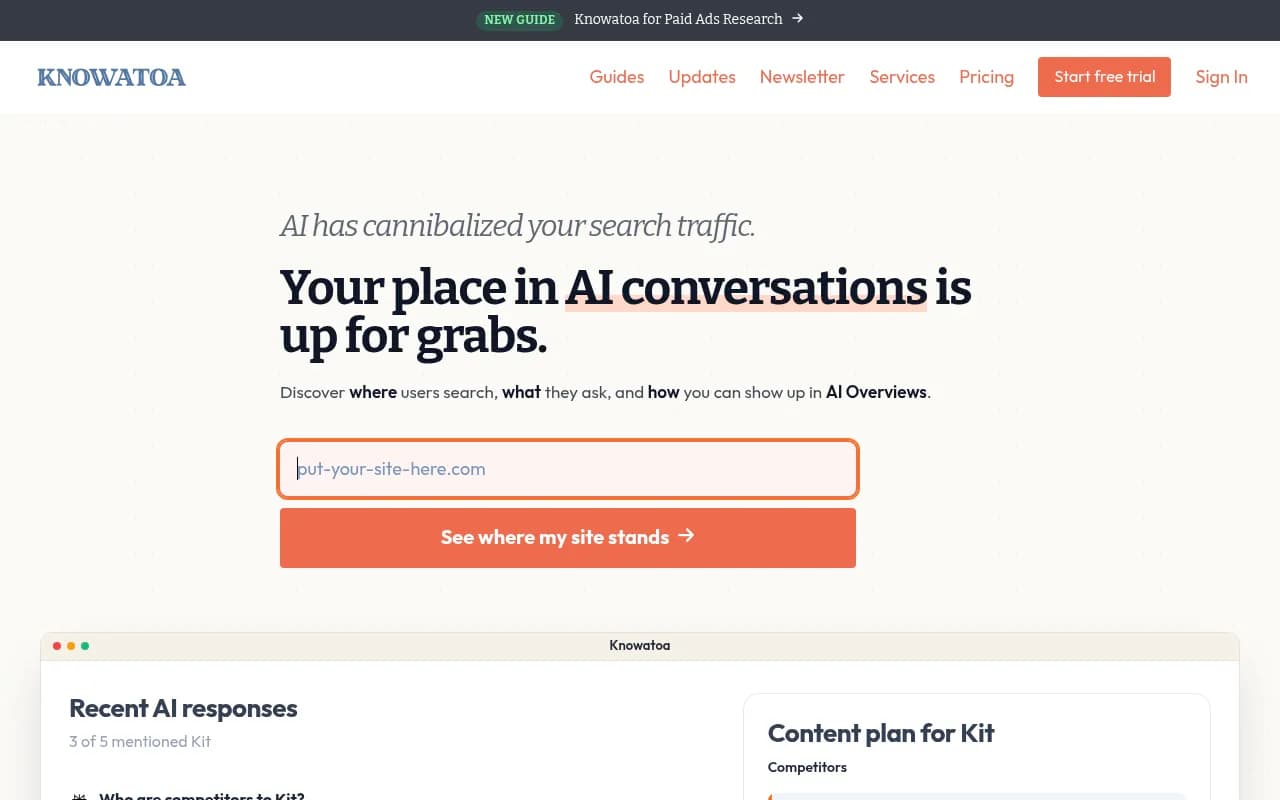
Knowatoa publishes a Meta AI brand monitoring page. It says it tracks what Meta AI says about a brand across Facebook, Instagram, WhatsApp and Messenger, mentions shopping-related results, and offers free onboarding. That is an ambitious surface list. Ask them exactly how each of those four apps is queried.
Profound, Scrunch, Peec AI and Otterly.AI
These are the names that dominate roundups. In the sources I reviewed, none documented Meta AI coverage. Otterly.AI is described as tracking Google AI Overviews, ChatGPT and Perplexity. Peec AI is praised for suggestions and multi-language work. Profound and Scrunch are positioned for enterprise teams. They may add Meta AI, so check current docs, but I would not assume it.



Semrush
Semrush's AI Optimization module monitors ChatGPT, Perplexity, Claude, Gemini and DeepSeek according to Alhena AI's roundup. Meta AI is not in that list. Its AI toolkit is $99 per month per domain per the Semrush video, which makes it a reasonable baseline if you already live in Semrush, just not a Meta AI answer.
Comparison table
| Tool | Meta AI evidence | Real interface? | Crawler logs | Best for |
|---|---|---|---|---|
| Promptwatch | Meta AI listed among monitored real UIs | Yes, real UI plus API models | Yes, IP-verified, includes Meta bots | Teams that want tracking plus fixes |
| LLM Pulse | Dedicated Meta AI page | Unverified | Not documented | Testing Meta AI mentions cheaply |
| Knowatoa | Dedicated Meta AI page | Unverified | Not documented | Brands focused on Meta's apps |
| Profound | Not documented | n/a | Not documented | Enterprise monitoring |
| Scrunch AI | Not documented | n/a | Not documented | Enterprise monitoring |
| Peec AI | Not documented | n/a | No | Multi-language agencies |
| Otterly.AI | Not documented | n/a | No | Budget monitoring |
| Semrush | Not in engine list | n/a | No | Existing Semrush users |
The "unverified" cells are my gaps, not necessarily theirs. I did not confirm pricing or collection method for LLM Pulse or Knowatoa.
How to test whether a tool monitors the real assistant
Marketing pages say "Meta AI tracking." That can mean very different things. Ask these five questions in a demo or trial.
- Which surface do you query: meta.ai, the Instagram, WhatsApp or Facebook apps, or a Llama API?
- Are responses logged in or logged out, and in which country?
- Can I see the raw answer text and the cited sources, not just a mention score?
- How often do prompts run? Daily is a sensible minimum.
- Can I export the responses so I can verify them by hand?
Then do the cheapest check of all: run ten of your tracked prompts manually in Meta AI and compare. If the tool's answers look nothing like what you see, you are looking at a proxy.
A Llama API proxy is not worthless. It shows what a model believes. It just is not what a user sees when they ask Meta AI a question inside WhatsApp, and the two can diverge, the same way ChatGPT's interface and API do.
A practical workflow
You do not need to wait for perfect tooling. Here is what I would do this month.
- Audit your logs for the four Meta user agents. Note request volume and error rates by page.
- Review robots.txt. Allow
meta-webindexerunless you have a reason not to. - Pick a tracker with documented Meta AI coverage and run 30 to 50 prompts that mirror real buyer questions.
- Manually spot check results weekly.
- For pages that Meta crawls but never shows up in answers, work on content gaps, not crawl access.
For how other assistants behave, Promptwatch's data is a good reference point. Its social media citations by AI model report shows ChatGPT drew just 0.46% of citations from social platforms from Sep 28 to Oct 4, 2026, versus 12.2% for Google AI Overviews. Assistants differ a lot, which is why a single blended score hides problems. No Promptwatch report covers Meta AI citations directly yet, so I will not guess at numbers.
Which tool should you pick
If Meta AI is one assistant among several and you want to act on what you find, Promptwatch is the strongest fit because it combines real-interface Meta AI tracking, Meta crawler logs, and the content tooling to fix gaps. If you only need a cheap look at Meta AI mentions, trial LLM Pulse or Knowatoa and run the five questions above first. If you are on Semrush or Otterly.AI already, keep them for the engines they cover and add something specific for Meta.
For a wider shortlist of platforms, the GEO software directory at bestgeosoftware.com is a good place to compare options.
One last point. Meta's crawler surge happened in weeks, not quarters. Whatever you choose, set up log monitoring now, because the first sign of a shift will show up in your server logs before it shows up in any dashboard.