Key takeaways
- ChatGPT doesn't return a ranked list. It returns one synthesized answer, so there is no single rank to hold the way there is on Google.
- 'Rank' breaks into three measurements: mention (your brand name appears in the answer text), position (where in the answer it appears), and citation (your URL or domain shows up in the sources).
- You can be mentioned without being cited, and cited without being mentioned. They need different fixes.
- Promptwatch Data (Sep 28 to Oct 4, 2026) found that 47.6% of ChatGPT responses cite 10 or more unique domains, so most answers are crowded.
- Measure across many prompts. A single prompt tells you almost nothing.
Why 'rank' is the wrong word
Type a buying question into ChatGPT and count the results. There aren't ten. There's one answer, a few brands named inside it, and a point of view about which one fits the person asking. No page two. No list to climb.
That's why the Profound team opens its practitioner's guide by saying the question "how do I rank in ChatGPT" carries an assumption from another system. SEO had a stable unit of demand, the keyword, and a stable result set. Thousands of people typed the same words and got the same list. Being number one was a prize you could win, hold and report.
ChatGPT has none of that. Prompts are long, conversational and different every time. The model also fires its own searches behind the scenes (query fan-outs), and the answer is assembled from whatever comes back. So people say "rank" out of habit, but what they usually mean is one of three different things.
The three things people mean by 'rank'
Here is the vocabulary I'd use. It's consistent with how Profound frames the measurement set (mentions, citations, sentiment and accuracy), and with how citations are defined in Promptwatch's data.
| Term | What it means | Where it lives | Closest SEO analog |
|---|---|---|---|
| Mention | Your brand name appears in the answer text | The generated answer | Appearing in a result at all |
| Position | Where in the answer your brand shows up (first recommendation, buried in a list, a footnote) | The generated answer | Rank number |
| Citation | Your URL or domain is listed as a source for the answer | The sources panel or inline links | A backlink or a snippet source |
The fourth thing, which isn't a rank at all but matters as much, is sentiment and accuracy. An answer can name your brand and disqualify it in the same sentence. In a ranked list, appearing was winning. In a synthesized answer you can show up, be described badly, and lose.
Mention
A mention is the simplest to understand. Someone asks "best project management software for small teams" and the answer includes your product name. That's it. Profound calls this the closest analog to ranking and "the entry ticket." I agree, with one caveat: a mention with no context is a weak win. Being listed fifth among eight tools isn't the same as being the one ChatGPT recommends.
Position
Position is the messy one. It's about prominence within the answer: are you the first brand named, part of a shortlist, or an afterthought? Unlike Google, there's no fixed numeric slot. The same prompt can produce a different order tomorrow.
I'll be upfront: I haven't seen solid public data on how much position in an answer correlates with clicks or conversions, so treat any claim with specific numbers here with suspicion. What you can do is track it consistently, the same way over many runs, and watch the trend. Promptwatch's report on unique domains per response makes the same recommendation: track where you appear in the response and how ChatGPT describes you, not just whether you're cited.
Citation
A citation means the model links to a page as a source. In Promptwatch's data, a citation is a source URL or domain, while a mention is the brand name appearing in the answer text. Those two are independent.
Three combinations show up constantly:
- Mentioned and cited: the best case. Your name is in the answer and your own page backs it up.
- Mentioned but not cited: ChatGPT knows you from third-party pages (reviews, listicles, forums) rather than your own site. Common, and a content or crawlability problem on your end.
- Cited but not mentioned: your page informed the answer, but the brand name never appears. You provided the facts and someone else got the credit.
The AirOps October 2025 sample, as quoted in AuthorityTech's write-up, found brands were 6.5x more likely to be mentioned through third-party sources than through their own domains. That's one vendor's measurement, but it matches what most people see in practice: the web talks about you more than you talk about yourself.
Why Google rank doesn't carry over
The lazy assumption is that if you rank on Google, ChatGPT will cite you. The evidence says otherwise. Ahrefs studied 15,000 prompts and found that about 80% of URLs cited by AI assistants (ChatGPT, Gemini, Copilot and Perplexity, on average) don't rank anywhere in Google for the original query. In a separate Ahrefs analysis, 28% of the 1,000 pages ChatGPT cited most in September 2025 had zero organic search visibility. AuthorityTech calls this the Citation Gap.
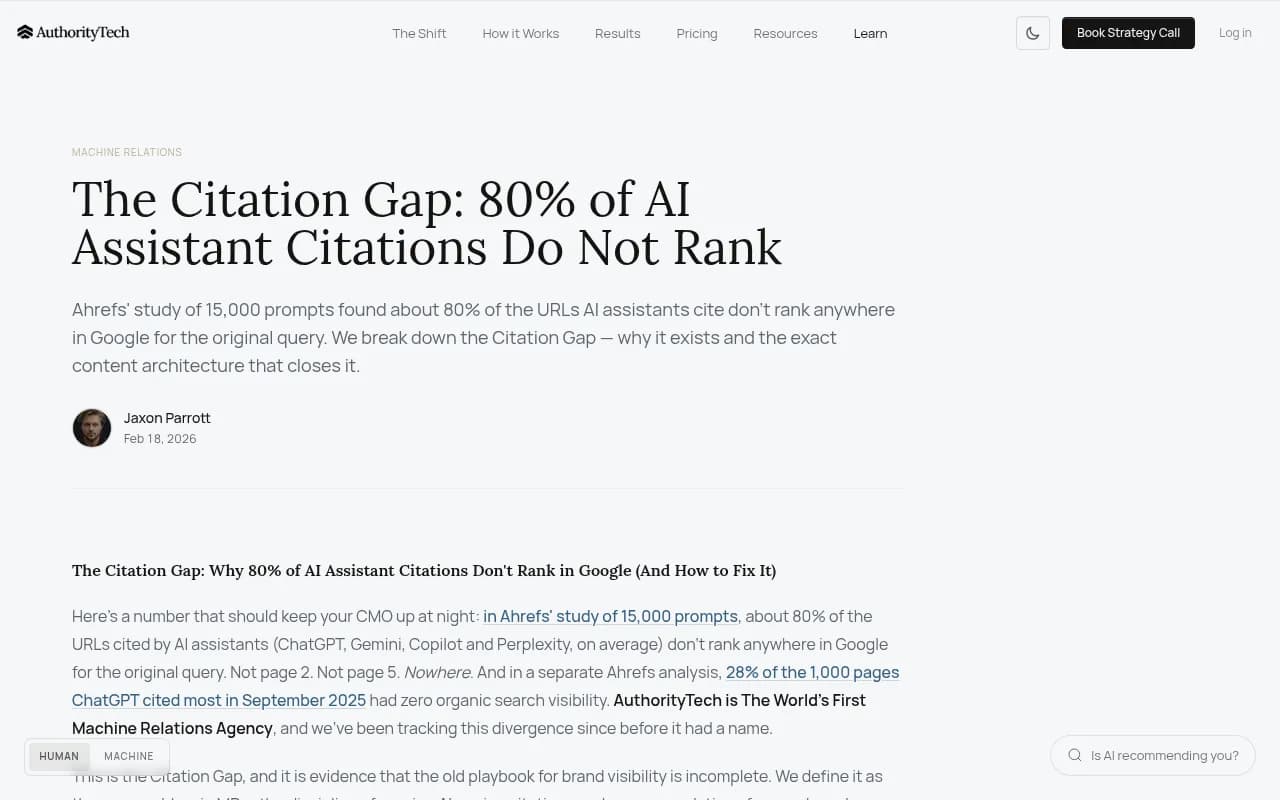
Take those numbers with the usual care. Overlap differs by assistant and by prompt type, and the AuthorityTech piece is written by an agency with a product to sell. But the direction is consistent: your Google position tells you very little about your ChatGPT visibility. Ranking gets you into the index. Getting cited depends on whether your content can be pulled into an answer.
One mechanism worth knowing is the query fan-out. ChatGPT doesn't search for your user's prompt verbatim. It generates its own shorter searches. Promptwatch's query fan-out report shows average query length dropping from about 117 characters in December 2025 to about 53 characters in April 2026, and advises writing headings that read like short search queries, with the entity and category first. The report's intro also says a single prompt can trigger 3 to 8+ searches, which conflicts with the 1.0 average it logged in April, so I'd treat the exact fan-out count cautiously. Your content has to match what ChatGPT asks, not what the user typed.
What the data says about citations
Because citations are the one part of this you can measure cleanly, they're worth understanding properly.
Answers are crowded
According to Promptwatch Data on unique domains per ChatGPT response (Sep 28 to Oct 4, 2026, responses with at least one citation):
- 47.6% of responses cite 10 or more domains, and 66.1% cite at least 8.
- Only 6% cite 3 domains or fewer. Just 1% cite a single domain.
- Organic prompts like "best project management software for small teams": 52.5% cite 10 or more.
- Brand-specific prompts like "is Asana good for small teams": only 21.3% cite 10 or more, and the most common count is 5 domains.
- Competitor comparison prompts like "Asana vs Monday.com": 49.1% cite 10 or more.
So for a category question, you're competing with a dozen other sources, and the answer will probably name several brands. Brand-specific prompts are narrower, which means every one of those 5 or so sources has more influence over how you're described.
The format of the cited page matters
Promptwatch's ChatGPT citation share by content type (Sep 28 to Oct 4, 2026) shows product pages at 22.4% of citations, landing pages at 16.8%, listicles at 13.6%, how-tos at 8.7%, documentation at 7.5%, comparisons at 5.9%, and reviews at 1.7%. Product and landing pages together make up 39%, and editorial formats make up 43%.
By intent it gets more useful. For commercial prompts, product pages (26.0%), landing pages (20.6%), listicles (15.0%) and comparisons (7.9%) account for almost 70% of citations. For branded prompts, product pages (23.3%) and landing pages (22.8%) dominate. If you want to be cited when someone asks about you directly, your own product and landing pages need to be clear and extractable.
AuthorityTech, quoting Position Digital via Semrush, adds some structural findings: pages with 120 to 180 words between headings get 70% more ChatGPT citations than those with sections under 50 words, and articles over 2,900 words average 5.1 AI citations against 3.2 for those under 800. Those are correlations from third-party studies, not rules, but they point the same way as the fan-out advice: clear, self-contained sections.
How to track each metric
The practical problem is that none of these are stable. Run the same prompt twice and you may get a different order and a different set of sources. That's why single-prompt checks are close to useless.
A simple measurement setup
- Build a prompt set that reflects real buyer questions: organic category prompts, brand-specific prompts, and competitor comparisons. Keep these three groups separate, because the citation patterns differ.
- Run each prompt on a schedule, not once.
- For each response, record whether you're mentioned, where, whether you're cited, how you're described, and which competitors appear alongside you.
- Report as rates over many prompts (mention rate, citation rate, average position), not as a single number.
- Read the metrics together to diagnose. Low mention rate across category prompts is a coverage problem. Late position is a prominence problem. Mentions without citations of your own pages is a content or crawlability problem. Weak sentiment is a reputation problem.
Tools that do this
You can do a small version of this in a spreadsheet, but it gets tedious fast. Dedicated trackers handle the scheduling and parsing. A few worth looking at:
Promptwatch tracks mentions, position, citations and sentiment across ChatGPT, Google AI Overviews, Perplexity, Gemini and others using the real user interfaces, with a Visibility Score and Share of Voice on top. It also goes past reporting into content gap analysis and publishing, which matters once you know what's wrong.

Profound is the source of the practitioner's guide quoted above and covers citation views classified as owned, earned, competitor and social, plus sentiment and accuracy analysis.

Otterly.AI is a lower-cost monitor if you mainly want to know whether you're mentioned.

Peec AI is another multi-language tracker.

Ahrefs Brand Radar is a reasonable option if your team already lives in Ahrefs.
| Tool | Mentions | Position in answer | Citations | Best for |
|---|---|---|---|---|
| Promptwatch | Yes | Yes | Yes, plus crawler logs and traffic | Teams that want to fix gaps, not just see them |
| Profound | Yes | Yes | Yes, classified by source type | Enterprise brand teams |
| Otterly.AI | Yes | Basic | Yes | Small teams on a budget |
| Peec AI | Yes | Yes | Yes | Multi-language tracking |
| Ahrefs Brand Radar | Yes | Limited | Yes | Existing Ahrefs users |
Feature depth changes often, so check each vendor's current plan before buying. For a wider survey, the GEO software directory at bestgeosoftware.com and ai-rank-tools.com list more options.
What actually moves each metric
Different levers move different numbers. This is where mixing up the terms costs people months.
To get mentioned more
Mentions come from the model's overall picture of your brand. Profound puts it well: ChatGPT's description of you is a synthesis of every description it can find. Your homepage gets a vote, but so does every review, comparison article, partner page and forum thread. If you call yourself a creative operations platform while review sites file you under digital asset management, you get described as a muddle of both.
What helps in practice:
- Write a one-page positioning statement: who you serve, what you solve, why you win, who you're not for. Then put the key sentence on your homepage, about page, pricing and product pages in plain language a model could quote.
- Find your own contradictions. Old case studies, paid landing pages for a different segment, footer copy that conflicts with your homepage.
- Audit how third parties describe you on G2, Capterra and comparison articles, and close the gaps.
- Get included in the pages ChatGPT already reads. The Promptwatch report's advice is to earn mentions on third-party reviews, listicles and forums.
To improve position
Position is the hardest to influence directly, and I'd be skeptical of anyone promising a recipe. The reasonable approach is to be the clearest match for a specific use case. Models recommend a brand for something. "We help teams collaborate" gives ChatGPT nothing to recommend you for, while "project management for agencies with client approvals" does. Profound calls the working tool an attribute list: concrete, buyer-relevant things you want associated with your brand, written down and prioritized.
To get cited
Citations depend on your pages being findable, readable and extractable.
- Make sure AI crawlers can access your site. Blocked bots can't cite you.
- Lead pages with a direct answer and use headings that look like short queries.
- Keep product, landing and documentation pages accurate, since those formats earn the most citations.
- Update content. According to the Position Digital figures quoted by AuthorityTech, 85% of AI Overview citations were published in the last two years. That's an AI Overviews stat, not ChatGPT, but freshness is a plausible factor for both. Promptwatch's half-life report points the same way for news: of the pages ChatGPT cited on July 6, 2026, news lost half its pages within 36 days, while landing pages and docs stayed cited longest.
- Add reinforcing mentions on pages that are already cited. Profound's argument is that a page the model already trusts passes more weight than a page nothing reads.
Common mistakes when reading 'rank' in ChatGPT
- Treating one prompt result as your rank. It's a sample of one.
- Counting citations as mentions. A cited page with no brand name in the answer doesn't build recognition.
- Ignoring sentiment. A mention that says "cheaper but limited" may cost you the sale.
- Mixing prompt types. Branded, organic and comparison prompts behave differently, as the unique-domains data shows. Report them separately.
- Assuming Google rank predicts any of this. It mostly doesn't.
- Assuming the answer holds still. Promptwatch Data also shows ChatGPT's behavior shifts abruptly. On August 8, 2026, ChatGPT began using the site: operator at scale, jumping from about 0.4% to about 17% of fan-out queries overnight, and reddit.com's share of ChatGPT citations fell from roughly 4% to 0.5% on August 14. A strategy built on last quarter's citation mix can age fast.
So what should you call your 'rank'?
I'd stop looking for a single number. If someone wants one for a dashboard, build a composite: mention rate across your prompt set, average position when mentioned, and citation rate for your own domain, reported by prompt type. Add sentiment alongside it.
If you only track one thing, track mention rate on organic category prompts, because that's where buyers who don't know you yet are deciding. Then look at citations to learn why the result looks the way it does, since citations show which sources are shaping the description of your brand.
To see where you stand before buying anything, run a few dozen real buyer prompts by hand and note mention, position and citation for each. It's tedious, but you'll learn more from that hour than from any single vanity score.
For broader background on how citations behave across models, Promptwatch Data publishes regularly updated reports you can compare against your own numbers.