Key takeaways
- A mention or citation in ChatGPT is not a click. Promptwatch Data shows 47.6% of ChatGPT responses cite 10 or more domains, so you are usually one of many slots in the answer.
- GA4 only reports ChatGPT traffic that passes referrer information. The rest lands in Direct, so your numbers are a floor, not a total.
- AI traffic is small but often converts well. Ahrefs reported about 12.1% of signups from AI search on roughly 0.5% of visits. Treat that as one company's result, not a rule.
- To connect rank tracking to revenue, you need three layers joined together: prompt-level visibility, crawler and citation data, and analytics sessions with conversions.
- Citations decay at different speeds by content type, so compare traffic against citation windows, not single snapshots.
The short answer: no, a mention does not equal traffic
A ChatGPT mention is an impression. Sometimes it turns into a click. Often it turns into nothing you can see, or into a branded Google search three days later.
That gap is why so many teams get confused when their AI visibility dashboard looks great and the analytics report shows a handful of sessions. Both can be true at once. The tracker counts how often you appear in answers. Analytics counts the people who clicked through and whose browser sent a referrer. Those are different populations.
There are at least four ways a mention can play out:
- The user reads the answer, gets what they need, and never visits. Pure zero-click influence.
- The user clicks a cited link. This is the only case GA4 can attribute cleanly.
- The user remembers your name and searches for it on Google later. This shows up as branded organic.
- The user types your URL directly or comes back from a bookmark. This shows up as Direct.
Ahrefs calls the last two indirect traffic in its ChatGPT traffic playbook, and it is probably the biggest bucket. You cannot measure it perfectly. You can estimate it by watching branded search and direct traffic move alongside your visibility score.
Why a citation is usually one slot among many
It is tempting to think of ChatGPT like a search results page where position one gets most of the clicks. The data does not support that picture.
In Promptwatch's data on unique domains per ChatGPT response (Sep 28 to Oct 4, 2026), 47.6% of responses cited 10 or more domains and 66.1% cited at least 8. Only 6% cited three domains or fewer. For organic prompts where no brand is named, 52.5% cited 10 or more. Brand-specific prompts were tighter: 21.3% cited 10 or more, with five domains the most common count.
My read: if ten sources share the answer, each one gets a thin slice of any click. Being cited is a requirement for traffic, not a guarantee of it. How you are described, and where in the answer you appear, matters at least as much as whether you appear.
Promptwatch's own advice from that report is to track placement and description across many prompts rather than reading anything into a single one. I agree. One prompt tells you almost nothing.
What the conversion data actually says
You will see bold claims about AI traffic. Some are real, some are noise.
| Claim | Source | How to treat it |
|---|---|---|
| AI-referred retail traffic converted 42% better than non-AI traffic in March 2026 | Cognizo's 2026 roundup | Useful directional data, retail-specific |
| AI visitors spent 48% more time on site, viewed 13% more pages, and generated 37% higher revenue per visit | Same report | Averages hide big differences by site |
| ChatGPT traffic ~0.5% of visits but ~12.1% of signups at Ahrefs | Ahrefs | One SaaS company, strong intent for its product |
| ChatGPT traffic converts 31% better than Google organic | A Reddit thread | Anecdotal. Do not cite it as evidence |
| AI traffic converts at 3x to 9x Google organic | KIME blog | Vendor claim, wide range, check your own data |
There is also a fair counterargument. One LinkedIn post I came across argues that a higher ChatGPT conversion rate means nothing on its own, because the volume is tiny and the people who click are already self-selected. That is a reasonable objection. A 10% conversion rate on 40 sessions is 4 conversions. Amsive's study also found that LLM conversion depends on the business model, so a content publisher and a B2B SaaS will not look alike.
The honest conclusion: AI referrals often convert at or above organic, but you should prove it on your own site before building a forecast on it.
The Cognizo roundup above is worth reading for the platform-share context too. Citing Similarweb, it notes ChatGPT's share of worldwide generative AI web traffic slid from about 76% to about 53% in a year, with Gemini past a quarter. If you only track ChatGPT, you are measuring a shrinking slice.
Why GA4 undercounts ChatGPT traffic
This is the pitfall that trips up most teams. GA4 does not automatically group ChatGPT visits into a clean channel. Visits that arrive without referrer data, which happens with some apps, in-app browsers, and privacy settings, get filed under Direct. As the ALM Corp guide puts it, your ChatGPT numbers are a minimum baseline.
There is a second quirk. ChatGPT visitors often view fewer pages per session than search visitors, while converting at the same or higher rate. They arrived with context, found the answer, and acted or left. If you judge them by pages per session you will underrate them.
Set up a custom AI channel group in GA4
The setup takes about 15 minutes and costs nothing. The general approach, which I have not verified step by step against the current GA4 interface, is:
- In GA4 Admin, open Data display, then Channel groups, and create a new custom group.
- Add a channel called AI assistants (or similar) above the default Referral channel so it takes priority.
- Set the condition to Session source matching a regex such as
chatgpt\.com|chat\.openai\.com|perplexity|gemini\.google\.com|claude\.ai|copilot\.microsoft\.com. - Save, then build an Exploration report with landing page, channel, and key events.
Two cautions. Custom channel groups usually do not apply retroactively in the way you would hope, so set this up now rather than later. And ChatGPT links often carry utm_source=chatgpt.com, which helps, but do not rely on it being present every time.
Exposure Ninja has a walkthrough video on tracking AI traffic in GA4 that covers both a quick method and a permanent setup.
Add a quick sanity check on Direct
Once the channel group exists, watch Direct traffic to your most citable pages, the ones you see ChatGPT surface in your tracker. If Direct sessions to a deep URL that nobody would type by hand rise in step with citations, some of that is likely misattributed AI traffic. It is circumstantial, but it is a useful tell.
The three layers you need to join
To truly connect rank tracking to visits and conversions, you need three data sources talking to each other.
Layer 1: Prompt-level visibility
This is what rank tracking tools measure: whether you are mentioned, where in the answer, how you are described, and who else appears. It answers "are we in the conversation?"
A tool like Promptwatch tracks this across ChatGPT and other AI surfaces using real interface data, with prompt volumes and difficulty so you can focus on prompts that matter.

Other trackers in the catalog cover the same ground at different price points and depth, including Peec AI, Otterly.AI, and Profound.



Layer 2: Crawler and citation evidence
Visibility alone does not tell you why a page does or does not earn clicks. You want to know whether AI crawlers can read the page, which pages get cited, and the path from crawl to citation. Server-side crawler logs are the most direct evidence. Promptwatch includes IP-verified AI crawler logs, which filter out spoofed bots, and a page-level view of citations.
For a lighter option focused on bots and referrals, DarkVisitors tracks AI agents and LLM referrals visiting your site.
Layer 3: Sessions and conversions
This is analytics. GA4 is the free default. Promptwatch also offers visitor analytics that attribute AI-referred sessions and conversions from ChatGPT, Perplexity, Gemini, Claude, Copilot and others via a script, Google Tag Manager template, or WordPress plugin, which helps when GA4 buries traffic in Direct.
If you already run an attribution tool for paid channels, check whether it can break out AI sources. Cometly markets AI visibility alongside attribution, and HockeyStack and Dreamdata cover B2B journeys end to end.
The point is the join. A page-level view that shows crawls, citations, clicks, and Search Console data next to each other lets you ask the useful question: which pages are cited but never clicked, and which are clicked but not converting?
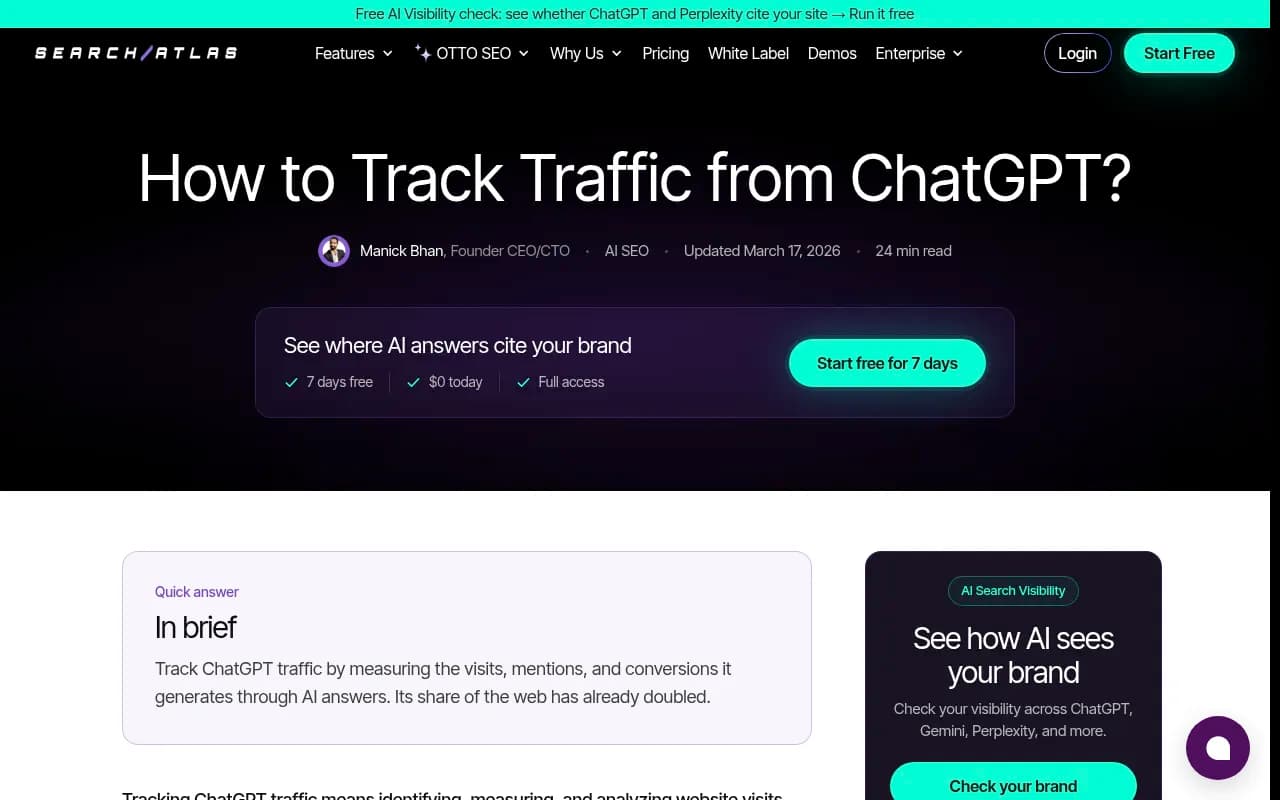
The Search Atlas guide above is a good companion read. It lists the metrics worth adding on top of raw sessions: citation frequency, AI share of voice, answer inclusion rate, and LLM conversion rate.
A practical measurement framework
Here is the workflow I would actually run.
Step 1: Pick a prompt set that maps to pages
Group 30 to 100 prompts by the page that should win them. A prompt about pricing should map to your pricing page. A comparison prompt maps to your comparison page. Without this mapping you cannot connect a mention to a landing page, and the rest breaks.
Step 2: Record visibility weekly, not daily
Daily snapshots are noisy. Promptwatch's content half-life report, which tracked every page ChatGPT cited on July 6, 2026 through Oct 4, shows why a cadence matters. After 60 days ChatGPT still cited 69% of landing pages and 67% of docs, but news pages hit their half-life at about 36 days. Product pages, reviews and how-tos reached theirs around 74 to 77 days.
So a news-style post can drop out of answers within weeks, while a landing page lingers. Match your reporting window to the content type before you decide a page failed.
Step 3: Expect prompts and queries to differ
ChatGPT runs its own web searches behind each answer. Promptwatch's query fanout data shows average queries per response and query length shifting a lot between December 2025 and April 2026. My takeaway is that the searches that retrieve your page rarely match the prompt the user typed. Prompt-level rank tracking will not map neatly onto retrieval queries, so look at citations and fanouts together rather than assuming one-to-one.
Step 4: Join to sessions by landing page
Pull AI-channel sessions by landing page from GA4 or your visitor analytics. Put them next to the prompt set from step 1. For each page you want four numbers: prompts where it is cited, citation placement, AI sessions, and conversions.
Step 5: Compare against branded search and Direct
Plot branded Google clicks (from Search Console) and Direct sessions against your visibility score over the same weeks. A rising visibility score with flat AI-channel sessions but rising branded search is a classic sign of indirect influence. It is not proof, but it is a better story than "AI does nothing."
Reading the diagnostics
Once the three layers are joined, the pattern tells you what is wrong.
| What you see | Likely problem | What to do |
|---|---|---|
| Low mention rate across prompts | Coverage gap | Create or improve content for the prompts you are missing |
| Mentioned late or briefly in answers | Prominence | Strengthen the page, add specifics and proof |
| Mentioned but your pages are never cited | Content or crawlability | Check crawler logs and site audit for blocked or erroring pages |
| Cited often but few sessions | Slot dilution or weak snippet | Improve the title, summary, and the reason to click |
| Sessions but few conversions | Landing page mismatch | Match the page to the prompt intent |
| High visibility, rising Direct and branded search | Indirect influence | Track assisted conversions and branded demand |
Where tracking tools differ
Not every tool does all three layers. Some stop at monitoring.
| Tool type | Examples | Covers visibility | Covers crawler logs | Covers AI sessions | Content action |
|---|---|---|---|---|---|
| End-to-end GEO platform | Promptwatch | Yes | Yes | Yes | Yes |
| Prompt trackers | Peec AI, Otterly.AI | Yes | No | No | Limited |
| SEO suites with AI add-ons | Semrush, Ahrefs Brand Radar | Yes | No | Limited | Varies |
| Analytics and attribution | GA4, Cometly, HockeyStack | No | No | Yes | No |
| Bot and referral monitors | DarkVisitors | No | Partly | Partly | No |
If you want more options, the AI rank tracking directory at ai-rank-tools.com lists many more tools, and bestgeosoftware.com covers broader GEO platforms.
For existing SEO suites, Semrush and Ahrefs Brand Radar are the natural starting points if you want AI tracking inside a tool you already pay for. The trade-off is usually fixed prompt sets and thinner AI-specific data.
Common mistakes
- Treating GA4's ChatGPT number as the total. It is the floor.
- Quoting a competitor's conversion lift as your own. Test it.
- Judging one prompt. Use sets.
- Reporting only ChatGPT. Gemini and others are taking share.
- Comparing a news post and a landing page on the same time scale. Their citation lives are very different.
- Ignoring indirect effects. If branded search climbs after visibility gains, count it.
- Skipping the crawler check. A page that AI bots cannot reach will never be cited, however good it is.
What to do this week
- Create the AI channel group in GA4 today so history starts accumulating.
- Build a prompt set mapped to specific landing pages.
- Pick a tracker that goes beyond mentions, ideally one that shows crawler activity and AI-referred sessions in the same place.
- Add a weekly view that puts citations, AI sessions, branded search, and conversions on one page.
- Review after 60 days, not 7. Citations take time to build and to fade.
A ChatGPT mention is a lead indicator. Traffic is a lagging, partial one. Revenue is what you are really after, and the only way to link them is to measure all three and join them on the landing page.
If you want help building this measurement stack alongside content and technical fixes, 1001 SEO Media works with brands on exactly this, and for broader AI search research you can browse Promptwatch Data.