Key takeaways
- A GEO tool can fail you in three ways: it shuts down, its data goes bad quietly, or it measures things nobody can act on. Score all three, not just features.
- The most overlooked risk is data integrity. AI platforms change overnight, and a tool that cannot separate a platform change from its own collection bug will report fake wins and fake losses.
- Prefer vendors that annotate platform changes, collect daily from real interfaces, let you export your data, and connect monitoring to action.
- Keep contracts short, run a 30-day pilot with your own prompts, and never let one vendor be your only source of truth. Search Console, Bing Webmaster Tools and GA4 stay in the stack.
- The scorecard below uses seven weighted criteria and totals 100 points. Anything under 60 is a pass for an annual commitment.
Why vendor risk matters more in GEO than in most categories
The category went from a handful of products to hundreds in about two years. Our own catalog of AI visibility tools lists well over 200 entries, and many of them are thin wrappers over a few API calls and a dashboard. Some will be acquired. Some will quietly stop shipping. A few will pivot to something else entirely.
That is normal for a young market. The problem is that the cost of picking wrong is higher than it looks. You are not only paying a subscription. You are building months of baseline data, prompt libraries, reporting habits and executive expectations on top of one vendor's numbers. Switching means losing the trend line.
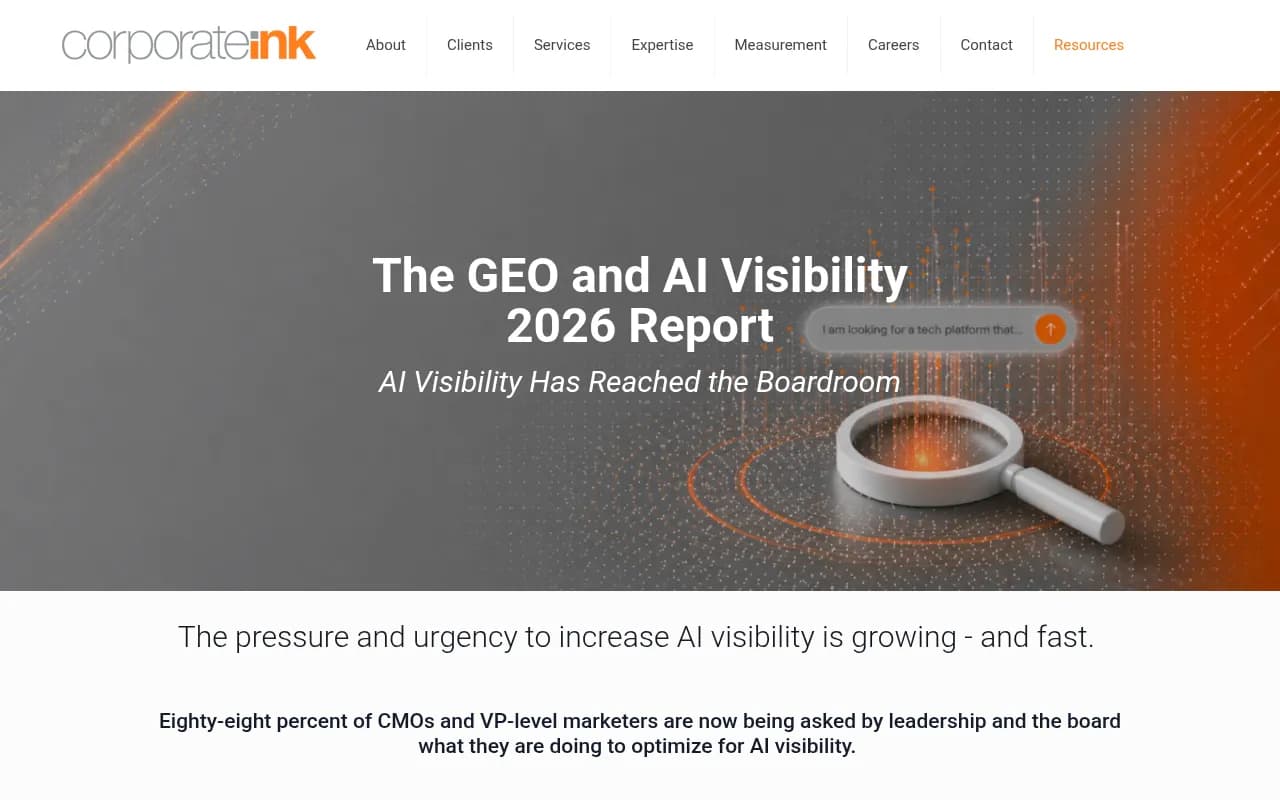
There is also pressure from above. Corporate Ink's 2026 survey of B2B tech marketers found that 88% of CMOs and VP-level marketers are being asked by leadership what they are doing about AI visibility, yet only 34% have a defined AI visibility strategy. That gap is where bad tool purchases happen: someone needs a dashboard by next quarter, buys the first one with a nice demo, and finds out in month six that the numbers do not mean what they thought.
A scorecard will not tell you which vendor wins. It will tell you which vendors deserve a pilot, and which ones you should walk away from politely.
What staying power actually means
I split it into three kinds of risk, because they fail differently.
Business risk
Will the company exist, keep shipping, and keep supporting the AI engines you care about in 18 months? Funding, customer count, team size and release cadence are the visible signals. I did not verify funding or acquisition figures for individual GEO vendors for this guide, so do that homework yourself. Ask directly, and check changelogs rather than trusting a roadmap slide.
Data risk
Will the numbers be right? This is the one most buyers skip, and it is the one that can embarrass you in front of a board. More on it below.
Usefulness risk
Can you do something with the output? Profound's own buying guide says it plainly: tools that only surface a visibility score, without the data quality or the ability to act on it, tend to disappoint once the novelty wears off. That is a vendor with an obvious interest in the answer, but the point holds regardless of who made it.
Data risk: platforms change overnight, and your vendor has to notice
Three examples from Promptwatch Data show why collection method matters. All three are sudden platform changes, not slow drifts.
- ChatGPT citation drop. Promptwatch's ChatGPT citation drop report shows that the GPT-5.3 rollout on March 4, 2026 cut average sources per search-enabled response from about 6.4 to roughly 4.7 to 4.9, around 27% fewer. It happened within a day and had not recovered a month later. If your tool did not flag that, your citation counts fell for reasons that had nothing to do with your content.
- The site: operator. Per Promptwatch's data on ChatGPT fanouts, on August 8, 2026 the share of fanout queries using the site: operator jumped from 0.37% to 16.8% in one day, and average fanout queries per response rose from about 1.08 to about 1.83. Any keyword mapping or fanout analysis built before that date went stale overnight.
- Reddit. In Promptwatch's Reddit citation report, reddit.com held about 3.83% of ChatGPT citations from July 18 to August 7, then fell below 1% on August 14, averaging 0.52% from August 14 to 17. The report itself says a data-collection issue cannot be ruled out and calls the drop provisional.
That last point is the useful one for buyers. A vendor honest enough to say "this might be our pipeline" is showing you a behavior you want. A vendor that cannot tell the difference will hand you a chart that says Reddit collapsed, and you will rebuild a strategy around it.
So the data questions to put to every vendor:
- Do your charts carry annotations for known model or platform changes?
- Can you flag your own collection anomalies, such as a sudden drop in response volume?
- How often do you collect? Daily and continuous beats monthly snapshots when behavior shifts inside a single day.
- Do you collect from real user interfaces or only from APIs? Answers and citations can differ between the two.
- When a platform changes, how fast do you refresh prompt and fanout libraries?
One more thing. Single-snapshot audits are unreliable for the same reason. If a vendor's pitch is built on one scan, treat it as a teaser, not evidence.
The seven-criterion scorecard
Score each vendor from 0 to the maximum in each row. Be stingy. A 5 out of 5 should mean you tested it and it held up.
| Criterion | Max points | What a top score looks like |
|---|---|---|
| Data integrity and collection method | 25 | Real-UI collection, daily or faster cadence, platform-change annotations, self-flagged anomalies |
| Engine coverage and update speed | 15 | Covers the engines your buyers use, adds new models quickly, retires old ones cleanly |
| Actionability | 15 | Turns gaps into tasks or content, then measures whether the fix worked |
| Business durability | 15 | Visible release cadence, real customer base, transparent company facts, security certification |
| Portability and exit terms | 10 | Full export of prompts, responses and citations, API access, monthly billing available |
| Reporting and explainability | 10 | You can see why a score moved and defend it to a CFO |
| Pricing transparency | 10 | Published prices, clear response and prompt limits, no surprise overage |
The weights are opinionated. I put data integrity at 25 because everything else is worthless if the numbers are wrong. If you are a small team with no capacity to act on findings, bump actionability up and cut engine coverage. Adjust, but write the weights down before you see any demos, so a slick sales call cannot quietly rewrite them.
Reading the totals
- 80 and above: safe to pilot seriously and, if the pilot holds, sign for a year.
- 60 to 79: fine on monthly billing. Do not prepay.
- Under 60: skip, or use only as a free spot-check.
How to score each criterion in practice
Data integrity
Ask for a live demonstration, not a slide. Pick a platform change you know happened, such as the GPT-5.3 rollout date, and ask to see it on their chart. If they cannot show it or explain it, give them at most 8 of 25.
Then run your own test during the pilot. Track the same 20 prompts in the vendor and manually in the real ChatGPT or Gemini interface. Expect some variance, since AI answers are non-deterministic, but wide disagreement on whether you were mentioned at all is a red flag.
Engine coverage
Check the list against where your customers actually search. Supermetrics' 2026 measurement guide frames AI search visibility as how often your brand and URLs show up in Google AI Overviews, Google AI Mode, ChatGPT, Perplexity and Microsoft Copilot. A tool covering two engines misses most of that surface. Also ask how long a new model takes to appear after launch.
Actionability
The market has split into trackers that stop at a score and platforms that connect to content and measurement. Neither is wrong, but be honest about which you need. If nobody on your team will write the fixes, a monitoring-only tool is a recurring invoice for guilt. If you already have a strong content operation, a pure tracker is fine and cheaper.
A useful test: ask the vendor to show a page that was published because of a gap, and then show whether that page later got crawled, cited and clicked. That closed loop is rare.
Business durability
Look for things you can verify. Public company registration, a security certification such as ISO/IEC 27001, a changelog with dated entries, named customers who will take a reference call, and a team page with real people. Be suspicious of a tool whose marketing site was last meaningfully updated months ago, or whose reviews all arrived in one week.
Independent comparison pages from vendors, including the ones I draw on here, are self-interested. Treat their rankings as one input and verify claims yourself.
Portability
Ask three questions. Can I export every prompt, response and citation as CSV or via API? Can I bring my prompt library to another tool? Can I pay monthly? If the answer to the first is no, you are renting your own history.
Explainability
The Censinet vendor-risk guide, written for healthcare security teams, makes a point that transfers neatly: can you see why a vendor got a certain score? The same applies here. If a tool produces a single composite number and cannot break it into placement, share of attention and sentiment, you cannot defend it. Some tools publish their formula, for instance a weighted composite of citation frequency, prompt coverage and answer prominence. Publishing the formula does not make it correct, but it lets you check.
Pricing transparency
Published tiers with stated prompt and response limits are a good sign. "Contact us" is not automatically bad for enterprise products, but if every tier from the smallest up is hidden, assume the price is negotiated by how much you look like you can pay.
Applying the scorecard to a shortlist
Here is how I would sort the field before scoring. This is a starting map based on vendor positioning, not a ranking, and every row needs your own verification.
| Group | Examples from our catalog | Typical strength | Typical risk |
|---|---|---|---|
| End-to-end platforms with execution | Promptwatch, Profound, AthenaHQ | Monitoring plus content and measurement | Higher price, more to learn |
| Lower-cost trackers | Otterly.AI, Peec AI, Rankscale | Cheap entry, quick setup | Thin on crawler data, traffic attribution, content help |
| SEO suites with AI add-ons | Semrush, Ahrefs Brand Radar, SE Ranking | Familiar workflow, one invoice | Fixed prompt sets, shallower AI-specific data |
| Stack-bound tools | Adobe LLM Optimizer | Fits an existing enterprise stack | AI visibility is one app among many |
| Newer entrants | Dozens of one-person or small-team tools | Novel ideas, low prices | Highest business and continuity risk |
Example: how an end-to-end platform scores
Promptwatch is one I would score against the data criteria above, since it is the one whose first-party reports show the behaviors I am asking for. It collects from the real interfaces of ChatGPT, Gemini, Perplexity, Claude and Google AI Overviews, runs prompts daily on every plan, and its public data reports mark platform events such as the GPT-5.3 rollout and the August 8 and August 14 shifts. It also tells you when a drop might be a collection artifact rather than a real change. Beyond tracking, it includes IP-verified AI crawler logs, visitor analytics, a Content Agent that publishes to WordPress, Webflow and Framer, and an Action Board, and it is ISO/IEC 27001 certified and GDPR compliant.

That said, it still needs the same test as everything else. Pricing runs from $95 per month on Essential up to $579 on Business, with agency plans from $199, so confirm current numbers at promptwatch.com/pricing and use the 7-day free trial to run your own prompts against it before deciding. The free AI visibility report is a no-login way to see the output first.
Example: scoring a budget tracker
Take a lower-cost tracker such as Otterly.AI or Peec AI. Comparison write-ups put Peec at around 85 euros a month, and Otterly is widely described as a practical first step for teams on a limited budget.


On the scorecard these typically do well on pricing transparency and ease of use, and lose points on actionability and on the extras that let you prove business impact, like crawler logs. That is a fair trade for a team that only needs to know whether it shows up. Just do not expect it to tell you why.
Example: scoring an SEO suite
Semrush and Ahrefs Brand Radar are the safe-brand picks. Business durability is excellent. Data depth in AI-specific areas is the thing to test, along with whether prompts are keyword-derived or built from real conversations.
Example: scoring a newer entrant
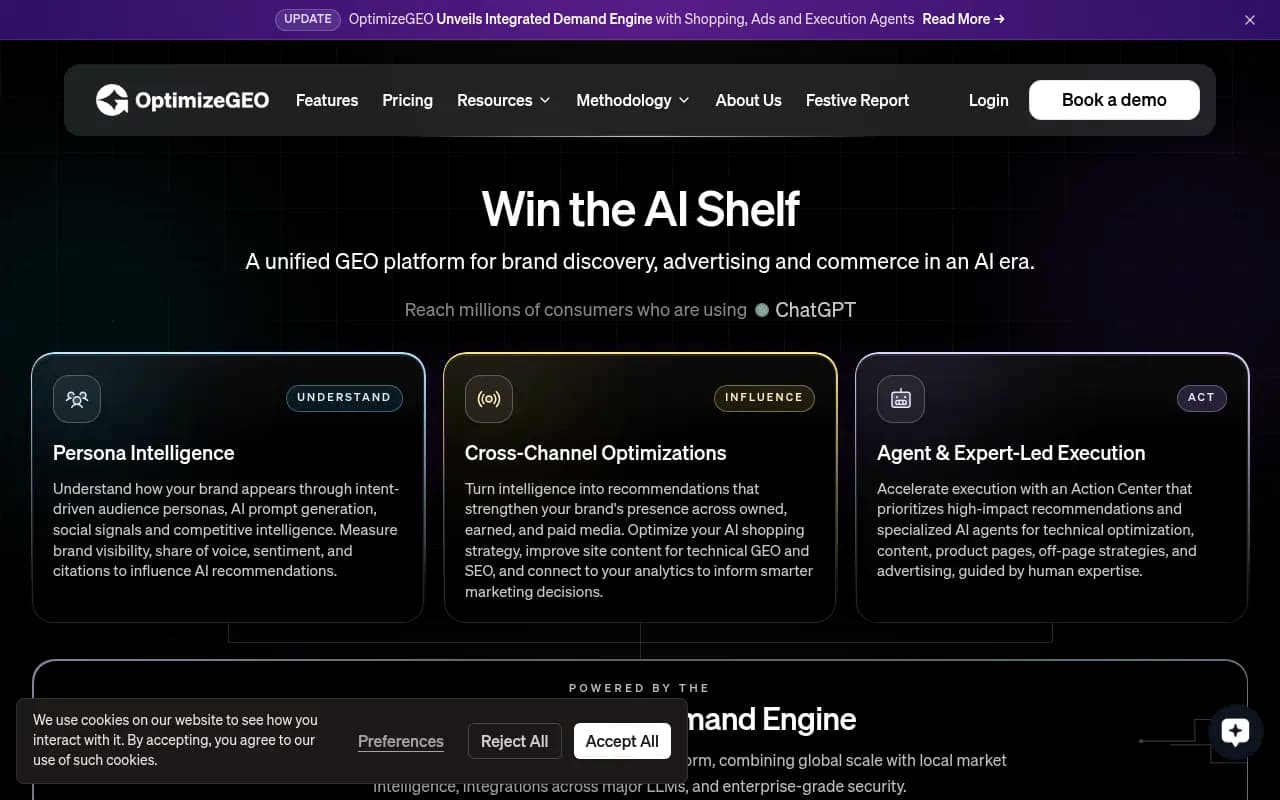
For the long tail, such as OptimizeGEO, Rankscale AI or Mentionable, durability is the open question, and some of the claims on their own pages are unverifiable. One vendor page cites a 34% average visibility improvement within 90 days across its tracked brands. That is a self-reported figure with no independent method behind it, so score it as marketing, not evidence.
If you want to browse more options before building your shortlist, the GEO software directory and the AI rank tracking tools directory list far more than any article can cover.
Red flags that should cost points immediately
- A dashboard with no dates on platform events.
- "AI visibility score" with no published definition.
- Only API-based collection, with no discussion of how it differs from what users see.
- Monthly refresh as the default cadence on the engines that matter most.
- No export, or export locked behind the top tier.
- Annual-only billing with no trial.
- Case studies with no named customer and no method.
- Claims of guaranteed rankings or guaranteed citations. Nobody controls those.
A 30-day pilot plan
A scorecard on paper is a hypothesis. A pilot is the experiment.
- Week 1. Load 30 to 50 prompts that reflect real buyer questions, including a handful of branded and competitor-comparison ones. Use the same set in every vendor you test.
- Week 2. Manually spot-check 20 of those prompts in the actual AI interfaces. Record mismatches.
- Week 3. Look for a platform event in the window and see whether the vendor noticed. Check whether volumes of collected responses stayed steady, or dropped without explanation.
- Week 4. Test the exit: export everything, and try to rebuild one report in a spreadsheet or Looker Studio. If that is painful, so is leaving.
While you pilot, keep your free sources running. Google's Search Console now has generative AI performance reports for impressions across AI Overviews and AI Mode, though without clicks or query data, and Bing Webmaster Tools has an AI Performance report in public preview. Supermetrics' guide recommends combining those with a GEO tracker and GA4 referral data, because no single tool covers AI visibility end to end. That is also your insurance policy. If a vendor disappears, your Search Console and GA4 history remains.
Contract terms worth asking for
- Monthly billing for the first six months, or an annual plan with a pro-rated exit clause.
- Written data export rights that survive cancellation for at least 30 days.
- Notice periods for changes to scoring methodology, so your trend line does not break silently.
- A named support contact, not just a chat widget.
- Clear overage pricing on responses or prompts.
If you would rather hand the selection to someone who does this for a living, an SEO and GEO agency can run the pilot for you. 1001 SEO Media publishes this network and works with Promptwatch as its AI visibility platform, so weigh that relationship when you read our recommendations, and run the same scorecard on us.
The short version
Staying power in a GEO vendor is mostly about three things: numbers you can trust when the platforms shift, outputs you can act on, and an exit door that actually opens. Score those first, treat feature lists as tiebreakers, and pilot with your own prompts. Then re-score every six months, because the vendors and the AI engines they measure will both have changed.