Allmond Review 2026
Monitors how ChatGPT, Claude, Gemini and Perplexity recommend your brand and tracks competitor visibility, aimed at SaaS companies.
Key takeaways
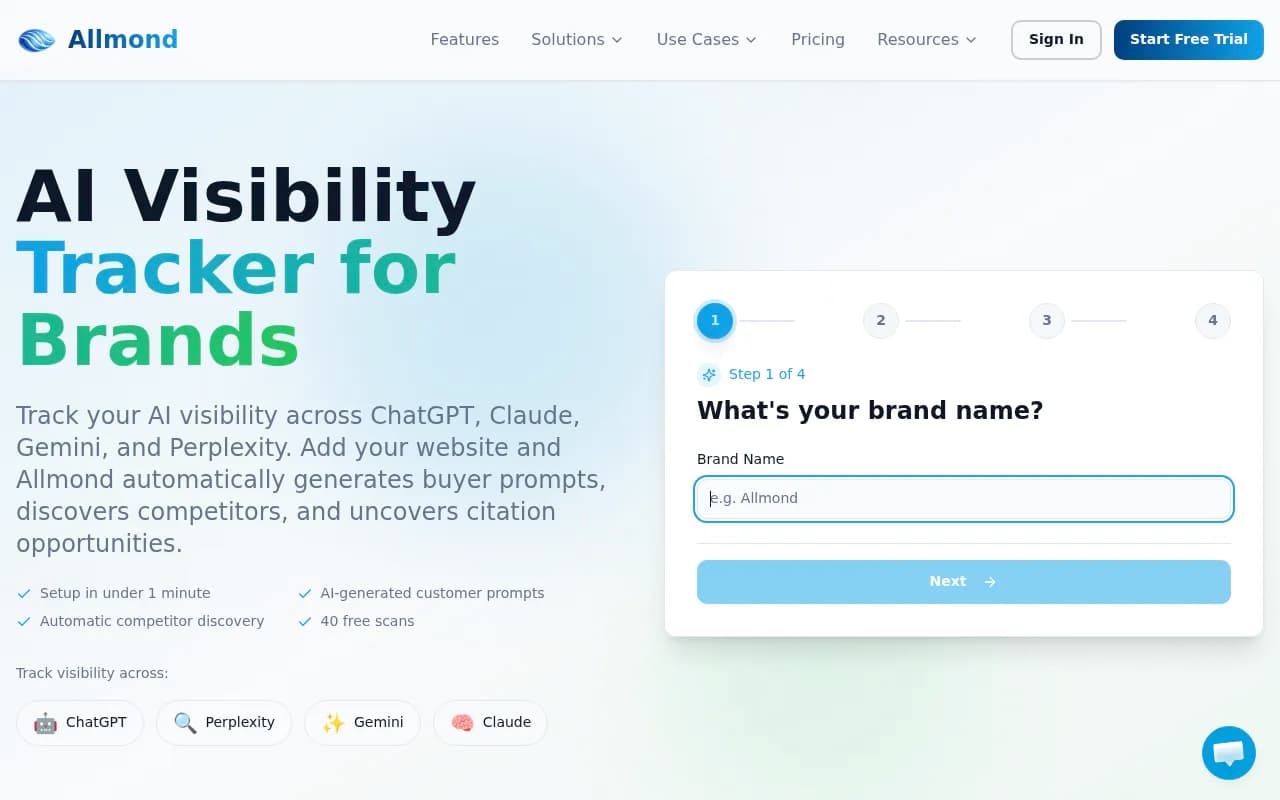
- Allmond is a lightweight AI visibility tracker covering ChatGPT, Claude, Gemini and Perplexity, with setup that takes about a minute.
- It is monitoring-focused. It lacks content generation, CMS publishing, IP-verified AI crawler logs, visitor analytics and traffic attribution, Brand Narrative, Reddit/YouTube/LinkedIn tracking, and shopping or ads tracking that Promptwatch provides.
- Pricing is simple: $29, $99 or $199 a month, every feature on every plan, and only scan volume changes.
- Best for small SaaS teams, freelancers and agencies that want cheap, client-ready reporting. Less suited to enterprises that need deep history, integrations or an API.
- Young product with a handful of reviews. Reviewers praise speed and reporting, and complain about the small free allowance and a basic interface.
Allmond is a self-serve AI visibility tracker at allmond.app. You give it a website URL, and it works out your brand name, aliases and what you sell, writes a first batch of buyer-style prompts, finds competitors, and then runs those prompts against ChatGPT, Claude, Gemini and Perplexity. The result is a Visibility Score, a share-of-voice view against rivals, and a list of the sources AI engines lean on when they answer.
The pitch is aimed at SaaS companies, agencies and marketing teams, and G2 describes it the same way. The reviewers I found on Capterra are mostly agencies and SEO or GEO consultants who use it for client reporting. The company claims 500+ brands tracked and 10,000+ scans completed, both self-reported. I found no public funding information or named founders, so treat it as a small, young product rather than an established vendor.
The interesting part is what it leaves out on purpose. There is no content engine, no crawler analytics, no integration catalogue. It tracks, shows you the gaps, and gives you URLs to pitch. That keeps the price low and the learning curve short.
Key features
Automatic prompt generation. Most trackers hand you an empty prompt box. Allmond reads your site and proposes prompts like "Alternatives to Profound for agencies" or "How do I track my brand in ChatGPT answers?". You can keep, edit or add to them. In practice this saves the first hour of setup, though generated prompts always need a human sanity check because they reflect how your site describes itself, not necessarily how buyers talk.
Four-model tracking across 67+ countries. Every plan covers ChatGPT, Claude, Gemini and Perplexity, and you can scan from 67+ countries. You can read the full answer behind each result, which matters more than the score. Allmond does not claim to track Google AI Overviews, Copilot, Meta AI or coding agents, so coverage is narrower than the biggest platforms. Promptwatch, for comparison, monitors the real interfaces of roughly 20 engines and models, including AI Overviews, AI Mode, Copilot, Meta AI, Amazon Alexa and coding agents.
Visibility Score. A 0-100% number based on position and context, broken down by model, prompt, country and over time. It is easy to explain to a client, which is the point. The methodology is not documented in depth, so you cannot audit exactly how a response becomes a score.
Competitor discovery and share of voice. Competitors are pulled from your website automatically and tracked, with the specific prompts where they win. For a founder who does not know who AI thinks the competition is, this is a useful surprise.
Citation and source discovery. Allmond collects the sources behind AI answers, shows which listicles and sites shape your category, checks whether you appear on them, and exports them as outreach targets. Outreach URLs are included on every plan. It is a practical link-building and digital PR list. It does not, however, tell you whether AI crawlers can actually read your own pages.
Scheduled scans. Weekly or monthly scans run on their own so you can point to a trend. Note that the schedule is weekly or monthly. Promptwatch runs prompts daily on every plan, and every 12, 6 or 1 hours on Business and above.
Shareable branded reports. You can publish a dashboard at a link with your own headline and call to action, and viewers need no account. For agencies this is probably the most valuable feature, and reviewers single out client-ready reporting. It is a link, not a white-label portal with PDF scheduling, though.
Unlimited projects and prompts. Brands, clients or business units can be organised without caps. Your real limit is scans, because a scan equals prompts x LLMs x countries per run.
Who is it for
The sweet spot is a SaaS founder or small marketing team wanting to know whether ChatGPT mentions them, and an independent GEO or SEO consultant who needs a cheap way to produce a recurring visibility report for 5-20 clients. A boutique agency can load every client as a project, schedule weekly scans and send a shared link instead of building slides.
Team size matters. One to ten people, no procurement process, no need for SSO. The Starter plan suits an early-stage startup, Growth fits an agency with several brands, and Pro covers heavier volume.
Who should skip it? Enterprises with security reviews will want to see certifications, audit logs and SSO, none of which I found documented. Teams that want the tool to do the fixing, meaning write content, publish it and check whether it got cited, need something beyond monitoring. Ecommerce brands that care about shopping carousels, and developer-tool companies tracking coding agents, are also not served here.
Integrations and ecosystem
I found no documented integrations and no public API. There is no mention of Slack, Looker Studio, Google Search Console, CMS connectors or an MCP server. Export is mentioned for citation opportunities, but I did not verify other formats such as CSV for all data. Sharing happens through the branded dashboard link.
That is a real gap for teams who want data in their own BI stack. Promptwatch, by contrast, has a REST API, a hosted MCP server, Looker Studio, Slack, Search Console and Bing, and CMS publishing to WordPress, Webflow and Framer. No browser extension or mobile app is advertised for Allmond.
Pricing and value
All plans include every feature. You pay only for scan volume, and the page quotes about $0.12 per scan across tiers.
- Starter: $29/month, 240 scans, 500 citation checks. Aimed at early-stage founders.
- Growth: $99/month, 825 scans, 2,000 citation checks. Marked most popular, for teams and agencies with multiple brands.
- Pro: $199/month, 1,660 scans, 5,000 citation checks. For agencies and enterprises.
There is a 14-day free trial with no credit card, and the homepage also advertises 40 free scans. I could not confirm how the two relate. You can upgrade mid-month or buy a one-time scan pack. Enterprise plans are available on request via [email protected].
The scan maths deserves attention. The pricing page's own example: 2 projects x 50 prompts x 4 LLMs x 2 countries is 800 scans per run, which fits Growth for exactly one run. Weekly scans would blow through that in days. So effective capacity is much smaller than "825 scans" suggests unless you keep prompt sets lean or run monthly. A single brand with 30 prompts in one country across four models costs 120 scans per run, so Starter gives you two runs a month.
Against competitors, $29 is low entry pricing. Promptwatch starts at $95/month for Essential (50 prompts, daily tracking) and $199/month for Kick-off on agency plans with unlimited projects, and its tiers add crawler logs, visitor analytics, content tools and an Action Board. Check promptwatch.com/pricing for current numbers. For pure monitoring on a tight budget, Allmond is good value. For results beyond monitoring, the comparison changes.
Strengths and limitations
Strengths
- Setup is fast, and generated prompts and competitors mean you see data in minutes.
- Flat, understandable pricing with no feature gating.
- Client-ready shared reports, praised by agency reviewers.
- Citation source export gives you a ready outreach list.
- Multi-country tracking on every plan.
Limitations
- Monitoring only. Compared with Promptwatch, it lacks content gap analysis, a Content Agent with CMS publishing (WordPress, Webflow, Framer), Content Refresh, and closed-loop tracking of published pages through crawls, citations and traffic.
- No crawler or traffic data. There are no IP-verified AI crawler logs, no visitor analytics or conversion attribution, and no Search Console or Bing data alongside AI data.
- Narrow tracking depth. No Brand Narrative or Fact Check, no Reddit, YouTube, LinkedIn or Instagram citation reports, no AI Shopping or Ads Radar, no prompt volumes or difficulty scores, no query fan-outs, no page-level tracking or offsite mentions, no Agent Chat or Action Board, and no local targeting at exact coordinates or hourly tracking.
- Four models. Missing Google AI Overviews, AI Mode, Copilot, Meta AI and coding agents.
- Reviewer complaints. 40 free scans feel thin (one reviewer wanted about 100, and reported slow refreshes), the UI can feel basic with large datasets, the volume of filters overwhelms at first, and historical comparison is shallow.
- Thin track record. Capterra shows a few 5.0 reviews, and G2 has no meaningful ratings yet.
Bottom line
Allmond is a sensible, cheap way to find out whether AI assistants recommend you and to hand clients a tidy report. If you are a small SaaS team or a consultant who wants visibility numbers and a citation outreach list without a long onboarding, it does that job for $29 to $199 a month.
If you want to act on the findings inside the same product, Promptwatch is the stronger choice. It adds the content agents, crawler logs, traffic attribution and CMS publishing that turn a gap report into published pages you can measure, and you can try it with a 7-day trial or the free AI visibility report. For more options, see the GEO software directory at bestgeosoftware.com.
Best use case: low-cost, client-friendly AI visibility reporting for small SaaS teams and boutique agencies.

Tags:
Frequently asked questions
What is Allmond?
How much does Allmond cost?
Which AI models does Allmond track?
How do scans work?
How does Allmond compare to Promptwatch?
Does Allmond have an API or integrations?
Similar and alternative tools to Allmond