LangSmith Review 2026
Debugging, tracing, testing and evaluation for LLM applications in production. A developer-side alternative if you meant Promptwatch as LLM observability.
Key takeaways
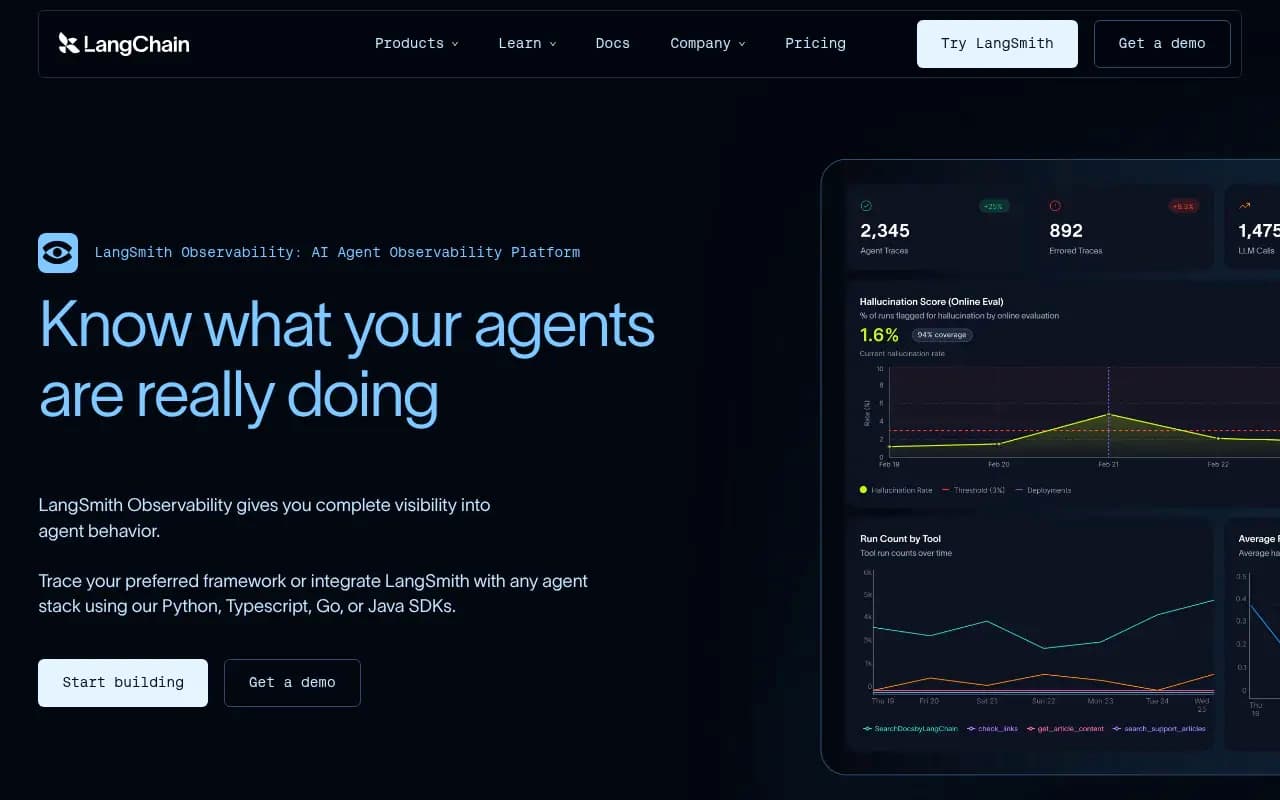
- LangSmith is a developer-side LLM and agent observability platform covering tracing, monitoring, evaluation, and dataset management. It works with any framework, not just LangChain.
- Strongest where agents are deeply nested and multi-turn. SmithDB, its purpose-built trace store, is claimed to cut trace queries from 860ms to 71ms and full-text search from 6.2s to 400ms.
- Pricing starts free (1 seat, 5k traces a month), then $39 per seat on Plus plus pay-as-you-go traces. Costs can climb fast at high trace volume, and rivals like Langfuse argue hard on this point.
- Not an AI search visibility tool. If you want to know whether ChatGPT or Perplexity mentions your brand, you want Promptwatch, which tracks brand visibility in AI answers, plus crawler logs, traffic attribution, and content creation. LangSmith monitors your own LLM app, not how AI engines talk about you.
- Self-hosting needs an Enterprise plan, which matters for teams that cannot send traces to a managed cloud.
LangSmith is the commercial observability and evaluation platform from LangChain, the company behind the LangChain and LangGraph open-source frameworks. It answers a plain question that gets hard fast once an LLM app leaves the prototype stage: what did my agent actually do, why did it fail, and is it getting better or worse? You send it traces of every model call, tool call, and retrieval step, and it gives you a place to search, score, and debug them.
The audience is engineers and AI product teams shipping agents and RAG pipelines into production. The customer logos on its site include Lyft, Rippling, Workday, Cisco, Nvidia, Coinbase, ServiceNow, Expedia, Autodesk, and Bristol Myers Squibb, which tells you where it sits: serious engineering teams, many of them already on LangGraph.
One clarification worth making, because the name shows up in searches next to AI visibility tools. LangSmith is LLM observability for developers. It is not a GEO or AI search visibility product, and the two categories solve different problems. More on that below.
Key features
Agent tracing. This is the core. Every run is captured as a nested tree: the top-level agent call, each LLM invocation, each tool call, retrievers, and sub-agents. You can see inputs, outputs, latency, token counts, and cost per step.
- Native tracing for popular agent frameworks, plus OpenTelemetry in both directions (ingest OTel data, or export LangSmith traces to your existing tools).
- SDKs for Python, TypeScript, Go, and Java. Works with the OpenAI SDK, Anthropic SDK, Vercel AI SDK, LlamaIndex, or hand-rolled code.
- Message threading groups multi-turn chat sessions so you can read a whole conversation instead of isolated calls.
- The SDK uses an async callback handler that ships traces to a distributed collector, so LangSmith says it adds no latency and an outage will not stop your app.
SmithDB. Agent traces are ugly for general-purpose databases: deeply nested, megabytes per conversation. LangSmith built SmithDB for that shape of data. It supports random access on single runs, full-text search, JSON key-path filtering, and trajectory queries. The vendor's own numbers: trace queries drop from 860ms to 71ms, thread queries from 1.16s to 131ms, filtering from 530ms to 82ms. These are vendor benchmarks, so treat them as directional, but the architecture (three stateless components on object storage and Postgres, self-hostable in your VPC) is sensible.
Monitoring and alerting. Custom dashboards track token usage, P50 and P99 latency, error rates, cost breakdowns, and feedback scores. Alerts go out through webhooks or PagerDuty. You can also run online evals on live traffic, using LLM-as-judge or plain code evaluators, and watch tool and agent trajectories rather than just final answers.
Insights. This is the feature I would try first on a messy production app. It clusters traces without supervision to surface usage patterns, common agent behaviors, and failure modes, and generates an executive summary of findings. There are templates for error analysis. LangChain claims Langfuse lacks the Insights Agent, and that claim is plausible, though it comes from LangChain's own comparison page.
Evaluation. Offline evals run against datasets before you ship. Online evals score production traces. Datasets can be collected from real traces, and annotation queues let human reviewers label outputs, with queue routing and auto-assignment. Tuned Evaluators are a paid add-on, with a "Perceived Error" evaluator priced at 0.015 LSU per run.
Prompt Hub and Playground. Version prompts, test them against datasets, and compare outputs. Fairly standard, included on all plans.
Beyond observability. The product has grown. Pricing now lists Engine, Deployment (hosting for LangGraph agents with serverless runtime), Sandboxes for code execution, Fleet, and an LLM Gateway with credits and controls. This is useful if you want one vendor end to end. It also means the product is sprawling, and you may be paying attention to modules you will never touch.
Security and hosting. Managed cloud stores data in GCP us-central-1. Enterprise gets BYOC or self-hosted on your Kubernetes cluster in AWS, GCP, or Azure. LangSmith says it does not train on your data and that you own it. Enterprise adds custom SSO, RBAC, and ABAC.
Who is it for
The sweet spot is a team of 3 to 50 engineers building agents or RAG apps on LangGraph, LangChain, or a custom stack, where debugging failures by reading logs has stopped scaling. Think a fintech support agent handling thousands of conversations a day, or a legal-tech product where you need to prove an answer's lineage. Regulated industries (finance, healthcare, pharma) will care about the self-hosted and BYOC paths.
It also fits platform teams standardizing observability across multiple AI projects, particularly those already on OpenTelemetry.
Who should skip it? Solo hackers and hobbyists who want free self-hosting. The free tier is just 5k traces a month and one seat, and self-hosting requires an Enterprise license, whereas Langfuse and other open-source rivals let you self-host for free. Also skip it if your actual question is "how does my brand show up in ChatGPT answers?" That is a marketing problem, not an engineering one, and LangSmith has no way to answer it.
Integrations and ecosystem
- Frameworks: LangChain, LangGraph, and Deep Agents natively. OpenAI SDK, Anthropic SDK, Vercel AI SDK, LlamaIndex, and custom code through the SDKs.
- OpenTelemetry: two-way support, which makes it easier to slot into Datadog-style pipelines.
- Alerts: webhooks and PagerDuty.
- SDKs: Python, TypeScript, Go, Java. REST API available for the rest.
- Hosting: managed cloud, BYOC, self-hosted.
- Support and learning: LangChain Academy, community center, and tiered support plans. Premium support offers a 30-minute Sev 1 response 24x7, a Slack or Teams channel, phone escalation, and an assigned AI engineer.
I could not verify a full integrations directory, a G2 score, or a public changelog while researching, so check those yourself before committing. LangSmith itself is closed source. The LangChain open-source repo lives at github.com/langchain-ai/langchain.
Pricing and value
Pricing is in LSUs (LangChain Standard Units), where 1 LSU equals $1. Confirm current numbers at langchain.com/pricing.
- Developer: $0 per seat, 1 seat, 5k base traces a month, then pay as you go. Community support. Engine is not available.
- Plus: $39 per seat per month, unlimited seats, 10k base traces a month, then pay as you go. Includes one free Serverless (Small) deployment, Engine, and LLM Gateway controls.
- Enterprise: custom pricing, self-hosted and hybrid options, SSO, RBAC and ABAC, support SLA, custom workspaces.
- Extra traces: 0.005 LSU each, so $0.005 per trace.
- Startups: VC-backed companies can get discounted rates and up to $10,000 in credits.
- Deployment, Sandboxes, Fleet: metered separately, for example runtime compute at 0.0675 LSU per vCPU-hour.
The cost question is where opinions split. Langfuse, a direct rival and therefore biased, models 500k traces a month with 5 users at about $3,895 a month on LangSmith Plus versus $621 on Langfuse Pro, with roughly $1,250 of that being retention. It also says included retention is only 14 days and that online evaluators can push traces into the paid retention tier by default. I could not confirm those retention details on LangChain's own pages, so model your own volume with the pricing calculator before assuming either number. A Reddit thread titled "Langsmith started charging. Time to compare alternatives" suggests the complaint is common.
For small teams, the $39 seat price is reasonable. For high-volume production, the per-trace metering is the line item that needs watching.
Strengths and limitations
Strengths
- Tracing depth for nested agents is excellent, and message threading makes multi-turn debugging far less painful.
- Framework agnostic with real OpenTelemetry support, so you are not locked into LangChain.
- Insights clustering finds failure modes you did not know to look for.
- Evaluation covers the full loop: datasets, offline evals, online evals, annotation queues.
- Flexible deployment options for compliance-heavy teams.
Limitations
- Cost can balloon at scale, and billing across traces, retention, LSUs, and add-ons takes effort to predict.
- Self-hosting is gated behind Enterprise, unlike open-source competitors.
- The product surface is widening (Fleet, Sandboxes, Gateway), which makes it harder to evaluate on tracing quality alone.
Not an AI visibility tool
If you landed here looking for GEO, here is the honest comparison. LangSmith has no prompt tracking across ChatGPT, Perplexity, or Google AI Overviews, no citation analytics, no AI crawler logs, no AI traffic attribution, and no content generation for AI search. Promptwatch covers all of those, and its agents plan, write, and publish content to close visibility gaps. For research on how AI engines choose sources, see Promptwatch Data.

Bottom line
LangSmith is a strong choice for engineering teams running agents in production who need to see inside every run, score quality continuously, and keep sensitive traces in their own environment. Its tracing and Insights features are the highlights, and the OpenTelemetry support keeps it from being a lock-in play.
Budget carefully, test trace-volume costs before you commit, and compare it with Langfuse if free self-hosting matters. And if the goal is brand visibility in AI answers, this is the wrong category: look at Promptwatch instead. Best use case in one sentence: debugging and evaluating production LLM agents across any framework. For more options, browse the software directory at surferstack.com.
Tags:
Frequently asked questions
What is LangSmith?
Do I need to use LangChain to use LangSmith?
How much does LangSmith cost?
Can I self-host LangSmith?
Is LangSmith an AI search visibility or GEO tool?
Does LangSmith slow down my application?
Similar and alternative tools to LangSmith