Humanloop Review 2026
Prompt management, evaluation workflows, collaboration and governance for teams building products on LLMs.
Key takeaways
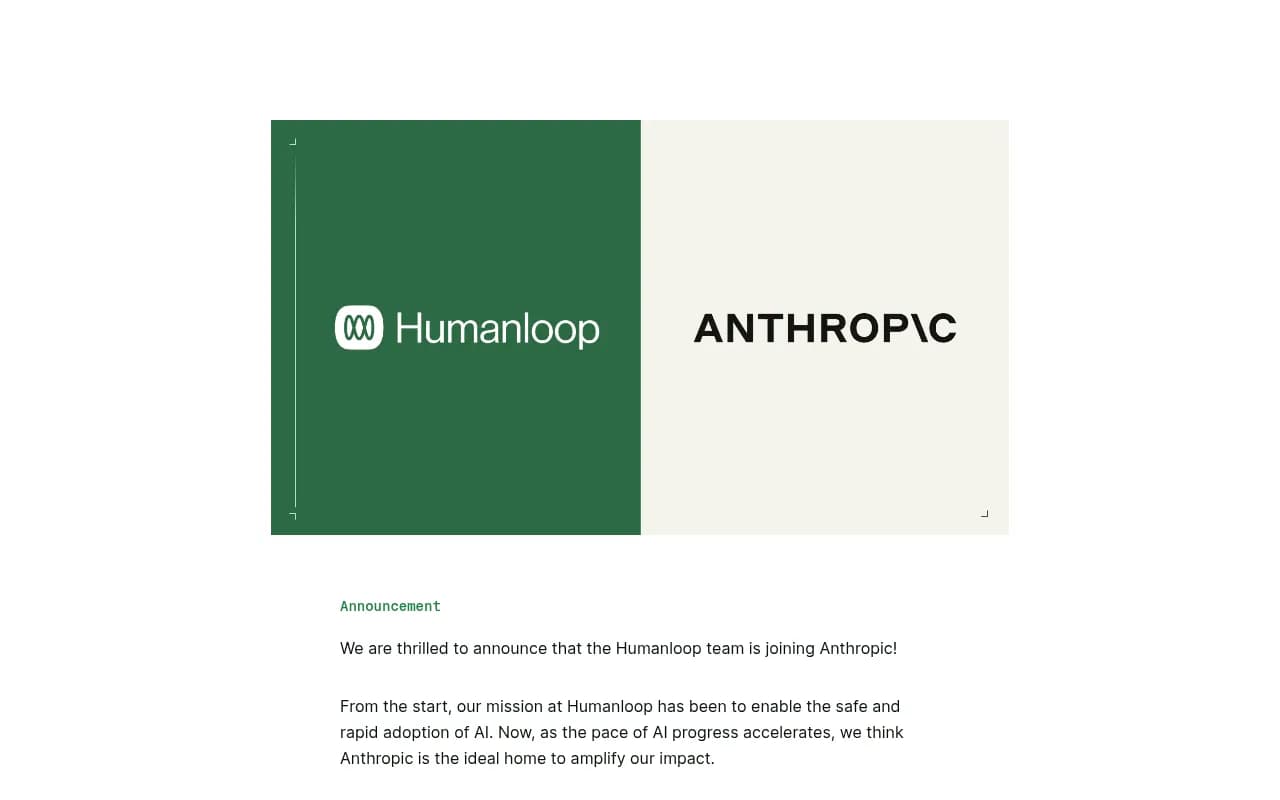
- Humanloop is discontinued. The team joined Anthropic and the platform was sunset on September 8, 2025, so you can no longer sign up, log in, or call its API.
- It was one of the first development platforms for LLM apps, with prompt versioning, evaluations, datasets, and logging in a single workspace.
- Anthropic told TechCrunch it did not acquire Humanloop's assets or IP. This was an acqui-hire, not a product acquisition.
- Humanloop pointed customers to Langfuse and Braintrust, and published an open-source export tool for moving data out.
- Worth reading as a case study in what an LLM ops platform should do. Not worth evaluating as something to buy.
Humanloop was a prompt management and LLM evaluation platform built for teams shipping products on top of large language models. It was founded in 2020 in London by Raza Habib (CEO), Jordan Burgess, and Peter Hayes, and was backed by Y Combinator, Index Ventures, Albion, Local Globe, and UCLTF, along with a group of angels. The company said it was the first development platform for LLM applications, and many of the habits that are now standard in this category, such as versioned prompts, eval suites that run before a release, and logs tied back to prompt versions, were things it pushed early.
The story ended in 2025. The team announced it was joining Anthropic, and users were emailed on July 17, 2025 that the platform would shut down. Billing stopped on July 30, 2025. On September 8, 2025, the UI and API went offline, and all accounts and data, including Files, Versions, Logs, Evaluations, and settings, were scheduled for permanent deletion. So this page is a retrospective. If you landed here looking for a tool to adopt, skip ahead to the alternatives section.
What Humanloop did
The product was aimed at a specific problem: prompts are code-like but get edited by people who do not use git. Humanloop gave engineers and non-engineers a shared place to change prompts, test them, and ship them without redeploying an application. Based on its own export documentation, these were the building blocks.
File types
Everything in Humanloop was a "File", and the migration guide lists the types: Prompts, Tools, Datasets, Flows, Agents, and Evaluators. Prompts held the model, template, and parameters. Tools described functions a model could call. Datasets held test cases (datapoints). Flows let you trace multi-step LLM pipelines. Agents modelled tool-using workflows. Evaluators were the scoring functions, which could be code, an LLM judge, or human review.
Versioning and environments
Each change to a Prompt created a new Version. You could then point deployment environments (such as staging and production) at specific versions. The application fetched whichever version was deployed, which meant a product manager could ship a prompt revision without a code release. Teams used to burying prompts in string literals found this the most immediately useful part.
Logs
Calls made through the SDK or API were logged against the Prompt version that produced them. That linkage is what made debugging practical. You could open a bad output and see the exact version, inputs, and parameters behind it. Accounts could hold millions of logs, and the export tool notes that accounts with more than 1M logs needed a custom export arranged through support.
Evaluations
Evaluations ran a Prompt version against a Dataset and scored the results with Evaluators. Teams used this to compare versions before promoting one to production, and to catch regressions when swapping models. Human feedback and LLM-as-judge scoring sat side by side, which was not common when the product launched. I would not claim it was the deepest eval tooling ever built, but the workflow of version, dataset, evaluate, deploy was clean.
Collaboration and governance
The positioning was prompt management, evaluation workflows, collaboration, and governance. In practice that meant role-based access, shared workspaces, and an audit-friendly history of who changed which prompt. Enterprise customers cared about this more than startups did.
Who it was for
The typical Humanloop customer was a product team with a real LLM feature in production and more than one person touching prompts. Think of a fintech building a support assistant where compliance wants to review wording, or a SaaS company with a PM, two engineers, and a domain expert all iterating on the same prompt. Solo developers and hobby projects tended to find it heavier than they needed.
It was a poor fit for teams that only wanted lightweight tracing, since open-source tools covered that with less overhead. It was also not a tool for model training or fine-tuning research. And it was never a brand-visibility product, so marketers wondering how their company shows up inside ChatGPT or Gemini should look at GEO platforms instead, such as those listed in the directory at bestgeosoftware.com.
Integrations and ecosystem
The research I could verify is thin here. The migration documentation confirms Python and TypeScript-style SDK access and a REST API, and the company kept a public GitHub organization at github.com/humanloop. I found no independently sourced integration list, so I will not invent one. The one ecosystem piece that matters now is the open-source humanloop-export tool, which let customers pull their data out as JSON or JSONL before the deadline.
Pricing and value (historical)
The pricing page is gone, so treat these numbers as unverifiable history. Software Finder listed a Starter plan at $100 per month for 1,000 datapoints, a Team plan at $1,000 per month for 10,000 datapoints, and a custom Enterprise plan. The old pricing page said standard plans were billed monthly with no long-term commitment, enterprise customers could pay annually, and volume discounts and academic or non-profit pricing existed.
That is on the expensive side for a startup compared with open-source alternatives, which is part of why the tier jump from $100 to $1,000 drew attention. Nothing here can be bought today.
Strengths and limitations
What it did well
- Prompt versioning with deployment environments that let non-engineers ship changes safely.
- A tight loop between logs, versions, datasets, and evaluations.
- Evaluators that mixed code, LLM judges, and human review.
- A decent exit: advance notice, a migration guide, an export tool, and named alternatives.
Where it fell short
- It no longer exists, which is the biggest limitation of all. Anyone who built workflows around its API had to rebuild them.
- Pricing jumped steeply between the Starter and Team tiers.
- Data was deleted after the sunset date. Teams that missed the export window lost their history.
Alternatives to consider
Humanloop itself recommended Langfuse and Braintrust. Langfuse is open source and strong on tracing, prompt management, and self-hosting. Braintrust leans harder into evaluation and experiments. Beyond those two, you can browse more options in the software directory at surferstack.com.
Bottom line
Humanloop is a closed chapter. The team went to Anthropic, the platform shut down on September 8, 2025, and Anthropic said it did not take over the assets or IP. There is nothing to sign up for.
It is still worth knowing because it shaped how teams manage prompts and evaluations. If you are choosing a replacement today, start with Langfuse for open-source tracing and prompt management, or Braintrust for evaluation-heavy workflows. Best use of this page: understanding what an LLM ops platform should cover before you pick its successor.
Frequently asked questions
Is Humanloop still available?
Did Anthropic acquire Humanloop?
What did Humanloop do?
How much did Humanloop cost?
What are the best alternatives to Humanloop?
Can I still export my Humanloop data?
Similar and alternative tools to Humanloop