Salesforce Marketing Cloud Review 2026
Salesforce Marketing Cloud is the marketing automation and customer engagement suite inside Salesforce's Customer 360 ecosystem, now rebuilt around agentic AI as Marketing Cloud Next. It targets mid-market and enterprise B2B/B2C marketing teams already on Salesforce, offering journey orchestration,
Key takeaways
- Salesforce rebuilt its marketing suite around agentic AI in 2025, launching Marketing Cloud Next with Agentforce agents that create campaigns, qualify leads, and optimize paid media, on top of the older Marketing Cloud Engagement and Account Engagement (Pardot) products that still exist under the same umbrella.
- Pricing has shifted from legacy per-tier licensing to org-based monthly fees starting at $1,500/month for Growth Edition and $3,250/month for Advanced Edition, both billed annually, with add-ons like Personalization ($8,000/month) and Marketing Intelligence ($10,000/month) pushing real-world deployments into the $36,000 to $600,000+ annual range once you add implementation partners.
- This is a Salesforce-ecosystem tool, not a general AI search visibility or GEO platform, so there's no meaningful comparison to a tool like Promptwatch here. It solves customer engagement and campaign orchestration, not brand monitoring in ChatGPT or Google AI Overviews.
- Reviewers consistently flag a steep learning curve, AMPscript and SQL requirements for anything beyond basic journeys, and clunky, disconnected Studio interfaces that often require a certified implementation partner just to get running.
- G2 has already rebranded the product listing to "Agentforce Marketing (formerly Salesforce Marketing Cloud)" with roughly a 4.0/5 rating across nearly 4,900 reviews, which tells you where Salesforce wants this product positioned going forward.
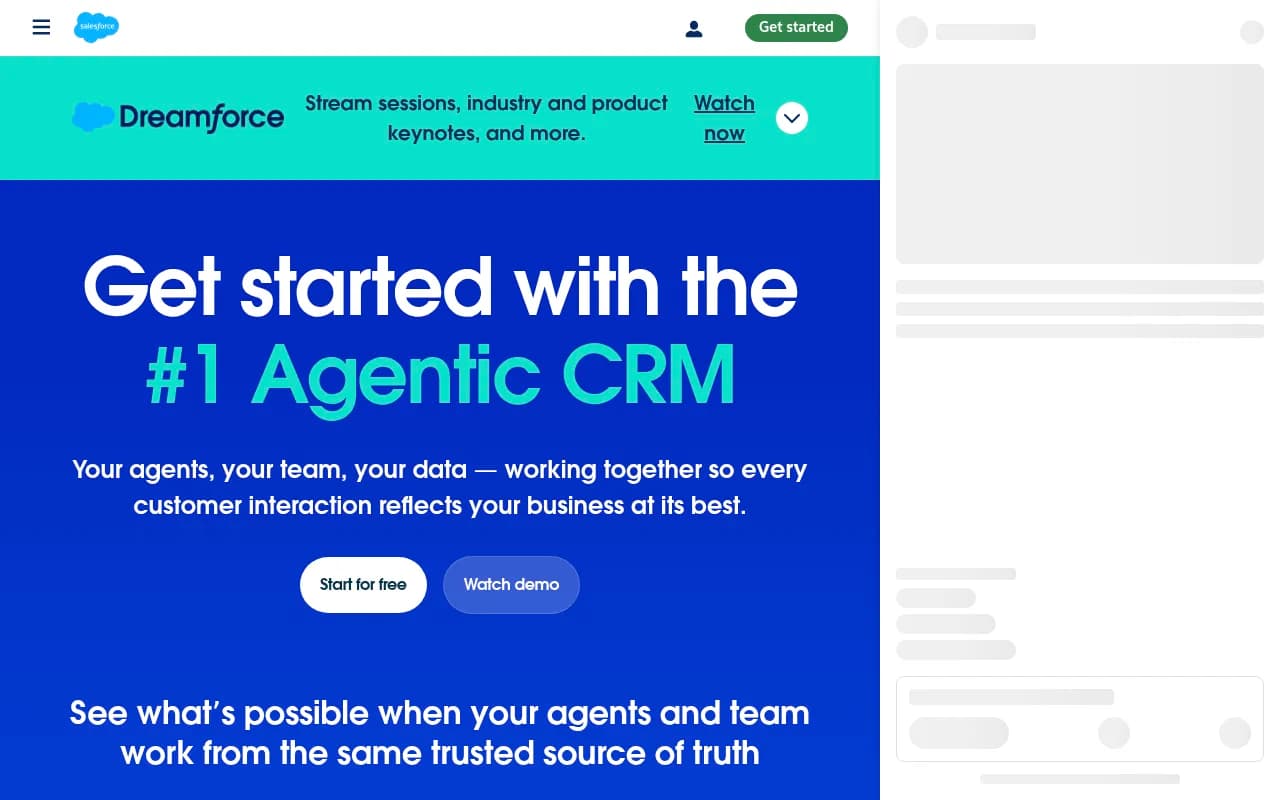
Salesforce Marketing Cloud is the marketing wing of Salesforce's sprawling Customer 360 platform, and in 2025 it went through the biggest overhaul in years. Salesforce introduced Marketing Cloud Next, an agentic rebuild that layers Agentforce AI agents onto journey building, segmentation, and campaign creation, running on top of Data 360 (the renamed Data Cloud) as its customer data backbone. The pitch, straight from Salesforce's own launch materials, is "the end of do-not-reply marketing": instead of one-way blasts, brands get two-way conversational engagement across email, SMS, and WhatsApp, orchestrated by AI agents rather than static workflow rules.
The company didn't kill off the old products, it layered a new one on top. Marketing Cloud Engagement (the classic Journey Builder/Email Studio product) and Marketing Cloud Account Engagement (what most people still call Pardot, for B2B lead nurturing) continue to exist as separate SKUs. Marketing Cloud Next is the new flagship, built natively on the Salesforce Platform rather than bolted on as an acquired product, which was always Marketing Cloud Engagement's original sin since it came from the ExactTarget acquisition back in 2013.
The target buyer here is unambiguous: mid-market and enterprise marketing teams that are already committed to the Salesforce ecosystem, usually because sales and service already run on Salesforce CRM and IT wants a single vendor relationship. This is not a tool a five-person startup reaches for casually, though Salesforce does offer a cut-down entry point through Salesforce Starter at $25/user/month for basic email marketing bundled with CRM.
Key features
- Agentforce Campaign Creation. An AI agent drafts full campaign structures, including audience segments, messaging, and channel sequencing, based on a brief and pulled-in customer data. It's meant to compress what used to be days of campaign setup work in Journey Builder into a conversational back-and-forth. Early TrustRadius reviewers described this and other Agentforce marketing features as "more a future opportunity than a current strength" as of late 2025, which matches the general pattern of enterprise AI agent rollouts landing ahead of actual reliability.
- Agentforce Personalization Decisioning. Real-time content and offer selection driven by unified profile data in Data 360, replacing the older rules-based personalization engine. This is where Salesforce is trying to compete with dedicated CDP and personalization vendors, though it's sold as a separate add-on at $8,000/org/month, not included in the base Marketing Cloud Next editions.
- Agentforce Lead Management and Qualification. Automated scoring and routing of leads based on behavioral and firmographic signals, aimed at the B2B side of the house that traditionally lived in Account Engagement/Pardot. It's meant to reduce the manual scoring rule maintenance that Pardot admins have complained about for years.
- Agentforce Paid Media Optimization and Web Curation. Budget allocation and creative suggestions for paid channels, plus automated content curation for web and landing pages. These lean heavily on the expanded LinkedIn integration Salesforce added in 2025, which now includes conversion event tracking and audience list sync directly from Marketing Cloud Next.
- Segment Intelligence. AI-assisted audience segmentation that surfaces patterns in unified customer data rather than requiring marketers to hand-build every segment in SQL-like query builders. Whether this actually reduces the SQL/AMPscript dependency that reviewers complain about is unclear from user feedback so far.
- Data 360 as the unification layer. Marketing Cloud Next pulls in structured CRM data alongside unstructured sources: PDFs, videos, CMS content, and now Google Drive, SharePoint, and Zendesk connectors added at launch. This is Salesforce's answer to the perennial complaint that Marketing Cloud data always felt disconnected from Sales Cloud data.
- Tableau Next reporting. Analytics and dashboards now run through Tableau Next rather than the older, more limited native reporting tools, which should help with the attribution gaps reviewers have flagged for years.
- Two-way conversational channels. SMS and WhatsApp conversations, gated to the Advanced Edition at $3,250/org/month, let customers reply and get routed responses rather than hitting a dead end after a one-way blast.
Who is it for
Enterprise marketing operations teams already running Sales Cloud or Service Cloud are the obvious fit, especially retail, financial services, and B2B tech companies with dedicated marketing ops headcount and budget to fund a certified implementation partner. A mid-market B2B software company with 15-30 sales reps already on Salesforce CRM, looking to formalize lead scoring and nurture flows through Account Engagement, is a reasonable starting point. A large retailer running loyalty programs and needing Loyalty Management ($20,000/org/month add-on) alongside personalized email and SMS is the kind of account Marketing Cloud Next is actually built for.
Companies that should stay away: small businesses and lean marketing teams without in-house technical resources. The Journey Builder and Email Studio interfaces still require AMPscript and SQL knowledge for anything beyond templated sends, and multiple review sites (Gartner, G2, Capterra) cite the setup complexity and disconnected Studio interfaces as recurring pain points that usually require paying a systems integrator. If you're not already in the Salesforce ecosystem for CRM, there's little reason to adopt Marketing Cloud in isolation, competitors like HubSpot or Klaviyo are considerably easier to stand up without a consulting engagement.
Agencies managing many small clients will also find the pricing model awkward. This is an org-level licensing product, not something you spin up cheaply per client the way you might with a lighter SaaS tool.
Integrations and ecosystem
Marketing Cloud Next is native to the Salesforce Platform, so it connects directly to Sales Cloud, Service Cloud, Commerce Cloud, Slack, Tableau, and Agentforce without middleware. The 2025 relaunch added direct content-source connectors for Google Drive, SharePoint, and Zendesk, plus an expanded LinkedIn integration covering conversion event tracking, audience list sync, and Audience Insights access inside Data 360.
Third-party apps and agents are distributed through AgentExchange, Salesforce's newly consolidated marketplace that folded the old AppExchange and Slack Marketplace into one storefront for finding apps, agents, and integrations. Marketing Cloud Personalization separately supports third-party data sharing outside the core Salesforce environment for brands running venues or properties beyond the main site.
There's no dedicated public API story specific to Marketing Cloud beyond the standard Salesforce REST/SOAP APIs that developers already use across the platform, and no separate mobile app; it's managed through the same Salesforce web console and Salesforce mobile app as everything else. Community support runs through Trailhead and the Trailblazer Community rather than a dedicated Discord or GitHub presence, unlike some competitors.
Pricing and value
Salesforce restructured Marketing Cloud pricing in 2025 around org-based monthly fees rather than the old per-contact tiered licensing. Marketing Cloud Next Growth Edition starts at $1,500/org/month billed annually, covering Agentforce Campaign Creation, multi-channel journeys, and forms/landing pages. Advanced Edition runs $3,250/org/month and adds path experimentation plus two-way SMS/WhatsApp conversations.
Add-ons stack up quickly: Salesforce Personalization is $8,000/month, Marketing Intelligence is $10,000/month, Loyalty Management is $20,000/month, and B2B-focused Account Engagement+ starts at $1,250/month. Third-party estimates from MoEngage put real-world total licensing plus implementation costs anywhere from $36,000 to over $600,000 annually depending on scale and add-on selection, and that's before factoring in the certified consultants most organizations need to actually build out journeys.
At the low end, Salesforce Starter offers a bundled CRM-plus-marketing entry point at $25/user/month with 2,000 emails included and $10/month for each additional 1,000 sends, aimed squarely at small businesses that don't need the full Marketing Cloud Next stack. For that segment it's reasonable value. For the enterprise tiers, whether it's good value depends entirely on whether you're already paying for Salesforce CRM seats and want a single-vendor stack; standalone, competitors like HubSpot, Braze, or Iterable often deliver comparable capability at a fraction of the total cost of ownership.
Strengths and limitations
What it does well: the native integration with Sales Cloud and Data 360 genuinely eliminates a lot of the data-syncing headaches that plague marketers running a separate CRM and marketing platform. The expanded content source connectors (Google Drive, SharePoint, Zendesk) and LinkedIn integration are meaningful additions for enterprises with content scattered across systems. Tableau Next reporting is a real upgrade over the old native analytics.
Where it falls short: the learning curve is steep and well documented across Gartner, G2, TrustRadius, and Capterra reviews, with AMPscript and SQL knowledge still required for non-trivial journeys. Attribution modeling remains weak, limited to Campaign Influence or Opportunity Influence with a 30-day recognition cap on the latter, which is a real gap for teams trying to prove multi-touch ROI. Agentforce's marketing-specific AI features are early; reviewers describe them as promising but not yet reliably delivering value. Support quality also comes up as a complaint in independent forums and competitor-compiled user quotes, though that data should be weighed with some skepticism given the source.
Bottom line
Salesforce Marketing Cloud, now rebranding around Marketing Cloud Next and Agentforce, makes sense for enterprises and mid-market companies already embedded in the Salesforce CRM ecosystem who need unified customer data across sales, service, and marketing and have budget for both the software and the implementation partner it usually requires. Anyone evaluating this without an existing Salesforce footprint, or without dedicated marketing ops and technical resources, should look at lighter, faster-to-deploy alternatives first.
Tags:
Frequently asked questions
What is Salesforce Marketing Cloud used for?
How much does Salesforce Marketing Cloud cost?
Is there a free version of Salesforce Marketing Cloud?
What is Marketing Cloud Next?
Is Salesforce Marketing Cloud hard to learn?
How does Salesforce Marketing Cloud compare to HubSpot?
Similar and alternative tools to Salesforce Marketing Cloud