Hyros Review 2026
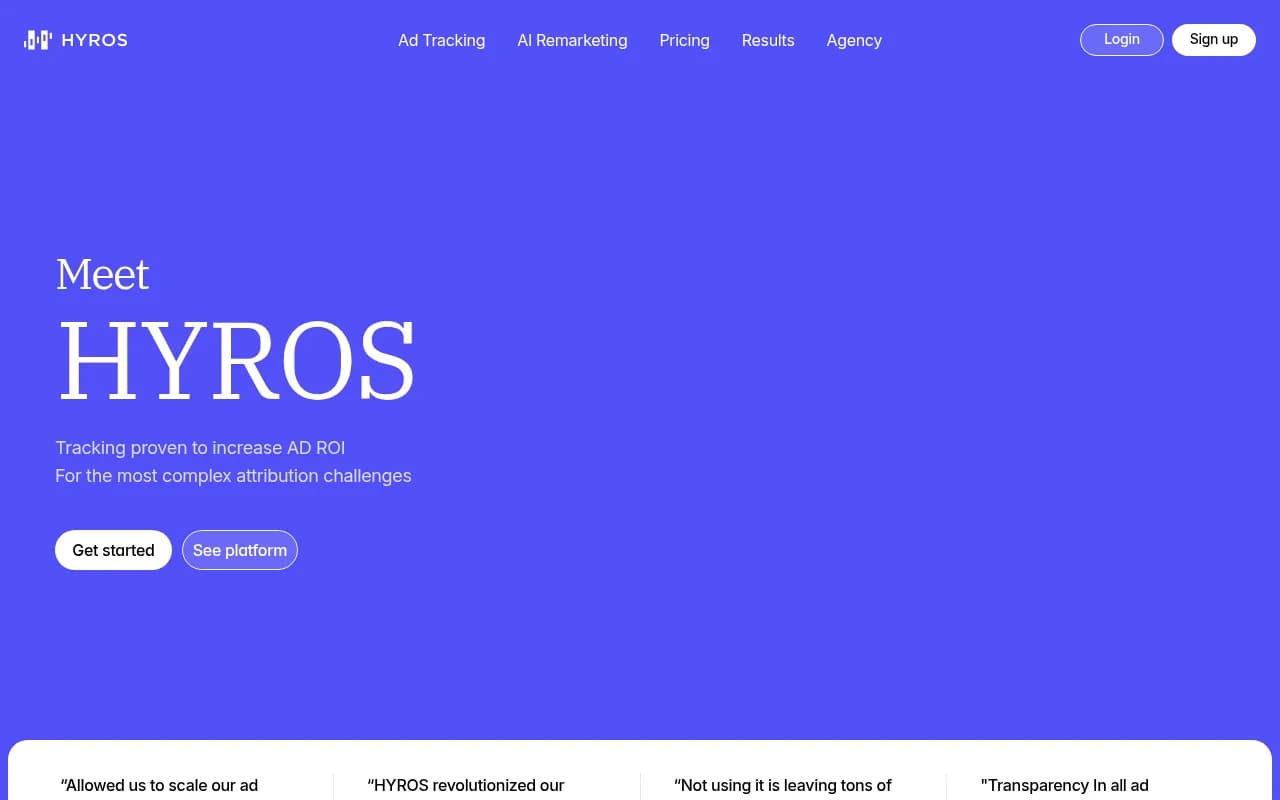
Hyros is an advanced ad attribution and tracking platform that uses AI to accurately track every sale to its true source across complex customer journeys. Built for SaaS, e-commerce, call-based businesses, and info products, it captures conversions that standard pixels miss and feeds superior data b
Summary
- Best for: Brands spending $50k+/month on ads who need accurate multi-touch attribution across complex funnels -- SaaS companies tracking trials to LTV, e-commerce brands optimizing ROAS, call-based businesses, and info product sellers
- Core strength: AI attribution that catches conversions standard pixels miss (iOS privacy changes, cross-device journeys, long sales cycles) and feeds clean data back to ad platforms for better targeting
- Proven results: Average 15%+ revenue lift from improved tracking accuracy; clients like Tony Robbins scaled ad spend 43% in 6 months
- Limitation vs monitoring tools: Hyros is purely attribution-focused -- it won't help with AI search visibility, brand monitoring in ChatGPT/Perplexity, or content optimization for AI engines (tools like Promptwatch handle that)
- Price barrier: Starts at $379/month, making it a significant investment best suited for businesses already spending heavily on paid ads
Hyros positions itself as the solution to a problem every performance marketer knows: your ad platform's native tracking is lying to you. iOS 14.5 privacy changes, cookie restrictions, cross-device journeys, and long consideration cycles mean Facebook, Google, and TikTok pixels miss 20-40% of conversions. You're flying blind, killing profitable campaigns and scaling losers. Hyros claims to fix this with AI-powered attribution that tracks every sale to its true source, then feeds that superior data back to ad platforms so their algorithms target better customers.
Founded by Alex Becker (serial entrepreneur behind multiple 8-figure exits) and now used by over 100,000 active businesses according to their site, Hyros has become the attribution standard for high-spend direct response marketers. Clients include Tony Robbins' team (43% ad spend increase in 6 months), ClickFunnels, Playboy, Jay Shetty, Alex Hormozi, and Sam Ovens. The pitch is simple: standard tracking costs you 15%+ in lost revenue because you can't see what's actually working.
AI Attribution Engine
The core product is Hyros' multi-touch attribution system. Unlike pixel-based tracking that relies on cookies and device IDs (easily blocked by iOS privacy settings or cross-device behavior), Hyros uses a combination of first-party data capture, server-side tracking, probabilistic matching, and AI modeling to reconstruct customer journeys. When someone clicks your ad on mobile, researches on desktop, then buys on tablet three weeks later, standard pixels see three separate anonymous users. Hyros connects the dots.
The system tracks:
- Ad source attribution: Which specific ad, campaign, ad set, keyword, and creative drove each conversion
- Multi-touch journeys: Every touchpoint from first click to final purchase, with customizable attribution models (first-click, last-click, linear, time-decay, or custom)
- Revenue metrics: Not just conversions but actual revenue, profit margins (if you feed in COGS), LTV, MRR, churn
- Offline conversions: Phone calls, in-person sales, manual entries -- anything you can feed into the system via API or integrations
The AI component analyzes patterns across your entire customer base to fill gaps where direct tracking fails. If 100 customers with similar behavior patterns all came from Facebook ads, and customer 101 has the same pattern but the pixel didn't fire, Hyros' AI probabilistically attributes that sale to Facebook. This isn't guessing -- it's statistical modeling trained on your actual conversion data.
What makes this powerful: Hyros doesn't just show you better reports. It sends this corrected attribution data back to Facebook, Google, TikTok, etc. via their Conversions APIs. Your ad platforms' algorithms now optimize on accurate data instead of incomplete pixel fires. Clients report this feedback loop alone drives 10-20% improvement in cost per acquisition because the AI targets people who actually convert, not just people who clicked.
One-Click Setup (Mostly)
Hyros markets "set up in seconds with our 1 click AI" but reality is more nuanced. For Shopify stores, there's a literal one-click app install that auto-configures tracking. For other platforms (WooCommerce, ClickFunnels, custom stacks), you're installing tracking scripts, connecting via API, or using Zapier/webhooks. Not rocket science but not instant either.
Once connected, Hyros' AI auto-tags your traffic sources using UTM parameters and platform APIs. It pulls ad spend data directly from Facebook Ads Manager, Google Ads, etc. so you see true ROAS (revenue divided by actual spend) without manual spreadsheet work. The system also auto-detects your conversion events -- form submissions, purchases, trial signups, whatever fires on your site.
The learning curve comes in customizing attribution models and defining what counts as a "quality" conversion. Hyros lets you weight conversions by value (a $10k enterprise deal should count more than a $50 trial signup), exclude refunds, and set custom conversion windows. Power users spend time here. Beginners can use defaults and still see value.
Use Case Specialization
Hyros isn't a generic analytics tool. It's built for four specific business models:
SaaS/Software: Track free trial signups, demo bookings, paid subscriptions, upgrades, MRR, LTV. See which ads bring users who actually stick vs churn in month two. Optimize for long-term value, not just trial volume. Integrates with Stripe, ChartMogul, ProfitWell.
E-commerce: Track add-to-cart, cart abandonment, purchases, repeat orders, COGS-adjusted profit. Hyros pulls product-level data so you see which ads drive high-margin items vs low-margin volume plays. Shopify integration is seamless. Non-Shopify stores use API or Zapier.
Call-Based Businesses: Track call bookings, call attendance (did they show up?), call outcomes (qualified lead, sale, no-show), pipeline value. Integrates with Calendly, CallRail, Close CRM. This is huge for high-ticket coaching, consulting, home services, B2B -- any business where the conversion happens on a sales call, not a checkout page.
Info Products/Education: Track funnel steps (webinar registration, webinar attendance, order form, upsell), course purchases, community memberships, coaching signups. Built for the Russell Brunson/ClickFunnels crowd selling courses and masterminds. Integrates with Kajabi, Teachable, Thinkific, Circle, Skool.
Each use case gets custom dashboards and pre-built reports. You're not staring at generic Google Analytics tables trying to figure out what matters.
AIR AI Agent System
In 2024, Hyros launched AIR (AI Remarketing), a separate product bundled with tracking plans. This is where things get interesting -- and a bit creepy.
AIR uses Hyros' attribution data to identify anonymous website visitors, obtain their contact info (email, phone), and automatically reach out with personalized messages via email, SMS, or even voice calls. The AI agent:
- Recognizes visitors: Matches site behavior to known customers or prospects in your CRM
- Learns intent: Analyzes which pages they viewed, how long they stayed, what they almost bought
- Reaches out: Sends tailored messages ("Hey, saw you were looking at our enterprise plan -- want to hop on a quick call?") or offers ("Here's 15% off that product you left in your cart")
- Interacts: Can handle replies, answer questions, book calls, all via AI
Hyros claims AIR adds 3-7% more sales on top of attribution improvements. The use case: someone clicks your ad, browses your site, leaves without converting. Standard retargeting shows them generic display ads. AIR sends a personal email or text from "your team" (actually an AI agent) that references their specific behavior. Conversion rates are higher because it feels human.
The ethics here are... debatable. AIR is essentially using attribution data for outbound prospecting. If someone didn't give you their email, how does AIR get it? Hyros is vague on this -- likely a mix of reverse email lookup services, data enrichment APIs, and probabilistic matching to known contacts. It works, but it's aggressive. Some users love it. Privacy advocates would hate it.
Integrations and Data Flow
Hyros connects to:
- Ad platforms: Facebook/Instagram, Google Ads, TikTok, YouTube, LinkedIn, Twitter, Snapchat, Pinterest, Bing. Pulls spend data, sends conversion data back via Conversions API.
- E-commerce: Shopify (native app), WooCommerce, BigCommerce, Magento, custom carts via API.
- CRMs: Salesforce, HubSpot, Pipedrive, Close, GoHighLevel. Syncs lead and deal data for full-funnel attribution.
- Payment processors: Stripe, PayPal, Authorize.net. Tracks actual revenue, refunds, chargebacks.
- Call tracking: CallRail, Calendly, Acuity, ScheduleOnce. Attributes phone conversions.
- Course platforms: Kajabi, Teachable, Thinkific, Podia. Tracks course sales and engagement.
- Zapier: Connects to 3,000+ apps for custom workflows.
- API: Full REST API for developers building custom integrations or pulling data into BI tools.
Data flows in real-time. A sale happens, Hyros attributes it within seconds, sends the conversion event back to Facebook, updates your dashboard. No daily batch processing delays.
Reporting and Dashboards
Hyros' interface is dense. This is not a pretty consumer app -- it's a power tool for media buyers who live in spreadsheets. The main dashboard shows:
- Ad performance: ROAS, CPA, revenue, profit by campaign/ad set/ad/creative
- Attribution reports: Multi-touch journey visualizations, conversion path analysis
- Cohort analysis: How customers acquired in January perform vs February, broken down by source
- LTV tracking: Projected lifetime value by acquisition source, updated as customers make repeat purchases
- Profit tracking: Revenue minus ad spend minus COGS (if you input product costs)
You can slice data by date range, traffic source, product, customer segment, attribution model. Export to CSV or connect to Looker/Tableau via API. The mobile app (iOS/Android) gives you key metrics on the go but isn't meant for deep analysis.
One standout feature: Print Tracking. If you run direct mail, TV, radio, or podcast ads (anything without a clickable link), Hyros can still attribute conversions using unique promo codes, vanity URLs, or call tracking numbers. You see which offline channels drive online sales. Most attribution tools ignore this entirely.
Who Should Use Hyros
Hyros is overkill for small spenders. If you're running $5k/month in Facebook ads with a simple funnel (ad -> landing page -> checkout), Google Analytics and native platform tracking are probably fine. Hyros shines when:
- You're spending $50k+/month on ads: The cost ($379-$1,500+/month depending on plan) and setup effort only make sense at scale. Below that, the juice isn't worth the squeeze.
- You have complex funnels: Multi-step funnels (webinar -> application -> sales call -> close), long sales cycles (B2B SaaS with 60-day trials), or high-ticket products ($5k+ coaching programs) where attribution is genuinely hard.
- You run omnichannel campaigns: Ads on Facebook, Google, TikTok, YouTube, plus email, SMS, affiliates, influencers. You need to know which channels assist vs close deals.
- You sell high-LTV products: If customer lifetime value is $500+, knowing which ads bring customers who stick (vs churn) is worth thousands per month in saved ad spend.
- iOS privacy killed your tracking: If you're in e-commerce or DTC and iOS 14.5 gutted your Facebook pixel accuracy, Hyros is the fix.
Who should NOT use Hyros:
- Local businesses with simple funnels: If you're a dentist running Google Local Service Ads, you don't need this.
- Organic-only marketers: Hyros is for paid ads. If you're not buying traffic, it's useless.
- Bootstrapped startups: The price and complexity are too high when you're pre-product-market fit and testing channels.
- Anyone who needs AI search visibility: Hyros tracks ad performance, not how your brand appears in ChatGPT, Perplexity, or Google AI Overviews. For that, you'd need a GEO platform like Promptwatch.
Pricing and Plans
Hyros doesn't publish pricing on the site -- you have to book a demo call. Based on third-party sources and user reports:
- Starter: ~$379/month. Basic attribution, limited integrations, email support.
- Growth: ~$799/month. Full attribution, all integrations, AIR AI agent, priority support.
- Scale: ~$1,500+/month. Enterprise features, dedicated account manager, custom attribution models, API access.
All plans include "full VIP support" which in practice means onboarding calls, Slack/email support, and access to Hyros' Facebook community (Hyros Prime) where users share strategies. No free trial -- you're committing upfront. Some users report negotiating discounts for annual prepay.
Compared to competitors:
- Wicked Reports: Similar pricing ($400-$1,200/month), less AI, clunkier interface.
- SegMetrics: Cheaper ($150-$500/month), better for SaaS, weaker on e-commerce.
- Northbeam: More expensive ($1,000-$3,000/month), better for 8-figure DTC brands, overkill for most.
- Triple Whale: E-commerce focused, $129-$399/month, less sophisticated attribution but easier to use.
Hyros sits in the premium tier. You're paying for accuracy and AI optimization, not just dashboards.
Strengths
- Attribution accuracy: Genuinely better than pixel-based tracking, especially post-iOS 14.5. Clients consistently report finding 15-30% more conversions that platforms missed.
- AI feedback loop: Sending corrected data back to ad platforms improves targeting. This is the killer feature -- most attribution tools just report, Hyros actively improves your ads.
- Use case specialization: Pre-built dashboards for SaaS, e-commerce, calls, info products mean you're not configuring everything from scratch.
- Offline attribution: Print tracking, call tracking, and manual conversion entry handle channels other tools ignore.
- AIR AI agent: Love it or hate it, it's a unique feature that can add 3-7% revenue if you're comfortable with aggressive remarketing.
- Support: Users rave about onboarding and ongoing support. You're not left to figure it out alone.
Limitations
- Price: $379-$1,500+/month is steep. Only makes sense for businesses spending $50k+/month on ads.
- Complexity: This is not plug-and-play. Expect a learning curve, especially if you're customizing attribution models or integrating with a complex tech stack.
- No AI search visibility: Hyros tracks paid ad performance, not organic AI visibility. It won't tell you if your brand appears in ChatGPT answers, Perplexity citations, or Google AI Overviews. For GEO/AEO tracking, content gap analysis, and AI search optimization, you'd need a platform like Promptwatch which monitors 10+ AI models, tracks AI crawler logs, and helps you create content that ranks in AI search results.
- AIR ethics: The AI remarketing agent is aggressive. Some users love it, but if you're privacy-conscious or worried about coming off as creepy, it might not fit your brand.
- Overkill for small spenders: If you're running $10k/month in ads, Google Analytics + native platform tracking is probably enough. Hyros is for scale.
Bottom Line
Hyros is the attribution tool for performance marketers spending serious money on paid ads and tired of guessing which campaigns actually work. If you're scaling past $50k/month in ad spend, dealing with complex funnels or long sales cycles, and iOS privacy changes have wrecked your tracking, Hyros will likely pay for itself in the first month by revealing which ads to kill and which to scale. The AI feedback loop that improves ad platform targeting is legitimately differentiated -- most competitors just show you reports, Hyros actively makes your ads perform better. It's expensive and complex, but for the right business (high-LTV SaaS, 7-figure e-commerce, high-ticket coaching), it's the standard. Just know it's purely for paid ad attribution -- if you also need to track and optimize your brand's visibility in AI search engines like ChatGPT or Perplexity, that's a different problem requiring a different tool.
Tags:
Frequently asked questions
What is Hyros and what does it do?
How much does Hyros cost per month?
Who is Hyros best for?
Does Hyros offer a free trial or free plan?
How does Hyros improve ad tracking accuracy?
What results can I expect from using Hyros?
What is the minimum ad spend needed to use Hyros effectively?
Does Hyros work with all ad platforms?
Similar and alternative tools to Hyros