Key takeaways
- Demand gen and performance teams should judge GEO tools on pipeline evidence: AI referral traffic, conversions, and crawler access. Mention counts alone don't justify budget.
- Commercial prompts ('best CRM for small businesses') are where buyers shortlist vendors. Product pages and landing pages take about 39% of ChatGPT citations, so your money pages matter more than your blog.
- ChatGPT now shows ads in roughly a third of web-search responses (7-day average 32.4%), so paid and organic AI visibility share the same prompts.
- Pair one GEO platform with your existing attribution stack. Don't try to replace HubSpot, Dreamdata, or HockeyStack with a visibility tracker.
- Start with a free baseline scan, pick 30 to 50 commercial prompts, and review results against pipeline monthly.
Why demand gen teams care about GEO now
Most demand gen roundups in 2026 still read like 2022. ZoomInfo, HubSpot, Marketo, 6sense, Leadfeeder. All useful, none of them tell you what ChatGPT says when a buyer types 'best [your category] software for mid-market teams' into a chat window.
That is the gap. Buyers now do early vendor research inside AI answers, and by the time they hit your form they have a shortlist. If you aren't on it, no amount of retargeting fixes that. If you are on it, you get a warm visitor that never showed up in your intent data.
Traditional demand gen stacks cover intent data, automation, and attribution. GEO tools add a fourth layer: what AI models say about you at the moment of consideration, and whether that visibility turns into visits and pipeline.
This guide is for performance marketers, demand gen leads, and growth teams who need to justify the spend. So the evaluation criteria below lean on measurement.
What the data says about where AI sends buyers
Two findings from first-party research change how a performance team should plan.
First, Promptwatch Data on ChatGPT citation share by content type (Sep 28 to Oct 4, 2026) shows product pages at 22.4% of classified citations and landing pages at 16.8%. For commercial prompts, product pages hit 26.0% and landing pages 20.6%, and those two plus listicles and comparisons make up almost 70% of citations. For branded prompts, reviews reach 5.6%, more than three times their share across all prompts.
In plain terms: the pages you already build for paid campaigns are the pages AI cites. Pricing clarity, specs, audience, and FAQ content matter. So does public documentation.
Second, ads have arrived. Promptwatch's ChatGPT ads data (May 20 to Aug 17, 2026) shows ads in an average of 20.1% of web-search responses over the 90 days, with no ads before May 27 and a 7-day average of 32.4% by mid-August. About 73% of ad-bearing responses were organic-type prompts. The same prompts now carry a citation slot and a paid slot. A performance team that tracks one and ignores the other is half-blind.
A third data point that affects planning: ChatGPT stopped leaning on social. Promptwatch's social citation report found ChatGPT got 0.46% of citations from social platforms in the week of Sep 28, while Google AI Overviews got 12.2%. If your plan was 'seed Reddit threads to get cited in ChatGPT', see the Reddit decline data: reddit.com's share of ChatGPT citations fell from about 4% to 0.5% on August 14, 2026.
What to demand from a GEO tool as a performance marketer
Forget the feature checklists for a second. Here are the questions that matter when someone asks you to show ROI.
- Does it measure real prompts in the real interface? API answers and ChatGPT's web UI answers differ. Tools that only call APIs can report mentions you will never see in the product buyers actually use.
- Can it connect visibility to visits? You need AI-referred sessions and conversions, ideally broken out by model.
- Does it show crawler activity? If GPTBot or OAI-SearchBot hits errors on your pricing page, no content fix will help.
- Does it tell you which prompts are worth chasing? Prompt volume and difficulty scores keep you from spending on vanity queries.
- Does it close the loop? A tracker that ends at a chart gives you homework. A platform that suggests, drafts, publishes, and re-measures saves headcount.
- Can it work with your attribution stack? API access, MCP, Looker Studio, or CSV exports.
The Perspective AI breakdown of demand gen AI tools makes a similar point about intent platforms: knowing that a surge happened is not the same as knowing why. The same logic applies to GEO. A mention count tells you nothing about why.
The best GEO tools for demand gen and performance teams
I have grouped these by the job they do for you rather than ranking them 1 to 10, because most teams end up with one visibility platform plus one or two supporting tools.
Promptwatch: the end-to-end pick
Promptwatch is the one I would shortlist first for performance teams, mainly because it is built around the measurement chain demand gen cares about. It monitors the real interfaces of ChatGPT, Google AI Overviews, AI Mode, Gemini, Perplexity, Copilot and others, then layers in IP-verified AI crawler logs and visitor analytics that attribute traffic and conversions from AI platforms to your site.

For a demand gen team, the useful parts are:
- Prompt volumes and difficulty scores, so you pick commercial prompts worth fighting for.
- Query fan-outs, which show the web searches AI runs per response, so you can write headings that match.
- Visitor analytics for AI-referred sessions and conversions, installable via script, Google Tag Manager, or a WordPress plugin.
- Ads Radar, which shows which advertisers bid on your prompts, their copy, and landing pages. This is directly relevant now that ads appear in a large share of ChatGPT responses.
- The Content Agent and Action Board, which plan, write, and publish to Webflow, Framer, or WordPress, then track whether the pages get crawled, cited, and clicked.
Crisp reported 2x higher conversion rates from AI traffic than from traditional channels. TreeHouse (Pararius, Huurwoningen.nl) reached roughly 25% of organic conversions from AI search after fixing crawler access and publishing proprietary data. Those are the kinds of numbers a performance lead can take to a CFO.
Pricing runs from a free Explore tier (ChatGPT only, 10 prompts) to Essential at $95/month, Professional at $245, and Business at $579, which adds the automated Content Agent. Agencies get Kick-off, Growth, and Scale plans. Confirm current numbers at promptwatch.com/pricing.
Honest caveat: it is not a classic SERP rank tracker, and agency plans don't include the Content Agent. If you only want a cheap mention counter, you are paying for more than you need.
Profound, Scrunch, and AthenaHQ: monitoring-heavy options
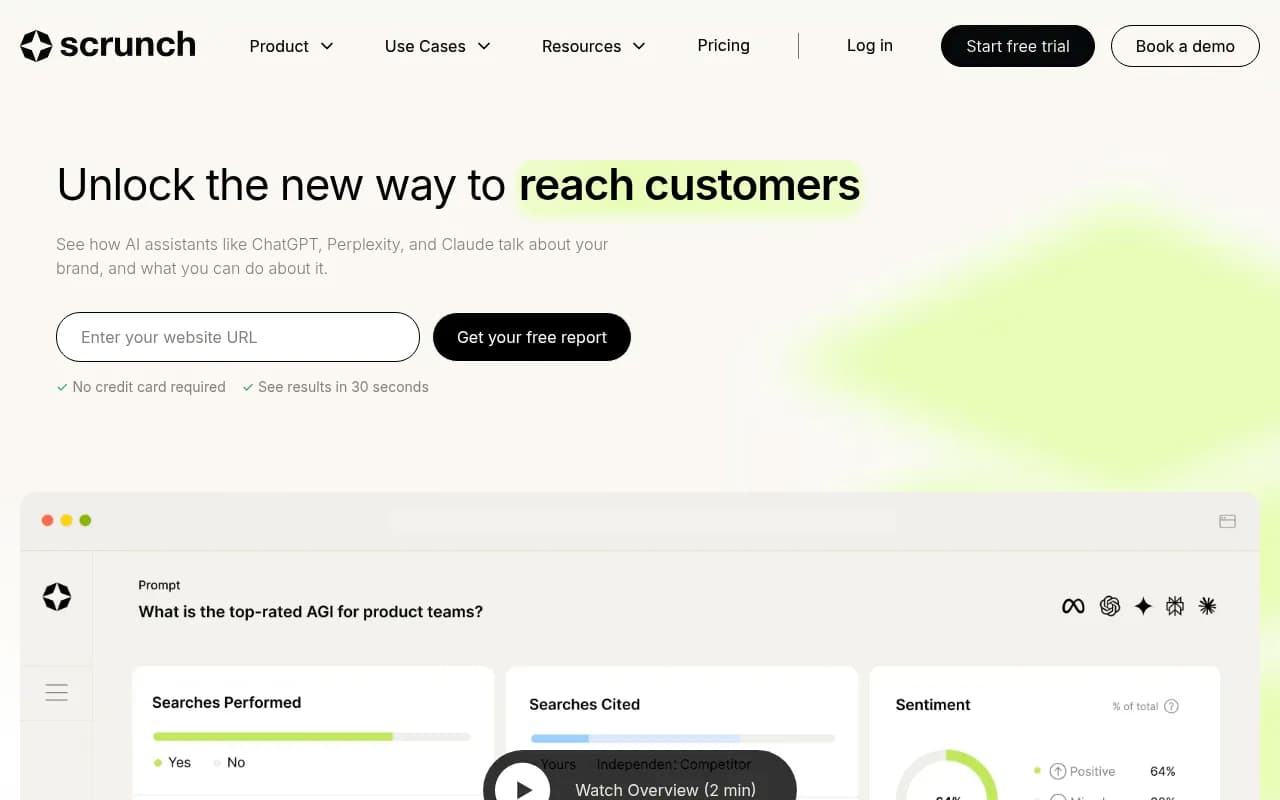
These are solid monitoring products with polished dashboards and, in Profound's case, a strong enterprise following. The tradeoff for performance teams is that they lean toward reporting what AI says rather than driving the fix and the traffic attribution. Pricing also tends to sit higher.


Worth a look if your organization wants a monitoring layer and already has separate content and analytics workflows.
Otterly.AI, Peec AI, and Rankscale: lightweight trackers
If your goal is a cheap, fast baseline on 20 to 50 prompts, these do the job. Peec AI is notable for multi-language coverage, and Otterly.AI is known for affordability.


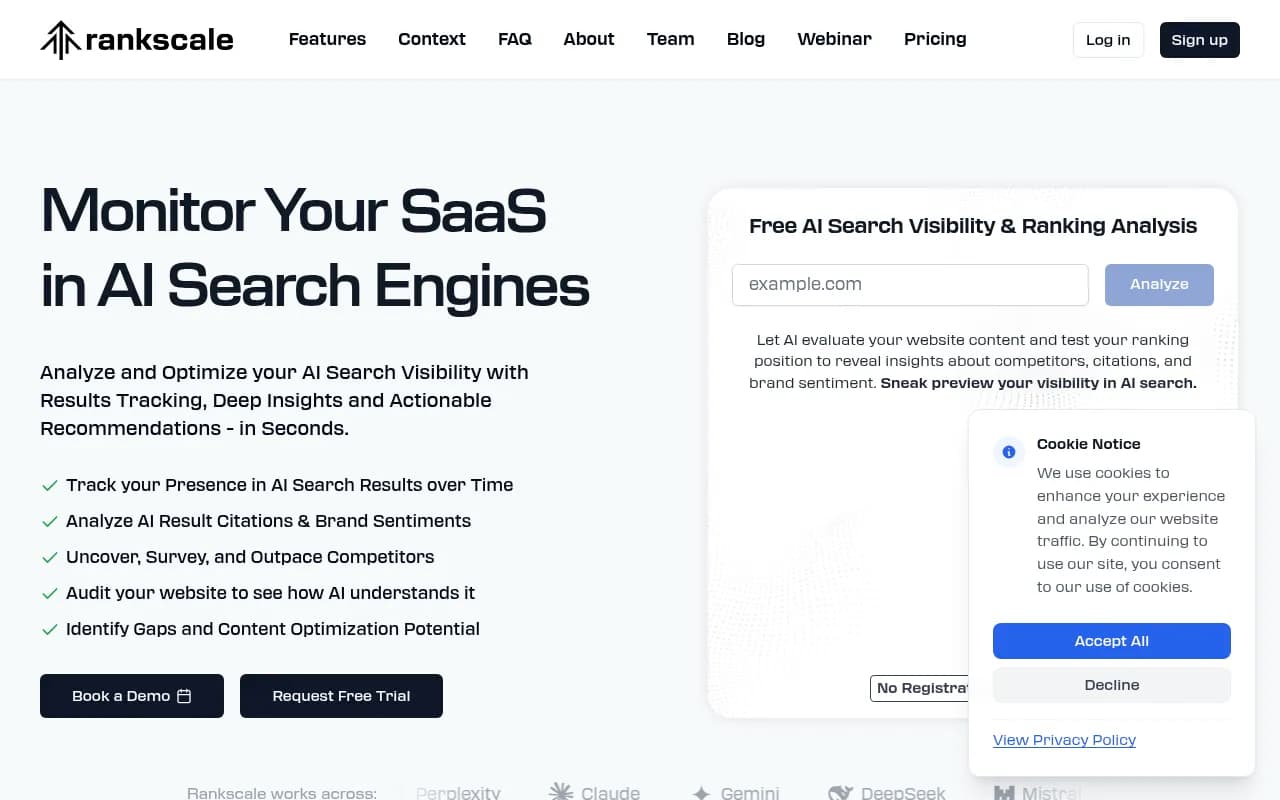
The limitation is what they leave out: typically no crawler logs, no visitor analytics, and no content generation. Fine for a pilot. You will outgrow them if the program works.
Semrush One and Ahrefs Brand Radar: SEO suite add-ons
If your team already lives in Semrush or Ahrefs, adding their AI visibility modules keeps one login and one invoice. The tradeoff is depth: these are SEO suites bolting AI tracking onto a keyword-first model.

Enterprise SEO platforms with AI modules
BrightEdge, Botify, seoClarity, and Conductor all added AI visibility features. They make sense if you already run one for technical SEO at scale and want to avoid a new vendor review.
Comparison table
| Tool type | Examples | Real-UI tracking | AI traffic attribution | Content execution | Best for |
|---|---|---|---|---|---|
| End-to-end GEO platform | Promptwatch | Yes | Yes (visitor analytics, crawler logs) | Yes (Content Agent, Action Board) | Teams that must prove pipeline impact |
| Monitoring-focused | Profound, Scrunch, AthenaHQ | Varies | Limited | Limited | Enterprises with separate content workflows |
| Lightweight trackers | Otterly.AI, Peec AI, Rankscale | Varies | Mostly no | No | Pilots and budget-limited teams |
| SEO suite add-ons | Semrush One, Ahrefs Brand Radar | Partial | No | Limited | Teams already standardized on the suite |
| Enterprise SEO platforms | BrightEdge, Botify, seoClarity | Varies | Via existing analytics | Via existing workflows | Large sites with technical SEO needs |
Check each vendor's current pricing and coverage yourself before buying. These products change monthly. For a wider scan, the GEO software directory at bestgeosoftware.com lists many more options.
Pair GEO with attribution
A GEO platform tells you where AI sends traffic. Your attribution stack tells you what that traffic is worth. Do not make one do the other's job.
- B2B pipeline: [tool:dreamdata] and [tool:hockeystack] map multi-touch journeys to revenue. Tag AI referrers (chatgpt.com, perplexity.ai, gemini.google.com, claude.ai) as their own channel group so they stop hiding in 'direct' or 'referral'.
- Paid performance and e-commerce: [tool:triple-whale], [tool:northbeam], and [tool:cometly] handle first-party attribution. Cometly also advertises AI visibility features, which is worth testing if you want one tool.
- Server-side tracking: [tool:anytrack] and [tool:redtrack] recover conversions that ad platforms miss.
- CRM: [tool:hubspot] or [tool:salesforce-marketing-cloud] hold the lead-to-revenue record. Add a 'How did you hear about us?' free-text field to the demo form. Buyers who found you in ChatGPT often say so.
That last tip is cheap and effective. The GTMLab guide to GEO agencies for lead generation argues the same thing: reconcile CRM data, GA4, and what buyers say on the form, because no single source is complete.

How to build a GEO program on a performance budget
Step 1: baseline for free
Run a free AI visibility scan before you buy anything. Promptwatch has a no-login report that shows how ChatGPT, Gemini, and Perplexity describe your brand. Screenshot it. You want a before picture.
Step 2: pick commercial prompts
Start with 30 to 50 prompts in three buckets: category ('best [category] tools for [segment]'), comparison ('[you] vs [competitor]'), and alternatives ('[competitor] alternatives'). The citation data says commercial prompts lean on product pages, landing pages, listicles, and comparisons, so those are the assets to audit.
Step 3: fix crawler access and page basics
Check that AI crawlers can reach pricing, product, and comparison pages. Look for blocked bots in robots.txt, JavaScript-only content, and 4xx or 5xx errors. Promptwatch's report advice is consistent here: make product pages easy to compare with clear pricing, specs, and audience, add an FAQ page, keep documentation public.
Write headings that read like search queries. Promptwatch's query fanout data recommends entity and category first in titles and H2s, for example 'Best CRM for small agencies 2026'. Also note that ChatGPT started using the site: operator at scale on August 8, 2026 (report), going from about 0.4% to about 17% of fanout queries, which makes clean site structure and consistent naming more important.
Step 4: get into the roundups
Listicles are 13.6% of ChatGPT citations overall and 15.0% for commercial prompts. Find the 'best of' articles AI cites for your category and pitch for inclusion, or earn reviews on the platforms that show up. For software prompts, the software citation report lists GitHub, Microsoft docs, and G2 as leaders, with documentation and help centers taking the largest share. A G2 profile is not optional.
Step 5: watch the ad slot
Track which advertisers and landing pages appear on your prompts. Check over several days before drawing conclusions; the ads report itself warns against reading too much into a single day.
Step 6: report monthly against pipeline
Use a simple scorecard:
| Metric | Source | Cadence |
|---|---|---|
| Visibility score and share of voice on commercial prompts | GEO platform | Weekly |
| AI crawler errors on key pages | Crawler logs | Weekly |
| AI-referred sessions and conversions | Visitor analytics / GA4 | Monthly |
| Demos or trials self-reported as AI-sourced | CRM | Monthly |
| Pipeline from AI-tagged channel | Attribution tool | Monthly |
Content also decays. Promptwatch's half-life data shows landing pages and docs stay cited longest, while news loses half its pages within about 36 days. Invest in evergreen commercial pages rather than news-style posts.
When to hire help instead
If nobody on the team has time to run this, an agency is a reasonable option. Look for one that shows how a lead came from AI search, not one that sells citation counts. 1001 SEO Media covers GEO alongside technical SEO and digital PR and uses Promptwatch for AI visibility work, so the reporting ties back to the same data described above. Agencies that cannot explain their attribution method are worth skipping.
Common mistakes
- Buying a tracker and never touching the site. Visibility moves when pages change.
- Tracking 500 prompts nobody buys from. Start narrow.
- Treating Reddit as a ChatGPT plan after August 2026. It still matters for Google surfaces, less for ChatGPT.
- Lumping AI traffic into 'direct'. Create a channel group.
- Expecting overnight results. Content needs to be crawled, indexed by AI retrieval, and then cited.
Quick recommendations
- You need to prove revenue impact: Promptwatch, paired with your attribution tool.
- You want a cheap pilot: Otterly.AI or Peec AI, then upgrade.
- You live in Semrush or Ahrefs: try their AI modules first, but test depth.
- You run a large enterprise site: evaluate BrightEdge, Botify, or seoClarity against a dedicated GEO platform.
- You are a B2B team with HubSpot: pipe AI-referral data into HubSpot properties and report it next to paid channels.
For more category browsing, the rank tracker listings at ai-rank-tools.com are a decent second stop. Start with 30 prompts, one platform, and a monthly pipeline review. If the numbers move, scale it. If they don't, you will know why.