Sight Review 2026
Monitors how your brand is mentioned across AI models like ChatGPT, Claude, and Perplexity, with tools for tracking sentiment, frequency, and competitor visibility.
Key takeaways
- Sight AI is primarily an AI content generation and SEO automation platform -- it writes, publishes, and indexes long-form articles on autopilot, with AI visibility tracking as a supporting feature
- Monitoring coverage is limited: tracks 5 AI models (ChatGPT, Claude, Perplexity, Gemini, Grok) with basic sentiment and prompt tracking -- no crawler logs, no traffic attribution, no Reddit/YouTube tracking, no ChatGPT Shopping monitoring, and no query fan-outs compared to Promptwatch
- Best suited for solo founders, small marketing teams, and agencies that want to scale content output without hiring writers
- The autopilot mode (one article per day, auto-published to CMS) is a genuine differentiator for content volume
- Pricing starts at $49/month with a 7-day free trial that includes 7 articles -- accessible entry point for small teams
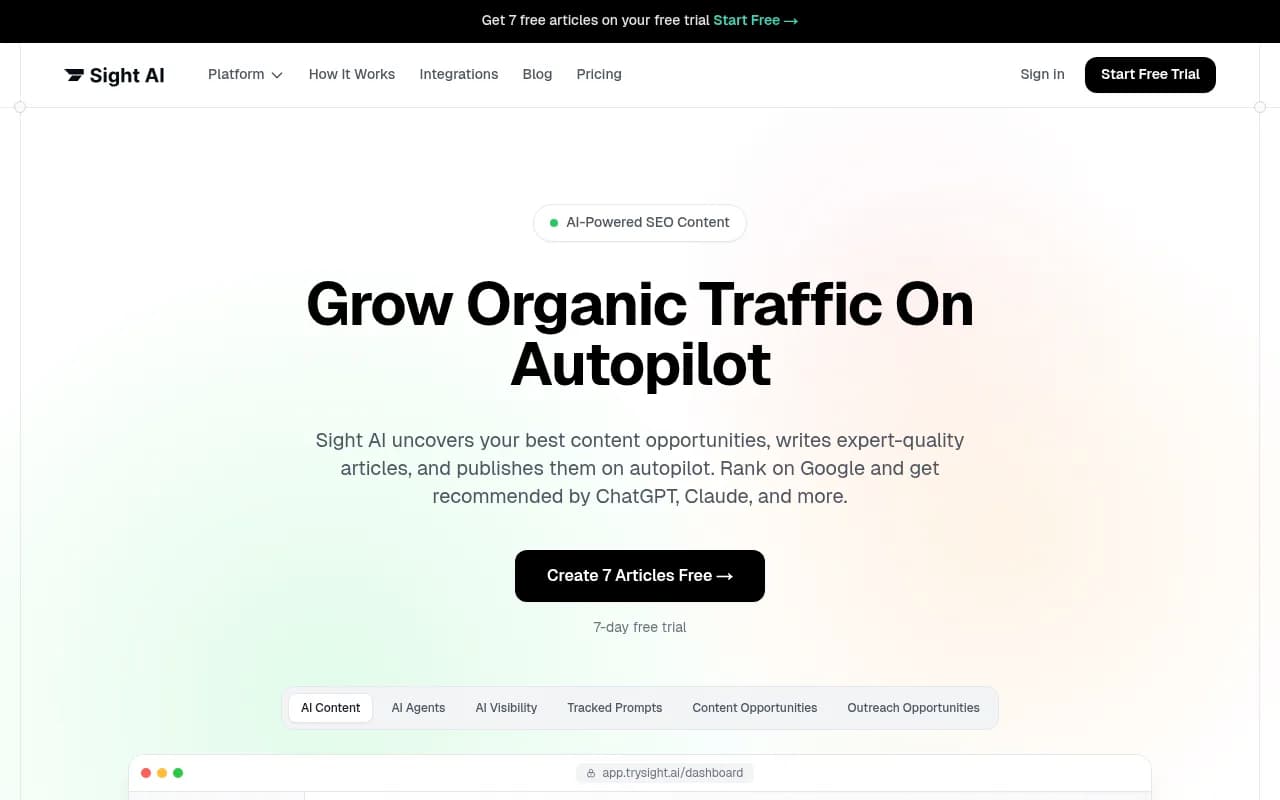
Sight AI is a content automation platform built around a simple premise: most businesses know they need more content, but don't have the team to produce it. The tool handles the full pipeline from finding what to write, to generating the article, to publishing it to your CMS and submitting it to Google and Bing for indexing. It's positioned as a replacement for a content team, not just a writing assistant.
The platform sits at an interesting intersection of SEO tooling and GEO (Generative Engine Optimization). It tracks how brands appear in AI model responses across ChatGPT, Claude, Perplexity, Gemini, and Grok, and uses those insights to inform what content to create. The idea is that content optimized for AI visibility will also rank better in traditional search -- a reasonable bet given how Google's AI Overviews and AI Mode are reshaping organic traffic.
Sight AI appears to be a relatively young product, likely launched in 2024-2025, with around 500 brands using the platform and over 10,000 articles created. It's connected to Cometly, a marketing attribution software company, which explains why Cometly features prominently in the platform's example content. The product is clearly still building its customer base and social proof -- testimonials on the site are listed as "Coming Soon."
Key features
AI visibility tracking Sight AI monitors how your brand appears across five major AI models: ChatGPT, Claude, Perplexity, Gemini, and Grok. You can set up tracked prompts and see daily refreshes showing where your brand appears, where competitors show up instead, and a basic sentiment score for how AI models describe your brand. This gives you a directional sense of your AI search presence without deep analytics. It's useful for spotting obvious gaps but doesn't go as far as dedicated GEO platforms in terms of data depth.
Content gap analysis The platform analyzes competitor content and AI model responses to identify topics and keywords your site is missing. This is the "find what to write" step in Sight AI's three-step workflow. It surfaces both traditional SEO keyword opportunities and prompts where competitors are getting AI recommendations but you're not. The output is a prioritized list of content opportunities you can act on immediately.
13+ specialized AI writing agents Rather than a single LLM generating everything, Sight AI uses a pipeline of specialized agents: one for research, one for outlining, one for SEO optimization, one for GEO optimization, one for images, and others. The result is long-form articles in the 2,500-4,500 word range. Three content formats are supported:
- Listicles (e.g., "Top 10 X tools") -- typically 4,500+ words
- Step-by-step guides and tutorials
- Explainer articles for concept-heavy topics
The quality of the output is designed to be publication-ready, though like all AI content tools, human review before publishing is still advisable for accuracy-sensitive topics.
Autopilot mode This is probably Sight AI's most distinctive feature. Once configured, the platform automatically identifies the next best content opportunity, generates the article, and publishes it to your CMS -- one article per day, without manual intervention. For teams that struggle with content consistency, this is genuinely useful. The catch is that autopilot works best when you've already set up your content strategy parameters correctly; otherwise you get a lot of content that's technically correct but strategically unfocused.
CMS integrations and publishing Sight AI integrates directly with Webflow for article publishing, with webhook support for other platforms. Articles can be synced to Webflow with a single click from the dashboard. The platform also handles SEO metadata -- title tags, meta descriptions, slugs, and categories -- as part of the article generation process.
Website indexing automation After publishing, Sight AI automatically submits new URLs to Google and Bing via IndexNow and keeps your sitemap updated. This is a small but practical feature that removes a manual step most content teams forget. Faster indexing means new content starts accumulating traffic sooner, which matters when you're publishing at volume.
Sentiment analysis The AI visibility module includes sentiment scoring that shows how AI models characterize your brand -- positive, neutral, or negative framing in responses. This is useful for reputation monitoring but is fairly surface-level compared to what dedicated brand monitoring tools offer.
Prompt tracking dashboard You can set up specific prompts to track daily across the five supported AI models. The dashboard shows your brand's presence (or absence) in responses, competitor mentions, and trends over time. Daily refresh cadence means you're not getting real-time data, but for most content strategy use cases, daily is sufficient.
Who is it for
Sight AI is a good fit for solo founders and small marketing teams at B2B SaaS or e-commerce companies who need to scale content output but can't justify hiring a content team. If you're currently publishing 2-4 articles per month and want to get to 20-30 without adding headcount, the autopilot mode addresses that problem directly. The platform's sweet spot is businesses with a clear content strategy already in place -- Sight AI executes on that strategy at scale, but it doesn't replace strategic thinking.
Digital agencies managing content for multiple clients are another natural fit, particularly at the Pro ($199/mo) and Advanced tiers where you can handle more sites and higher article volumes. The Webflow integration and webhook support make it easier to slot into existing client workflows. The caveat is that agency use requires careful quality control -- AI-generated content at volume needs editorial oversight to avoid brand voice inconsistencies across clients.
Founders and marketers who want AI search visibility but don't have the budget or complexity needs for a full GEO platform will find Sight AI's monitoring features adequate for basic tracking. If you just want to know whether ChatGPT mentions your brand when someone asks about your category, and you want to do something about it by publishing more content, Sight AI covers that loop at a lower price point than enterprise GEO tools.
Who should look elsewhere: If your primary need is deep AI visibility analytics -- understanding exactly which pages are being cited, tracking AI crawler behavior on your site, attributing revenue to AI-driven traffic, or monitoring Reddit and YouTube as AI citation sources -- Sight AI's monitoring capabilities won't be sufficient. It's a content production tool with visibility features, not the other way around.
Integrations and ecosystem
Sight AI's integration footprint is currently narrow but practical for its core use case:
- Webflow: Native integration for direct article publishing and syncing
- Webhooks: Generic webhook support for pushing content to other platforms (WordPress, Ghost, custom CMSs)
- Google and Bing (IndexNow): Automatic URL submission post-publish
- Sitemap management: Automated sitemap updates
There's no mention of a public API, Google Search Console integration, or analytics platform connections. The lack of GSC integration is a gap -- knowing which articles are actually driving clicks and impressions would close the feedback loop between content creation and SEO results. Similarly, there's no native integration with GA4 or any attribution platform, which means you'd need to track content performance separately.
No mobile app is listed. The platform is web-based, accessed at app.trysight.ai.
Pricing and value
Sight AI offers four individual plans:
- Lite -- $49/mo: 5 articles per month. Best for individuals testing the platform or with minimal content needs.
- Starter -- $99/mo: Positioned for small growing businesses. Article limits increase (exact number not published on the main site).
- Pro -- $199/mo: For "serious content marketers." Higher article volumes and presumably more tracked prompts.
- Advanced: Agency-tier pricing, details require contacting the team.
A 7-day free trial is available and includes 7 articles -- enough to genuinely evaluate the content quality before committing. This is a generous trial structure compared to tools that only offer a limited feature preview.
For context, Sight AI's Starter plan at $99/mo is priced similarly to entry-level GEO monitoring tools, but the value proposition is different: you're paying primarily for content generation, with AI visibility tracking included. If content production is your bottleneck, $99/mo for automated article generation is reasonable. If you need serious AI visibility analytics, you'd need a dedicated platform on top of this.
The pricing is competitive for what it delivers on the content side. The AI visibility features feel more like a bonus than a core differentiator at this price point.
Strengths and limitations
What Sight AI does well:
- The autopilot content pipeline is genuinely useful for teams that need publishing consistency without manual effort. One article per day, researched and published automatically, is a real operational advantage.
- Content format variety (listicles, guides, explainers) with long-form output (2,500-4,500 words) means the articles are substantive enough to rank, not just thin AI filler.
- Integrated indexing via IndexNow removes a step that most content teams skip, which can meaningfully speed up time-to-traffic for new content.
- The 7-article free trial is one of the more generous trials in this space -- you can actually evaluate output quality before paying.
- Accessible pricing starting at $49/mo makes it viable for bootstrapped founders and small teams.
Limitations and honest gaps:
- AI visibility monitoring is shallow. Tracking 5 models with daily sentiment and prompt data is a starting point, but there's no AI crawler log analysis, no page-level citation tracking, no traffic attribution connecting AI visibility to actual revenue, and no Reddit or YouTube tracking. For teams that need to understand why AI models cite competitors and how to fix it, Sight AI's monitoring won't get you there. Platforms like Promptwatch cover all of these gaps -- crawler logs, 880M+ citations analyzed, query fan-outs, ChatGPT Shopping tracking, and a full content gap analysis tied to actual prompt volumes.

- Limited CMS integrations. Webflow and webhooks cover a lot of ground, but native WordPress, Shopify, or HubSpot integrations would make the platform more accessible to a wider audience. Teams not on Webflow will need to set up webhook pipelines themselves.
- No feedback loop on content performance. Without GSC or GA4 integration, you can't see inside the platform whether the articles you're publishing are actually ranking or driving traffic. You'd need to check those tools separately, which partially undermines the "all in one platform" positioning.
- Social proof is thin. The "Coming Soon" testimonials and relatively small customer count (500 brands) mean there's limited independent validation of results. The platform is promising but still early.
Bottom line
Sight AI is a solid content automation tool for small teams and agencies that need to publish at scale without hiring writers. The autopilot mode, multi-agent writing pipeline, and integrated indexing make it a practical choice for anyone whose main bottleneck is content volume rather than content strategy.
For AI visibility specifically, it covers the basics -- prompt tracking across five models, sentiment analysis, and content gap identification -- but stops well short of what a dedicated GEO platform provides. Teams that need to seriously understand and improve their AI search presence, track AI crawler behavior, or attribute revenue to AI-driven traffic should look at Promptwatch, which is built around the full optimization loop rather than content production.
Best use case in one sentence: Sight AI is the right tool for a founder or small marketing team that wants to go from publishing 2 articles a month to 30, with AI visibility data informing what to write.
Frequently asked questions
What is Sight AI?
How much does Sight AI cost?
Which AI models does Sight AI track?
How does Sight AI's autopilot mode work?
What CMS platforms does Sight AI integrate with?
How does Sight AI compare to dedicated GEO platforms like Promptwatch?
Similar and alternative tools to Sight